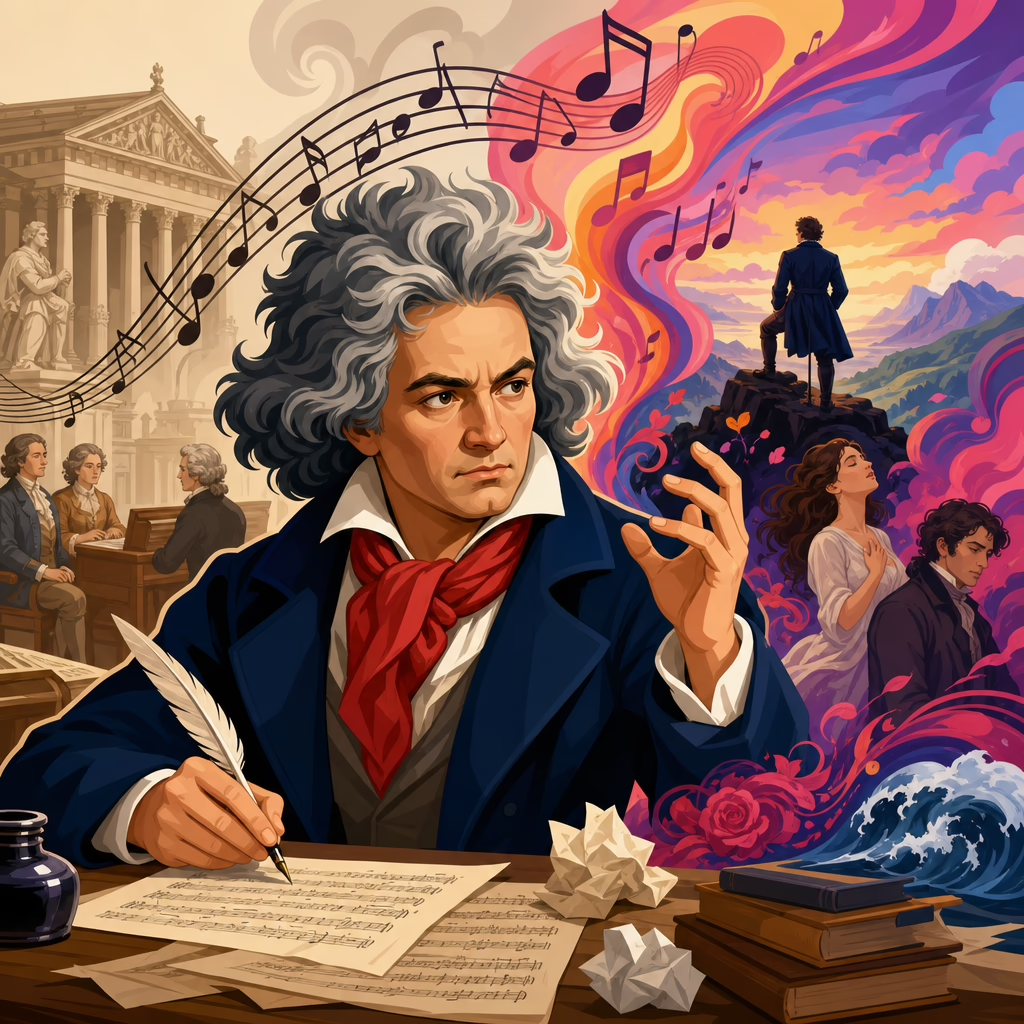
Did Beethoven Influence the Birth of Romanticism?
Did Beethoven influence the birth of Romanticism? Yes, decisively, though not alone. He stood at the hinge between the Classical style of Haydn and Mozart and the more subjective, dramatic, and expansive language that came to define nineteenth-century music. In practical terms, Beethoven transformed inherited forms by enlarging scale, intensifying harmonic tension, foregrounding personal struggle, and treating instrumental music as a vehicle for ideas once reserved for poetry and drama. For readers exploring Beethoven’s inspirations and influence, this question matters because it reveals how one composer can redirect an entire artistic era without operating in isolation.
Romanticism in music is often described as an emphasis on individual expression, emotional breadth, imagination, nature, memory, national identity, and the sublime. That definition is useful, but incomplete unless tied to sound. In music, Romanticism meant longer melodic spans, bolder modulation, more extreme dynamics, richer orchestration, expanded forms, and a heightened sense that a composition embodied a unique inner world. Beethoven did not invent every one of these tendencies. Carl Philipp Emanuel Bach had already cultivated expressive volatility, Gluck had pursued dramatic truth, and Mozart and Haydn had stretched Classical language with startling subtlety. What Beethoven did was consolidate and magnify these impulses so powerfully that later composers treated his work as a new starting point.
I have found that discussions of Beethoven and Romanticism become clearer when framed as a historical transition rather than a clean break. Beethoven was trained in the late eighteenth-century Viennese tradition, admired Bach and Handel, studied counterpoint rigorously, and absorbed Enlightenment ideals of order and reason. Yet his mature music repeatedly tests the limits of those ideals. The famous opening of the Fifth Symphony is not merely a motif; it becomes a generative cell driving a whole movement with an intensity that feels psychological. The Eroica Symphony does not simply extend a symphonic plan; it redefines what a symphony can signify in public culture. These are not cosmetic changes. They altered listeners’ expectations permanently.
This article serves as a hub for the broader miscellaneous branch of Beethoven’s inspirations and influence. It asks the central question directly, then maps the supporting issues readers usually pursue next: which works mattered most, how Beethoven changed form, what writers and later composers took from him, where his influence had limits, and why the debate still matters. If you are navigating outward to related pages on Beethoven’s politics, literary interests, pianism, orchestral legacy, or reception history, this page provides the conceptual foundation.
Why Beethoven occupies the turning point between Classical and Romantic music
Beethoven occupies the turning point because he inherited Classical procedures and made them carry unprecedented expressive weight. Sonata form, variation form, fugue, scherzo, and symphonic four-movement design all existed before him. His achievement was to make these structures feel like arenas of conflict, transformation, and resolution. In Haydn, surprise and wit often animate form; in Mozart, balance and dramatic characterization refine it. In Beethoven, form itself becomes narrative pressure. Exposition, development, recapitulation, and coda are no longer merely proportional sections. They behave like phases of argument.
The historical timing is crucial. Beethoven’s career spans the 1790s through the 1820s, exactly when European intellectual life was being reshaped by the French Revolution, Napoleonic wars, changing patronage systems, and the rise of the public concert. Composers were increasingly less tied to a single court or church position and more dependent on publication, subscription, and reputation. Beethoven navigated this shift with unusual self-consciousness. He cultivated the image of the independent artist, negotiated assertively with publishers, and positioned serious instrumental music as culturally elevated art rather than refined entertainment. That idea became foundational for Romantic composers from Schumann to Liszt.
His personal circumstances reinforced the larger historical shift. Progressive hearing loss, documented in letters and in the Heiligenstadt Testament of 1802, deepened the perception that his music emerged from inner necessity rather than social polish. One must be careful not to turn biography into myth, but the myth mattered. Nineteenth-century audiences heard Beethoven as the exemplary suffering genius, wrestling with fate and transcending limitation through art. That image powerfully shaped Romantic aesthetics, criticism, and concert culture.
The works that most clearly point toward Romanticism
Several works explain why Beethoven is so often treated as Romanticism’s catalyst. The Third Symphony, Eroica, premiered in 1805, is the clearest watershed. Its scale far exceeds earlier symphonies, its first movement development is radically expansive, its Marcia funebre gives public instrumental music tragic depth, and its finale turns variation into cumulative drama. Contemporary listeners were shocked not only by the length but by the sense that the work embodied heroic aspiration and collapse. That enlarged conception of instrumental meaning influenced Berlioz, Brahms, Wagner, and Mahler.
The Fifth Symphony compresses an extraordinary amount of energy into motivic concentration. Beethoven takes a tiny rhythmic idea and saturates an entire work with it. Later composers learned from this economy. Brahms absorbed it in his own symphonic writing; Wagner recognized in it the potential of recurring, identity-bearing motifs. The Sixth Symphony, Pastoral, points in another Romantic direction. It links instrumental music with landscape, memory, and feeling while insisting that it is “more the expression of feeling than painting.” That distinction became central for later program music debates.
In piano music, the Sonata in C-sharp minor, Op. 27 No. 2, and especially the Appassionata Sonata, Op. 57, intensified the piano’s dramatic range. The Waldstein and Hammerklavier sonatas expanded scale, sonority, and structural ambition to levels later pianists and composers could not ignore. In chamber music, the Razumovsky Quartets and the late quartets shattered conventional expectations about continuity, texture, and expressive possibility. The String Quartet in C-sharp minor, Op. 131, with its seven uninterrupted movements, became a touchstone for Schubert, Wagner, and beyond. The Ninth Symphony, with chorus and soloists entering a symphonic finale, decisively erased boundaries between genres and announced that the symphony could encompass philosophical and civic ideals.
How Beethoven changed musical language, not just musical style
Beethoven’s influence was deeper than a mood of intensity. He changed musical language at the levels of harmony, rhythm, texture, timbre, and form. Harmonically, he increased the expressive force of remote keys and delayed resolution for dramatic effect. Rhythmically, he used syncopation, obsessive repetition, sforzando accents, and disruptive silences to create tension that feels bodily, even when the underlying meter remains stable. Texturally, he moved rapidly between stark unison writing and dense contrapuntal accumulation, making contrast itself a primary expressive device.
His codas deserve special attention. In many eighteenth-century works, the coda confirms closure. Beethoven often turns it into a second development, as in the first movement of the Eroica or the finale of the Fifth. That strategy changes the listener’s sense of destination. A movement no longer ends when a textbook form says it should; it continues until the expressive argument is truly settled. Romantic composers inherited that sense of teleological drive.
Beethoven also expanded the orchestra’s rhetorical range without requiring the gigantic forces of later composers. He used trombones, piccolo, and contrabassoon in the Fifth and Sixth symphonies with strategic purpose, not mere novelty. He strengthened the role of winds as thematic participants rather than decorative support. At the piano, he exploited the evolving technology of the instrument, writing music that demanded broader dynamic range, stronger action, and sustaining power. Instrument makers and performers responded, creating a reciprocal cycle between composition and design that fed directly into the nineteenth century.
| Beethoven innovation | Representative work | Romantic consequence |
|---|---|---|
| Expanded symphonic scale | Symphony No. 3 “Eroica” | Encouraged monumental symphonies by Berlioz, Bruckner, Mahler |
| Motivic saturation | Symphony No. 5 | Modeled thematic unity for Brahms and Wagner |
| Subjective landscape expression | Symphony No. 6 “Pastoral” | Helped legitimize programmatic and nature-centered music |
| Genre expansion with voices | Symphony No. 9 | Broadened the idea of what a symphony could communicate |
| Late-style formal freedom | String Quartet Op. 131 | Inspired experimental continuity and introspection |
How later composers understood Beethoven’s example
The strongest evidence for Beethoven’s role in the birth of Romanticism is found in how later composers responded to him. Schubert, only a generation younger, absorbed Beethoven’s harmonic boldness, large-scale pacing, and seriousness of instrumental utterance, even while developing a distinct lyrical voice. Berlioz took from Beethoven the idea that orchestral music could project vivid psychological and dramatic states on a grand scale. Schumann built his criticism and composition around the notion that instrumental music could express inward poetic truth, a belief impossible to separate from Beethoven’s precedent.
For Brahms, Beethoven was both liberating model and intimidating burden. The often-quoted phrase about hearing “the footsteps of a giant” behind him captures a historical reality: by the mid-nineteenth century, writing a symphony meant entering a field Beethoven had transformed. Brahms’s First Symphony was heard immediately in relation to Beethoven, especially the finale’s allusive grandeur. Wagner approached Beethoven differently. In his 1870 essay on Beethoven, he cast him as the composer who revealed the deepest essence of music, thereby preparing the ground for music drama. Wagner’s interpretation was self-serving, but it demonstrates how central Beethoven had become to competing visions of Romantic art.
Even composers who reacted against him defined themselves through that reaction. Mendelssohn revived earlier repertories and cultivated transparency, yet his symphonies and overtures still operate under a Beethovenian expectation of organic coherence. Chopin focused on piano miniatures and concert works rather than symphonies, but his intensified harmonic rhetoric and idea of the composer as singular poetic voice belong to a culture Beethoven helped shape. Liszt turned Beethoven into a public monument through performances, transcriptions, and advocacy, helping to establish the canon-centered concert life that still structures classical music today.
Limits, debates, and what Beethoven did not do alone
It would be inaccurate to say Beethoven single-handedly created Romanticism. Romantic tendencies emerged across literature, philosophy, painting, and music before and alongside him. German writers such as E.T.A. Hoffmann framed instrumental music as the highest Romantic art, and Hoffmann’s celebrated review of Beethoven’s Fifth Symphony helped codify that view. Weber developed a distinctively Romantic operatic language. Schubert, fielding different instincts, expanded song and harmony in ways Beethoven never matched. National schools later added traits Beethoven did not define, including explicit folk stylization and regional color.
There are also important respects in which Beethoven remained fundamentally Classical. He cared deeply about motivic discipline, architectural coherence, and contrapuntal craft. Even his most disruptive works are rarely diffuse. That is why describing him as simply “emotional” misses the point. His force comes from disciplined construction under pressure. Romanticism after Beethoven sometimes magnified the emotional side while relaxing structural rigor; at other times, as in Brahms, the Beethovenian balance remained central.
Scholars therefore tend to make a more precise claim: Beethoven did not originate every Romantic trait, but he was the decisive catalytic figure who gave those traits their most compelling early large-scale realization. That is the formulation that best fits both the music and its reception history. It preserves nuance without blurring the fact that nineteenth-century composers, critics, performers, and audiences repeatedly treated Beethoven as the turning point.
Why this question still matters for listeners and researchers
Understanding Beethoven’s influence on Romanticism changes the way modern listeners hear familiar works. The Eroica becomes more than a famous symphony; it becomes a moment when public instrumental music claimed new expressive authority. The late quartets become more than difficult masterpieces; they become models for artistic risk, interiority, and formal reinvention. For students and researchers, this topic also connects multiple fields: reception history, aesthetics, performance practice, organology, political history, and canon formation. A single question about influence opens into the broader story of how Western art music redefined itself around originality and personal vision.
As a hub within Beethoven’s inspirations and influence, this miscellaneous page should point readers toward those connected studies. If you continue into articles on Beethoven and the French Revolution, Beethoven’s relationship to nature, his impact on symphonic form, his effect on piano technique, or the nineteenth-century cult of genius, you are following lines that begin here. The central takeaway is straightforward. Beethoven influenced the birth of Romanticism by transforming Classical forms into vehicles of unprecedented expressive, structural, and cultural ambition. He was not the only force, but he was the indispensable one. To understand Romantic music clearly, start with Beethoven’s middle and late works, then trace how later composers either extended his example or struggled to escape it.
Frequently Asked Questions
Did Beethoven actually start Romanticism in music?
Beethoven did not single-handedly “invent” Romanticism, but he was one of the most decisive figures in its emergence. He worked at a historical turning point, inheriting the formal clarity and balance of Haydn and Mozart while pushing those Classical models toward greater emotional intensity, larger scale, and stronger individual expression. That is why many historians describe him as a bridge between the Classical and Romantic eras rather than placing him neatly in only one camp.
What makes Beethoven so important is not simply that his music sounds more dramatic. He changed the expectations of what instrumental music could do. In earlier Classical practice, symphonies, sonatas, and quartets were often valued for proportion, elegance, and structural coherence. Beethoven preserved those qualities, but he also made those forms feel urgent, personal, and even philosophical. His music often suggests conflict, struggle, triumph, grief, heroism, or transcendence without relying on words. That shift helped define the Romantic idea that music could express the inner life of the artist and evoke meanings beyond formal design alone.
So the most accurate answer is that Beethoven decisively influenced the birth of Romanticism, but he did so as part of a broader cultural transformation. Literature, philosophy, politics, and changing ideas about individuality were all contributing to Romantic thought. Beethoven became one of the clearest musical embodiments of that change.
How did Beethoven’s music differ from Haydn and Mozart in ways that pointed toward Romanticism?
Beethoven built on the achievements of Haydn and Mozart, but he altered the expressive weight of the music in ways that opened the door to Romanticism. Haydn and Mozart mastered clarity, balance, wit, and formal precision. Beethoven kept those inherited structures, especially in his early works, yet he increasingly stretched them from within. Themes became more concentrated and motivic, developments more intense, contrasts more extreme, and codas more expansive. Instead of feeling like elegant conversation, the music often feels like a drama unfolding in sound.
One major difference lies in scale. Beethoven’s works frequently became longer, more architecturally ambitious, and more emotionally demanding than those of many of his predecessors. He enlarged the symphony, piano sonata, and string quartet so they could sustain a broader expressive journey. He also deepened harmonic tension, using dissonance, unexpected modulations, and prolonged instability to create a stronger sense of conflict and release. This kind of heightened emotional trajectory became central to Romantic musical language.
Another crucial difference is the emphasis on subjectivity. In Beethoven’s mature style, the listener often senses a powerful individual will at work. The music seems to argue, resist, wrestle, and overcome. That impression of personal struggle strongly influenced later Romantic composers, who saw in Beethoven a model of the composer as visionary, not merely as skilled craftsman. In that sense, Beethoven did not abandon Classical form; he transformed it into a vehicle for the more inward, dramatic, and expansive spirit associated with Romanticism.
Why is Beethoven often called a bridge between the Classical and Romantic periods?
Beethoven is called a bridge because his music combines core features of both eras. On one side, he was trained in the Classical tradition and deeply respected its genres and procedures. He wrote symphonies, concertos, sonatas, chamber music, and sacred works using forms that had been refined in the eighteenth century. The basic framework of sonata form, thematic development, balanced phrase structure, and tonal architecture remains central to much of his output.
On the other side, Beethoven expanded those same forms so dramatically that they began to serve a different artistic purpose. Instead of simply organizing musical ideas with elegance and logic, form itself became a means of expressing tension, conflict, transformation, and transcendence. This is one of the clearest signs of Romanticism: structure is no longer just a container for beauty and order, but an active force in shaping emotional and philosophical meaning.
His middle- and late-period works especially show this dual identity. They are disciplined and coherent in a Classical sense, yet their expressive ambition points unmistakably forward. Beethoven’s example gave later composers permission to treat instrumental music as serious art capable of conveying the deepest human experiences. Because he retained the old language while radically expanding its expressive horizons, he stands at the hinge between two eras more clearly than almost any other composer.
Which Beethoven innovations most influenced later Romantic composers?
Several Beethoven innovations proved foundational for Romantic composers. First was his expansion of musical scale. He made symphonies, sonatas, and quartets longer and more structurally ambitious, encouraging later composers such as Schumann, Brahms, Berlioz, Liszt, and Wagner to think in larger spans. Beethoven showed that instrumental works could sustain a broad narrative arc, with tension accumulating over long stretches rather than resolving quickly.
Second was his treatment of motivic development. Beethoven could take a tiny rhythmic or melodic idea and build an entire movement from it. This gave his music extraordinary unity and dramatic inevitability. Romantic composers learned from this technique, whether they adopted it directly or reacted against it. The idea that a simple musical cell could generate a vast expressive world became one of the great legacies of his style.
Third was his heightened emotional and harmonic language. Beethoven intensified contrast, widened dynamic range, and used harmony to deepen psychological drama. He often made instability feel meaningful rather than merely transitional. Later Romantic music, with its stronger chromaticism, emotional volatility, and sense of inward striving, owes much to that example. Finally, Beethoven elevated the cultural status of the composer. He helped shape the Romantic image of the artist as an independent, heroic, and deeply individual creator whose works embody personal vision. That ideal influenced not just composition, but the entire nineteenth-century understanding of musical genius.
Can Beethoven’s instrumental music really be seen as expressing ideas like struggle, heroism, or personal emotion?
Yes, and this is one of the strongest reasons Beethoven mattered to Romanticism. While instrumental music does not specify meaning in the way words do, Beethoven’s works often create a compelling sense of emotional and dramatic trajectory. Listeners and critics have long heard in his music qualities such as resistance, conflict, grief, triumph, solemnity, and exaltation. These interpretations are not arbitrary; they arise from the way he shapes rhythm, harmony, texture, pacing, and formal momentum.
For example, Beethoven frequently constructs movements around tension that feels unusually charged and purposeful. A small motive can be driven obsessively, disrupted by silence, pushed into instability, and finally transformed into something victorious or serene. That kind of process invites listeners to hear the music as more than decorative sound. It suggests an inner drama. In the nineteenth century, this was revolutionary because it encouraged audiences to think of instrumental music as capable of bearing meanings once associated mainly with poetry, theater, or epic narrative.
This does not mean every Beethoven piece should be forced into a literal storyline. Rather, his music made it increasingly plausible to treat instrumental composition as an art of profound human expression. That idea became central to Romantic aesthetics. Later composers took different paths from there: some embraced program music and explicit storytelling, while others pursued “absolute music” with intense expressive depth. In both cases, Beethoven’s example helped establish the belief that instrumental music could speak powerfully to the imagination, emotions, and moral consciousness of listeners.