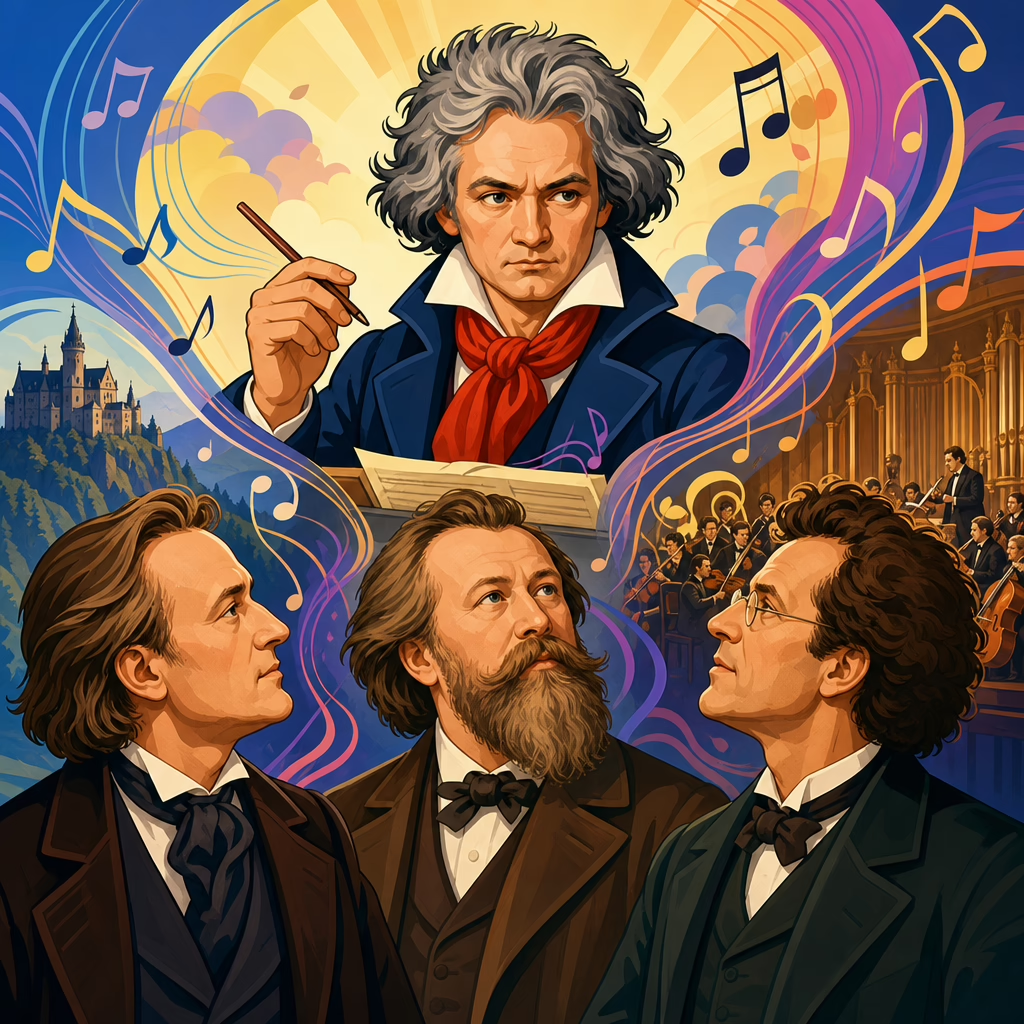
How Beethoven Inspired Wagner, Brahms, and Mahler
Ludwig van Beethoven reshaped the course of Western music so profoundly that later composers had to decide, consciously and repeatedly, how to live in his shadow. Any serious discussion of how Beethoven inspired Wagner, Brahms, and Mahler begins with that fact: Beethoven was not merely a great predecessor, but a standard against which ambition, form, expression, and artistic purpose were measured. In practical terms, his influence reached beyond melody or orchestration. He changed what a symphony could mean, what a sonata could argue, and what audiences expected a major composer to attempt.
When musicians speak about Beethoven’s influence, they usually mean several connected ideas. One is formal influence: his expansion of structures such as sonata form, variation form, and cyclical integration across movements. Another is expressive influence: his ability to turn instrumental music into something that feels dramatic, philosophical, and morally urgent. A third is cultural influence: Beethoven helped establish the image of the composer as a serious, independent artistic voice rather than a servant of aristocratic taste. I have spent years working through scores, rehearsal notes, and performance traditions around these composers, and one lesson comes up constantly: Wagner, Brahms, and Mahler did not imitate Beethoven in the same way. Each absorbed different parts of his legacy and then redirected them toward distinct artistic goals.
This matters because these three composers stand at crucial junctions in nineteenth-century music. Wagner transformed opera into music drama, Brahms became the leading symphonist of the conservative Austro-German tradition, and Mahler stretched the symphony toward modernity. Understanding their relationship to Beethoven helps explain why nineteenth-century music split into competing camps while still sharing a common ancestor. It also clarifies why Beethoven remains central to concert life today. His influence was not static homage. It was a living problem, a challenge that produced some of the most important works in the repertoire.
For readers exploring Beethoven’s inspirations and influence, this article serves as a hub for the miscellaneous branch of that larger topic. It connects ideas that often appear separately: Beethoven’s role in expanding symphonic scale, his impact on harmonic thinking, his example as a public artist, and the psychological burden later composers felt under his example. Wagner, Brahms, and Mahler form an ideal trio for this discussion because together they show three major responses to Beethoven: transformation, continuation, and expansion. Looking at them side by side reveals not just influence, but the many ways a towering artistic legacy can be inherited.
Beethoven’s Legacy: The Models Later Composers Could Not Ignore
Before focusing on Wagner, Brahms, and Mahler individually, it helps to define the specific Beethovenian models they encountered. The most obvious was the symphonic model, especially the Third, Fifth, Seventh, and Ninth Symphonies. These works demonstrated unprecedented unity, motivic concentration, and emotional range. The famous four-note opening of the Fifth Symphony is the clearest textbook example of economy generating large-scale coherence. Later composers learned that a tiny rhythmic cell could shape an entire movement, even an entire work, if handled with discipline.
Another model was Beethoven’s treatment of struggle and resolution. His middle-period works often present conflict not as decorative contrast but as the engine of musical development. That concept became foundational for nineteenth-century music. Just as important was the late style: the late quartets, the Missa solemnis, the Diabelli Variations, and the final piano sonatas showed that music could become introspective, discontinuous, and structurally experimental without losing authority. For composers after 1850, Beethoven offered both a public heroic voice and a private visionary one.
There was also the example of Beethoven’s career. He publicly asserted artistic seriousness, negotiated with patrons from a position of unusual strength, and cultivated an image of moral and creative independence. Later composers inherited not only his techniques but also his artistic posture. Wagner took from this the idea of the artist as revolutionary visionary. Brahms took the burden of measuring himself against the symphonic canon. Mahler took the conviction that the symphony could encompass a world of human experience. In all three cases, Beethoven was less a style than a set of expectations.
How Beethoven Inspired Wagner
Richard Wagner’s debt to Beethoven is direct, declared, and strategically important. Wagner wrote essays on Beethoven, conducted his works, and repeatedly positioned himself as the composer who would extend Beethoven’s achievement into a new age. The crucial point is that Wagner saw Beethoven, especially the Ninth Symphony, as the turning point where instrumental music reached its limit and pointed toward a fusion of music, poetry, and drama. In Wagner’s reading, the choral finale of the Ninth was not an isolated experiment. It was evidence that pure symphonic logic sought fulfillment in the human voice and in explicit dramatic meaning.
This interpretation shaped Wagner’s mature music dramas. In works such as Tristan und Isolde, Die Meistersinger von Nürnberg, and the Ring cycle, Beethoven’s influence appears less as formal imitation than as intensified motivic development and large-scale structural thinking. Wagner’s leitmotifs are not identical to Beethovenian motives, but they inherit the idea that small musical units can generate broad continuity and psychological depth. Beethoven taught Wagner that thematic fragments could carry dramatic destiny. Wagner then applied that lesson to opera, allowing recurring motives to track memory, desire, power, and transformation across vast spans of time.
Beethoven also influenced Wagner’s harmonic and expressive ambition. The opening movement of the Ninth Symphony and the late quartets showed that tonal tension could be prolonged for extraordinary expressive effect. Wagner radicalized that tendency. The “Tristan chord” is often treated as a revolution detached from the past, yet it makes more sense when heard as an extension of Beethoven’s willingness to stretch tonal expectation in service of emotional intensity. Beethoven did not write Wagnerian chromatic harmony, but he legitimized the idea that form and harmony could be bent toward psychological extremity.
At the level of cultural identity, Wagner adopted Beethoven as a predecessor who authorized artistic totality. Beethoven had elevated the prestige of instrumental composition and the seriousness of musical argument. Wagner took from that precedent the confidence to claim that his own works were not entertainment but major cultural events. His 1872 laying of the foundation stone at Bayreuth was framed with Beethovenian grandeur, and his festival ideal depended on the notion that music could carry civilizational significance. That claim would have been far harder to sustain without Beethoven’s elevation of the composer’s public role.
How Beethoven Inspired Brahms
If Wagner treated Beethoven as a springboard toward music drama, Johannes Brahms encountered him as a daunting standard in absolute music. No composer illustrates the anxiety of Beethoven’s legacy more vividly. Brahms delayed publishing his First Symphony until 1876, when he was already in his forties, because he knew any symphony he released would be compared with Beethoven’s nine. Friends and critics discussed this openly. Hans von Bülow famously called Brahms’s First Symphony “Beethoven’s Tenth,” a compliment that also reveals how tightly Brahms’s achievement was measured against Beethovenian precedent.
The influence itself is unmistakable but never superficial. Brahms absorbed Beethoven’s methods of motivic development, rhythmic tension, and structural integration. In rehearsal and analysis, one sees how Brahms builds movements from short, malleable cells in a way that recalls Beethoven’s concentration. The opening of Brahms’s Fourth Symphony, for example, grows from a simple descending-third figure whose implications unfold across the movement. This is Beethoven’s lesson transformed: thematic economy becomes the basis of symphonic argument.
Brahms was also deeply influenced by Beethoven’s command of variation form. Beethoven treated variation not as ornament but as structural inquiry, and Brahms carried that principle into works such as the Haydn Variations, the finale of the Fourth Symphony, and numerous chamber pieces. The passacaglia finale of the Fourth demonstrates a Beethovenian seriousness about inherited forms: an old procedure becomes a vehicle for modern expressive complexity. Brahms learned that discipline and invention are not opposites. In the best Beethovenian tradition, limits sharpen imagination.
| Composer | Main Beethovenian Inheritance | Clear Example | Resulting Direction |
|---|---|---|---|
| Wagner | Motivic unity, Ninth Symphony as turning point | Ring leitmotif network | Music drama and expanded harmonic language |
| Brahms | Symphonic rigor, variation, motivic development | Symphony No. 1 and Symphony No. 4 | Renewal of absolute music within classical forms |
| Mahler | Symphony as philosophical statement | Symphony No. 2 and Symphony No. 9 | Expanded symphonic world embracing modern anxiety |
Another important connection is Brahms’s relationship to Beethoven’s expressive balance. Beethoven could combine intellectual control with immense emotional power, and Brahms pursued that same equilibrium. He resisted the idea that depth required programmatic narrative. Instead, he trusted abstract musical processes to carry feeling. That is why Brahms became central to the camp often set against Wagner in the nineteenth-century debate over musical progress. Yet this opposition can be overstated. Brahms was not anti-Beethovenian restraint; he was one of Beethoven’s most serious heirs, preserving the belief that instrumental music can think, argue, and move listeners without external story.
Brahms also inherited Beethoven’s seriousness about genre hierarchy. Symphonies, quartets, piano sonatas, and concertos were not occasional products but statements. Brahms revised relentlessly before publication, much as Beethoven sketched obsessively. The evidence in surviving manuscripts shows a shared respect for compositional labor. Beethoven demonstrated that greatness was not spontaneous overflow alone; it was crafted through revision, compression, and structural testing. Brahms adopted that ethic fully, and it is one reason his music carries such density and durability.
How Beethoven Inspired Mahler
Gustav Mahler encountered Beethoven from a later historical vantage point, after Wagner and Brahms had already transformed the landscape. For Mahler, Beethoven was the composer who made the symphony capable of bearing metaphysical weight. Mahler’s often-quoted idea that a symphony “must be like the world” did not come from nowhere. Beethoven’s Third and Ninth had already expanded the symphony beyond elegant form into a space for public struggle, ethical aspiration, and existential breadth. Mahler inherited that ambition and magnified it.
The clearest line of influence runs through the Ninth Symphony. Beethoven’s inclusion of chorus and vocal soloists in a symphony gave later composers permission to blur genre boundaries when the expressive goal demanded it. Mahler follows that path in the Second, Third, Fourth, and Eighth Symphonies, all of which incorporate voices. But the resemblance is not merely technical. Beethoven established the precedent that the symphony could confront humanity, community, and transcendence directly. Mahler took that precedent into a fin-de-siècle world marked by fragility, irony, and spiritual uncertainty.
Beethoven also influenced Mahler’s handling of motivic recall and long-range architecture. Conducting Mahler makes this especially clear: small intervals, rhythmic gestures, and marching patterns often return transformed across large spans, creating an organic logic beneath surface contrast. This is a descendant of Beethoven’s developmental thinking. Mahler’s canvases are much larger, his orchestration more heterogeneous, and his emotional world more unstable, but the underlying idea remains Beethovenian: a symphony must grow from internal relationships, not from decorative succession.
There is, however, a crucial difference. Beethoven often drives toward hard-won resolution. Mahler frequently questions whether resolution is possible or trustworthy. That difference makes Mahler’s relationship to Beethoven especially revealing. He inherited Beethoven’s seriousness and scale but translated them into a later age in which triumph had become problematic. The final movement of Mahler’s Ninth Symphony, for instance, can be heard as a distant conversation with Beethoven’s late style: inward, searching, fragmentary, and aware of farewell. Mahler did not continue Beethoven by repeating heroic closure; he continued him by treating the symphony as the highest arena for human truth.
Why Beethoven’s Influence Produced Different Outcomes
The reason Beethoven could inspire Wagner, Brahms, and Mahler so differently is that his music contains multiple futures. The Fifth Symphony points toward motivic concentration and dramatic logic. The Ninth points toward expanded forces and philosophical scope. The late quartets point toward formal experimentation and inwardness. Wagner emphasized Beethoven the pathbreaker who made new art forms necessary. Brahms emphasized Beethoven the master builder who proved that rigorous structures could remain alive. Mahler emphasized Beethoven the symphonist of existential reach.
These differences were shaped by historical context as well. Wagner wrote in a period of political upheaval and aesthetic manifesto. Brahms worked amid intense arguments over whether music should progress through programmatic innovation or renew classical forms. Mahler composed at the edge of modernism, when inherited certainties were breaking down. Beethoven’s legacy remained central in each case because he had already linked musical form with large cultural meaning. Later composers could disagree about method precisely because Beethoven had made the stakes so high.
For readers using this page as a hub within Beethoven’s broader sphere of influence, the main takeaway is practical: studying Beethoven’s afterlife works best when you track specific inheritances rather than relying on vague claims of inspiration. Ask which Beethoven each composer chose. Was it the Beethoven of the Fifth Symphony’s motivic drive, the Eroica’s heroic scale, the Ninth’s vocal-humanistic reach, or the late quartets’ visionary freedom? Once that question is asked, Wagner, Brahms, and Mahler become clearer, and Beethoven’s continuing relevance becomes easier to hear.
Beethoven inspired Wagner, Brahms, and Mahler not by offering a single style to copy, but by redefining what serious music could attempt. Wagner extended Beethoven’s dramatic and harmonic impulses into music drama. Brahms carried forward Beethoven’s structural discipline and motivic concentration in the symphony, chamber music, and variation form. Mahler enlarged Beethoven’s concept of the symphony as a vessel for the biggest human questions. Together, they show that influence is strongest when it is selective, contested, and creative.
That is why Beethoven remains the central reference point in this subtopic of musical influence. His works generated not one school, but several competing legacies, each embodied by major composers who felt compelled to answer him. If you want to explore Beethoven’s wider impact, use this article as a starting map: follow Wagner toward drama and chromatic expansion, Brahms toward symphonic craft and formal continuity, and Mahler toward philosophical breadth and modern uncertainty. Return to Beethoven afterward, and those later masterpieces will sound less isolated and more like part of a long, evolving conversation. Start with the Third, Fifth, and Ninth Symphonies, then trace what each successor heard in them.
Frequently Asked Questions
How did Beethoven change the expectations for later composers like Wagner, Brahms, and Mahler?
Beethoven transformed the very idea of what a major composer was supposed to do. Before him, symphonies and sonatas were often understood primarily as elegant, well-made works within established conventions. Beethoven kept those inherited forms, but he enlarged their emotional range, structural ambition, and philosophical weight. His music suggested that an instrumental work could carry the force of a personal statement, a moral struggle, or even a vision of humanity itself. That shift mattered enormously for Wagner, Brahms, and Mahler because it meant they were not simply writing pieces for performance; they were entering a tradition in which music could claim deep cultural and spiritual significance.
For Wagner, Beethoven’s example showed that music could strive toward overwhelming dramatic intensity and large-scale unity. For Brahms, Beethoven created both a model and a burden: how could one write symphonies after Beethoven had made the form seem so complete and so serious? For Mahler, Beethoven opened the path toward the symphony as a world-encompassing genre, capable of confronting fate, memory, transcendence, and the human condition. In all three cases, Beethoven raised the stakes. He made later composers ask bigger questions about form, expression, artistic responsibility, and the meaning of a musical work. That is why his influence was so persistent: he changed not just style, but the purpose and perceived destiny of composition itself.
In what ways did Beethoven inspire Richard Wagner specifically?
Wagner admired Beethoven as the composer who pushed instrumental music to its highest expressive potential and, in Wagner’s view, to a point of transformation. Beethoven’s Ninth Symphony was especially important to him. The inclusion of chorus and vocal soloists in the final movement seemed to Wagner like a breakthrough that dissolved the old boundaries of the symphony and pointed toward a more total form of art, one that combined music, poetry, and drama. Wagner interpreted Beethoven as a figure who had expanded pure instrumental form until it nearly demanded the addition of words, and this helped Wagner justify his own music dramas as the next step in German musical evolution.
Beyond that, Beethoven influenced Wagner through techniques of thematic development, dramatic tension, and large-scale cohesion. Beethoven showed how a small musical idea could generate an entire movement or even shape the logic of a whole work. Wagner absorbed that lesson deeply, even though he applied it in opera rather than in the classical symphony. His use of recurring motives, his sense of long-range harmonic direction, and his pursuit of continuous musical drama all reflect a Beethovenian ambition to make every detail serve a larger expressive arc. Wagner did not imitate Beethoven literally; he reinterpreted him. He took Beethoven’s intensity, structural seriousness, and historical authority and redirected them into the realm of opera, where he believed the future of music lay.
Why is Brahms so often described as composing in Beethoven’s shadow?
Brahms is described this way because Beethoven’s achievement in the symphony was so immense that any later composer working in that genre had to confront him directly. Brahms understood this with unusual seriousness. He delayed writing his First Symphony for many years, not because he lacked skill, but because he felt the weight of Beethoven’s example. Beethoven had made the symphony into a form of profound intellectual and emotional consequence, and Brahms knew that publishing a symphony invited comparison with the most revered model in German music. His hesitation was therefore not weakness; it was evidence of how powerfully Beethoven defined the standards of seriousness, coherence, and expressive depth.
At the same time, Brahms was one of Beethoven’s most creative heirs. He learned from Beethoven’s motivic development, formal control, rhythmic tension, and ability to build large structures from compact ideas. Brahms’s music often sounds different on the surface, more autumnal, inward, and classically restrained, but underneath it shares Beethoven’s commitment to organic construction. Brahms did not respond to Beethoven by abandoning tradition. Instead, he proved that the inherited forms of symphony, sonata, chamber music, and concerto could still yield new results if handled with enough imagination and rigor. In that sense, Brahms’s greatness lies partly in how he answered Beethoven: not by trying to escape the shadow, but by showing that living within it could still produce original, compelling, and deeply personal art.
How did Beethoven’s influence appear in Mahler’s symphonies?
Mahler inherited Beethoven’s idea that a symphony could be far more than a formal exercise. Beethoven had already expanded the genre into something heroic, dramatic, and spiritually charged, and Mahler took that conception to an even broader scale. Mahler’s symphonies often feel like vast journeys that encompass conflict, irony, memory, folk elements, catastrophe, and transcendence. That kind of ambition would be difficult to imagine without Beethoven’s precedent, especially the later symphonies, which demonstrated that instrumental music could bear philosophical weight and communicate a sense of existential urgency.
One of the clearest points of connection is Beethoven’s Ninth Symphony, a work that deeply affected the entire nineteenth-century understanding of what a symphony might become. Mahler followed Beethoven in treating the symphony as a genre that could absorb voices, texts, and monumental human themes. Even when Mahler wrote purely instrumental symphonies, the Beethovenian inheritance remained visible in the sense of struggle, the shaping of long-range dramatic trajectories, and the idea that the final movement might deliver not just closure but revelation. Mahler also admired Beethoven’s ability to unify sprawling structures through motivic relationships and through a powerful sense of destination. While Mahler’s language is unmistakably his own, more ironic, more psychologically unstable, and often more expansive in orchestral color, his basic conception of the symphony as a serious, world-embracing statement belongs firmly to the Beethoven tradition.
Did Wagner, Brahms, and Mahler respond to Beethoven in the same way?
No, and that is precisely what makes Beethoven’s influence so remarkable. He inspired all three composers, but each responded according to his own artistic priorities. Wagner saw Beethoven as a revolutionary whose work pointed beyond the traditional symphony toward music drama. For him, Beethoven was not simply a master to imitate; he was a historical turning point. Brahms, by contrast, treated Beethoven as the supreme example of how classical forms could remain alive, coherent, and profound. He responded through discipline, craftsmanship, and a determination to continue the symphonic and chamber traditions at the highest level. Mahler approached Beethoven as the great predecessor who had legitimized the symphony as a vehicle for ultimate questions, allowing later composers to write works of immense emotional and metaphysical reach.
So while the source of inspiration was shared, the outcomes were very different. Wagner turned Beethoven into a foundation for operatic and aesthetic revolution. Brahms turned him into a model of structural integrity and artistic responsibility. Mahler turned him into a starting point for the modern symphony as an all-encompassing universe of experience. This variety shows that Beethoven’s influence was not narrow or prescriptive. He did not force later composers into one style. Instead, he created a challenge so large that each major successor had to define himself in relation to it. That may be the clearest measure of Beethoven’s importance: his legacy was powerful enough to shape opposing musical paths, yet broad enough to sustain radically different interpretations.