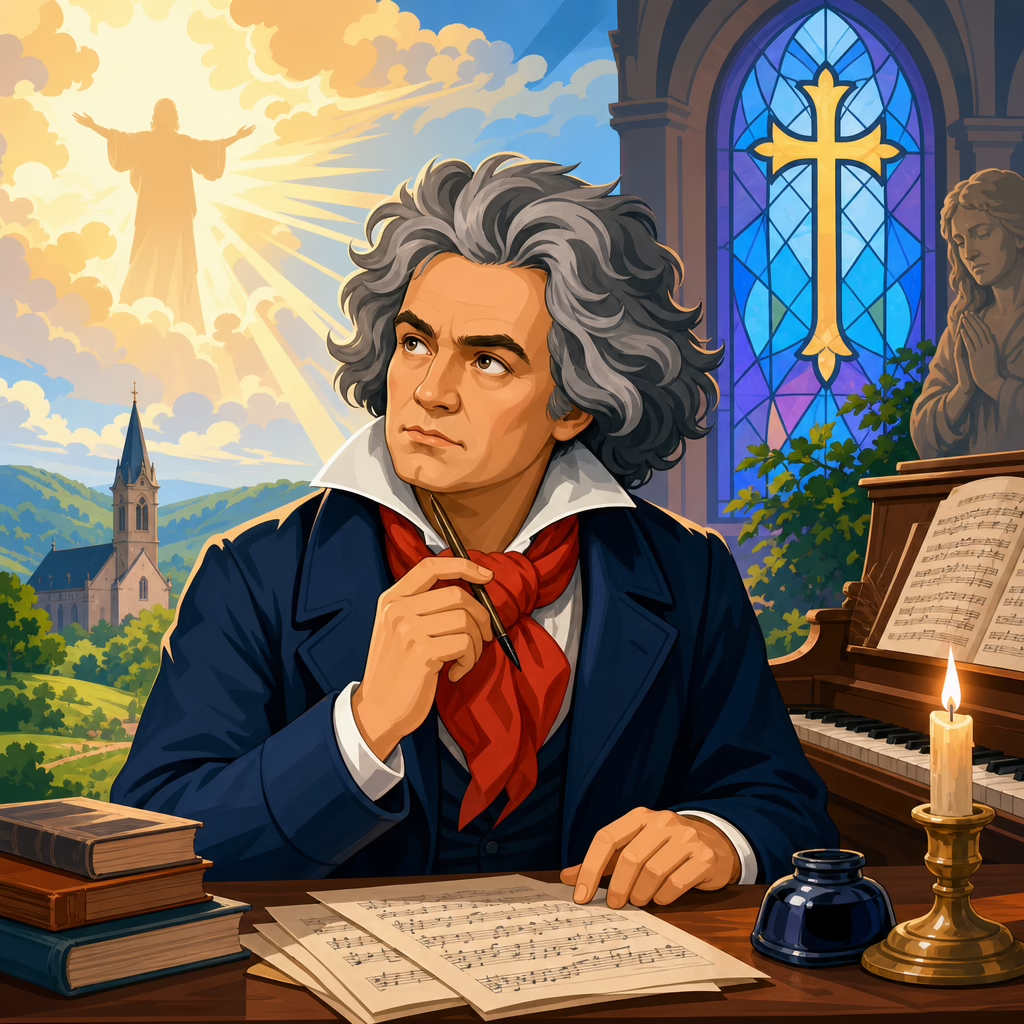
Beethoven’s Relationship with Religion and Spirituality
Beethoven’s relationship with religion and spirituality was neither simple piety nor outright rebellion, but a lifelong, evolving search for moral order, transcendence, and inner freedom. For anyone studying Beethoven’s inspirations and influence, this “miscellaneous” hub matters because religion touched his biography, his letters, his major works, and the way later audiences interpreted his music. In practical terms, religion refers here to organized belief, ritual, doctrine, and church culture, especially the Catholic world into which he was born in Bonn in 1770. Spirituality refers to Beethoven’s more personal sense of the divine: reverence for nature, belief in providence, admiration for moral law, and the conviction that music could elevate human beings beyond ordinary suffering. I have worked through Beethoven’s letters, sketchbook commentary, liturgical works, and the reception history around pieces such as the Missa solemnis, and the pattern is consistent: Beethoven was deeply engaged with sacred ideas, but on his own terms.
That distinction helps answer the most common question directly: was Beethoven religious? Yes, but not conventionally. He remained marked by Catholic formation, respected scripture and sacred art, and composed some of the greatest religious music in the Western canon. At the same time, he distrusted empty ceremony, resisted clerical narrowness, read widely in Enlightenment and idealist thought, and often expressed faith in broad, universal language rather than confessional formulas. This complexity is one reason his music speaks to believers and nonbelievers alike. He could write a Mass of overwhelming devotional intensity, then frame human brotherhood in the Ninth Symphony with language that sounds almost like a civic religion. Understanding that tension is essential for readers exploring Beethoven’s wider imaginative world, because his spiritual outlook connects to his ideas about heroism, suffering, artistic vocation, morality, and the dignity of humanity.
Beethoven’s early religious formation in Bonn
Beethoven grew up in the Electorate of Cologne, a Catholic environment where church life shaped education, ceremony, and musical employment. His grandfather had served as Kapellmeister, and his father worked as a court musician, so sacred music was not remote from daily life. In Bonn, the line between religious institution and musical profession was thin: masses, feast days, funerals, and court observances required trained performers. Beethoven therefore encountered religion not only as belief but as sound, structure, and labor. He learned through liturgical repertoire, organ playing, and the disciplined craft expected of musicians serving ecclesiastical settings. This matters because his later sacred compositions did not emerge from abstract curiosity; they rested on practical familiarity with Catholic musical traditions.
Yet even in youth, Bonn exposed him to more than devotional routine. The city’s intellectual climate carried Enlightenment currents, and figures around the court were interested in reform, philosophy, and literature. Beethoven absorbed both inherited Catholic culture and a broader moral-humanist outlook. That dual inheritance explains why he never fit neatly into categories like “orthodox” or “secular.” When scholars debate his beliefs, they sometimes force a choice that his life does not support. The more accurate picture is developmental: early sacramental and liturgical exposure gave him sacred language and symbols, while broader reading encouraged independent judgment. From the start, Beethoven’s spirituality combined institutional memory with personal conscience.
Private belief, moral seriousness, and the language of providence
Beethoven’s letters reveal a man who frequently invoked God, providence, and duty, especially during crisis. These references were not decorative. When confronting deafness, loneliness, financial pressure, or family conflict, he often wrote in a tone that treated suffering as morally meaningful. The famous Heiligenstadt Testament of 1802 is not a doctrinal confession, but it is saturated with spiritual seriousness. He describes despair, restraint, and a decision to continue living for art, and the underlying framework is ethical rather than merely emotional. He believed he had obligations beyond private pain. That conviction resembles religious thought even when expressed outside church language.
In my reading of Beethoven’s correspondence, what stands out is the consistency of his moral vocabulary. He speaks of virtue, endurance, gratitude, and accountability before a higher order. He admired thinkers who connected reason with ethical law, and he was drawn to the idea that human beings participate in something universal and elevated. This is why his spirituality cannot be reduced to superstition or convention. It was bound up with character. He expected seriousness from himself and others, and he often judged social life by moral standards that had clear religious resonance. Even when he quarreled with patrons, publishers, or relatives, he framed conduct in terms of justice, dignity, and truth.
At the same time, Beethoven was not serene in the devotional manner associated with some eighteenth-century sacred composers. His spirituality was hard won. He argued, suffered, and doubted. The result is not smooth religious confidence but a dramatic spiritual psychology. That inner struggle is one reason listeners hear transcendence in his music. It often feels earned rather than assumed.
Theological breadth: Catholic roots, Enlightenment influence, and universal religion
Beethoven’s mature outlook drew from multiple streams. Catholicism remained foundational through ritual memory, biblical references, and the Latin texts he set. But he was also shaped by Enlightenment ideals of human dignity, reason, and freedom. He read Schiller, admired moral philosophy, and moved in Viennese circles where intellectual independence was normal. As a result, his language about God often became universal. He emphasized a creator, moral law, and the brotherhood of humanity more than confessional boundaries. This does not make him vague. It means he was seeking the broadest terms in which the sacred could address modern life.
That search appears in his artistic choices. The Ninth Symphony’s “Ode to Joy” finale is not a church work, yet its rhetoric of joy, unity, and a loving father beyond the stars carries unmistakable spiritual force. Beethoven treats human solidarity as something almost sacramental. Likewise, in many instrumental works, especially late pieces, transcendence is conveyed without explicit religious text. He trusted music to articulate experiences that theology and philosophy could only partly capture. For Beethoven, spiritual truth could be sung in Latin, spoken in idealist poetry, or embodied in purely musical form.
| Dimension | What shaped Beethoven | How it appears in his life and music |
|---|---|---|
| Catholic inheritance | Bonn church culture, liturgy, sacred repertoire | Mass settings, biblical references, reverence for sacred tradition |
| Enlightenment thought | Reason, reform, moral autonomy, human dignity | Suspicion of empty ritual, emphasis on conscience and freedom |
| Personal spirituality | Suffering, deafness, reflection, nature, artistic vocation | Providential language in letters, transcendence in late works |
| Universal idealism | Schiller and broader humanist culture | Ninth Symphony, brotherhood themes, religion beyond denomination |
The Missa solemnis as Beethoven’s clearest sacred statement
If one work most directly answers what Beethoven believed about religion and spirituality, it is the Missa solemnis in D major, Op. 123. Begun in connection with the installation of Archduke Rudolph as Archbishop of Olmütz, the piece became far more than a ceremonial commission. Beethoven inscribed on the score, “From the heart—may it go to the heart,” and that phrase remains the best guide to the work. He treated the Mass Ordinary not as a routine liturgical assignment but as a total spiritual undertaking. Over years of labor, he studied the text intensively, consulted liturgical practice, and shaped each section with exceptional seriousness. This was not decorative sacred style; it was a composer wrestling with the meaning of prayer, mercy, glory, creed, and peace.
Musically, the work shows both reverence and independence. The Kyrie opens with humility, but the Gloria and Credo expand into monumental affirmations that stretch liturgical convention. Beethoven does not simply accompany the Mass text; he interprets it dramatically. The “Et incarnatus est” softens with awe, the “Et resurrexit” bursts with kinetic force, and the “Agnus Dei” turns the plea for peace into one of the most unsettling conclusions in sacred music, interrupted by martial anxiety. I have always found that ending crucial to understanding Beethoven’s spirituality. He refuses cheap consolation. Prayer for peace must confront the reality of violence. In that sense, the Missa solemnis is both devotional and ethically realistic.
The piece also shows why Beethoven cannot be confined to ordinary church categories. Though grounded in the Latin Mass, it often seems aimed at humanity at large rather than a single congregation. Performers and scholars regularly note that its scale makes strict liturgical use difficult. That practical problem points to a deeper truth: Beethoven approached sacred text as a universal spiritual drama. He honored the Mass while also transforming it into a statement about the human search for reconciliation with the divine.
Nature, silence, and spirituality beyond church walls
Beethoven’s spirituality was not limited to formal religion. Nature played a central role in how he experienced the sacred. Accounts from friends and notebooks show his love of walking in the countryside around Vienna, where he found renewal, perspective, and compositional stimulus. This was not casual pastoral preference. Like many thinkers and artists of his era, Beethoven regarded nature as a revelation of order and grandeur. The sense of a living, meaningful universe appears repeatedly in the emotional architecture of his music.
The clearest example is the Sixth Symphony, the “Pastoral.” Beethoven famously noted that it was “more the expression of feeling than painting.” That sentence is often quoted, but its spiritual significance is not always unpacked. He was not interested merely in imitating birds or storms. He wanted to portray the inward state produced by contact with the natural world: gratitude, calm, wonder, vulnerability, and thanksgiving. The final movement, “Shepherds’ song; happy and thankful feelings after the storm,” reads almost like a secular hymn. It captures a pattern central to Beethoven’s life: ordeal, endurance, and renewal through a larger order that exceeds the self.
His deafness intensified this inward spirituality. As external hearing failed, Beethoven’s sense of vocation became more interior and more absolute. Silence, paradoxically, did not sever him from transcendence; it sharpened his need to locate meaning beyond social noise and physical limitation. In the late piano sonatas and string quartets, many listeners hear music that approaches meditation, prayer, or metaphysical inquiry. Those interpretations are justified. Beethoven used instrumental form to enact suspension, contemplation, and breakthrough. Even without text, the late works often function as spiritual documents.
Spiritual struggle in the late style and its lasting influence
Beethoven’s late style is where religion and spirituality most fully merge with artistic innovation. Works such as the String Quartet in A minor, Op. 132, include explicit sacred markers, most famously the “Heiliger Dankgesang eines Genesenen an die Gottheit,” the “Holy Song of Thanksgiving of a Convalescent to the Deity.” Written after serious illness, this movement is not metaphorically spiritual; it is overtly so. Built around archaic modal writing and alternating sections of renewed strength, it presents gratitude as process rather than pose. Recovery appears as an exchange between weakness and vitality. The effect is intimate, disciplined, and profoundly moving.
This late spiritual language influenced generations of composers, conductors, and listeners. Wagner, Bruckner, Mahler, and many later symphonists inherited the idea that music could stage metaphysical conflict and resolution on a grand scale. Concert culture also elevated Beethoven into a near-prophetic figure. Nineteenth-century audiences often treated his works as moral experiences, not mere entertainment. That reception history sometimes exaggerated the saintly image, but it was responding to something real: Beethoven had expanded the perceived purpose of serious music. He made it plausible for instrumental and choral works to function as vehicles of ethical reflection and spiritual encounter.
For readers using this page as a hub within Beethoven’s inspirations and influence, the key takeaway is that religion in Beethoven is not an isolated niche topic. It connects to his ideas about liberty, suffering, genius, community, and artistic responsibility. It also links outward to related subtopics: the Enlightenment background in Bonn and Vienna, Schiller’s influence on human brotherhood, the sacred dimensions of the Missa solemnis, the role of nature in the “Pastoral,” and the spiritual intensity of the late quartets. Follow those related articles to see how one thread in Beethoven’s imagination becomes many.
Beethoven’s relationship with religion and spirituality was dynamic, conflicted, and unmistakably central to his art. He began within Catholic culture, absorbed Enlightenment and humanist ideas, suffered deeply, and forged a personal language of providence, moral duty, nature, and transcendence. His sacred works prove that he took religious text seriously. His letters show that faith for him involved endurance and ethical accountability. His instrumental music demonstrates that spiritual meaning can exist without explicit doctrine. Across all of it, Beethoven insists that suffering does not cancel dignity and that art can lead the mind and heart toward what is highest.
That is why this topic deserves hub status within Beethoven’s inspirations and influence. It helps explain the Missa solemnis, the Ninth Symphony, the “Pastoral,” Op. 132, and the late style as parts of one larger search. It also helps modern readers avoid false choices. Beethoven was neither merely a church composer nor merely a secular hero. He was a spiritually serious artist who tested inherited belief against lived experience and transformed both into music of lasting power. If you want a fuller picture of what inspired Beethoven and why his influence remains so wide, continue to the related articles in this subtopic and trace how his moral and spiritual imagination shaped the works the world still returns to.
Frequently Asked Questions
Was Beethoven a traditionally religious man?
Beethoven was not traditionally religious in the narrow sense of unquestioning church obedience or steady devotional conformity, but he was deeply engaged with spiritual questions throughout his life. His relationship with religion was complex, personal, and continually evolving. He was raised within the Catholic world of the late eighteenth century, and that background remained part of his cultural and moral vocabulary. At the same time, he lived in an era shaped by Enlightenment thought, political upheaval, and growing skepticism toward institutions, so his beliefs developed in dialogue with reason, individual conscience, and a strong sense of inward morality.
His letters and recorded remarks show that he often thought in terms of divine order, providence, moral duty, and the dignity of the human spirit. Rather than presenting himself as a model churchman, Beethoven comes across as someone searching for a higher truth that could unite suffering, freedom, and ethical purpose. He was not known for consistent attachment to formal ritual life in the way a conventionally devout believer might be, yet he repeatedly expressed reverence for something greater than human power. In that sense, his spirituality was real and serious, even when it did not fit neatly into institutional expectations.
It is often most accurate to say that Beethoven’s religion was inward and moral rather than merely ceremonial. He valued sincerity over outward display, and his spiritual outlook seems to have been grounded in the conviction that human beings must strive toward truth, goodness, and inner nobility. That helps explain why discussions of Beethoven and religion resist simple labels. He was neither straightforwardly orthodox nor simply anti-religious. He was a composer and thinker who wrestled with ultimate questions and tried to give those struggles artistic form.
How did religion and spirituality influence Beethoven’s music?
Religion and spirituality influenced Beethoven’s music not only in explicitly sacred compositions but also in the broader emotional and philosophical world of his art. In sacred works, the connection is direct. Pieces such as the Missa solemnis show that Beethoven engaged deeply with liturgical text, religious symbolism, and the challenge of expressing faith through sound. But even beyond church music, many listeners and scholars have heard in Beethoven’s instrumental writing a persistent striving toward transcendence, moral struggle, and spiritual liberation. His music often unfolds as if it were dramatizing the passage from darkness into illumination, conflict into reconciliation, or isolation into a larger unity.
This does not mean every symphony or sonata should be treated as hidden theology. Rather, Beethoven frequently composed in a way that made audiences feel they were witnessing more than technical craftsmanship or entertainment. The scale, tension, and resolution of his music often suggest an ethical or metaphysical journey. That is one reason later generations described his works in almost religious language, speaking of revelation, redemption, and the sublime. His ability to make instrumental music feel spiritually consequential became a major part of his legacy.
His spiritual orientation also appears in the seriousness with which he approached artistic creation itself. Beethoven often treated composition as a calling, not just a profession. He expected music to elevate human beings, awaken moral energy, and point beyond ordinary life. Whether in a sacred mass, a late piano sonata, or the Ninth Symphony, he repeatedly sought a language capable of expressing human longing for meaning. That ambition is central to understanding why religion and spirituality remain so important in interpreting his work.
Why is the Missa solemnis so important when discussing Beethoven’s faith?
The Missa solemnis is one of the most important works for understanding Beethoven’s relationship with religion because it places him in direct engagement with one of the central forms of Christian worship: the Mass. Unlike instrumental works that can be interpreted in many ways, this composition confronts sacred text head-on. Beethoven had to respond to the words of the Kyrie, Gloria, Credo, Sanctus, and Agnus Dei, and in doing so he revealed how seriously he took the spiritual and emotional force of liturgical tradition. The result is not routine church music but an expansive, searching, and often overwhelming work that feels both devotional and intensely personal.
What makes the piece especially revealing is the way it balances reverence with individuality. Beethoven did not simply illustrate doctrine in a conventional style. He approached the Mass text as a living spiritual drama, investing it with emotional extremes, introspection, grandeur, and human urgency. Many listeners have noticed that the work seems to ask as much as it affirms. It reaches toward faith with enormous intensity, but it also carries the weight of struggle, longing, and the difficulty of peace. That combination makes it one of the clearest examples of Beethoven’s spirituality as a lived quest rather than a fixed formula.
The Missa solemnis also mattered to Beethoven personally. He appears to have regarded it as one of his greatest achievements, and his famous aspiration that it come “from the heart” and return “to the heart” captures the spirit of the work. That phrase is telling because it links sacred music not merely with institutional obligation but with inner conviction. For scholars and listeners, the piece stands as a major document of Beethoven’s religious imagination: rooted in tradition, shaped by personal conscience, and driven by the desire to express the sacred in a way that feels truthful rather than merely conventional.
Did Beethoven reject organized religion or the church?
It would be misleading to say that Beethoven simply rejected organized religion or the church. A better way to understand his position is that he maintained a complicated and selective relationship with religious institutions. He was formed by a Christian cultural environment and continued to draw on religious language and sacred forms, yet he was not an uncritical defender of ecclesiastical authority. Like many intellectuals and artists of his time, he was influenced by Enlightenment ideals that emphasized reason, liberty, and personal moral responsibility. Those influences made him wary of empty formalism, hypocrisy, and any institution that seemed to suppress truth or human dignity.
That tension shows up in how he handled religious themes. Beethoven could respect sacred tradition while also insisting on the rights of the individual conscience. He did not appear interested in religion merely as external observance or social convention. What mattered to him was whether religion led to moral depth, sincerity, and elevation of spirit. When institutional religion aligned with those aims, it could serve as a meaningful framework. When it seemed rigid, superficial, or politically compromised, he was less likely to treat it with deference.
This is why Beethoven is often described as occupying a middle ground between piety and rebellion. He was neither a faithful institutional partisan in the ordinary sense nor a straightforward secular iconoclast. He engaged religion seriously, but on terms shaped by his own moral and artistic intensity. That stance helps explain both the power of his sacred compositions and the persistent fascination surrounding his beliefs. His example reminds us that, for many major artists of his era, religion was not simply accepted or denied; it was argued with, reinterpreted, and transformed into part of a broader search for meaning.
How have later audiences interpreted Beethoven’s spirituality?
Later audiences have interpreted Beethoven’s spirituality in many different ways, often projecting onto him the concerns of their own time. In the nineteenth century, he was frequently elevated into a near-prophetic cultural figure, someone whose music seemed to reveal truths beyond ordinary language. Critics and admirers described his art in terms usually associated with religion: transcendence, revelation, communion, and the sublime. Because his music often feels monumental and morally charged, listeners came to hear him not just as a composer but as a spiritual force in Western culture.
These interpretations were shaped in part by Beethoven’s biography. His deafness, his personal suffering, his independence, and his perseverance all contributed to the image of a heroic artist struggling toward higher truth. In that narrative, his music became the record of an inward ascent, almost a secular scripture of human dignity and liberation. This view was especially influential in concert culture, where Beethoven’s works were treated with a seriousness that blurred the line between artistic and religious experience. The concert hall itself, in some accounts, became a kind of modern sacred space for receiving his music.
At the same time, modern scholarship tends to be more cautious. Researchers emphasize that Beethoven should not be reduced either to a conventional believer or to a purely secular prophet. His spirituality was historically specific, shaped by Catholic heritage, Enlightenment thought, personal crisis, and the intellectual climate of his age. Still, the reason later audiences keep returning to this topic is clear: Beethoven’s music invites questions about transcendence, moral struggle, and what lies beyond mere surface emotion. Whether listeners hear him in explicitly religious terms or in a broader spiritual sense, his work continues to feel like a profound exploration of the human search for meaning.