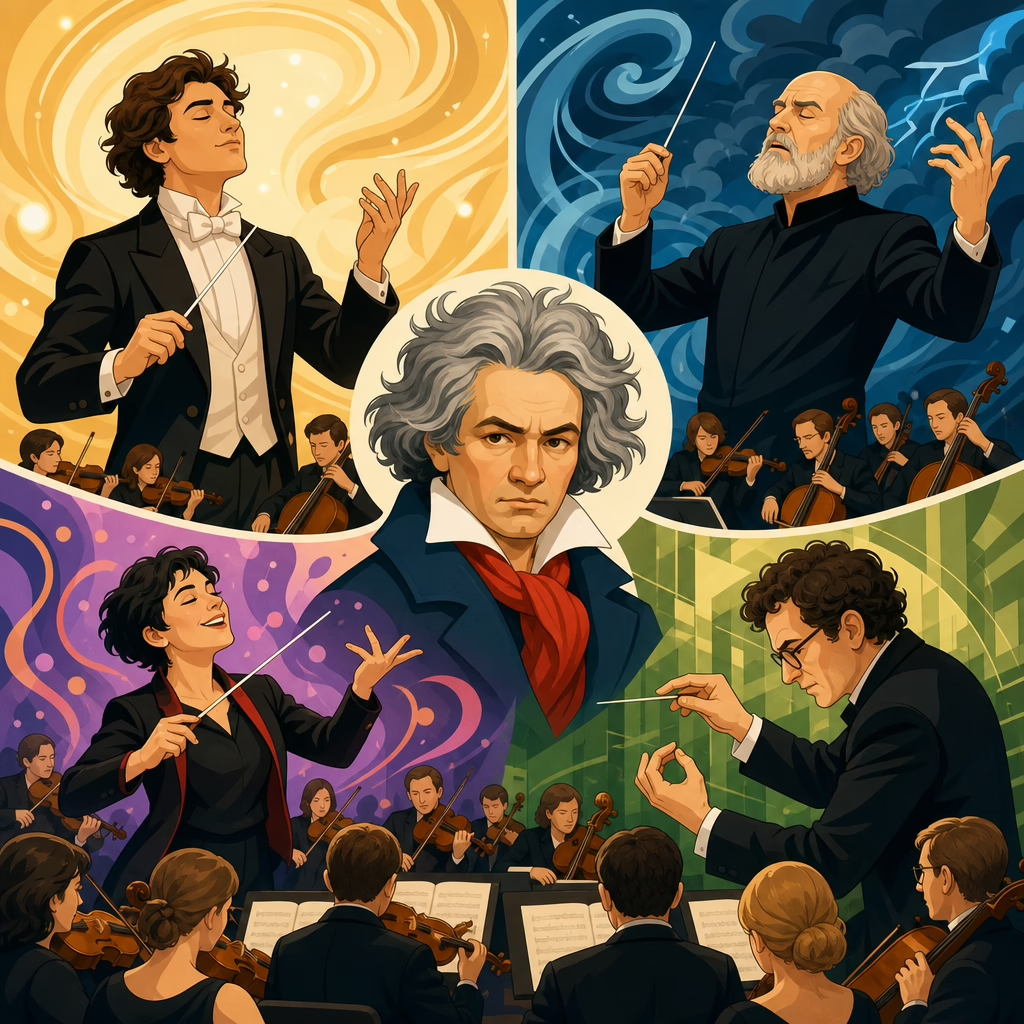
Comparing Conductors: How Interpretation Changes Beethoven’s Works
Beethoven can look fixed on the page, yet anyone who has spent years listening across catalogs knows his music changes radically when different conductors shape tempo, balance, articulation, phrasing, and orchestral sound. Comparing conductors means studying interpretation: the practical decisions that turn notation into performance. In Beethoven, those decisions matter more than many casual listeners realize because his scores combine precise markings with open spaces that demand judgment. A fermata can feel defiant or suspended. A sforzando can strike like a hammer or flash by as color. A transition can sound architectural, volatile, lyrical, militaristic, or intimate depending on the conductor.
This makes Beethoven an ideal composer for performance comparison. His symphonies, overtures, concert works, masses, and incidental music sit at the center of the recording industry, so listeners can trace interpretive traditions from Toscanini and Furtwängler through Karajan, Bernstein, Harnoncourt, Gardiner, Abbado, Chailly, Rattle, and Nelsons. The result is not merely a contest of taste. Interpretation changes the perceived meaning of the works themselves. A broad Eroica becomes a public monument; a lean one becomes a drama of propulsion and fracture. A Ninth can sound devotional, revolutionary, or anxiously modern. Even familiar pieces such as the Fifth and Seventh reveal different harmonic tension, rhythmic swing, and emotional scale under different hands.
For a hub page in performance and recordings, the essential question is simple: what should listeners compare, and why does it matter? The answer begins with a clear definition. Interpretation is the conductor’s integrated approach to beat, pulse, dynamics, orchestral layout, sonority, repeats, period style, and narrative pacing. It also includes rehearsal priorities: whether inner voices speak, whether brass dominate tuttis, whether strings use continuous vibrato, and whether timpani articulate structure. In my own listening and score study, the biggest surprises often come not from headline tempo choices but from transitions and balances that change how Beethoven’s arguments unfold. Once you hear those variables clearly, every recording becomes more informative, and the broader miscellaneous field of Beethoven performance becomes easier to navigate.
What Conductors Actually Change in Beethoven
Conductors do not rewrite Beethoven, but they control the listener’s path through the score. The first lever is tempo, including the relationship between sections. Beethoven’s metronome marks remain controversial; some scholars and performers treat them as practical targets, others as aspirational indicators of character. A conductor who takes the first movement of the Fifth Symphony at a sharp, driven pace emphasizes rhythmic inevitability. One who broadens key arrivals and codas can make the same movement feel more rhetorical and weighty. Neither approach is neutral. Tempo determines whether motifs sound obsessive, heroic, unstable, or ceremonial.
Balance is equally decisive. Beethoven’s orchestration depends on winds and brass carrying structural information, not simply adding color. In recordings influenced by later Romantic practice, thick string sonority can smooth over woodwind detail and harmonic bite. In historically informed readings, harder timpani sticks, lighter strings, and clearer brass placement often expose rhythmic scaffolding that many listeners never noticed. Articulation changes the effect further. Detached bass lines sharpen momentum; legato phrasing broadens continuity. Accents can either disrupt the bar line or sit comfortably inside it. These are not cosmetic adjustments. They alter how form is perceived in real time.
Another major variable is orchestral size and setup. Beethoven stands at a crossroads between Classical proportion and nineteenth-century expansion. A chamber-sized orchestra can make the First, Second, Fourth, and Eighth sound agile and conversational. A larger modern ensemble may project grandeur and sustain long paragraphs more easily in the Third, Fifth, Seventh, and Ninth. Seating plans matter too. Antiphonal violins, with firsts on the left and seconds on the right, clarify Beethoven’s dialogue writing, especially in symphonic finales and scherzos. Conductors who adopt that layout often reveal counterpoint that disappears in a blended modern block.
Three Broad Beethoven Traditions in Recording History
Although individual conductors resist neat categories, Beethoven recordings often fall into three broad traditions. The first is the high-voltage modernist line associated with conductors such as Toscanini. Here the emphasis is tensile rhythm, direct attack, clean ensemble, and momentum. The argument is that Beethoven’s energy should feel urgent and unsentimental. Toscanini’s NBC recordings, despite dated sound, remain crucial because they present Beethoven as structurally disciplined and dramatically taut rather than monumentally heavy. Many later conductors adopted pieces of this method even when working with richer orchestral sonority.
The second tradition is the expansive, rhetorical, and often explicitly metaphysical approach associated with Furtwängler and, in different ways, Klemperer and Bernstein. In these performances, tempo flexibility is not a flaw but a tool for shaping long spans. Climaxes may widen, transitions may breathe, and the music can feel improvised on a grand scale. This tradition is especially persuasive in the Ninth, Missa solemnis, and late overtures, where Beethoven’s sense of struggle can support a broader temporal canvas. The danger is loss of rhythmic discipline, yet at its best the style makes Beethoven sound searching, unstable, and profoundly human.
The third tradition emerged from period-instrument practice and historically informed scholarship. Conductors such as Norrington, Gardiner, Harnoncourt, Brüggen, and later Chailly in hybrid ways challenged inherited assumptions about vibrato, articulation, tempo, repeats, and orchestral weight. Their recordings restored sharper accents, brisker dance rhythms, and more transparent textures. For many listeners, these performances changed Beethoven from granite monument to theatrical event. The point is not that one tradition replaced the others. The modern Beethoven landscape is a conversation among them, and the most interesting current conductors borrow selectively rather than declaring a single orthodoxy.
| Interpretive approach | Typical traits | Representative conductors | Listener takeaway |
|---|---|---|---|
| High-voltage modern symphonic | Strict pulse, tight ensemble, strong forward drive, lean rhetoric | Toscanini, Szell | Beethoven sounds urgent, structural, unsentimental |
| Broad rhetorical tradition | Flexible tempo, weighty climaxes, dark sonority, large-scale phrasing | Furtwängler, Klemperer, Bernstein | Beethoven sounds monumental, searching, emotionally vast |
| Historically informed or hybrid | Brisk tempos, clear inner lines, lighter textures, emphatic accents | Gardiner, Harnoncourt, Brüggen, Chailly | Beethoven sounds vivid, volatile, rhythmically alive |
How the Symphonies Change Under Different Conductors
The symphonies are where interpretive contrast is easiest to hear. In the Eroica, funeral march pacing is decisive. Otto Klemperer treats the Marcia funebre as massive architecture, with implacable tread and grave weight. John Eliot Gardiner, using period forces, keeps the line moving, stressing processional rhythm and stark wind color. Both readings can be convincing, but they imply different narratives: one public and monumental, the other theatrical and raw. In the scherzo, horn articulation and tempo decide whether the movement explodes from grief or unfolds as a noble interlude.
The Fifth Symphony provides another textbook case. Carlos Kleiber’s famous Vienna recording balances propulsion with elasticity, so the first movement breathes without losing danger. Herbert von Karajan, especially in his 1963 cycle, offers burnished orchestral blend and almost seamless control, making the symphony feel inevitable and polished. Harnoncourt breaks that polished surface by emphasizing accents, rougher brass edges, and dramatic silence. Suddenly the work sounds less like a perfectly machined icon and more like a risky argument. Listeners who compare these versions quickly understand that the score contains more than one legitimate dramatic profile.
The Seventh often exposes a conductor’s instinct for dance versus monumentality. Beethoven called it one of his finest works, and conductors either underline its kinetic obsession or inflate it into generalized grandeur. Kleiber again is central because he finds spring in the rhythm without trivializing the piece. Bernstein, by contrast, can broaden the Allegretto into a dark ritual. With a conductor like Abbado, transparency of texture lets the woodwinds and lower strings define pulse, making the work feel lighter on its feet. These differences explain why one listener hears intoxication and another hears ceremonial gravity in the same symphony.
The Ninth raises the highest stakes. Chorus size, solo balance, recitative pacing, and the treatment of the finale’s Turkish march all affect coherence. Furtwängler’s wartime and postwar accounts stress existential urgency; Gardiner’s period approach restores fleetness and sharper rhythm; Abbado often seeks humane clarity rather than sheer mass. The first movement can be apocalyptic or analytically lucid. The Adagio can become a suspended prayer or a flowing variation set. The finale can sound patched together or brilliantly cumulative. When choosing Beethoven recordings, the Ninth remains the clearest reminder that conducting is interpretation, not mere coordination.
Beyond the Symphonies: Overtures, Concert Works, and Sacred Music
Beethoven interpretation is often reduced to the symphony cycles, but the miscellaneous field becomes richer when listeners compare overtures, concert works, stage music, and sacred repertory. Leonore No. 3 is a revealing test piece because it contains everything conductors struggle with in Beethoven: slow introduction, explosive allegro, dramatic spacing, offstage trumpet tension, and a coda that can either blaze or lumber. Conductors who control cumulative energy make the overture feel like compressed opera. Those who overemphasize weight in the introduction may sacrifice the necessary shock when the allegro arrives.
The piano concertos show a different side of interpretation because the conductor must coordinate style with a soloist. In the Fourth Concerto, a conductor can either frame the work as lyrical dialogue or underline its structural daring. Claudio Abbado with Maurizio Pollini favors clarity and classical proportion, while more interventionist partnerships may push the orchestral tuttis toward symphonic confrontation. In the Emperor Concerto, broad ceremonial pacing can be thrilling, but if the pulse loses spring the piece hardens into pageantry. The best conductors support the soloist while preserving Beethoven’s orchestral argument, especially in transitional passages.
Missa solemnis and Christus am Ölberge are even more dependent on interpretive judgment. Missa solemnis is not just a choral spectacle; it is an intricate collision of liturgical form, operatic rhetoric, contrapuntal craft, and private devotion. Conductors must decide how much monumental breadth the score can bear before textual clarity disappears. A performance with transparent choral diction and sharply profiled timpani often reveals the work’s urgency better than one that simply maximizes volume. In the Benedictus, violin solo placement and tempo determine whether the music feels transcendent, intimate, or overly generalized. Sacred Beethoven rewards conductors who balance awe with motion.
How to Listen Critically and Build a Beethoven Comparison List
Listeners do not need conservatory training to compare conductors effectively, but they do need a method. Start with one work and three recordings from different traditions. Use a score if possible, even a cheap study edition from Bärenreiter, Breitkopf, or Dover. Mark the opening tempo, the handling of transitions, whether repeats are observed, the prominence of timpani and winds, and whether climaxes arrive through acceleration, thickening texture, or dynamic layering. I also recommend noting how silence functions. Beethoven’s rests often create suspense, and conductors who respect them can transform familiar passages.
Next, compare engineering and orchestra identity without confusing them with interpretation. The Vienna Philharmonic, Berlin Philharmonic, Orchestre Révolutionnaire et Romantique, and Chamber Orchestra of Europe do not sound alike, even under similar concepts. Brass color, string vibrato, hall resonance, and microphone placement change the emotional surface. Yet repeated listening reveals what belongs to the conductor. For example, Chailly’s Leipzig Beethoven often combines modern precision with historically informed articulation; that blend remains recognizable across different works. Building a comparison list around recurring interpretive habits helps listeners hear beyond marketing claims and star reputation.
For this hub, the practical recommendation is to branch outward from landmark recordings into specialized subtopics. Compare complete cycles with single standout performances. Explore antiphonal violin setups, Beethoven metronome debates, period timpani practice, the role of repeats, and live versus studio differences. Then move into adjacent materials: overtures, concertos, choral works, and rehearsal documentaries. The benefit is cumulative. Once you hear how conductors reshape Beethoven, every performance and recording becomes part of a larger map rather than an isolated product. Start with one symphony this week, take notes, and let comparison sharpen how you listen.
Frequently Asked Questions
Why can Beethoven’s music sound so different from one conductor to another if the notes on the page are the same?
Because a score is not a finished sound object; it is a set of instructions that must be realized in performance. Beethoven’s notation specifies pitches, rhythms, dynamics, articulations, and formal structure, but it does not eliminate the need for judgment. A conductor still has to decide how strictly to take tempo relationships, how much weight to give inner voices, how sharply to shape accents, how long to sustain pauses, how to balance strings against winds and brass, and how to pace transitions so the music feels inevitable rather than merely correct. Those choices can fundamentally alter the character of a movement.
In Beethoven, this matters especially because his music often lives at the intersection of architecture and impulse. A conductor can emphasize the long-range design, making a symphony feel tightly argued and structurally driven, or foreground its volatility, highlighting surprise, tension, and expressive risk. The same opening can sound noble, urgent, defiant, lyrical, or even destabilizing depending on tempo, articulation, and orchestral sonority. What changes is not Beethoven’s composition itself, but the listener’s experience of its meaning, momentum, and emotional pressure. That is why comparing conductors is so revealing: it shows how interpretation turns notation into a living event.
Which conducting choices most strongly affect how Beethoven is heard?
The biggest variables are usually tempo, phrasing, articulation, balance, dynamics, and orchestral sound. Tempo is the most immediately noticeable. A brisk tempo can make Beethoven sound lean, propulsive, and modern, while a broader one can stress grandeur, weight, and rhetorical power. But tempo alone is only part of the picture. Just as important is tempo flexibility: whether a conductor presses forward through transitions, relaxes at cadences, or keeps a firm pulse to preserve structural tension. Even small fluctuations can change whether a passage feels driven by inevitability or shaped by expressive breathing.
Articulation and phrasing are equally decisive. Beethoven’s accents, sforzandos, slurs, and rests are not decorative details; they are often the engines of the music’s drama. One conductor may treat those markings with biting precision, producing a sharply profiled, rhythmically aggressive Beethoven. Another may smooth lines and connect phrases, creating a more singing and expansive sound. Balance also changes interpretation in major ways. If winds are brought forward, harmonic color and conversational counterpoint become more audible. If strings dominate, the texture may feel more unified and saturated. Brass and timpani can either crown climaxes with force or integrate more modestly into the orchestral fabric. Add differences in ensemble size, vibrato practice, bowing style, and the acoustic of the hall or recording, and the result can be a Beethoven performance that feels almost like a different argument about the same text.
How do historical performance ideas change the way conductors approach Beethoven?
Historically informed performance has had a major impact on Beethoven interpretation, even among conductors using modern orchestras. The central idea is not simply to make Beethoven sound “old,” but to reconsider performance choices in light of early nineteenth-century instruments, playing techniques, tempo practices, phrasing habits, and the musical rhetoric of Beethoven’s own era. Conductors influenced by this approach often favor lighter textures, clearer articulation, faster or more strongly profiled tempos, less continuous vibrato, and more transparent balances that allow inner detail to emerge. The result can be a Beethoven that sounds more agile, more volatile, and more rhythmically incisive than the broader, heavier style associated with some twentieth-century traditions.
This does not mean there is one historically correct Beethoven that cancels all other interpretations. Beethoven’s scores are too rich, and performance history is too complex, for that kind of simplification. What historical performance has done, very productively, is challenge inherited habits. It has asked whether a phrase really needs to be broadened, whether a chord should carry so much sustained weight, whether rhythmic sharpness has been softened in the name of monumentality, and whether Beethoven’s famous energy is best conveyed through mass or through attack and motion. Many of today’s most compelling conductors draw from both older symphonic traditions and historically informed insights, creating performances that combine structural depth with textual clarity. For listeners, that makes comparison especially valuable, because it reveals how different schools of thought illuminate different truths in Beethoven’s music.
What should listeners focus on when comparing different conductors in Beethoven’s symphonies or overtures?
A good comparison starts with specific listening points rather than a vague impression of whether one performance feels “better.” Begin with the opening tempo and ask what it establishes: tension, breadth, urgency, ceremonial weight, or dramatic instability. Then listen to transitions, because great conductors often reveal themselves in how they move between themes and sections. Do they intensify the pulse, hold back to mark a structural threshold, or maintain a relentless continuity? Beethoven’s transitions are often where interpretation becomes most visible, since they can either sound purely functional or become some of the most exciting moments in the work.
Next, pay attention to orchestral balance and articulation. Can you clearly hear winds, bass lines, and inner rhythmic figures, or is the texture dominated by the upper strings? Are accents sharply etched or absorbed into a broader legato flow? Notice also how climaxes are prepared. Some conductors build them gradually over long spans, creating a sense of architecture. Others emphasize contrast and immediacy, making Beethoven sound more theatrical and combustible. Finally, listen to silence and release: pauses, fermatas, cadences, and the ends of phrases. Beethoven often uses breaks in motion as dramatic events, and conductors differ widely in how much suspense or finality they draw from them. By focusing on these concrete elements, listeners move beyond personal preference and begin to hear interpretation as a set of meaningful artistic decisions.
Is there such a thing as a “definitive” Beethoven conductor, or is interpretation always subjective?
There is no permanently definitive Beethoven conductor in any absolute sense, because interpretation is shaped by aesthetics, scholarship, orchestral resources, recording conditions, and changing ideas about style. What one generation praises as monumental authority, another may hear as heavy or generalized. What sounds thrillingly direct and textually alert in one era may strike another listener as lean or underpowered. Beethoven’s music is resilient enough to support multiple persuasive approaches, which is one reason it remains central to the orchestral repertory. The absence of a single final answer is not a weakness; it is evidence of the music’s depth.
That said, interpretation is not purely arbitrary. Some performances persuade more strongly because the conductor’s choices produce coherence, tension, expressive logic, and fidelity to the score’s character. A convincing Beethoven performance usually makes its decisions feel necessary rather than mannered. Even when listeners disagree about ideal tempos or sonorities, they often recognize when a reading has command of form, rhythmic life, and dramatic trajectory. So while there may never be one conductor who settles Beethoven for everyone, there are many whose recordings and performances become essential reference points. The best way to understand Beethoven is not to search for a single final version, but to hear how different conductors reveal different dimensions of the same masterpiece.