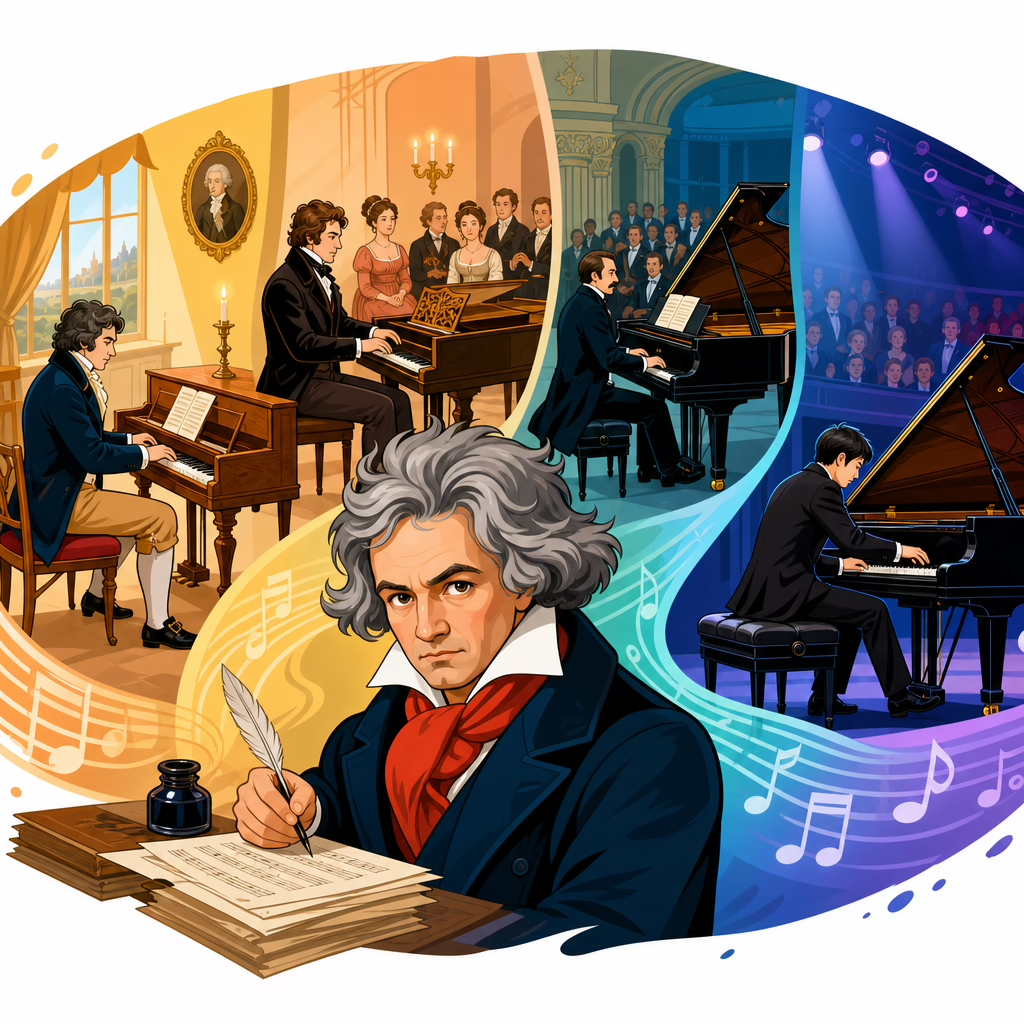
The Evolution of Beethoven Performance Practice
The evolution of Beethoven performance practice traces how musicians, scholars, instrument makers, and listeners have reimagined his music from the early nineteenth century to the streaming era. Performance practice means the set of decisions performers make about tempo, articulation, phrasing, dynamics, instrumentation, pitch, vibrato, pedaling, ornamentation, rehearsal method, and even concert presentation. In Beethoven, those choices matter unusually strongly because his scores are both highly detailed and open to argument. He wrote with uncommon precision, yet he worked in a period of rapid technological change, shifting ensemble size, and fluid notation habits. As a result, every generation has had to ask the same direct questions: How loud is fortissimo on period instruments? How literal should one be with his metronome marks? How much sustain belongs in the piano sonatas? What balance between strings and winds reveals the architecture of the symphonies?
I have worked with Beethoven scores in rehearsal rooms where those questions were not academic at all. A single decision about timpani sticks, string bow distribution, or antiphonal violins can change whether a passage sounds heroic, volatile, or monumental. That is why Beethoven performance practice matters. It shapes what audiences believe Beethoven is: a revolutionary classicist, a proto-Romantic titan, a dance-driven dramatist, or all three at once. It also affects how performers approach related repertoire by Haydn, Mozart, Schubert, Brahms, and the wider nineteenth century.
This hub article surveys the main currents in Beethoven interpretation across orchestral, chamber, keyboard, and vocal repertory. It also points toward the miscellaneous topics that often decide whether a performance convinces: edition choice, venue acoustics, continuo debates, chorus size, historical bows, valve versus natural brass, and recording technology. The goal is not to declare one permanent correct style. The goal is to explain how Beethoven performance practice evolved, why certain approaches rose or faded, and which practical decisions remain central for musicians today.
From Beethoven’s world to the nineteenth-century tradition
Beethoven composed during a transition between late eighteenth-century conventions and the larger expressive culture of the nineteenth century. His early symphonies still depend on Classical transparency, clear dance rhythms, and sharply profiled phrase structures, yet by the Eroica and the Fifth Symphony he had expanded duration, dynamic range, orchestral weight, and formal tension. The instruments he knew were not the modern standard orchestra. Strings used gut rather than steel or synthetic cores, winds had fewer keys, brass often relied on natural harmonic series, and timpani technique produced a harder, more speech-like attack. Pianos were lighter, more quickly decaying, and more coloristic in their registers than later concert grands by Steinway or Bösendorfer.
Early nineteenth-century performers also inherited flexible habits that later generations partly suppressed. Portamento, rhetorical timing, varied articulation within repeated material, and a speech-like approach to accent were common. Treatises by Czerny, Hummel, Spohr, and Baillot, while not identical, show that tempo was connected to character rather than machine regularity. Beethoven’s own metronome marks, introduced after Maelzel’s device became available, remain controversial because some seem exceptionally fast. Yet the broader evidence suggests that Beethoven valued kinetic energy, continuity, and sharply differentiated character more than later monumental traditions often allowed.
As the nineteenth century progressed, Beethoven became a cultural monument. Conductors and virtuosi increasingly presented him as the summit of serious art. This elevated status encouraged larger orchestras, broader tempos, heavier string tone, sustained legato, and a more homogeneous blend. By the time of Wagner, Bülow, and later Nikisch, Beethoven interpretation often emphasized spiritual struggle and symphonic mass. The results could be powerful, but they also moved away from the leaner attack and rhythmic bite likely familiar to Beethoven himself.
The rise of modern Beethoven style in the recording age
Recording changed Beethoven performance practice as decisively as any treatise. Early discs by conductors such as Arthur Nikisch, Felix Weingartner, Arturo Toscanini, Wilhelm Furtwängler, Bruno Walter, and later Herbert von Karajan documented competing ideals. Toscanini favored precision, forward motion, and textual clarity; Furtwängler favored elastic tempo, cumulative architecture, and philosophical breadth. Neither simply reproduced Beethoven’s own sound world, but each established a durable model. Listeners learned to identify Beethoven either with objective drive or with existential flexibility, and conductors after them often positioned themselves somewhere on that spectrum.
In piano playing, the same divergence appeared. Artur Schnabel’s sonata cycle presented structural urgency and expressive risk, often prioritizing line over polish. Wilhelm Kempff brought lyric inwardness and tonal refinement. Claudio Arrau explored sonorous breadth and gravitas. These recordings shaped conservatory standards for decades. They also reflected modern instruments and modern halls. The sustaining pedal on a twentieth-century grand could create sonorities impossible on an 1803 Erard or a Viennese action instrument by Walter. That meant pedaling had to be rethought, not copied literally from the page.
By the mid-twentieth century, mainstream Beethoven often featured continuous vibrato in the strings, blended wind timbres, equalized orchestral choirs, and larger sections than Beethoven generally knew. This was not ignorance so much as adaptation to modern venues and audience expectations. Symphony halls had grown; international touring required consistency; and microphone placement rewarded certain balances. The drawback was that inner rhythms and wind colors could disappear under generalized grandeur. Many late Romantic habits, effective in Bruckner or Mahler, were simply transferred backward onto Beethoven.
Historically informed performance and the Beethoven reset
The most significant reset came from historically informed performance. Beginning in earnest in the 1960s and accelerating in the 1980s and 1990s, conductors and players asked what Beethoven’s notation meant on the instruments and in the acoustic conditions for which it was written. Nikolaus Harnoncourt, John Eliot Gardiner, Roger Norrington, Christopher Hogwood, Frans Brüggen, Jos van Immerseel, and later Philippe Herreweghe and others challenged inherited norms. They restored natural trumpets and horns, harder timpani, smaller string sections, reduced vibrato, and clearer articulation. They also reconsidered seating, often placing first and second violins antiphonally to clarify imitative writing.
These changes did not produce a single orthodox answer. Instead, they reopened the score. Audiences could suddenly hear the offbeat accents in the Seventh Symphony as dance impulse rather than massed legato, or the wind writing in the Pastoral as independent chamber texture rather than background color. Beethoven’s crescendos became directional events; sforzandi sounded disruptive again. One lesson from this movement was practical: when instrumental attack is more varied, Beethoven’s rhythmic syntax becomes easier to understand.
| Performance factor | Twentieth-century mainstream tendency | Historically informed tendency | Musical effect |
|---|---|---|---|
| String vibrato | Continuous and blended | Selective and rhetorical | Greater contrast in texture and harmony |
| Orchestra size | Large string body | Leaner forces | Clearer winds, sharper rhythm |
| Brass and timpani | Valve brass, softer timpani profile | Natural brass, harder sticks | More bite in climaxes and cadences |
| Tempo approach | Broad, monumental pacing | Dance-based, mobile pulse | Stronger momentum and phrase logic |
| Violin seating | Grouped to the conductor’s left | Often antiphonal | Improved stereo dialogue in symphonies |
The debate over metronome marks belongs here. Scholars have proposed faulty metronomes, misreadings, or intentional ideal markings. In rehearsal, the useful conclusion is narrower: Beethoven’s marks are evidence of desired character, and they should be tested seriously before being dismissed. Conductors who begin closer to the written mark often discover that articulation, phrase length, and harmonic rhythm suddenly make better sense. The mark may still need adjustment for hall, instrument, or ensemble, but not by reflexive slowing.
Keyboard, chamber, and vocal performance questions
Beethoven’s piano music sits at the center of performance-practice debate because the instrument changed so dramatically during and after his lifetime. On a fortepiano, bass notes speak quickly, treble registers can glitter rather than sing, and contrasts between registers are more extreme. That changes voicing, balance, and pedaling. In the Waldstein Sonata, for example, repeated harmonies remain transparent on a period instrument in a way that demands much more pedal restraint on a modern Steinway. In the Hammerklavier, the colossal architecture remains, but the sound is less orchestral and more tensile.
Historically aware pianists do not all choose period instruments. Some perform on modern pianos but adapt touch, pedaling, ornament execution, and tempo relationships using evidence from Beethoven’s instruments, his students, and early editions. András Schiff, Ronald Brautigam, Paul Lewis, Igor Levit, and others have shown different ways this can work. The key issue is not museum purity; it is whether the chosen instrument helps reveal the score’s rhetoric. Long pedal indications, for instance, may represent an acoustic effect achievable on an early piano but muddy on a modern one. Intelligent adaptation is therefore more faithful than mechanical literalism.
In the string quartets and violin sonatas, bowing and vibrato have been especially contested. Research into Classical and early Romantic bow strokes supports lighter detaché, more transparent slurring patterns, and varied bow speed rather than the sustained blanket legato favored in some older schools. Quartets such as the Alban Berg, Takács, Quatuor Mosaïques, and the Belcea have each demonstrated how Beethoven can sound either warmly modern or sharply etched without losing emotional depth. The same applies to intonation. Temperament and expressive tuning choices affect harmonic tension, especially in late Beethoven, where remote tonal areas matter structurally.
Vocal and choral Beethoven brings another set of practical questions. In the Missa solemnis and Ninth Symphony, chorus size must match articulation goals and venue acoustics, not just prestige. Oversized choruses can blur consonants and fugue entries, while too-small forces may fail to project. German diction, Latin pronunciation, and the relationship between solo quartet and chorus all influence intelligibility. Conductors informed by period practice often favor leaner choral forces and more agile tempos, which can restore textual clarity without reducing grandeur.
Editions, acoustics, and the future of Beethoven performance practice
No discussion of Beethoven interpretation is complete without editions. Performers routinely choose among autograph sources, first editions, critical editions from Bärenreiter or Henle, and heavily edited older publications. Slurs, accents, staccato marks, dynamics, and even notes can differ. I have seen rehearsals transformed by what looked like a tiny editorial correction: a misplaced accent in a scherzo, or a missing crescendo hairpin before a transition. The practical rule is simple. Start from a respected critical edition, compare sources where the passage matters, and avoid inheriting expressive additions without scrutiny.
Acoustics are equally decisive. A dry hall encourages faster tempos and cleaner articulation because detail reaches the listener quickly. A reverberant church or large romantic hall may require broader spacing, lighter bass resonance, and more careful brass control. Beethoven is especially sensitive to these variables because his scores depend on rhythmic profile. The same Fifth Symphony can sound thrillingly taut in a clear room and merely rushed in a resonant one. Performance practice is therefore not just history; it is applied listening.
Current Beethoven style is best understood as informed pluralism. Major orchestras now borrow freely from historical research while retaining modern instruments. Conductors such as Claudio Abbado, Paavo Järvi, Iván Fischer, Riccardo Chailly, and Sir Simon Rattle have integrated lighter articulation, antiphonal seating, sharper timpani presence, and more mobile tempos into mainstream performance. Pianists increasingly consult facsimiles and period evidence even when playing modern concert grands. Chamber ensembles shift between gut and modern setups depending on repertoire and venue. This cross-pollination has raised the general standard of Beethoven playing because it replaced habit with reasoning.
For readers exploring performance and recordings, the main takeaway is clear: Beethoven performance practice has evolved from inherited tradition toward evidence-based choice, without erasing artistic individuality. The best performances now ask not what fashion demands, but what this passage, on these instruments, in this room, needs in order to speak. That approach serves every miscellaneous topic gathered under this hub, from tempo and editions to recording style and ensemble layout. Use this page as a starting point, then compare recordings, study critical editions, and listen actively. Beethoven rewards performers and listeners who question assumptions and hear the score afresh.
Frequently Asked Questions
What does “Beethoven performance practice” actually mean?
Beethoven performance practice refers to the full set of artistic decisions that shape how his music is brought to life in performance. It includes obvious matters such as tempo, dynamics, articulation, phrasing, balance, and instrumentation, but it also extends to pedaling, vibrato, pitch standard, ornamentation, rehearsal method, seating arrangement, and even the size and acoustics of the venue. In Beethoven, these choices carry exceptional weight because his notation is both highly specific and, at times, open to interpretation. He often wrote with unusual force, marked extreme contrasts, and pushed the instruments of his day to their expressive limits, which means performers must constantly decide how literally to take the score and how to translate its intentions onto modern instruments and for modern audiences.
The idea has also evolved historically. Early nineteenth-century musicians approached Beethoven through the habits of his own musical world, where flexibility, rhetorical delivery, and performer initiative were expected. Later generations, especially in the late nineteenth and early twentieth centuries, often treated Beethoven as a monumental, almost sacred figure, emphasizing grandeur, weight, sustained tone, and architectural breadth. In the later twentieth century, historically informed performance brought renewed attention to period instruments, original tempos, articulation patterns, and performance conventions closer to Beethoven’s lifetime. Today, performance practice is less a single doctrine than a conversation between scholarship and artistry. A pianist, conductor, string quartet, or orchestra may draw on historical evidence while still making contemporary expressive choices. In that sense, Beethoven performance practice is not just about historical correctness; it is about understanding how different eras have heard his music and why those interpretive traditions continue to change.
How have performances of Beethoven changed from the nineteenth century to the present?
Performances of Beethoven have changed dramatically because the musical culture around them has changed. In the decades closest to Beethoven’s lifetime, performers worked with smaller orchestras, lighter bows, narrower-bore wind instruments, lower pitch standards, and pianos with quicker decay and less sustaining power than modern concert grands. Tempos could be energetic, accents sharply profiled, and textures more transparent. Audience expectations were also different: concerts were less standardized, rehearsal time could be limited, and performers often took greater liberties in shaping details. Beethoven’s music was still relatively new, and musicians approached it as living repertoire rather than untouchable heritage.
By the later nineteenth century, a more monumental Beethoven emerged. Larger orchestras, more powerful instruments, and expanding concert halls encouraged a broader, heavier sound. Conductors increasingly became central interpretive authorities, and Beethoven symphonies were often presented as moral and cultural statements. This approach continued into much of the twentieth century, when recordings helped canonize certain styles: broad tempos in slow movements, rich string vibrato, blended orchestral sonority, and a strong emphasis on long structural arcs. These performances often conveyed tremendous seriousness and grandeur, but they sometimes softened the sharp edges, rhythmic volatility, and instrumental bite that may have been more audible in earlier contexts.
From the mid-to-late twentieth century onward, historically informed performance challenged these inherited traditions. Scholars revisited surviving instruments, early editions, treatises, metronome markings, and descriptions from Beethoven’s circle. Conductors and instrumentalists began experimenting with smaller forces, faster tempos, leaner textures, more pointed articulation, reduced vibrato, and period or period-inspired instruments. The result was not merely a “lighter” Beethoven, but often a more volatile, contrasting, and rhythmically driven one. In the streaming era, listeners can easily compare many interpretive models side by side, from lush mid-century performances to brisk period-instrument readings to hybrid modern approaches. That accessibility has made Beethoven performance practice more pluralistic than ever: instead of one dominant tradition, there are now multiple compelling ways to perform his music, each grounded in different artistic and historical priorities.
Why are Beethoven’s tempo markings and metronome indications so controversial?
Beethoven’s tempo markings are controversial because they sit at the intersection of textual authority, practical performance, and musical character. He was one of the earliest major composers to embrace the metronome, and some of his metronome marks appear strikingly fast to performers raised in later traditions. For generations, musicians and scholars have debated whether these markings reflect Beethoven’s true intentions, whether some were affected by faulty equipment or transmission errors, or whether modern performers have simply inherited slower habits that make Beethoven’s own speeds seem implausible. The controversy persists because tempo in Beethoven is never just a numerical issue; it affects articulation, phrasing, stamina, sonority, and the perceived emotional meaning of the music.
Part of the challenge lies in the instruments themselves. A fortepiano from Beethoven’s time responds differently from a modern Steinway; early nineteenth-century strings and winds balance differently from a modern symphony orchestra. A tempo that feels brilliant and clear on period instruments may feel dense or unwieldy on modern ones unless players adjust articulation and weight. Likewise, acoustics matter: a hall designed for a large modern audience may reward different pacing than a smaller salon or court theater. There is also a philosophical divide. Some performers believe Beethoven’s metronome marks should be taken as seriously as possible unless there is strong evidence to do otherwise. Others treat them as important but not absolute, arguing that musical character, phrase shape, and structural clarity must guide the final result.
The most persuasive modern interpretations often avoid simplistic answers. They recognize that Beethoven’s tempos are part of a larger expressive system involving accent, rhythmic propulsion, and dramatic contrast. When performers engage seriously with his markings, they often discover that seemingly fast tempos can reveal dance impulse, wit, and urgency that slower traditions obscure. At the same time, intelligent flexibility remains essential, especially in transitions, lyrical episodes, and acoustically challenging settings. The controversy, then, is productive rather than merely divisive: it forces performers to think more deeply about how Beethoven’s music moves, breathes, and speaks.
What role have period instruments and historically informed performance played in Beethoven interpretation?
Period instruments and historically informed performance have had a transformative effect on Beethoven interpretation because they changed not only the sound of the music but also the questions performers ask about it. When musicians play Beethoven on instruments modeled after or originating from his era, they encounter a very different sonic environment. Early pianos have less sustaining power but greater clarity of attack, making articulation, register contrast, and rhythmic profile especially vivid. Natural horns and trumpets bring a more varied, sometimes raw brilliance. Wooden flutes, classical timpani, and gut strings alter orchestral color and balance in ways that can make Beethoven’s textures feel more transparent, sharply etched, and dramatically volatile.
Historically informed performance also encouraged musicians to revisit documentary evidence: treatises on bowing and phrasing, reports from Beethoven’s contemporaries, early editions, tempo debates, and the practical realities of rehearsal and ensemble size. This research challenged long-standing assumptions, particularly the idea that Beethoven should always sound massive, blended, and uniformly noble. Instead, HIP approaches often foreground contrast, rhetorical immediacy, rhythmic spring, and a wider range of articulation. Sforzandos can sound more disruptive, sudden silences more theatrical, and repeated figures more urgent. The result is often a Beethoven that feels less like a marble monument and more like a living, risk-taking dramatic force.
Importantly, historically informed performance has influenced even musicians who never use period instruments. Many modern orchestras and pianists now adopt clearer textures, more selective vibrato, more attentive articulation, and greater respect for Beethoven’s original dynamic and tempo language because HIP changed the interpretive landscape. At the same time, period performance is not a single fixed style, nor does it guarantee authenticity in any simplistic sense. It is best understood as an evolving method of inquiry: a way of using historical evidence to enrich present-day artistic choices. Its greatest contribution may be that it expanded the range of believable Beethoven interpretations and reminded performers that tradition itself has a history.
How do modern recordings and streaming platforms affect Beethoven performance practice today?
Modern recordings and streaming platforms have reshaped Beethoven performance practice by making comparison instantaneous and global. Earlier generations often knew Beethoven through local concert life, influential teachers, and a relatively limited catalog of recordings. Today, a listener can move within minutes from a mid-twentieth-century symphonic performance with broad tempos and saturated string sound to a period-instrument reading with lean textures and urgent pacing, then to a hybrid modern interpretation that combines historical awareness with contemporary orchestral resources. This easy access has weakened the authority of any single tradition and created a more informed, more curious listening culture.
For performers, recordings are both liberating and demanding. On one hand, musicians can study an unprecedented range of approaches, learning from specialists in fortepiano, chamber music, conducting, organology, and source study. On the other hand, constant availability raises expectations. Audiences and critics can compare details of tempo, repeats, ornamentation, pedaling, and articulation with unusual precision, and performers are often expected to justify their choices in historical as well as expressive terms. Recording technology itself also influences practice. Microphones reveal textures, balances, and articulation details that may not register in the same way in a live hall, while edited studio recordings can create standards of precision that affect rehearsal methods and ensemble discipline.
Streaming culture has also encouraged niche expertise and interpretive diversity. A listener interested in Beethoven’s piano sonatas can now explore