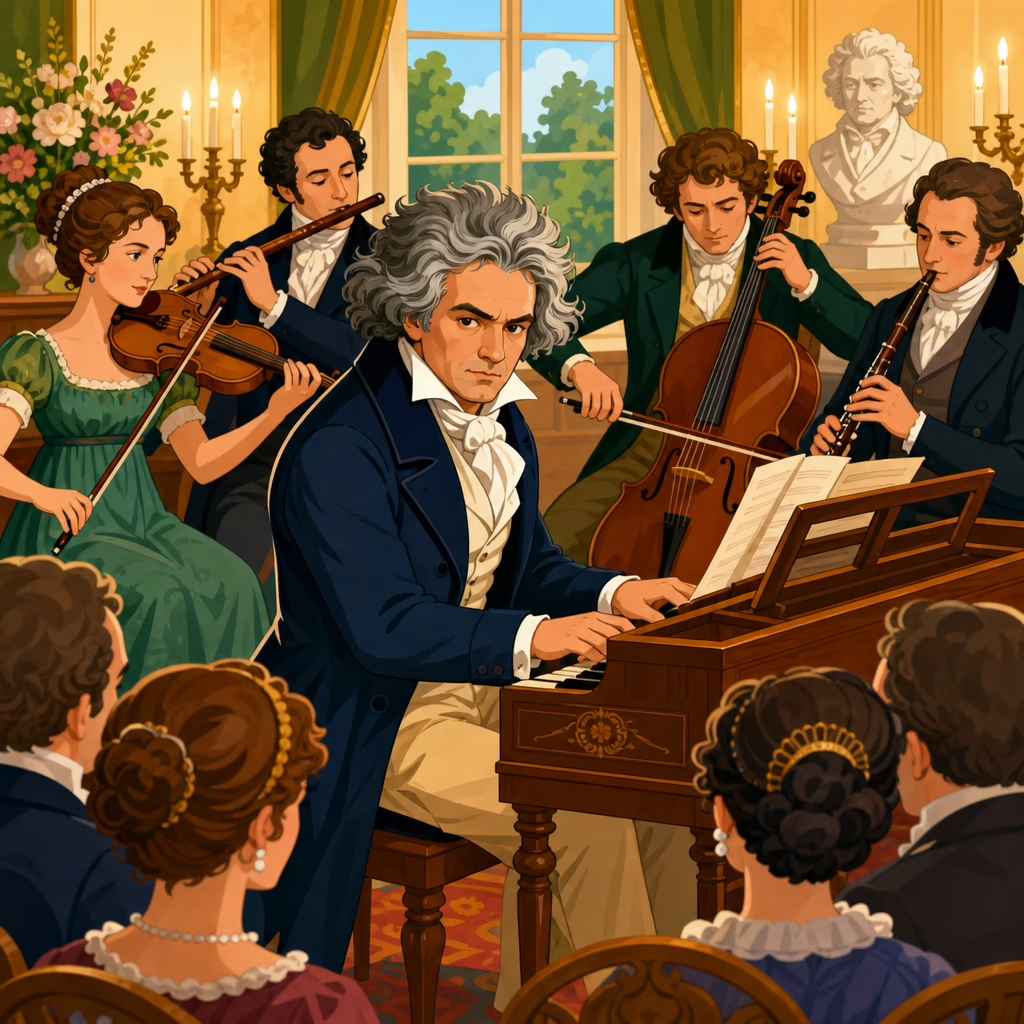
Historically Informed Performances of Beethoven
Historically informed performances of Beethoven sit at the meeting point of scholarship, instrument craft, and live musical decision making. The phrase usually means performances shaped by evidence from Beethoven’s lifetime: original instruments or close copies, period bowing and articulation, early nineteenth-century pitch levels, smaller orchestral forces, and tempos grounded in the composer’s metronome marks, surviving parts, and contemporary reports. In practice, it is broader than simply playing old instruments. It asks how Beethoven expected accents to bite, how wind colors balanced against gut strings, how timpani strokes projected in a hall, and how phrasing, vibrato, ornamentation, seating plans, and rehearsal methods changed the sound world his audiences knew.
This matters because Beethoven’s music has been central to the modern concert tradition for two centuries, yet that tradition often reflects late Romantic habits more than Viennese practice around 1800 to 1827. I have spent years comparing scores, autograph details, first editions, and recordings, and the differences are not academic trivia. A natural horn can make a heroic call sound dangerous rather than polished. Hard-stick timpani can sharpen rhythmic tension. Leaner string vibrato can reveal inner voices that disappear in plush modern sonorities. For listeners, historically informed Beethoven offers not a museum reconstruction but a fresh encounter with familiar masterpieces. For performers, it can reset assumptions about expression, ensemble size, and dramatic pacing. As a hub within performance and recordings, this guide maps the key issues, landmark ensembles, disputed questions, and listening paths that define the miscellaneous but important world of Beethoven performed with historical awareness.
What historically informed Beethoven actually changes
The most immediate change is timbre. Period strings use gut or gut-wound strings, classical bows, and lower string tension, producing a quicker speech-like attack and less sustained blanket of sound. Woodwinds speak with distinct personalities: classical oboes can sound more pungent, clarinets less homogenized, and bassoons more vocal. Brass are transformative. Natural horns and trumpets, without valves, rely on crooks and hand-stopping, so harmonic color shifts inside a phrase. Timpani, often played with harder sticks, add edge that can drive the orchestra without sheer volume. These are not cosmetic details; they reshape balance and rhetorical emphasis in every symphony and concerto.
Tempo is the next flashpoint. Beethoven supplied many metronome marks, especially for the symphonies, and they have long divided conductors. Historically informed performances tend to take them seriously, though not blindly. In my experience, the real lesson is not speed for its own sake but proportional thinking. A brisk first movement can make a scherzo feel properly volatile and a finale genuinely cumulative. Conductors such as Roger Norrington, John Eliot Gardiner, and Frans Brüggen showed that music once considered massive can move with startling kinetic clarity. Yet practical questions remain: were Beethoven’s metronomes reliable, did copyists introduce errors, and how should acoustics alter execution? Good historically informed performances answer those questions musically, not dogmatically.
Articulation and phrasing also shift. Beethoven’s slurs, sfz markings, accents, hairpins, and rests are unusually specific. Period players often treat them as structural instructions rather than expressive suggestions layered onto a smooth legato baseline. The result can be more contrast within a bar and more audible hierarchy across phrases. In the Eroica Symphony, for example, detached bass lines and sharply terraced dynamics can make the first movement’s harmonic drama easier to hear. In the Seventh, rhythmic cells acquire a dance impulse often blurred in broader, heavily sustained performances. This approach does not eliminate grandeur; it relocates grandeur into structure, rhythm, and harmonic risk.
Instruments, pitch, and ensemble layout
Many historically informed Beethoven performances use A around 430 to 435 Hz rather than the modern orchestral standard around 440 to 443, though practice varies by repertoire and instrument collection. Lower pitch changes color and response, especially for winds and singers. Instrument makers and restorers have played a major role here. Copies based on period models by workshops specializing in classical and early Romantic instruments let ensembles approach original balances more closely than generic “old-style” equipment ever could. Fortepianos modeled on instruments by Anton Walter, Conrad Graf, or Broadwood can radically alter Beethoven’s piano concertos and sonatas. Their lighter action, rapid decay, and transparent bass encourage articulation and dynamic contour different from those used on a modern Steinway.
Seating plans matter as much as hardware. Antiphonal violins, with firsts left and seconds right, clarify imitative writing and stereophonic exchanges in symphonies such as the Fifth and Ninth. Basses placed behind the violins or cellos can either reinforce rhythm or blend harmony, depending on the chosen layout. Trumpets and timpani positioned for direct projection can restore the martial brilliance Beethoven often imagined. Choir placement in the Ninth affects text intelligibility and orchestral blend. Historically informed conductors also tend to use smaller but not tiny forces, often closer to documented Viennese practice than the supersized orchestras common in the mid-twentieth century. The point is not minimum numbers; it is achieving transparency with enough weight to honor Beethoven’s public ambition.
| Element | Common modern practice | Historically informed tendency | Musical result |
|---|---|---|---|
| Strings | Metal strings, continuous vibrato | Gut strings, selective vibrato | Clearer attacks and inner voices |
| Brass | Valved horns and trumpets | Natural brass with crooks | Sharper color contrasts |
| Timpani | Softer sticks, blended impact | Harder sticks, stronger articulation | Greater rhythmic definition |
| Pitch | A440 to A443 | Often A430 to A435 | Darker overall sonority |
| Violins | Grouped on one side | Often antiphonal | Better dialogue across sections |
Tempos, metronome marks, and the debate over Beethoven’s intentions
No issue attracts more argument than Beethoven’s metronome marks. Some are exceptionally fast by later symphonic standards, especially in the First, Second, Seventh, and Ninth symphonies. Critics have proposed damaged devices, copying errors, or Beethoven’s hearing loss as explanations. Those possibilities deserve consideration, but the evidence does not justify dismissing the marks wholesale. Beethoven knew Johann Nepomuk Maelzel, promoted the metronome, and supplied markings after the device became available. Modern scholarship, including source comparison and practical testing, suggests that at least many marks are playable and musically coherent when texture, articulation, and period instruments are taken into account.
The strongest performances treat tempo as part of rhetoric. Fast does not mean breathless. With lighter bows, cleaner bass response, and less sustaining vibrato, lines can articulate at speeds that sound congested on modern instruments. Gardiner’s cycle with the Orchestre Révolutionnaire et Romantique is a classic example: driven but rarely blurred. Norrington’s London Classical Players recordings pushed the debate further, stripping away habitual weight and exposing rhythmic bones. Brüggen often found a middle path, preserving dance energy while allowing harmonic arrivals to register fully. Even conductors on modern instruments, including David Zinman and Paavo Järvi in parts of their Beethoven work, absorbed lessons from historically informed practice about pulse, accent, and proportional relationships between movements.
For listeners asking whether the marks should always be followed exactly, the best answer is no, but they should always be confronted. A funeral march that ignores Beethoven’s character indication and metrical design in favor of generalized solemnity misses the point. A scherzo broadened into grandeur may lose its wit. The practical test is whether tempo reveals form, textural detail, and dramatic tension. Historically informed Beethoven has improved the conversation by replacing inherited habit with evidence-based choice.
Symphonies, concertos, opera, and sacred works
The symphonies remain the center of this repertory, but historically informed ideas matter equally in the piano concertos, violin concerto, Fidelio, Missa solemnis, and chamber music. In the concertos, the fortepiano changes orchestral relationships. Passagework sparkles rather than booms, and the orchestra becomes a true partner instead of accompaniment for a dominant modern grand. Listen to performances by Malcolm Bilson, Ronald Brautigam, or Andreas Staier to hear how articulation and instrument decay make Beethoven’s keyboard writing sound improvisatory and conversational. Cadenzas can feel more dangerous because the instrument does not smooth every edge.
Fidelio benefits from historical awareness because it sits between Singspiel, rescue opera, and high moral drama. Spoken dialogue, orchestral attack, and brass writing all gain urgency with period style. Conductors such as Gardiner and René Jacobs have shown that the score can move with theatrical immediacy rather than monumental heaviness. In the Missa solemnis and the Ninth Symphony, the stakes are different. Historically informed choirs often use faster diction, lighter vibrato, and clearer consonants, helping dense counterpoint and text emerge. Balance becomes crucial: too few singers can underweight climaxes, while too many erase orchestral detail. The most convincing performances find tensile strength rather than sheer mass.
Chamber music may be where historically informed Beethoven convinces skeptical listeners fastest. String quartets on period instruments reveal registral contrasts and attack patterns often hidden by modern blend. The Op. 18 quartets gain wit and asymmetry; the late quartets gain fragility and volatility. Violin sonatas with classical bows and fortepiano expose Beethoven’s equal partnership between instruments. Cello sonatas become more speech-driven and less cushioned. These works demonstrate that historical awareness is not a special effect reserved for symphonies; it is a practical method for understanding Beethoven’s language across genres.
Essential recordings, ensembles, and how to listen critically
Any hub on historically informed performances of Beethoven should name the reference points. For symphonies, important cycles include Norrington with the London Classical Players, Gardiner with the Orchestre Révolutionnaire et Romantique, Brüggen with the Orchestra of the Eighteenth Century, and Jos van Immerseel with Anima Eterna. Philippe Herreweghe offers a more blended but still historically alert approach. In piano concertos and solo keyboard music, Bilson, Brautigam, Staier, and Kristian Bezuidenhout are indispensable. For sonatas, Brautigam’s fortepiano cycle is especially useful because it combines virtuosity with attention to rhetoric and instrument color. For chamber music, ensembles such as Quatuor Mosaïques and the Eroica Quartet illuminate how bowing, gut strings, and temperamental tuning alter texture.
Listening critically means comparing choices, not ranking old versus new. Start with one movement you know well, such as the opening of the Fifth Symphony or the slow movement of the Emperor Concerto. Ask four questions. First, can you hear inner lines more clearly? Second, do accents and silences carry more structural meaning? Third, does the tempo illuminate the form? Fourth, how do instrumental colors affect character? A natural horn entry may sound rougher than a modern horn, but that roughness can be expressive truth rather than technical deficiency. Historically informed performances are successful when they make Beethoven’s notation sound necessary, not merely unusual.
The broader benefit of historically informed performances of Beethoven is not doctrinal purity. It is sharper listening. By reconsidering instruments, tempos, ensemble size, articulation, and evidence from Beethoven’s world, performers have reopened works that risk becoming overfamiliar. The best results combine scholarship with conviction: they sound urgent, dramatic, and alive, not cautious or antiquarian. This miscellaneous hub should serve as a gateway across the entire performance and recordings landscape, from symphonies and concertos to opera, sacred music, and chamber repertory.
If you are building your own listening path, begin with two contrasting recordings of the same work, follow the score if possible, and note where historical choices change your understanding of rhythm, balance, and form. Then explore related articles under performance and recordings for deeper guides to specific symphonies, fortepiano practice, period instruments, and landmark Beethoven discographies. The reward is simple: music you thought you knew starts speaking in a more vivid, human voice.
Frequently Asked Questions
What does “historically informed performance” mean in Beethoven’s music?
Historically informed performance, often shortened to HIP, refers to an approach to Beethoven that draws on the musical evidence of his own era rather than relying only on later performance traditions. In Beethoven’s case, that usually includes studying original instruments or faithful reproductions, early nineteenth-century playing techniques, period ideas of phrasing and articulation, pitch standards that were often lower than modern concert pitch, and orchestral sizes closer to what Beethoven actually knew. It also involves reading surviving parts, treatises, letters, concert reports, and the composer’s own metronome marks to understand how his music may have sounded and moved in performance.
Just as important, HIP is not a rigid museum exercise. It is a practical, living way of making musical decisions. Performers use historical evidence to shape tempo, balance, accentuation, vibrato, bow strokes, pedal use, and even the dramatic character of a phrase. In Beethoven, this matters because his scores are unusually specific and often revolutionary. He pushes instruments to their limits, writes extreme dynamics, and builds drama through rhythm and articulation as much as melody. A historically informed reading aims to recover that sense of immediacy, contrast, and unpredictability that early listeners may have experienced.
At its best, historically informed Beethoven does not claim to offer a single “correct” version. Instead, it narrows the range of plausible choices by grounding interpretation in historical knowledge. The result can sound leaner, sharper, more transparent, and more rhythmically urgent than many later Romantic-style performances, while still leaving room for imagination, expression, and individual artistry.
How do period instruments change the sound of Beethoven compared with modern instruments?
Period instruments can transform the color, balance, and expressive profile of Beethoven’s music. Gut-string violins, violas, cellos, and basses tend to produce a warmer, less homogenized sound than modern steel-strung instruments, with quicker response and a broader range of articulation between notes. Classical and early Romantic bows also encourage different phrasing, often making short gestures, dynamic inflections, and speech-like articulation more natural. Wind instruments are especially revealing: natural horns and trumpets, wooden flutes, and earlier oboes, bassoons, and clarinets create a more varied and characterful palette, with distinctive timbral shifts across registers rather than the smooth uniformity often associated with modern instruments.
These instrumental differences affect more than tone color. They also reshape orchestral balance. In a historically informed Beethoven performance, winds frequently emerge with greater individuality, inner lines become easier to hear, and brass and timpani can sound more incisive without overwhelming the ensemble. Because Beethoven often wrote with specific instrumental colors in mind, using period instruments can clarify why certain textures feel so dramatic or surprising on the page. What may sound dense or blended in a modern symphony orchestra can become transparent and sharply etched on historical equipment.
Keyboard music changes significantly as well. Performing Beethoven on a fortepiano rather than a modern concert grand alters touch, sustain, attack, and dynamic scale. Fast passagework can sound lighter and more articulate, while contrasts between registers become more pronounced. Pedaling also works differently, which affects harmony and resonance. None of this means modern instruments are unsuitable for Beethoven, but period instruments can reveal aspects of his writing that are closely tied to the tools he knew, especially his fascination with contrast, clarity, and expressive immediacy.
Why are Beethoven’s tempos such a major issue in historically informed performance?
Tempo is one of the most debated topics in Beethoven performance because his music depends so heavily on momentum, rhythmic tension, and structural drive. Beethoven provided metronome marks for many works, and those markings have long sparked controversy. Some conductors and players believe they are too fast, impractical, or inconsistent with later traditions. Historically informed performers tend to take them seriously, even when they do not follow them slavishly, because they are direct evidence from the composer himself and because they often make musical sense when played on period instruments and with smaller, more agile forces.
In practice, HIP musicians examine Beethoven’s tempo markings alongside meter, note values, articulation, genre, surviving parts, and contemporary descriptions of performances. A tempo is not chosen in isolation; it is linked to character. For example, a faster Beethoven tempo can make repeated figures feel energetic rather than heavy, and it can allow large structures to cohere more convincingly. It can also change how accents, sforzandos, and syncopations register, often increasing the music’s sense of volatility and forward motion. What sounds aggressive or breathless in a broad modern orchestral style may sound clear and compelling when phrased with lighter articulation and leaner sonorities.
That said, historically informed performance does not mean blindly racing through Beethoven. Skilled interpreters weigh acoustics, ensemble size, instrument response, and the expressive function of the movement. The real goal is not speed for its own sake but fidelity to the music’s pulse and rhetoric. HIP has pushed many listeners and performers to reconsider Beethoven as a composer of urgency and dramatic propulsion, not just monumentality, and that reconsideration has had a lasting influence well beyond period-instrument circles.
Does historically informed performance make Beethoven sound smaller or less emotional?
This is a common concern, but in many cases the opposite is true. Historically informed Beethoven may involve smaller orchestras and less heavily blended sonorities, yet that does not reduce emotional impact. Instead, it often intensifies it by making contrasts more vivid and details more immediate. Beethoven’s music is full of abrupt dynamic shifts, sharp accents, sudden silences, destabilizing rhythms, and highly charged dialogue between instrumental groups. When textures are clearer and articulation is more pointed, those gestures can feel more dangerous, theatrical, and emotionally direct.
The idea that emotional depth requires a large, lush, late-Romantic sound is a relatively modern assumption. Beethoven certainly inspired later monumental traditions, but he was also a composer deeply rooted in rhetorical clarity, dramatic pacing, and instrumental character. Historically informed performances often restore a sense of edge and unpredictability that can become softened in more expansive interpretations. A period orchestra may sound lighter in mass, but it can also sound fiercer in attack, more explosive in brass and timpani writing, and more exposed in ways that heighten tension.
Emotion in HIP Beethoven usually comes from contrast, line, timing, and gesture rather than sheer sonic weight. A whisper can feel more intimate, a crescendo more alarming, and a rhythmic disruption more destabilizing when the musical surface is transparent. For many listeners, historically informed performance reveals Beethoven not as a reduced version of the modern symphonic hero, but as a radical dramatist whose music can be raw, urgent, humorous, tender, and unsettling all at once.
Is historically informed performance the only valid way to perform Beethoven today?
No. Historically informed performance is an important and influential approach, but it is not the only musically valid one. Beethoven’s works have lived through many traditions, and great performances can arise from both period and modern instruments when they are thoughtful, stylistically aware, and artistically convincing. What HIP has done, however, is permanently change the conversation. It has challenged inherited habits, forced performers to justify tempo choices and articulation styles, and encouraged closer attention to the evidence Beethoven left behind. Even musicians who do not identify as specialists in HIP have absorbed many of its insights.
In today’s performance world, the most interesting Beethoven interpretations often draw from a range of perspectives. A modern orchestra may adopt lighter articulation, reduced vibrato, sharper rhythmic definition, and more transparent balances because of HIP research, while still using modern instruments. Likewise, a period-instrument ensemble may make flexible interpretive choices that are not strictly literal but are informed by historical understanding. The point is not ideological purity; it is informed musicianship.
For audiences, the value of historically informed performance lies in what it opens up. It invites listeners to hear familiar masterpieces anew, to recognize that performance traditions evolve, and to understand Beethoven’s music as something shaped by specific instruments, specific rooms, and specific aesthetic assumptions. Rather than closing interpretation down, HIP broadens it by reconnecting modern performance with the richness of historical evidence. It is best understood not as a rulebook, but as a powerful framework for asking better questions about how Beethoven’s music speaks most vividly today.