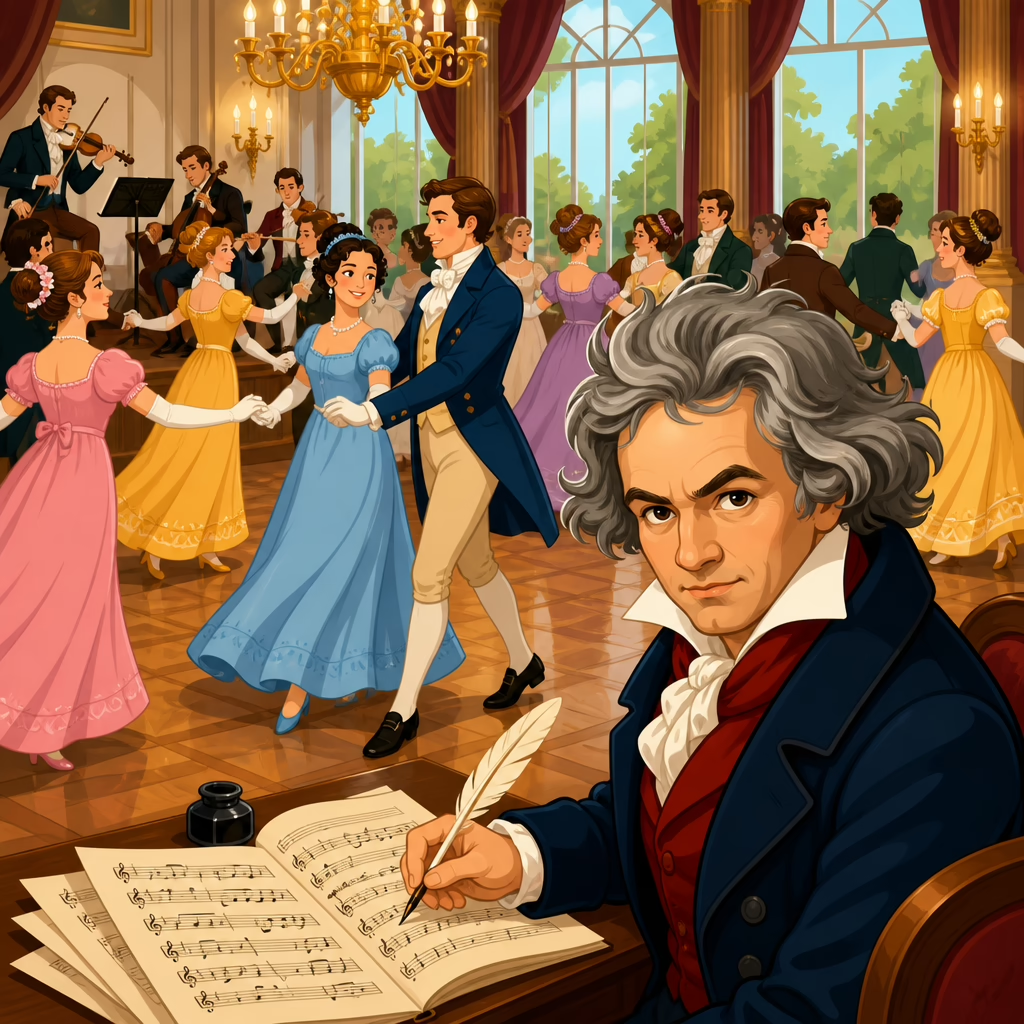
The Twelve Contredanses and Beethoven’s Ballroom Style
Beethoven’s Twelve Contredanses, WoO 14, occupy a small but revealing corner of his catalog, showing how a composer famous for symphonies and sonatas handled the practical demands of the ballroom. A contredanse was a social dance for groups of couples arranged in lines or squares, built on regular phrasing, clear pulse, and instantly graspable melodic patterns. In late eighteenth-century Vienna, these pieces were not minor curiosities but essential functional music, written to support movement, sociability, and fashionable public entertainment. When I have studied Beethoven’s dance works alongside his concert music, what stands out is not a split between “serious” and “light” styles, but his ability to compress character into tight, usable forms. The Twelve Contredanses matter because they reveal Beethoven writing for real dancers, real rooms, and real social timing, while still sounding unmistakably like himself.
Composed around 1791 to 1801 depending on the individual number and surviving sources, the set survives as orchestral miniatures of great economy. Each dance is brief, usually in binary or rounded design, with square four- and eight-bar units suited to memorized figures. Yet within those limits Beethoven varies accent, orchestral color, cadence placement, and motivic profile with unusual care. Listeners often know one melody indirectly: Contredanse No. 7 contains the tune later transformed into the finale theme of the “Eroica” Symphony and the basis of the Fifteen Variations and Fugue, Op. 35. That single connection has drawn attention to the set, but the larger significance lies elsewhere. These dances demonstrate how Beethoven mastered public utility music without writing mechanically. They also offer a precise window onto ballroom style in Vienna, where clarity, propulsion, and repeat-friendly design determined what worked on the floor. Understanding the Twelve Contredanses means hearing Beethoven not on the concert stage, but in motion, among dancers.
What the Twelve Contredanses are and where they fit in Beethoven’s output
The Twelve Contredanses, cataloged as WoO 14, belong to Beethoven’s body of occasional and social dance music, a category that also includes minuets, allemandes, ecossaises, German dances, and marches. “WoO” stands for “Werke ohne Opuszahl,” works published or transmitted without opus numbers, often because they served immediate purposes rather than a carefully managed public image. That classification can mislead modern readers into underrating them. In practice, Beethoven devoted real craft to such pieces because they had demanding constraints: the music had to be playable, memorable after one hearing, and regular enough for dancing. Unlike a piano sonata, a contredanse could not indulge long transitions, unstable phrase lengths, or dense developmental argument without disrupting the dancers’ steps.
The orchestration of the Twelve Contredanses reflects that function. Beethoven writes for a compact late Classical ensemble, typically emphasizing strings with winds used for color, punctuation, and melodic doubling. The musical surface is transparent, and harmonic plans stay close to tonic and dominant, with occasional excursions for brightness rather than drama. This is not a limitation of imagination; it is a design solution. In my experience comparing Beethoven’s dance sets with those of Haydn and Mozart, the best test is simple: can you feel where the dancers would turn, advance, pause, and regroup? In WoO 14, the answer is almost always yes. Cadences arrive where bodies need them, not merely where theory predicts them.
The set also fits a crucial moment in Beethoven’s development. During his Vienna years, he was building a reputation as pianist, improviser, and composer while navigating aristocratic patronage and urban entertainment culture. Dance music helped composers participate in that world. It could circulate in manuscript, serve civic or private events, and display local fluency. For Beethoven, writing contredanses meant engaging with a social repertoire that valued immediacy over monumentality. That is exactly why the set is revealing. It shows how he could tailor his language to environment without surrendering identity.
How Beethoven writes for the ballroom
Beethoven’s ballroom style in these dances rests on three foundations: metrical stability, phrase symmetry, and sharply profiled motives. A successful contredanse must broadcast its beat structure instantly. Beethoven therefore keeps hypermeter legible, usually in balanced units of four or eight measures, and places accents where collective movement can lock in. Even when he introduces syncopation or offbeat emphasis, he does so against a firm underlying grid. That contrast creates liveliness without confusion. Dancers feel energy, not uncertainty.
Phrase design is equally functional. The opening idea typically states itself with little preamble, often in a sentence-like or period-like shape that can be grasped on first hearing. Repeats are not filler; they are structural necessities in dance music, allowing figures to align with musical cycles. Beethoven uses repetition economically, but he often freshens the return through scoring changes, registral shifts, or stronger cadential preparation. In practical terms, this is ballroom intelligence: the form remains stable while the ear stays engaged.
His motives are short and physical. Instead of expansive singing lines, many of these dances rely on triadic outlines, scalar tags, repeated notes, and upbeat gestures that trigger motion. This is one reason they sound so effective in performance. The melodic material does not ask listeners to contemplate; it asks them to move. At the same time, Beethoven avoids bland neutrality. Sudden dynamic punctuation, cheeky wind interjections, and emphatic cadences give several numbers a theatrical snap. He writes to animate a room.
| Ballroom requirement | Beethoven’s solution in WoO 14 | Effect on dancers and listeners |
|---|---|---|
| Predictable step cycles | Four- and eight-bar phrase groups | Figures align cleanly with musical units |
| Clear beat perception | Strong bass support and regular cadences | Easy coordination in group dancing |
| Variety without confusion | Short motives, scoring changes, dynamic accents | Freshness while preserving usability |
| Memorable tunes | Triadic melodies and repeated-note cells | Immediate recognition after one hearing |
| Compact duration | Binary designs with efficient harmonic motion | No loss of momentum on the floor |
Another hallmark of Beethoven’s ballroom style is his management of texture. Thick contrapuntal writing would cloud rhythmic cues, so he keeps vertical sonority clean. Melody and accompaniment are usually distinct, and inner parts support pulse rather than compete for attention. That restraint can seem simple on the page, but it takes judgment. In rehearsal, overly dense articulation in this repertoire quickly muddies the dance impulse. Beethoven writes in a way that anticipates that risk and avoids it.
The “Eroica” connection and what it reveals
Contredanse No. 7 is the most discussed piece in the set because its principal theme became one of Beethoven’s most productive melodic ideas. He used it in the finale of the ballet The Creatures of Prometheus, then in the Fifteen Variations and Fugue, Op. 35, and most famously in the finale of the Symphony No. 3, the “Eroica.” This reuse is not a trivial act of self-borrowing. It shows that Beethoven recognized in a dance tune the potential for large-scale structural transformation. A melody designed for social utility became the seed of symphonic argument.
What made that possible? The theme is plain, balanced, and harmonically durable. Its clarity leaves room for variation, inversion of emphasis, bass-first presentation, and contrapuntal enrichment. In other words, it is strong because it is simple, not despite being simple. Beethoven understood that a robust theme does not need decorative complexity at the outset. In ballroom form, the tune projects immediate intelligibility. In symphonic form, that same intelligibility supports expansion across a much larger canvas.
This connection helps correct a common misunderstanding about Beethoven’s dance music. The dances are not interesting only because they foreshadow “greater” works. Rather, later masterpieces expose the compositional strength already present in the dances. When teaching or writing about this repertoire, I find No. 7 especially useful because it lets listeners hear continuity across genres. Beethoven does not maintain separate vocabularies for low and high forms. He adapts core materials to different social functions. That adaptability is central to his style.
For readers interested in how smaller Beethoven works can illuminate larger patterns across his output, the best broader companion is this complete guide to Beethoven’s bagatelles. It provides a useful parallel case: brief forms, practical dimensions, and concentrated invention often reveal compositional habits as clearly as the headline masterpieces do.
Listening to individual character across the set
Although the Twelve Contredanses share functional constraints, they are not interchangeable. Some numbers lean toward genial brightness, using buoyant anacruses and open triadic writing. Others have a more stamping profile, with stronger downbeats and thicker tutti punctuation. Several depend on conversational exchanges between strings and winds, giving the impression of social interplay translated into orchestral sound. Even within a few dozen measures, Beethoven distinguishes one dance from another through attack, contour, and cadence weight.
A practical way to hear those differences is to track openings and endings. Beethoven often establishes character in the first two measures: an upbeat can make the room feel spring-loaded, while a tonic downbeat can feel grounded and processional. Endings matter just as much. Some close with quick, efficient cadences suited to immediate transition; others underline the final bars with extra emphasis, as if to mark a completed figure set. These are small decisions with large bodily consequences. In dance music, how a phrase ends affects when people shift formation, not just how they applaud.
The orchestral palette contributes more than many listeners expect. Wind doublings brighten texture and sharpen profile, while strings carry the continuity needed for steady movement. Brass and timpani are not the point here; elegance and definition are. When ensembles overinflate these pieces with symphonic weight, the style suffers. The best performances keep articulation light, tempos alive but not rushed, and phrase endings clean. That approach restores the music’s intended scale: social, kinetic, and alert rather than monumental.
The set also rewards attention to repetition. Because forms are short, every return counts. Beethoven uses repeated material as an opportunity for reinforcement, not redundancy. If the first statement teaches the room the idea, the repeat confirms it and deepens the groove. This is exactly how effective dance music works, whether in eighteenth-century Vienna or modern social genres. The listener’s body learns the pattern, and enjoyment grows with recognition.
Why these dances still matter
The Twelve Contredanses matter because they preserve Beethoven’s command of function, proportion, and social style in unusually concentrated form. They remind us that great composers were not always writing for posterity. Sometimes they wrote for an evening’s use, for patrons’ guests, for circulating fashion, and for dancers needing dependable cues. Meeting those needs well is not lesser craftsmanship; it is specialized craftsmanship. Beethoven’s success here lies in making utility musical.
They also help modern listeners hear continuity across his catalog. The same composer who could build vast dramatic arcs could also shape sixteen or thirty-two bars with precision enough to move a room. That dual capacity is essential to understanding his art. If you listen to the Twelve Contredanses attentively, you hear not a sideline but a workshop of essentials: pulse, motif, cadence, timing, and character under pressure. Start with No. 7 for the famous theme, then hear the full set in sequence and notice how often Beethoven says exactly what the genre requires, with no wasted gesture. That is ballroom style at its sharpest. Revisit these dances with their social purpose in mind, and Beethoven’s miniature craft becomes impossible to overlook.
Frequently Asked Questions
What are Beethoven’s Twelve Contredanses, WoO 14, and why do they matter?
Beethoven’s Twelve Contredanses, WoO 14, are a set of short orchestral dance pieces written for social use rather than for the concert hall. At first glance, they can seem modest beside the symphonies, piano sonatas, and string quartets that define Beethoven’s reputation. Yet they matter precisely because they reveal another side of his craft: his ability to write music that was immediately usable, physically clear, and socially functional. In the ballroom, music had to do more than sound attractive. It had to organize motion, support group coordination, and maintain energy for dancers moving in shared patterns. These pieces show Beethoven responding to those practical demands with remarkable economy and skill.
They also matter historically because they place Beethoven firmly inside the musical life of late eighteenth-century Vienna. Dance music was not peripheral to urban culture; it was woven into public entertainment, aristocratic gatherings, and everyday sociability. Composers were expected to supply music that could work in real time for actual bodies in motion. The Twelve Contredanses therefore offer a valuable glimpse of Beethoven as a working composer navigating popular taste, social utility, and stylistic convention. Rather than treating them as curiosities, it is better to hear them as evidence of how flexibly Beethoven could adapt his musical language when the setting demanded directness, brevity, and rhythmic reliability.
What exactly is a contredanse, and how does that form shape Beethoven’s writing in these pieces?
A contredanse is a social dance built for groups of couples, typically arranged in lines, columns, or squares, performing figures in coordinated sequence. Its musical design had to serve the logic of communal dancing, which meant regular phrase lengths, an unmistakable beat, balanced sections, and melodic ideas that could be understood almost instantly. Unlike a highly individual concert work, a contredanse was not meant to draw attention to itself through complexity. Its success depended on how well it guided movement. Dancers needed to anticipate cadences, feel the pulse without effort, and recognize recurring patterns that matched the choreography.
That functional purpose shapes Beethoven’s writing throughout WoO 14. The phrasing is generally square and symmetrical, often unfolding in predictable units that make physical timing easy. The rhythms tend to be clean and emphatic, with accents placed where dancers can feel them clearly. Melodies are concise, memorable, and rhythmically distinctive without becoming overly elaborate. Harmonic motion usually supports stability rather than surprise, because too much ambiguity would interfere with the dance’s practical flow. Even when Beethoven adds a touch of wit or charm, he does so within a framework that remains serviceable. The result is music that reflects the discipline of utility: every gesture has to be grasped quickly, every phrase has to land cleanly, and every section has to help dancers stay oriented.
How do these dances reflect Beethoven’s “ballroom style” rather than his more famous symphonic voice?
Beethoven’s ballroom style is defined less by grand development and more by clarity, propulsion, and social readability. In the Twelve Contredanses, he writes with a different set of priorities than he would in a symphony or sonata. Instead of extended argument, large-scale tension, or dramatic transformation, he favors compact forms, steady momentum, and musical surfaces that communicate immediately. The writing is lighter in construction, more repetitive by necessity, and more sharply focused on bodily response. This is not a lesser Beethoven so much as a situational Beethoven: a composer adjusting his technique to fit a room full of dancers rather than a hall full of listeners.
That said, traces of his personality still come through. Even within strict formal limits, Beethoven can energize a phrase with a pointed rhythm, brighten a melody with a clever turn, or animate a cadence with a slightly stronger-than-expected emphasis. His ballroom style often depends on controlled vividness. He knows how to give a tune enough profile to be appealing without making it too complex for dancing. He knows how to keep the music moving while still shaping it with craft. In this way, the contredanses are useful reminders that style is not only about lofty expression; it is also about suitability. Beethoven’s achievement here lies in making practical dance music lively, polished, and unmistakably competent while never losing sight of its social function.
Do the Twelve Contredanses show Beethoven as a popular or accessible composer?
Yes, in an important sense they do. These works show Beethoven engaging with a repertoire designed for broad social participation rather than elite contemplation alone. The music had to be accessible, not because accessibility was a compromise, but because it was the essential condition of success in the ballroom. Dancers could not stop to decode unusual structures or highly intricate thematic manipulation. The tunes had to register at once, and the rhythm had to remain dependable. In meeting those expectations, Beethoven demonstrates that accessibility and craftsmanship are not opposites. He could write music that was straightforward, usable, and appealing without sacrificing control or intelligence.
This also helps correct a common modern image of Beethoven as only a heroic, intense, and monumental figure. The contredanses remind us that he operated within a lively musical marketplace in which practical genres mattered. He was capable of writing for immediate pleasure, coordinated movement, and social enjoyment. That does not mean these pieces are simple in a dismissive sense. Rather, they are refined examples of applied musical thinking. Their accessibility is part of their achievement. Beethoven understood how to meet listeners and dancers where they were, how to supply what an event required, and how to build music that worked on first hearing. In that respect, the Twelve Contredanses broaden our understanding of him as a composer who could be direct without being dull and popular without being generic.
How should modern listeners approach the Twelve Contredanses if they are used to Beethoven’s larger masterpieces?
Modern listeners will get the most from these pieces by resisting the urge to measure them against the symphonies, sonatas, or late quartets. The right question is not whether they possess the depth of Beethoven’s largest works, but whether they succeed on their own terms. They were written for a specific environment in which music had to support collective movement, sustain atmosphere, and communicate instantly. If heard with that function in mind, the Twelve Contredanses become much more revealing. Their compactness starts to feel purposeful, their repetitions become structurally necessary, and their directness emerges as a sign of discipline rather than limitation.
It also helps to imagine the physical world these dances inhabited: a Viennese ballroom, sets of couples moving through figures, and musicians providing a clear rhythmic framework for social interaction. In that context, details that might seem small on paper become central. The steadiness of pulse, the balance of phrases, the bright contour of a melody, and the firmness of a cadence all take on practical meaning. Listeners may also notice how effectively Beethoven creates freshness within constraint. He does not need large forms to hold attention; he uses timing, accent, melodic profile, and concise contrast to keep the music alive. Approached this way, the Twelve Contredanses are not miniature versions of “greater” Beethoven works. They are a distinct kind of success, showing how a major composer handled functional dance music with assurance, tact, and style.