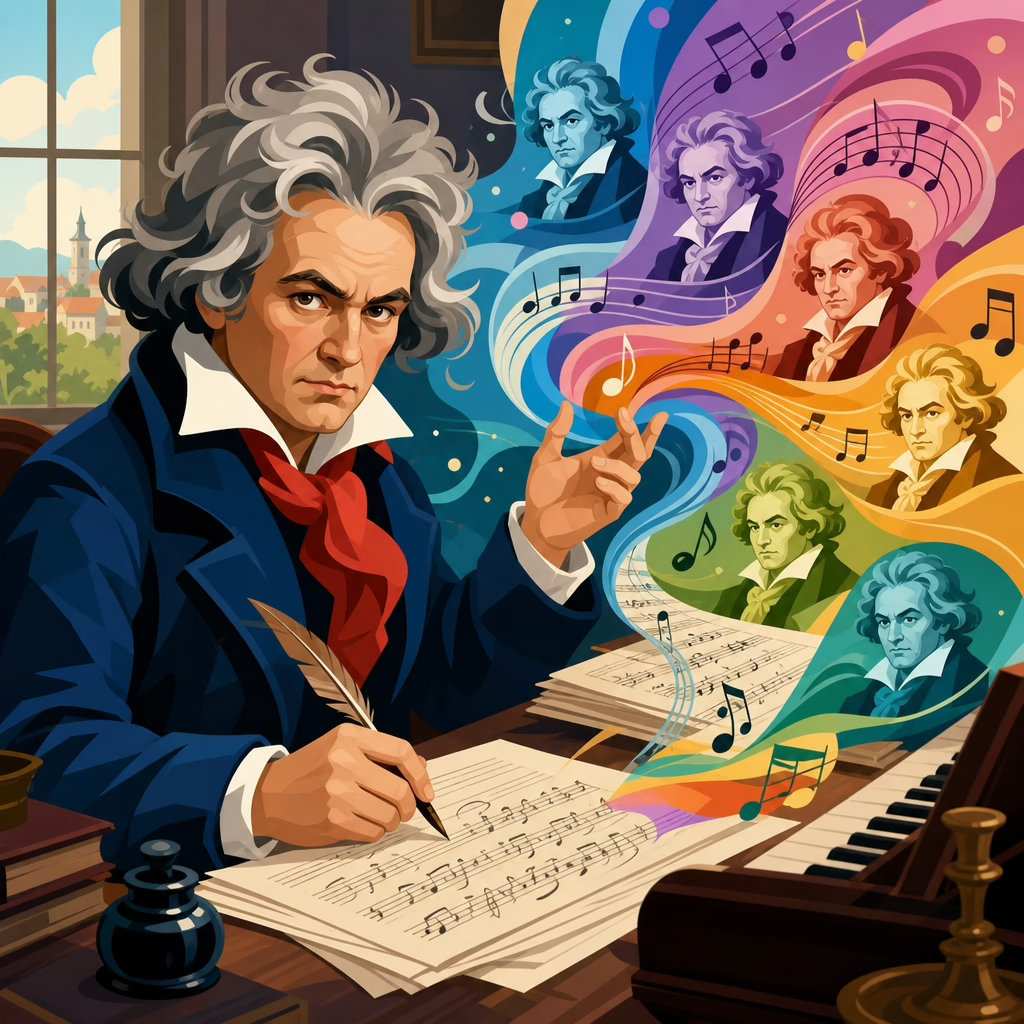
Beethoven and the Reinvention of Variation Form
Variation form, at its simplest, begins with a theme and follows it with altered restatements, but in Beethoven’s hands that inherited design became a laboratory for drama, structure, and psychological change. Earlier composers had treated variations largely as decorative transformations: a melody might be ornamented, reharmonized, shifted to the minor mode, or recast with different accompanimental patterns while its identity remained comfortably visible. Beethoven accepted those tools, yet he treated them as only the starting point. Across piano works, chamber music, orchestral scores, and late-period monuments, he expanded variation form from a sequence of pleasing modifications into a process that could generate tension, narrative direction, and large-scale unity.
That reinvention matters because variation form sat near the center of eighteenth-century musical practice. Audiences knew it from keyboard sets on popular tunes, from slow movements, and from concluding finales designed to delight through ingenuity rather than surprise. By transforming a familiar format, Beethoven altered expectations for what instrumental music could express without words. He showed that a theme need not remain a stable object merely dressed in new clothing; it could be questioned, fragmented, hidden, purified, and rebuilt. In practical terms, that shift influenced Schubert, Brahms, Liszt, and later modernists who understood variation as a deep compositional principle rather than a surface device.
When musicians speak about Beethoven and variation form, several key terms matter. A theme is the initial musical idea, usually with a clearly defined phrase structure and harmonic plan. A variation preserves enough of that identity to remain recognizable, but it may alter rhythm, texture, mode, register, meter, accompaniment, or even phrase articulation. More advanced practice includes character variation, where each restatement behaves like a distinct expressive world; developmental variation, where motives are transformed with cumulative logic; and double variation, where contrasting themes alternate through paired transformations. Beethoven worked fluently across all these approaches, often combining them within a single movement.
Having rehearsed and performed these works, I have seen how Beethoven’s innovations are not abstract musicological claims but audible realities. Players must solve problems of pacing, touch, voicing, and formal proportion that simply do not arise in many pre-Beethoven variation sets. The reason is that his variations often do not sit side by side as detachable miniatures. They push toward climaxes, destabilize expectations, suspend cadences, and make the listener re-evaluate what counts as the “same” material. The result is variation form as transformation in the strongest sense: identity persists, but meaning changes. That is Beethoven’s real reinvention.
From Ornament to Structural Process
Beethoven inherited a rich variation tradition from Haydn, Mozart, C. P. E. Bach, and countless keyboard virtuosos, yet he refused to leave the form at the level of embellishment. In many eighteenth-century examples, the harmonic skeleton remains almost untouched while figurations become progressively more elaborate. Beethoven could do that when he wished, especially in early works intended to engage players and audiences immediately. But even there, he often inserted disruptive contrasts: a sudden move to the minor, a thinning of texture after brilliance, or a contrapuntal variation that changes the listener’s sense of weight and direction.
The crucial difference is structural thinking. Beethoven understood that a variation set could behave like a dramatic argument. Instead of asking, “How else can this tune be dressed?” he asks, “What hidden possibilities does this theme contain, and how can one variation alter the meaning of the next?” That change sounds simple, but it reorients the entire listening experience. A variation is no longer just an example of wit or craft. It becomes a stage in a process, and its local details matter because they affect the long-range trajectory of the whole movement or set.
A clear early demonstration appears in the Six Variations in F major, Op. 34, where Beethoven abandons the usual strategy of keeping all variations in one tonic area. Instead, each variation moves to a different key in descending thirds: F major, D major, B-flat major, G major, E-flat major, and C minor before the return. That tonal plan gives the set a structural arc independent of mere figuration. The listener experiences not only changing textures but changing tonal light. For a pianist, each variation also demands a recalibration of sound and phrasing, because the form is traveling harmonically, not just decorating in place.
His Fifteen Variations and Fugue in E-flat major, Op. 35, often called the “Eroica” Variations, goes further by withholding the full theme. Beethoven begins with the bass line alone, then layers in fragments before presenting the complete tune. This is a radical move: the foundation precedes the melody, almost as if the music were showing its own construction site. In rehearsal, this changes interpretation immediately. One cannot treat the theme as a fixed monument unveiled at the outset; its identity emerges gradually, making every later transformation feel rooted in a deeper structural DNA. Variation form here becomes investigative.
Beethoven’s Middle-Period Expansion of Expressive Range
During the middle period, Beethoven made variation form capable of sustaining heroic breadth, lyric introspection, and abrupt emotional reversal within a single design. The second movement of the Symphony No. 3, the funeral march, is not a textbook variation set, yet its repetitive thematic transformations show how deeply variation thinking informed his larger style. For a broader view of that symphonic imagination, see the main guide at how Beethoven reinvented the symphony. Within variation form itself, this era proves that Beethoven no longer viewed the genre as secondary to sonata form. It became one of his main engines of expression.
The slow movement of the Piano Sonata in A-flat major, Op. 26, is especially important because it is a full theme and variations movement placed where listeners might expect a conventional sonata-form opening movement. The theme is poised and symmetrical, but the variations intensify through rhythmic animation, denser figuration, and altered emotional color. Beethoven’s innovation lies in preserving clarity while making each stage feel necessary. The movement does not merely continue; it accumulates expressive pressure. By the time performers reach the later variations, the original calm seems transformed from within rather than simply revisited.
Another hallmark of this period is character variation. Beethoven often gives each restatement a sharply profiled expressive identity: one sings, another marches, another meditates, another sparkles with toccata-like motion. This may sound familiar today, but in his hands the contrasts are unusually consequential. They are not just entertaining changes of costume. They test the resilience of the theme. If a melody can survive being rendered as lament, dance, hymn, or counterpoint, then the composer has discovered something fundamental about its construction. Beethoven repeatedly designs themes with that adaptability built in from the start.
The finale of the Appassionata Sonata is not a variation set, but its relentless motivic reworking helps explain Beethoven’s broader contribution. He increasingly thinks in terms of transformation at every scale. That same mindset informs explicit variation movements. Once you hear this, the apparent boundary between “variation form” and “development” begins to dissolve. This is one reason Beethoven’s variation writing feels modern. He treats the theme not as a fixed object but as a generative cell, a source of energy that can drive an entire musical argument.
Techniques Beethoven Used to Reinvent Variation Form
Beethoven’s methods were concrete and repeatable, not mystical. He manipulated harmony, texture, rhythm, register, counterpoint, and formal pacing with unusual strategic control. Just as important, he understood that variation sets need contrast without losing coherence. In performance, the challenge is to make each variation distinct while preserving the through-line. Beethoven helps by embedding continuity in the harmonic framework, motivic profile, or bass structure even when the surface seems transformed almost beyond recognition.
| Technique | What Beethoven Changes | Effect on the Listener | Example |
|---|---|---|---|
| Rhythmic transformation | Subdivision, syncopation, propulsion, metric stress | Makes the same theme feel newly urgent or suspended | Op. 26 variations |
| Textural redefinition | Chordal writing, filigree, imitation, bass emphasis | Shifts expressive character without erasing identity | Op. 35 |
| Mode and tonal planning | Major/minor alternation, remote key schemes | Creates drama across the whole set, not just within one variation | Op. 34 |
| Counterpoint | Canon, fugato, invertible lines | Adds intellectual tension and cumulative weight | Diabelli Variations |
| Formal disruption | Delaying theme, inserting fugue or coda, changing proportions | Turns a sequence into a large-scale narrative | Op. 35, Op. 111 |
One of Beethoven’s most effective tools is bass-line thinking. In the “Eroica” Variations, the bass pattern carries so much identity that the melody can be delayed, displaced, or transformed without collapsing recognition. This was a sophisticated answer to a practical compositional problem: how far can a variation go before the listener loses the thread? By rooting identity below the surface, Beethoven gained freedom above it. That principle later influenced Brahms, whose own variation sets frequently depend on harmonic and bass continuity rather than literal melodic repetition.
He also mastered cumulative pacing. Many earlier sets peak in obvious virtuoso fashion and then simply stop. Beethoven tends to reserve his deepest surprises for later stages: a severe minor-mode turn, a learned contrapuntal variation, an adagio suspension of motion, or a coda that retrospectively redefines the set. This pacing is one reason his variation movements reward repeated listening. Their logic is not exhausted by hearing one variation at a time. The meaning of an early variation often becomes clearer only after later transformations reveal what role it played in the long arc.
The Late Style and the Diabelli Revolution
If Beethoven’s early and middle-period works enlarged variation form, the late works completely changed its prestige. The most decisive example is the Diabelli Variations, Op. 120, thirty-three transformations of a waltz by the publisher Anton Diabelli. The source theme is deliberately ordinary, almost banal. That choice is essential. Beethoven proves that greatness in variation form does not depend on a noble original melody. It depends on the composer’s ability to expose latent structures, to hear comic, sublime, grotesque, and metaphysical possibilities hidden inside unpromising material.
What makes the Diabelli set revolutionary is not only its scale but its interpretive breadth. Some variations magnify tiny rhythmic cells from Diabelli’s theme; others parody the original with heavy accents or mock-pompous gestures; still others abstract it into lyrical stillness or rigorous counterpoint. The famous fughetta and the monumental fugue are not decorative add-ons. They show Beethoven treating variation as a route toward recomposition, where the initial tune becomes raw material for entirely new forms of thought. Yet the set never feels random. Its unity comes from obsessive attention to intervals, rhythms, cadential shapes, and formal placement.
Performers quickly discover that the Diabelli Variations demand architectural hearing. No one can make sense of all thirty-three pieces by playing each as a self-contained encore. Groupings, tensions, and release patterns matter. Variation 1’s muscular march-like exaggeration immediately announces that Beethoven will not prettify the theme. Variation 20 strips texture down with extraordinary inwardness. Variation 31 creates sacred stillness through slow ornamented writing, preparing the comic and dancing release of the minuet-like close. Beethoven thus replaces linear “more and more elaborate” progression with a multidimensional field of contrasts governed by overarching design.
The final movement of the Piano Sonata in C minor, Op. 111, offers another late statement. The Arietta and its variations begin with disarming simplicity, then unfold into rhythmic subdivision so radical that later listeners have heard anticipations of jazz-like swing and boogie-woogie patterns in the syncopated middle variations. Those comparisons should not be overstated, but the rhythmic imagination is undeniable. More important, the movement shows Beethoven using variation form to suggest transcendence. The theme is not merely changed; it is spiritually rarefied. Trills, floating textures, and registral expansion make the music seem to leave earthbound pulse behind.
Why Beethoven’s Variation Form Still Shapes Listening and Performance
Beethoven’s reinvention of variation form still matters because it changed the criteria by which listeners judge repetition and change in music. After him, a variation set could aspire to the seriousness of a sonata, quartet movement, or symphonic finale. Composers such as Schumann, Brahms, and Rachmaninoff inherited not just a genre but a method: build large forms through transformation, allow contrast to reveal structure, and let a theme’s essence survive even when its surface identity is challenged. That legacy reaches beyond explicit variation sets into film music, jazz arranging, and contemporary minimalism, all of which rely on meaningful recurrence.
For performers and informed listeners, the practical lesson is to hear beneath the surface. In Beethoven, the question is rarely “How pretty is this variation?” It is “What aspect of the theme is being tested now?” Sometimes the answer lies in harmony, sometimes in rhythm, sometimes in character, and sometimes in the deliberate stripping away of everything ornamental. That is why these works remain inexhaustible. They invite analysis, but they also communicate immediately, because the drama of persistence through change is something any attentive listener can feel.
Beethoven reinvented variation form by turning it from decorative succession into structural, expressive, and philosophical transformation. He expanded tonal planning, deepened motivic logic, used counterpoint and pacing to shape large spans, and proved in works from Op. 34 to the Diabelli Variations and Op. 111 that a theme can generate an entire world. Listen again to one of these sets with that process in mind. Follow what remains constant, notice what changes, and Beethoven’s boldest innovation will become unmistakable.
Frequently Asked Questions
What did Beethoven change about traditional variation form?
Beethoven transformed variation form from a mainly decorative procedure into a vehicle for large-scale musical argument. In earlier practice, a composer would present a theme and then offer a sequence of modified restatements that preserved the original tune clearly enough for listeners to recognize it at every step. Those changes could be elegant and inventive, but they often functioned as surface alterations: added ornamentation, changes of rhythm, shifts in texture, or a move into the minor mode. Beethoven certainly used all of those inherited techniques, yet he treated them as starting points rather than limits.
What makes his approach so distinctive is that each variation can feel like a necessary stage in a process of growth, conflict, or revelation. Instead of merely dressing the theme in new clothing, he often isolates a rhythmic cell, harmonic progression, bass pattern, or structural principle and develops that element with unusual intensity. As a result, the identity of the theme may become less obvious on the surface even while the deeper logic of the piece becomes stronger. In Beethoven’s hands, variation form becomes dramatic: one variation may heighten tension, another may dissolve certainty, and another may reassemble the material in a more powerful form.
He also expanded the expressive and architectural range of the form. A set of variations could now sustain humor, pathos, grandeur, learned counterpoint, or spiritual stillness, sometimes all within one composition. Rather than treating variations as a chain of equivalent miniatures, Beethoven often arranged them to create trajectory and contrast, almost as though he were composing a compressed drama. That is why his reinvention of variation form matters so much: he showed that variation could be not just a method of embellishment, but a way of thinking compositionally about transformation itself.
Why is variation form so important in understanding Beethoven’s style?
Variation form sits very close to the center of Beethoven’s musical imagination because his style is fundamentally concerned with the unfolding consequences of a small musical idea. Even in works not formally labeled as variations, Beethoven often composes as though he were testing a motive, rhythm, interval, or harmonic gesture under changing conditions. He asks what happens when a pattern is compressed, expanded, intensified, interrupted, displaced, or contradicted. That habit of mind is exactly what variation form encourages, which is why it offers such a clear window into how he thinks.
Looking at Beethoven through the lens of variation also helps explain the unusual sense of inevitability in much of his music. He was less interested in repeating attractive material than in discovering what that material could become. A simple theme might generate vigorous rhythmic activity, contrapuntal complexity, lyrical inwardness, or monumental climax, and the progression from one state to another can feel psychologically charged. The listener hears not only change, but development with purpose. This gives Beethoven’s music its characteristic mixture of coherence and surprise.
Variation form also reveals how he connects structure and expression. In his music, a formal transformation is rarely just technical. A change in meter, register, texture, or harmony often carries emotional weight. A sparse variation can sound exposed or desolate; a densely worked one can feel triumphant or obsessive; a sudden return to simplicity can seem consoling or uncanny. Because Beethoven binds these expressive shifts to the internal mechanics of the music, variation becomes one of the clearest demonstrations of his ability to unite craft and feeling. To understand his variations is, in many ways, to understand Beethoven himself.
How did Beethoven make variations feel dramatic rather than merely ornamental?
Beethoven achieved drama in variation form by treating each transformation as an event with expressive consequences rather than as a polished redecoration of the same material. One of his most effective strategies was to alter the listener’s sense of weight and direction. He could take a stable theme and gradually destabilize it through syncopation, fragmentation, harmonic ambiguity, registral extremes, or unexpected silences. These are not just changes in style; they create suspense, resistance, and release. The theme becomes something acted upon, challenged, and ultimately redefined.
Another crucial factor is pacing. Beethoven often orders his variations so that they accumulate meaning across the set. A brilliant passagework variation may energize the music, but it can be followed by something slower and more searching that changes the emotional frame entirely. A move into the minor mode may introduce shadow or strain; a contrapuntal variation may tighten the argument; a seemingly simple variation late in the sequence may feel profound because of everything that has preceded it. The variations do not merely coexist. They interact, and their sequence produces narrative force.
He also understood how to manipulate continuity and rupture. Sometimes the underlying harmonic skeleton remains firm while the surface becomes increasingly transformed; at other times he obscures the theme so thoroughly that recognition itself becomes part of the listening experience. This creates a dramatic tension between identity and change. The listener senses that the music still belongs to the original idea, yet that idea is being tested from multiple angles. In this way Beethoven turns variation form into a stage for psychological transformation, where the theme is not simply repeated, but challenged, expanded, and made to reveal unsuspected depths.
Which Beethoven works best show his reinvention of variation form?
Several works demonstrate Beethoven’s originality in this area, and together they show just how broad his variation thinking became. The Eroica Variations, Op. 35, are an especially revealing example because Beethoven does not begin in the most expected way. He foregrounds the bass line and structural framework before fully presenting the theme, already signaling that variation for him concerns underlying design as much as melodic surface. The result is a set that moves far beyond decorative transformation, exploring wit, brilliance, contrapuntal control, and large-scale culmination.
The slow movement of the Piano Sonata in A-flat major, Op. 26, is another important case, as is the first movement’s use of variation form in place of a more conventional sonata-form opening. This alone says much about Beethoven’s confidence in the form’s ability to sustain serious structural work. Later on, the Diabelli Variations, Op. 120, stand as one of the supreme achievements in the history of the genre. Given a modest, even awkward waltz by Anton Diabelli, Beethoven creates a vast universe of character, intellect, parody, grandeur, and introspection. Here variation becomes encyclopedic, critical, and visionary all at once.
The late quartets and late piano sonatas also contain profoundly original variation movements. The “Arietta” from the Piano Sonata in C minor, Op. 111, is a landmark in how a theme can be transformed through rhythm, texture, and atmosphere into something that seems to transcend ordinary formal boundaries. Similarly, the slow movements and variation finales in late works often blur the line between strict variation form and continuous spiritual unfolding. These pieces matter because they show Beethoven using variation not simply to display compositional skill, but to explore time, memory, identity, and transcendence at the highest artistic level.
How did Beethoven’s approach to variation influence later composers?
Beethoven’s impact was immense because he expanded the perceived purpose of variation form. After him, composers could no longer regard variations only as elegant diversions or technical exercises. He demonstrated that a theme and its transformations could support deep expressive contrast, rigorous architecture, and even philosophical weight. Later composers inherited from him the idea that variation could be developmental in the strongest sense: not just changed repetition, but a process in which musical identity is discovered through transformation.
This influence can be felt across the nineteenth century and beyond. Composers such as Brahms absorbed Beethoven’s concern with underlying structure, often building variations from bass lines, harmonic plans, or motivic cells rather than relying solely on surface melody. Schumann and Liszt, in different ways, took from Beethoven the sense that variation could become character drama or poetic metamorphosis. Even when later composers departed from his style, they worked in a world he had permanently altered, one in which the variation set could be as serious and ambitious as any symphonic or sonata-based form.
His legacy also reaches into modern conceptions of thematic transformation and developmental form. The notion that a musical idea can retain identity while undergoing radical change becomes central to much later music, whether in Romantic cyclical structures, orchestral transformations, or twentieth-century reimaginings of thematic process. Beethoven helped redefine variation as a fundamental artistic principle: continuity through change. That principle remains one of the most powerful ideas in Western art music, and it is one reason his variation works continue to be studied not merely as genre pieces, but as models of musical thought at its most inventive and profound.