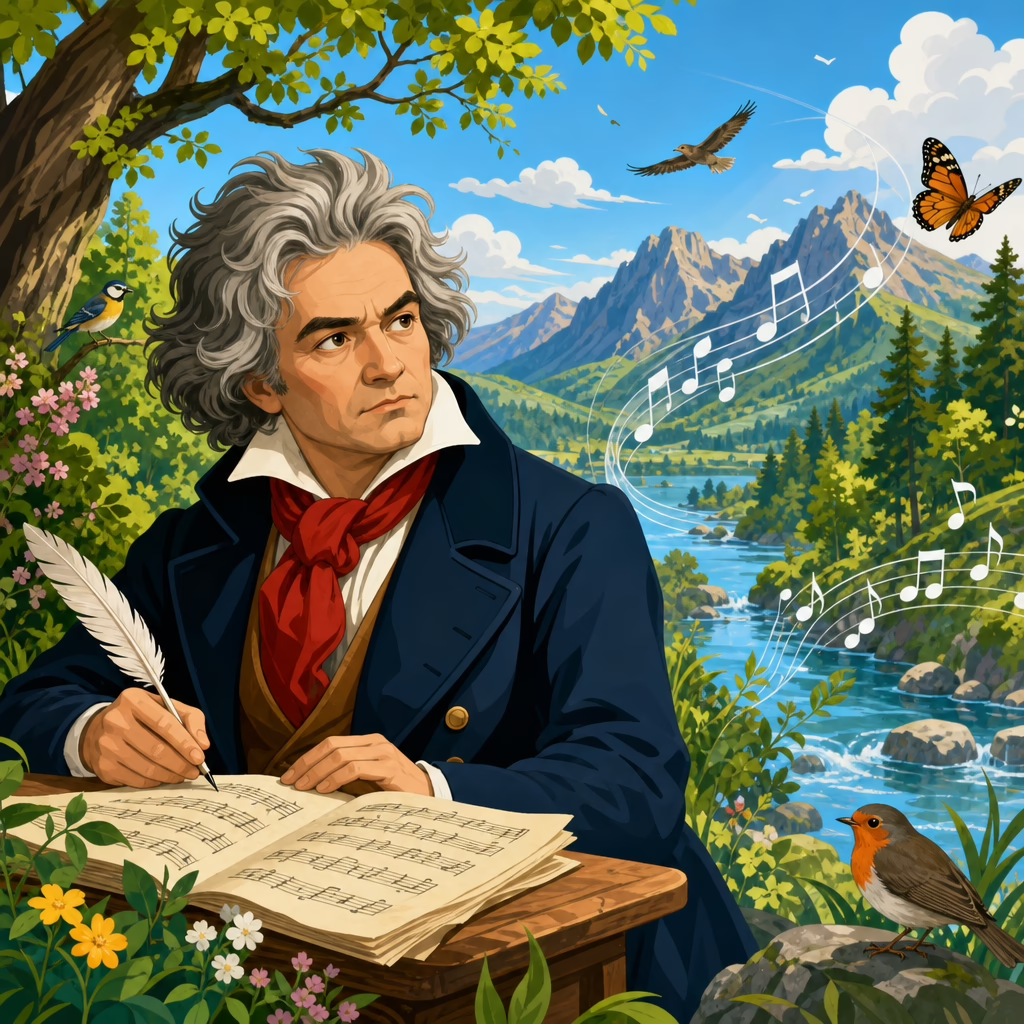
Beethoven’s Fascination with Nature and Its Musical Reflection
Ludwig van Beethoven’s fascination with nature shaped not only his habits and moods but also the sound, structure, and expressive purpose of his music. In the broad landscape of Beethoven’s inspirations, nature belongs to the “miscellaneous” category only because it crosses so many boundaries: biography, aesthetics, philosophy, daily routine, sketchbook practice, and reception history. To understand Beethoven’s relationship with fields, rivers, storms, birdsong, and rural life is to understand a central thread running through his creative identity.
When scholars discuss Beethoven and nature, they usually mean more than simple scenic description. Nature, in his world, included direct sensory experience, long country walks around Vienna, reverence for elemental power, and a moral idea of the natural world as a source of truth and renewal. This mattered profoundly for a composer who spent much of his adult life coping with increasing deafness, social strain, and volatile health. In my own work tracing Beethoven’s letters, conversation books, and scores across this topic, the pattern is unmistakable: nature was not decorative background. It was a refuge, a working environment, and a creative catalyst.
The most famous example is the Symphony No. 6 in F major, Op. 68, the “Pastoral,” yet reducing the subject to one symphony misses the breadth of the evidence. Beethoven repeatedly sought lodgings in villages or suburban districts such as Heiligenstadt, Döbling, Mödling, Baden, and the countryside around Vienna. Friends described his habit of carrying sketchbooks on walks, stopping to jot thematic ideas. His letters contain striking expressions of affection for woods, trees, and open air. One well-known sentiment from 1810 states, “How happy I am to be able to wander among bushes and herbs, under trees and over rocks; no man can love the country as I love it.”
Nature also helped define Beethoven’s artistic position at a pivotal historical moment. He inherited Classical forms from Haydn and Mozart, yet he expanded them toward a more subjective, emotionally charged style often associated with early Romanticism. His engagement with nature sits at that crossroads. Unlike strict pictorial imitation, his musical reflection of nature often transforms external experience into inner feeling. That distinction is crucial, because Beethoven himself wrote regarding the “Pastoral” Symphony that it was “more the expression of feeling than painting.” In plain terms, he was less interested in making music that merely sounded like a brook than in composing music that conveyed what being near a brook does to the human spirit.
Nature in Beethoven’s Life, Routine, and Working Method
Beethoven’s attachment to nature was grounded in daily practice, not abstract rhetoric. Throughout his Viennese years, he often organized life around walking. He was known to roam for hours, sometimes alone, sometimes distracted, often carrying loose sheets or sketchbooks. Anton Schindler’s reports must be treated cautiously because of reliability problems, but independent testimony from friends, visitors, and surviving documents confirms that Beethoven regularly composed away from the keyboard and used outdoor movement to stimulate invention. For him, a walk was frequently part of the compositional process.
The setting mattered. Vienna in Beethoven’s lifetime offered relatively quick access to meadows, vineyards, streams, and wooded paths beyond the denser urban core. Districts such as Heiligenstadt and Baden were not remote wilderness, yet they provided enough landscape contrast to restore him physically and mentally. During summers, he repeatedly left the city center for these places. That pattern became even more significant as his hearing declined. Outdoor solitude reduced social frustration and gave him a sphere in which inward listening could intensify. Many major works were planned, drafted, or revised during seasonal retreats.
There is also a philosophical dimension. Beethoven read widely, including writers associated with Enlightenment rationalism and moral idealism. In that intellectual climate, nature was often linked with authenticity, liberty, and spiritual order. The composer’s notebooks show interest in ideas of human dignity and ethical seriousness; nature functioned as part of that value system. He did not approach landscape as a tourist collecting views. He approached it as a place where truth felt less corrupted by hierarchy, gossip, and courtly obligation. That is one reason nature appears in Beethoven not as charming wallpaper but as something morally weighty.
For readers exploring this hub within Beethoven’s inspirations and influence, this theme connects naturally with related subtopics: his deafness, his reading, his ideals of heroism, and his evolving public image. Nature intersects with all of them. It offered practical relief from illness, emotional contrast to urban life, and a conceptual model for musical growth from tension to release. Once that foundation is clear, the musical evidence becomes easier to hear.
The “Pastoral” Symphony as Beethoven’s Most Direct Nature Statement
Symphony No. 6 remains the clearest case study because Beethoven labeled each movement and explicitly framed the work around country experience. Premiered on 22 December 1808 in Vienna, the symphony appeared on the same marathon concert that also introduced the Fifth Symphony, the Fourth Piano Concerto, and the “Choral Fantasy.” The Sixth’s five-movement design was unusual enough to signal a special concept from the outset. Its movement headings guide listeners through arrival in the countryside, scene by the brook, peasant merrymaking, storm, and thanksgiving after the storm.
Yet the real achievement lies in how Beethoven balances recognizable natural reference with symphonic logic. The first movement, “Awakening of cheerful feelings upon arrival in the countryside,” does not paint a landscape detail by detail. Instead, it builds spacious, gently repeating rhythmic cells that evoke steadiness, openness, and ease. The second movement, “Scene by the brook,” includes perhaps Beethoven’s most cited moment of tone painting: bird calls identified near the end as nightingale, quail, and cuckoo. Even here, the birds appear within a larger texture of flowing accompaniment and suspended calm.
The fourth movement, the storm, shows Beethoven’s control at its most vivid. Low strings, tremolos, timpani, and brass create gathering threat, then violent release. Importantly, the storm is not an isolated spectacle. It functions structurally and emotionally as the necessary crisis before the final movement’s hymnlike gratitude. This is exactly where Beethoven’s treatment of nature differs from decorative pastoral convention. Nature contains pleasure, motion, labor, danger, and restoration. The countryside is not sentimental escape; it is a complete world with elemental force.
| Movement | Heading | Nature Reflection | Musical Technique |
|---|---|---|---|
| I | Arrival in the countryside | Settling into open rural space | Repeated rhythmic cells, spacious phrasing, warm F major |
| II | Scene by the brook | Water flow and birdsong | Undulating accompaniment, sustained textures, woodwind bird calls |
| III | Peasants’ merry gathering | Rustic dance and community | Drone effects, folk-like accents, rougher dance rhythms |
| IV | Thunderstorm | Natural violence and disruption | Tremolos, timpani, brass bursts, dynamic escalation |
| V | Shepherds’ song of thanksgiving | Relief, reverence, renewal | Hymnic theme, stable harmony, luminous orchestral balance |
Beyond the Sixth Symphony: Other Works Shaped by Natural Thinking
Beethoven’s musical reflection of nature extends well beyond Op. 68. The Piano Sonata in D major, Op. 28, gained the nickname “Pastoral” after publication, not from Beethoven himself, but the association is understandable. Its relaxed sonorities, drone-like bass effects, and broad outdoor character suggest rustic spaciousness without literal program. The Violin Sonata No. 5 in F major, Op. 24, also nicknamed “Spring,” similarly projects freshness, buoyancy, and lyrical expansion tied by later listeners to seasonal renewal. These titles are unofficial, but the listening instinct behind them is not baseless.
The Symphony No. 3, “Eroica,” is not a nature work, yet its scale and elemental momentum often feel shaped by the same sense of organic growth that marks Beethoven’s countryside imagination. Themes do not simply decorate a surface; they germinate, branch, collide, and transform. That developmental thinking resembles processes found in nature: emergence, accumulation, rupture, and regeneration. In practical analysis, this matters because Beethoven often builds large spans from compact motivic cells, allowing music to evolve rather than merely repeat. Listeners often perceive that as “natural” coherence.
Another revealing example appears in the late String Quartet in B-flat major, Op. 130, especially the Cavatina, where the inwardness resembles a distilled encounter with stillness. It does not imitate landscape, but it embodies a contemplative state Beethoven repeatedly sought outdoors. The late works in general, including the Missa solemnis and Ninth Symphony, treat nature less pictorially and more cosmically. Their scale suggests a world in which human feeling, spiritual aspiration, and universal order belong together. Nature here becomes less brook and bird, more vastness and law.
His songs also contribute evidence. “An die ferne Geliebte,” Op. 98, frames longing through landscape distance, while many folksong arrangements draw on rural imagery and simple melodic contour associated with communal life close to the land. These works remind us that Beethoven’s nature response was flexible. Sometimes it was explicit, sometimes atmospheric, sometimes structural. The through-line is consistent: natural experience gave him a language for intimacy, endurance, and emotional truth.
How Beethoven Turned Landscape into Musical Language
Beethoven reflected nature through concrete compositional choices. One method was rhythmic regularity that suggests walking, flowing water, or rustic dance. Another was drone bass, common in pastoral style since the Baroque, evoking bagpipes or folk instruments associated with shepherd life. He also used sustained pedal points, open intervals, simple triadic themes, and woodwind color to create spaciousness. None of these devices automatically means “nature,” but in Beethoven’s hands they become part of a recognizable expressive field.
Equally important is form. Beethoven often treats natural scenes as evolving experiences rather than static images. In the “Pastoral” Symphony, for example, the brook movement unfolds through continuity and suspension, whereas the storm movement depends on escalation and release. This temporal shaping mirrors how weather or walking is lived in time. It is one reason the music still feels convincing. He understood that nature is process.
There are limits, and Beethoven knew them. He resisted simplistic imitation. His comment about expression over painting should be taken seriously as an artistic principle. Bird calls in the Sixth are memorable because they are exceptional details within a larger emotional design. If the whole symphony were filled with literal imitation, it would lose force. Beethoven chose selectively, then integrated those choices into rigorous structure. That balance between reference and abstraction is one of his great strengths.
For modern listeners, this is the key answer to a common question: did Beethoven write program music? Sometimes, partly, but never casually. He used extra-musical ideas when they deepened form and expression. Nature gave him content, but craft gave that content permanence. That is why the music survives beyond its original context and why this hub topic belongs at the center of any serious account of Beethoven’s inspirations.
Why Beethoven’s Nature Fascination Still Matters
Beethoven’s bond with nature matters because it clarifies both the man and the music. It explains why the “Pastoral” Symphony is not an isolated novelty but the most visible point in a much wider pattern of thought, habit, and sound. It helps us hear rural dance rhythms, flowing textures, spacious forms, and elemental contrasts as meaningful choices tied to lived experience. It also reminds us that Beethoven’s creativity was nourished by walking, observing, and seeking mental freedom outside the room where notes were written down.
For readers using this page as a hub within “Beethoven’s Inspirations and Influence,” nature is a gateway topic. It connects to his deafness, daily routine, aesthetics, spirituality, and legacy in later Romantic music. Composers from Berlioz to Mahler inherited a world in which symphonic music could engage weather, landscape, memory, and subjective response with new seriousness. Beethoven helped make that possible by proving that nature in music could be structurally strong, emotionally direct, and philosophically rich at once.
The lasting benefit of studying Beethoven’s fascination with nature is sharper listening. You begin to hear not just pretty scenes but a disciplined artist translating outdoor experience into musical argument, character, and renewal. Revisit the Sixth Symphony, then listen outward to Op. 28, Op. 24, and the late works with this perspective in mind. Follow those connections across the broader Beethoven inspiration hub, and the music opens further.
Frequently Asked Questions
Why was nature so important to Beethoven?
Nature was central to Beethoven’s inner life, artistic imagination, and daily routine. Unlike a casual admirer of scenic beauty, he treated the natural world as a source of renewal, reflection, and even moral strength. Long walks in the countryside around Vienna were part of his regular habits, and friends, pupils, and early biographers repeatedly described how deeply he responded to woods, streams, open fields, changing weather, and bird calls. These experiences were not separate from his work as a composer. They helped shape his moods, stimulated ideas, and gave him a setting in which he could think through musical problems away from social distractions.
For Beethoven, nature also had philosophical meaning. He lived in an era shaped by Enlightenment thought, early Romantic sensibility, and new ideas about the individual’s emotional relationship to the natural world. In that context, nature could be understood as a place of truth, freedom, spiritual depth, and escape from artificial society. Beethoven’s letters and reported conversations suggest that he felt especially at peace outdoors, where he experienced a profound sense of connection that was both emotional and almost devotional. This helps explain why nature in his music is rarely mere decoration. It often represents restoration, gratitude, vitality, and the idea that human feeling is part of something larger than itself.
His attachment to nature also became more significant as his hearing loss progressed. As his social world became more difficult and isolating, the countryside offered a form of companionship and stability. Even when communication with people became strained, the rhythms of the natural world remained available to him as a source of order and inspiration. That biographical reality deepens our understanding of why nature appears so persistently in his musical language: not as a superficial theme, but as one of the foundations of his creative identity.
How did Beethoven reflect nature in his music?
Beethoven reflected nature in his music through several different methods, ranging from direct suggestion to broader emotional atmosphere. In some works, he used recognizable musical gestures that evoke elements of the natural world, such as murmuring accompaniment patterns that suggest flowing water, repeated rhythmic figures that recall rustic dances, and instrumental imitations of birdsong. The most famous example is the Symphony No. 6 in F major, the “Pastoral,” where specific movements and passages clearly invite listeners to imagine countryside scenes, a brook, a peasant gathering, and a thunderstorm.
But Beethoven’s approach was never limited to simple sound effects. He was more interested in expressing the feeling created by nature than in painting a literal picture. He famously indicated that the “Pastoral” Symphony was “more the expression of feeling than painting,” a statement that reveals a great deal about his aesthetic priorities. Nature in Beethoven is often filtered through human response: calm, gratitude, awe, exhilaration, tension, release, and renewed serenity. This means that even when his music evokes landscape or weather, it usually does so in a way that emphasizes emotional experience rather than mere description.
He also reflected nature structurally. Open, spacious themes, gently unfolding phrases, pedal points, drone effects, and dance-like rhythms can create a sense of groundedness and rural simplicity. Sudden dynamic surges, tremolos, and harmonic instability can evoke storms or elemental power. At other times, broad lyrical writing and luminous textures suggest not a specific scene but an expansive natural atmosphere. Because Beethoven fused musical form with expressive meaning so powerfully, nature in his music often shapes not just isolated moments but the architecture and dramatic trajectory of an entire movement.
Is Beethoven’s “Pastoral” Symphony the main example of his love of nature?
The “Pastoral” Symphony is certainly the most famous and explicit example, but it should not be treated as the only one. Symphony No. 6 is unique because Beethoven gave each movement a descriptive title, making the natural connection unmistakable. Listeners encounter “Awakening of cheerful feelings on arrival in the countryside,” a “Scene by the brook,” a rustic peasant celebration, a storm, and a concluding hymn-like expression of thanks after the tempest passes. Few works in his output present nature so clearly at the surface level.
Even so, Beethoven’s fascination with nature extends far beyond this single symphony. Many of his works contain moments that suggest outdoor space, pastoral calm, elemental force, or a powerful emotional identification with the natural world. Certain piano sonatas, chamber works, and slow movements create a sense of spaciousness and contemplation that many listeners associate with landscape and solitude. The Violin Sonata in F major, Op. 24, often called the “Spring” Sonata, is one example often linked in reception history with freshness, lyric brightness, and seasonal renewal, even if the nickname was not Beethoven’s own.
Nature also appears indirectly in the way Beethoven composed. His sketching habits, walking routines, and preference for working through ideas outdoors suggest that contact with the natural world shaped the conditions of creation, not just the content of finished works. In that sense, the “Pastoral” Symphony is the clearest statement of a larger truth: nature was not an isolated topic for Beethoven, but a recurring presence in his life and artistic imagination.
Did Beethoven try to imitate actual natural sounds, like birds and storms?
Yes, at times he did, but usually with artistic restraint and larger expressive purpose. The best-known examples again come from the “Pastoral” Symphony. In the “Scene by the brook,” Beethoven includes brief instrumental imitations of specific birds: the nightingale, quail, and cuckoo. Later, in the storm movement, he uses orchestral devices such as timpani, rapid string figures, strong dynamic contrasts, and dark harmonic tension to suggest gathering thunder, wind, and rain. These passages show that he was fully capable of translating observed natural sounds into orchestral terms.
However, Beethoven was not interested in realism for its own sake. He did not aim to create a purely acoustic reproduction of nature. Instead, these imitations function within a broader musical and emotional design. The birdsong at the brook does not interrupt the music as a novelty effect; it crowns a movement already saturated with serenity and flowing motion. Likewise, the storm is not just meteorological spectacle. It serves as a dramatic turning point, making the final movement’s thanksgiving feel earned, necessary, and spiritually meaningful.
This balance is crucial to understanding Beethoven’s style. He knew how to borrow from the sound world of nature, but he transformed those references into symphonic thought. The result is music that can feel vividly concrete while still operating on a high structural and expressive level. In other words, Beethoven could imitate nature, but he was more interested in interpreting it.
What does Beethoven’s relationship with nature reveal about his broader artistic vision?
Beethoven’s relationship with nature reveals that his art was grounded in more than formal mastery or heroic struggle. It shows a composer deeply concerned with the connection between inner feeling and the larger world. Nature gave him a language for expressing peace, freedom, humility, joy, and spiritual gratitude alongside conflict and triumph. This matters because Beethoven is sometimes reduced to a single image: the stormy, defiant genius wrestling with fate. His engagement with nature broadens that picture considerably. It reminds us that tenderness, contemplation, and reverence were equally important dimensions of his imagination.
It also highlights the unity between biography, philosophy, and musical craft in his work. Beethoven did not simply observe nature; he absorbed it into the way he thought about expression itself. The natural world offered a model of organic growth, contrast, energy, and return, all ideas that resonate with his compositional methods. Themes develop, tensions accumulate, storms break, and calm is restored. That pattern is not just descriptive; it reflects a worldview in which struggle and renewal are part of a meaningful order.
Finally, Beethoven’s fascination with nature helps explain why his music continues to feel both intimate and universal. When he draws on fields, rivers, birds, storms, and rural festivity, he is not merely referencing the countryside around Vienna. He is engaging experiences that listeners across times and cultures recognize instinctively: the relief of open air, the awe of weather, the comfort of recurring natural rhythms, and the sense that beauty can heal or steady the mind. Through that connection, Beethoven’s music speaks not only as a product of its era, but as an enduring meditation on humanity’s place within the living world.