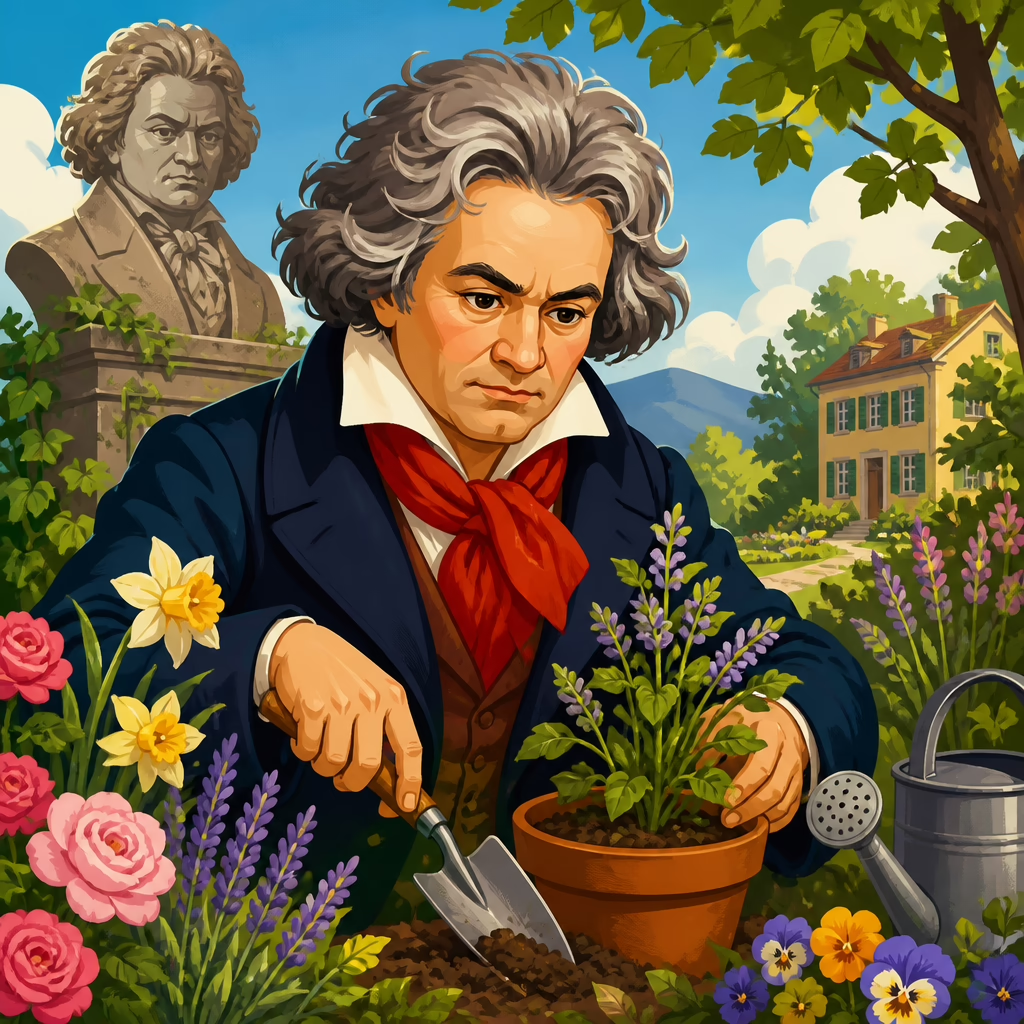
Beethoven and Gardening in Cultural Memory
Beethoven and gardening meet in cultural memory not because the composer kept a famous estate or published horticultural advice, but because later generations used gardens, fields, and cultivated landscapes to explain his character, habits, and music. In this context, cultural memory means the stories, images, commemorations, and repeated interpretations through which a society remembers a historical figure long after firsthand witnesses are gone. Gardening, here, should be understood broadly: not only planting and pruning, but the ordered human care of nature that stands between wild landscape and domestic life. That middle ground matters for Beethoven because he has often been remembered as both a fierce, untamed genius and a man who relied on structured routines, seasonal movement, and habitual contact with growing things.
In archives, memoirs, and museum interpretation, I have repeatedly seen how small references to gardens acquire symbolic weight when attached to Beethoven. A walk through a village lane becomes a meditation among orchards. A rented room with access to a courtyard becomes evidence of intimacy with nature. Even remarks about vegetables, household economy, or summer lodgings can become part of a larger image in which cultivation mirrors composition: patient, repetitive, disciplined, and responsive to seasonal change. The subject matters because cultural memory is rarely built only from major facts. It also depends on the ordinary settings that make a great figure feel legible and human.
For Beethoven, this is especially important. His relationship with nature has long been treated as essential to understanding his creative life, yet memory tends to favor dramatic scenes of storms, forests, and solitary walks. Gardening adds a more precise and revealing dimension. It points toward enclosure rather than vastness, care rather than spectacle, and daily practice rather than momentary inspiration. By studying how gardening enters Beethoven’s remembered image, we can see how nineteenth-century biography, twentieth-century heritage culture, and present-day audiences turned lived environments into meaning. The result is not a trivial anecdote. It is a serious clue to how Beethoven became a moral, artistic, and even domestic emblem in European memory.
Why gardens became attached to Beethoven’s image
Beethoven’s documented life in and around Vienna included constant movement through suburban and semi-rural spaces. He regularly sought summer lodgings outside the dense city center, worked while walking, and preferred environments where air, light, and relative quiet supported both health and concentration. Those facts created ideal conditions for later biographers to place him near gardens. Unlike a court composer permanently enclosed in palaces, Beethoven could plausibly be remembered amid kitchen plots, vineyards, orchard paths, and inn courtyards. In cultural memory, plausibility is powerful. Once a figure is repeatedly associated with a setting that fits the known character, that setting hardens into a durable part of the public image.
The garden also solved a narrative problem. Beethoven’s legend depends on contrasts: wild emotion and strict form, social difficulty and deep human feeling, urban career and longing for nature. A cultivated garden holds these opposites together. It is natural but shaped, intimate but open, practical yet contemplative. Writers from Anton Schindler onward often exaggerated or selectively framed details, but the attraction of the image is understandable. A man famous for sketching musical ideas outdoors seems even more intelligible when imagined in places where nature has been tended rather than left untouched. Gardens made Beethoven’s communion with nature appear disciplined, almost ethical.
This is one reason museum houses and memorial sites so often emphasize windows, courtyards, vine-covered walls, and nearby planted spaces. Visitors do not simply want proof of residence. They want environmental coherence. When they see a modest garden attached to a Beethoven site, the setting communicates a biographical argument without many words: here was a composer who needed growth, rhythm, repetition, and seasonal life around him. That visual language remains persuasive today, especially for audiences who approach Beethoven through place before they approach him through manuscripts or critical editions.
The historical evidence: what can actually be said
The strongest claims should remain modest. There is no major body of evidence showing Beethoven as an active gardener in the modern sense, and responsible scholarship should not invent one. We do know that he repeatedly chose lodgings in villages and outskirts such as Heiligenstadt, Döbling, Baden, Mödling, and other areas where houses commonly included yards, orchards, or access to cultivated land. We also know that contemporaries frequently described his outdoor habits, his responsiveness to weather and landscape, and his preference for summer environments less confined than central Vienna. These are secure foundations, but they do not justify romantic fantasies of Beethoven happily hoeing vegetable beds every dawn.
At the same time, absence of dramatic evidence does not make gardening irrelevant. In Beethoven’s period, domestic horticulture and semi-rural living were woven into everyday experience. A composer renting rooms from local householders would have encountered fruit trees, kitchen gardens, grape arbors, herb beds, and agricultural routines as part of ordinary life. Even if he did not cultivate them himself, these spaces formed the sensory environment in which he walked, worked, argued, ate, and composed. Cultural memory often preserves that environmental truth in condensed form. The remembered garden can therefore be historically meaningful even when literal gardening by Beethoven remains unproven.
When evaluating memoirs, the safest method is triangulation. If a late recollection places Beethoven in a leafy court or pacing beside cultivated plots, ask whether the location, season, and housing pattern fit independent records. If they do, the image may capture a real environmental context even if details are polished. This is standard historical practice: separate verifiable topography from anecdotal embellishment. It is also why the garden motif has survived scrutiny better than some wilder Beethoven myths. It aligns with known geography, lodging patterns, and the social history of Vienna’s outskirts.
How biography turned domestic nature into meaning
Nineteenth-century Beethoven biography did more than report facts; it translated places into character. Writers used domestic landscapes to suggest inward truths. A garden implied contemplation without passivity, labor without commerce, and closeness to ordinary life without loss of grandeur. In practical terms, this let biographers soften Beethoven’s reputation for irritability. The man who quarreled with servants, landlords, publishers, and relatives could also be pictured listening to birds near a hedge or pausing in a courtyard under trees. The cultivated setting humanized him while preserving his seriousness.
That process intensified in visual culture. Engravings, commemorative postcards, guidebooks, and later museum displays repeatedly favored views of Beethoven houses nestled among greenery. Such images rarely aimed at strict documentary accuracy. They aimed at emotional truth as audiences understood it. The garden was a framing device, much like the writing desk or the piano. It implied creative process. It also domesticized genius, making Beethoven approachable for bourgeois households that valued both art and home cultivation. By the late nineteenth century, when urban middle-class gardening became a marker of taste and moral order, Beethoven fitted easily into that symbolic economy.
I have seen this pattern in exhibition design as well. Curators know that visitors respond strongly to thresholds between house and landscape: the gate, the path, the courtyard, the vine, the bench. Those details anchor abstract admiration in lived space. They also encourage a slower mode of looking. In that sense, the memory of Beethoven and gardening is not merely inherited from texts. It is continually reproduced by heritage practice, which teaches people how to imagine his days. For readers wanting broader context on walking and outdoor experience in his life, the main guide at https://lvbeethoven.com/beethovens-love-of-walking-and-what-it-meant-for-his-music/ helps situate this more focused question.
Gardens, health, and the disciplined body
Another reason gardening became important in Beethoven’s cultural memory is that cultivated outdoor space signaled health. Beethoven struggled with chronic illness, digestive complaints, worsening deafness, and recurrent physical stress. In his era, physicians often prescribed fresh air, mineral baths, regulated routine, and stays outside the city. Summer residence in Baden or Heiligenstadt was therefore not only aesthetically pleasing; it was part of practical self-management. Gardens and courtyards represented therapeutic order. They were spaces where one could pace, reflect, and take measured exercise without plunging into urban noise.
This association matters because public memory likes coherence between body and mind. A composer battling illness while preserving disciplined work habits becomes easier to understand when placed near maintained natural spaces. The garden is neither wilderness cure nor medical institution. It suggests recovery through routine. That interpretation matches Beethoven’s known habits better than more sentimental myths. He was not simply “inspired by nature” in a passive way. He used environments strategically, choosing lodgings and daily patterns that helped him function despite substantial difficulties.
The link between cultivation and self-command also carries moral weight. In nineteenth- and early twentieth-century commemorative writing, gardens often stood for inner order achieved under pressure. Beethoven’s life was read as a victory of will, and cultivated nature became a visual analogy for that effort. Whether in a simple inn garden or a suburban orchard lane, the message remained consistent: here was a man shaping material under resistance. That is one reason the motif endured even when documentary evidence stayed fragmentary.
Where the motif appears in cultural memory
The memory of Beethoven and gardening shows up across several recurring media and institutions. Each presents the motif differently, but together they form a stable pattern.
| Memory form | How gardens appear | What the audience is meant to infer |
|---|---|---|
| Biographies and memoirs | Descriptions of summer lodgings, courtyards, orchards, village paths | Beethoven lived close to ordered nature and worked within daily routines |
| Museum houses | Restored yards, planted spaces, views toward greenery | The physical setting explains his habits and emotional world |
| Visual art and postcards | Green facades, vine-covered homes, peaceful suburban scenes | Genius can be imagined within domestic calm rather than only heroic drama |
| Concert and festival marketing | Outdoor imagery, park settings, floral motifs around commemorations | Beethoven remains culturally linked to renewal, seasonality, and public gathering |
This pattern is not accidental. It persists because gardens offer a versatile symbol that works for scholars, curators, and general audiences at once. They can support factual interpretation, emotional storytelling, and tourism without requiring extravagant claims. A room can feel historically remote; a garden path feels immediately legible. That accessibility helps explain the motif’s longevity.
Gardening as metaphor for musical creation
One of the deepest reasons the garden adheres to Beethoven’s memory is metaphorical. His compositional method, especially in the public imagination, resembles cultivation more than sudden revelation. Sketchbooks show themes tested, revised, expanded, and reorganized. Motives are planted in small forms, developed through repetition, and transformed across movements or entire works. This does not mean Beethoven consciously thought like a gardener, but it explains why later readers found the analogy irresistible. Cultivation is patient work on living material; composition in Beethoven’s case often appears as patient work on resistant musical material.
The analogy becomes especially strong when discussing temporal process. Gardens are never finished once and for all. They require revisiting, pruning, seasonal adjustment, and acceptance of delay. Beethoven’s manuscripts reveal a similarly iterative discipline. A theme might appear spare at first, then gather force through reworking. In cultural memory, this made the composer compatible with ideals of growth rather than mere inspiration. It also helped teachers and critics explain his music in plain language. Listeners could grasp development through the familiar logic of tending, cutting back, and allowing structure to emerge over time.
There is a limit, however. Metaphor can overreach. Not every pastoral association in Beethoven justifies a gardening interpretation, and not every compositional process should be naturalized. The best use of the motif is specific: it clarifies why cultivated environments became a preferred setting for remembering him. It does not replace close musical analysis. What it does provide is a durable cultural bridge between daily life and artistic labor.
What this reveals about Beethoven’s afterlife
The persistence of gardening in Beethoven’s cultural memory reveals less about a hidden horticultural hobby than about the needs of remembrance. Audiences want a Beethoven who is monumental yet inhabitable. Gardens make that possible. They reduce distance without trivializing achievement. They place genius in spaces of care, maintenance, and recurring time, which are easier to integrate into civic memory than scenes of pure transcendence. That is why suburban houses, memorial plantings, and green museum settings continue to matter.
This focus also corrects a common imbalance. Beethoven’s connection to nature is often cast only in sublime terms: storms, mountains, ecstatic freedom. Those themes are real, but they are incomplete. Cultural memory has also preserved a quieter Beethoven located in cultivated spaces where work and reflection could happen every day. That version is historically plausible and interpretively rich. It shows how ordinary environments contribute to extraordinary art without turning the artist into a rustic saint.
For readers, the main takeaway is simple. When Beethoven is remembered through gardens, the point is not botany for its own sake. The point is that cultivation became a language for talking about discipline, health, domesticity, and creative growth. Looking closely at that language makes Beethoven’s image sharper, not softer. It helps us see how places shape memory and how memory, in turn, reshapes places. If you visit a Beethoven site, read a memoir, or hear his music described through nature, notice whether a garden is quietly doing interpretive work. That small detail often explains more than the grandest legend.
Frequently Asked Questions
What does “Beethoven and gardening in cultural memory” actually mean?
It refers to the way later generations connected Beethoven to gardens, cultivated landscapes, and rural imagery as part of remembering and interpreting him, even though he was not primarily known as a gardener in the ordinary biographical sense. In this context, cultural memory is not just a collection of facts about Beethoven’s life. It is the larger process through which societies shape his image through anecdotes, commemorations, artistic representations, tourism, scholarship, and repeated storytelling. Gardens and managed landscapes became useful symbols in that process because they suggested reflection, order, growth, seasonal change, and a close relationship between human creativity and the natural world.
So the topic is less about Beethoven planting roses or keeping a documented ornamental estate, and more about how people used the language and imagery of gardening to explain his personality and music. For example, later writers and admirers often placed him in parks, along country paths, near fields, or in village settings to emphasize his independence, his habit of walking, and his responsiveness to nature. These settings helped turn him into a cultural figure who seemed rooted in the landscape, not merely a composer at a desk. In memory culture, a garden can function as a symbolic space: cultivated, but alive; structured, but changing. That made it an appealing metaphor for Beethoven’s art and legacy.
Did Beethoven himself have a strong personal connection to gardens or rural landscapes?
Yes, but with an important distinction. Beethoven is well documented as having a strong attachment to nature, country walks, and periods spent outside dense urban life, especially in and around Vienna. He often sought lodgings in suburban or semi-rural areas, and contemporaries frequently described his long walks and his immersion in natural surroundings. Those habits are historically grounded and form an important part of his biography. However, that is different from saying he was famous as a gardener, landscape designer, or horticultural enthusiast in a technical sense. The evidence for the latter is much weaker.
What matters for cultural memory is that his genuine attraction to natural surroundings gave later generations material to build on. A composer who walked through fields and wooded areas, listened intently, and worked through musical ideas outdoors was easy to associate with gardens and cultivated landscapes more generally. In remembrance culture, the exact line between field, park, garden, and pastoral retreat often becomes blurred. Rural scenes surrounding Beethoven’s residences, the memorialization of houses connected to him, and visual depictions of him in contemplative outdoor settings all encouraged the impression that nature was a key to understanding his genius. Over time, those associations grew broader and more symbolic than the surviving biographical record alone would justify.
Why do gardens and cultivated landscapes become such powerful symbols in remembering Beethoven?
Gardens are powerful in cultural memory because they combine nature and human intention, and that combination makes them especially useful for interpreting artists. A garden is not wilderness, but it is not purely mechanical either. It suggests discipline, patience, cultivation, and transformation over time. Those qualities align neatly with common ideas about Beethoven: intense labor, artistic structure, emotional depth, and the ability to shape raw feeling into enduring form. As a result, gardens and related landscapes became a natural symbolic language for explaining him to later audiences.
There is also a broader historical reason. In the nineteenth century and beyond, European culture often linked great composers with scenes of nature in order to elevate them into almost mythic figures. For Beethoven in particular, this tendency was especially strong because his music was frequently described as elemental, organic, and morally serious. Landscapes offered an accessible visual and emotional frame for that reputation. A cultivated path, an orchard, a park, or a countryside retreat could all stand in for deeper ideas: solitude, inspiration, inner struggle, and spiritual renewal. In this way, gardens did not merely decorate Beethoven’s memory; they helped organize it, giving audiences a physical and emotional setting in which to imagine the composer’s life and works.
How have stories, images, and commemorations linked Beethoven to gardening over time?
The connection developed through accumulation rather than through one single defining event. Biographical anecdotes about Beethoven’s walks, his seasonal moves to quieter surroundings, and his preference for working amid relative natural calm created an early framework. Portraits, illustrations, memorial sites, and later museum interpretations then reinforced that framework by presenting him in outdoor settings or by emphasizing the landscapes around places associated with his life. Even when the focus was not literally on gardening, cultivated environments such as village lanes, gardens around residences, and arranged parks could serve as part of the visual vocabulary through which Beethoven was remembered.
Commemoration also plays a major role. Once a historical figure becomes iconic, the places linked to that figure are often preserved, landscaped, interpreted, and visited in ways that shape public understanding. A house museum garden, a memorial grove, or a carefully presented rural vista can subtly suggest authenticity and intimacy, even if the exact historical details are more complex. In Beethoven’s case, this means later generations often encountered him through environments that had already been curated for remembrance. Those curated settings encouraged people to think of him not only as a composer of monumental works, but as a figure whose creativity was nourished by lived contact with cultivated and semi-rural landscapes. Over time, the memory of Beethoven and the memory of such spaces became intertwined.
How does this idea help us understand Beethoven’s music and legacy today?
It helps by reminding us that legacy is shaped not only by compositions and documents, but also by the interpretive frameworks later audiences create around them. When people connect Beethoven with gardens and cultivated landscapes, they are often trying to make sense of the balance in his music between structure and vitality, control and spontaneity, struggle and renewal. These are the same tensions embodied in a garden: something carefully formed, yet always growing and changing. That does not prove Beethoven intended all such meanings, but it does show how cultural memory works. It organizes complex artistic reputations through familiar images that people can picture, visit, and emotionally inhabit.
This perspective is valuable because it keeps us from reducing Beethoven to either pure historical fact or pure myth. On one hand, we can acknowledge the real biographical basis for his association with nature and outdoor life. On the other, we can see how later generations expanded that association into a larger symbolic world that includes gardens, pastoral settings, commemorative landscapes, and ideas of cultivation itself. For modern readers, listeners, and visitors, that means Beethoven’s afterlife is not confined to concert halls and manuscripts. It also lives in the cultural imagination of paths, green retreats, managed nature, and places where memory is carefully tended. In that sense, gardening is not a side note to Beethoven’s remembrance; it is one of the metaphors through which his legacy has been planted, preserved, and made to flourish.