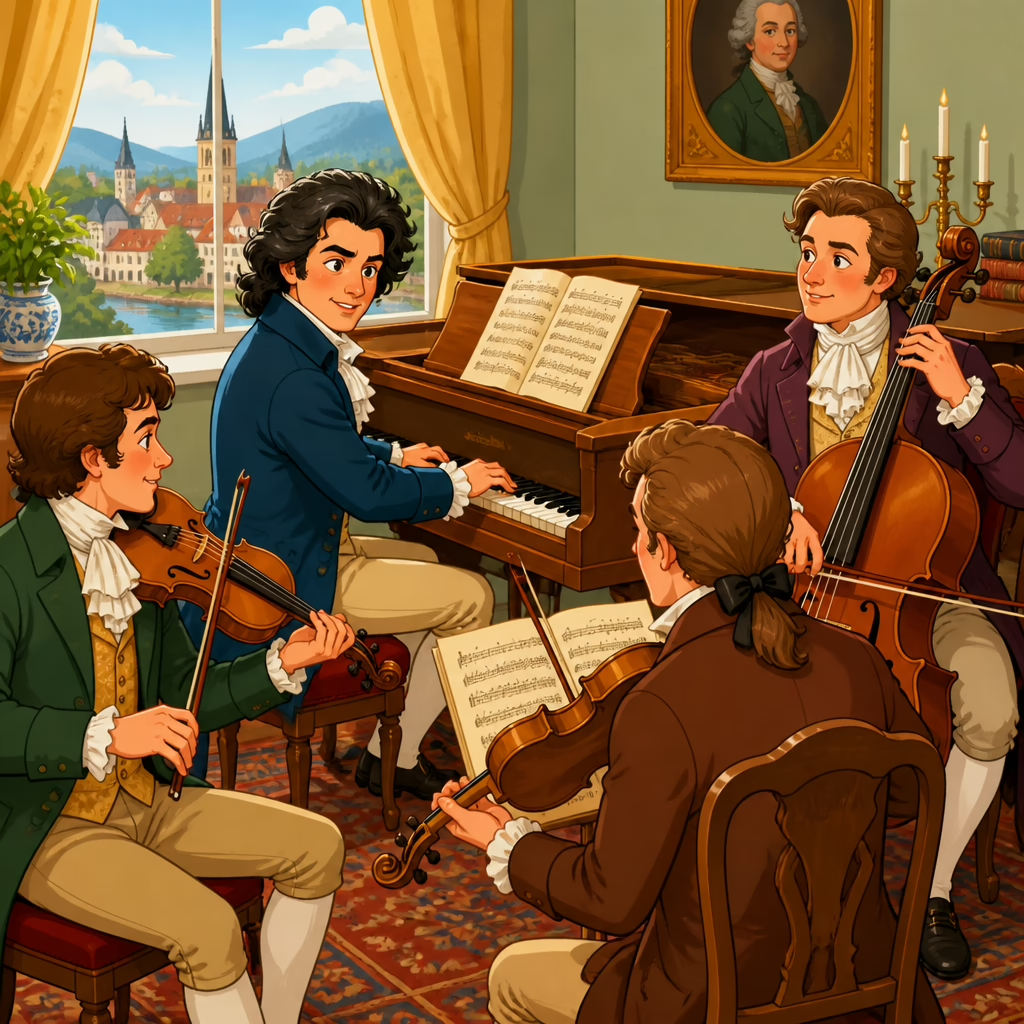
Beethoven’s Early Piano Quartets Before Vienna
Beethoven’s early piano quartets before Vienna stand at a revealing crossroads in his development, capturing a gifted Bonn teenager testing inherited Classical forms while already pushing toward a more individual musical voice. These three works, known today as WoO 36 and scored for piano, violin, viola, and cello, were composed around 1785, when Beethoven was still a court musician in the Electorate of Cologne and years away from the artistic battles and public triumphs that would define his Vienna career. Calling them “early” is accurate in every sense: early in chronology, early in technique, and early in the emergence of the dramatic instincts that later transformed the piano sonata, string quartet, and symphony. Yet they are not merely juvenilia to be filed away as curiosities. In my experience studying and programming Beethoven’s chamber music, these quartets reward close attention because they show exactly how he learned to absorb models, solve formal problems, and write effectively for mixed ensemble textures.
The phrase “before Vienna” matters because Beethoven’s Bonn years shaped his foundations. He was born in 1770, trained first by his father and then more seriously by Christian Gottlob Neefe, and grew up in an environment where keyboard playing, figured bass, sacred repertory, and courtly entertainment all intersected. By the mid-1780s he was already recognized locally as a keyboard talent, but he had not yet undergone the decisive stylistic expansion that came through his later contact with Haydn, broader publication networks, and Vienna’s intensely competitive concert life. These piano quartets therefore belong to a period of apprenticeship, but an apprenticeship pursued at unusually high speed. They reflect the conventions available to a talented youth in Bonn while also revealing a striking confidence in thematic shaping, keyboard figuration, and ensemble balance.
Understanding these works also helps correct a common misconception. Many listeners jump from Beethoven’s Bonn childhood directly to the mature revolutionary of the middle period, as if the transformation happened overnight. The piano quartets prove otherwise. They document process. They show Beethoven working within a Mozart-inflected idiom, especially the piano quartet model associated with Mozart’s K. 478 and K. 493, while simplifying certain textures and experimenting with his own rhetorical emphases. They matter because they let us hear Beethoven becoming Beethoven: not yet radical, but already energetic, structurally alert, and unwilling to let accompaniment remain merely decorative.
The Bonn Context and Why These Quartets Were Written
The three quartets in E-flat major, D major, and C major were almost certainly composed for Beethoven’s own use as a pianist and for the domestic or semi-private music making that sustained court culture in Bonn. At that stage, a piano quartet was not the most commercially secure genre for publication, and these works remained unpublished during his lifetime. That fact sometimes leads writers to underrate them, but unpublished did not mean unimportant. Young composers often wrote to develop craft, impress patrons, and furnish practical repertory for local performance. In Bonn, Beethoven had access to capable string players and to a social world that valued chamber music as both cultivation and entertainment.
Neefe’s influence is important here. He introduced Beethoven to the music of J. S. Bach and encouraged systematic composition, but Beethoven was also absorbing the broader south German and Viennese Classical language circulating in manuscript and print. The quartets suggest a composer learning by close imitation of successful models, then altering details from within. That was normal eighteenth-century practice. Originality did not begin with rejecting precedent; it began with mastering recognized procedures so thoroughly that personal habits emerged. In these pieces, Beethoven practices sonata form, motivic economy, phrase expansion, and instrumental dialogue on a compact scale.
Another reason these works exist is pragmatic keyboard culture. Beethoven was first known as a pianist, and in all three quartets the piano part carries unusual weight. This is not a string trio with keyboard support. The keyboard drives motion, establishes character, and often introduces or reshapes thematic material. That emphasis reflects the young Beethoven’s own strengths. Even at this stage, he wrote from the hands outward. Passagework lies idiomatically on the keyboard, and harmonic pacing often grows from what a gifted improvising pianist would naturally generate under the fingers.
Structure, Style, and the Mozart Model
The obvious comparison is Mozart, specifically the piano quartets in G minor and E-flat major. Beethoven almost certainly knew that type of writing, whether directly from scores or through broader stylistic transmission. The resemblance appears in the basic choice of ensemble, in the alternation between lyrical and brilliant keyboard textures, and in the effort to integrate strings as participants rather than continuo-like support. Still, Beethoven’s early quartets are not copies. They are leaner, more direct, and sometimes more sectional. Where Mozart often achieves an effortless conversational fluency, Beethoven tends to emphasize contrast, propulsion, and clearly marked formal joints.
Each quartet follows the three-movement plan common in lighter Classical chamber genres: a fast opening movement, a lyrical slow movement, and a lively finale. This layout immediately signals function and audience. These are works designed to be grasped on first hearing, yet their craft becomes clearer with repetition. The outer movements generally rely on crisp periodic themes, energetic scale passages, and transparent tonal plans. The slow movements are especially revealing because they show Beethoven trying to sustain cantabile line and expressive stillness without losing momentum. He is not yet the master of suspended time heard in the later slow movements, but the instinct for lyrical concentration is already present.
What I find most telling is Beethoven’s handling of transitions and cadences. Even in these youthful scores, he dislikes simply arriving and stopping. Cadential gestures often become launching pads for fresh motion, and accompanimental figures can take on motivic significance. That habit later becomes central to his mature style, where tiny cells generate entire spans. Here the process is simpler, but the impulse is recognizable. The quartets teach us to listen for continuity beneath surface politeness.
What Distinguishes the Three Quartets
Although they are usually grouped together, the three quartets have distinct profiles. The E-flat major Quartet, WoO 36 No. 1, is often the easiest point of entry because its key and rhetoric align comfortably with late eighteenth-century ceremonial brightness. The opening movement projects assurance, and the piano writing already shows Beethoven’s confidence in articulating large gestures cleanly. The slow movement is notable for its poised lyricism, with the strings supporting and answering the keyboard in phrases that avoid mere duplication. The finale brings the expected liveliness but also a firmness of rhythmic profile that keeps the music from sounding generic.
The D major Quartet, WoO 36 No. 2, feels more extroverted and, in places, more overtly brilliant. D major was a favored key for open, public, assertive writing, and Beethoven uses it effectively. There is a youthful delight here in passagework and contrast, but the best moments come when the keyboard’s brightness is tempered by genuine interplay with the strings. The inner voices matter. Viola lines in particular often help define harmonic rhythm and texture, something performers ignore at their peril.
The C major Quartet, WoO 36 No. 3, may be the most interesting of the set because C major invites compositional clarity while exposing weaknesses. Beethoven responds with music that is direct but not plain. The thematic material is tightly profiled, and the writing sometimes hints at the sturdier, more architectonic instincts that would later flourish in Vienna. It would be a mistake to overstate prophetic elements, but this quartet does suggest a growing ease with proportion and thematic control.
| Quartet | Key | Approximate character | What to listen for |
|---|---|---|---|
| WoO 36 No. 1 | E-flat major | Confident, balanced, courtly | Elegant slow movement and firm rhythmic closure |
| WoO 36 No. 2 | D major | Brilliant, outgoing, youthful | Keyboard sparkle balanced by active inner-string support |
| WoO 36 No. 3 | C major | Clear, sturdy, more tightly argued | Strong thematic outlines and clean structural pacing |
Instrumentation and Performance Challenges
One reason these works can sound slighter than they are is poor performance balance. On a modern concert grand, the piano can easily overwhelm the strings, flattening the chamber dialogue into a soloist-plus-accompaniment texture. Historically informed performers often solve this by using a fortepiano or by adopting Classical articulation, lighter pedaling, and more transparent voicing on modern instruments. That approach is not antiquarian fussiness; it restores proportion. Beethoven wrote these quartets for a different keyboard world, one in which string detail could register more naturally against the piano’s attack and decay.
The strings, meanwhile, must avoid playing with symphonic weight. These parts require conversational alertness, quick response to keyboard gestures, and attention to the hierarchy of lines. Violin often carries melodic exchange, but viola and cello are crucial in defining texture and harmonic direction. In rehearsals, the turning point usually comes when players stop treating the lower strings as filler and begin shaping them as active rhetoric. Once that happens, the quartets gain dimension.
Tempos also matter. Young Beethoven invites brilliance, and performers are sometimes tempted to push finales too hard. But if articulation blurs, the music loses its Classical poise and sounds merely busy. The best readings let the keyboard sparkle while preserving enough space for phrase endings, dynamic nuance, and string interjections to speak. Recordings by ensembles using period-informed sensibilities tend to illuminate the quartets’ strengths, though excellent modern-instrument performances can be equally persuasive when balance is carefully managed.
How These Quartets Fit Beethoven’s Development
These works are best understood not as isolated student exercises but as part of a larger pre-Vienna network that includes early keyboard variations, songs, and chamber attempts. They show Beethoven consolidating techniques he would later expand dramatically: thematic concentration, rhetorical contrast, keyboard-led momentum, and a refusal to separate melody from structure. Even when the material is conventional, the handling is often unusually purposeful.
They also reveal what Beethoven had not yet fully mastered. Long-span harmonic tension is still relatively modest. The deepest emotional ambiguities of the mature chamber music are absent. String writing, while effective, does not yet display the radical independence found in the later quartets or even in the Op. 16 and Op. 1 repertory from the Vienna years. Acknowledging those limits makes the achievements easier to hear. For a fifteen-year-old composer, these are remarkably controlled, stylistically literate works that already avoid emptiness.
In practical listening terms, the quartets form a bridge between inherited Classical elegance and Beethoven’s future appetite for stronger profile and argument. If you know the early piano trios or the first published piano sonatas, you can hear related habits: punchier rhythmic definitions, a tendency to energize accompanimental figures, and an instinct for making a theme feel like the start of a process rather than a closed object. Those habits did not appear suddenly in Vienna. They were already active in Bonn.
For readers exploring Beethoven’s smaller-scale works more broadly, it can also be useful to place these quartets alongside repertory that later distilled his miniaturist side, such as the pieces discussed in this guide to Beethoven’s bagatelles. The contrast is instructive: the quartets show apprenticeship in inherited form, while the bagatelles reveal a mature composer compressing drama and character into concentrated spans. Hearing both ends of that arc clarifies just how much Beethoven’s language evolved.
Why They Still Matter to Listeners and Performers
The strongest case for Beethoven’s early piano quartets before Vienna is simple: they are enjoyable, historically revealing, and better crafted than their neglected status suggests. For listeners, they offer access to Beethoven without the interpretive intimidation that can accompany the late quartets or the monumental piano sonatas. You can hear the musical grammar clearly. Themes are memorable, textures are transparent, and formal designs are legible. That accessibility does not reduce their value; it increases their usefulness as documents of style and growth.
For performers, the quartets present rewarding programming opportunities. They fit well in recitals that trace Beethoven’s evolution, pair effectively with Mozart piano quartets, and offer audiences a fresh perspective on his Bonn years. They also challenge ensembles to refine Classical balance, articulation, and rhetorical timing. In that sense, they are pedagogically rich. Students learn how much detail is required to make apparently simple music sound alive.
Most important, these works remind us that artistic greatness is built, not bestowed. Before Vienna, before the heroic narratives, before the public image of the defiant genius, there was a young musician in Bonn learning how to write for four players with clarity and purpose. These quartets preserve that moment. Listen to them as living chamber music, not as footnotes, and they repay the attention. If you have not heard all three in a single sitting, start there, compare their characters, and notice how often the future Beethoven flashes into view.
Frequently Asked Questions
What are Beethoven’s early piano quartets before Vienna, and why do they matter?
Beethoven’s early piano quartets before Vienna are the three works now catalogued as WoO 36, written around 1785 when he was still a teenager in Bonn. Scored for piano, violin, viola, and cello, they belong to a formative stage in his career, long before his move to Vienna and long before the symphonies, sonatas, and string quartets that made him one of the defining composers of Western music. These pieces matter because they offer a rare window into Beethoven’s musical thinking at an age when most composers are still learning to imitate their models. In them, listeners can hear a gifted young musician absorbing the Classical language associated with Mozart and Haydn while also showing early signs of the dramatic contrast, rhythmic energy, and structural ambition that would later become hallmarks of his mature style.
They are especially important because they capture Beethoven at a crossroads. He was not yet the revolutionary composer of the Viennese years, but he was already more than a promising student. The quartets reveal how he handled inherited forms, how he balanced keyboard brilliance with chamber interaction, and how he experimented within a genre that was not yet central to his output. For historians, performers, and curious listeners alike, these works help fill in the story of Beethoven’s development by showing what he could do before the pressures and opportunities of Vienna reshaped his artistic world.
When did Beethoven compose WoO 36, and what was happening in his life in Bonn at the time?
Beethoven composed the three piano quartets of WoO 36 around 1785, during his teenage years in Bonn. At that point, he was part of the musical life of the Electorate of Cologne, serving in an environment shaped by court culture, church traditions, and the tastes of cultivated aristocratic patrons. Bonn was not Vienna, but it was by no means artistically insignificant. It provided Beethoven with practical experience as a keyboard player, exposure to current repertory, and access to teachers and colleagues who helped form his musical instincts. This setting gave him a strong grounding in performance and composition while allowing him to encounter the prevailing Classical style from the inside.
This was also a period of intense learning and rapid growth. Beethoven was developing as a pianist, composing in multiple genres, and building the technical command that would later serve him in larger, more daring works. He had not yet undergone the public artistic struggles associated with his Viennese career, and he was still working within the expectations of a young court musician. That context matters because it helps explain the blend of discipline and experimentation in these quartets. They show a composer mastering accepted conventions while beginning to test their expressive limits, all within the more local, pre-celebrity phase of his life.
How do these early piano quartets reflect Mozart and Haydn, and where does Beethoven’s own voice start to appear?
The influence of Mozart and Haydn is unmistakable in Beethoven’s early piano quartets. The formal outlines, phrase structures, and overall clarity of design place these works firmly within the Classical tradition. Beethoven was clearly engaging with models that valued balance, elegance, and conversational interplay among instruments. In particular, listeners often hear connections to Mozart’s chamber writing, especially in the lyrical shaping of themes and the use of the piano as both a leading and collaborative voice. Haydn’s influence can be felt in the logic of construction and in the sense that musical ideas are not merely presented but actively developed.
At the same time, Beethoven’s own voice already begins to emerge in telling ways. Even in these early pieces, there is a stronger-than-average sense of contrast, with sharper dynamic turns and more assertive gestures than one might expect from a purely imitative student work. The piano writing can be especially revealing: it often carries a heightened energy and a more driving character, hinting at Beethoven’s future identity as a composer-pianist. There are also moments where the music presses harder on an idea, digs deeper into a motive, or heightens dramatic tension in a way that feels distinctly Beethovenian. These are not mature masterpieces in the full sense, but they are highly valuable because they let us hear the young composer discovering how to turn Classical fluency into something more personal and urgent.
What should listeners pay attention to when hearing Beethoven’s WoO 36 piano quartets?
One of the first things to notice is the relationship between the piano and the strings. In these quartets, the piano often has a prominent role, which reflects Beethoven’s own background as a keyboard virtuoso in the making. But the strings are not simply accompanists. A good performance reveals how the violin, viola, and cello contribute to the dialogue by answering, supporting, and occasionally challenging the keyboard line. Listening for that exchange can make the music feel much more alive and less like a solo piece with background support.
It is also worth paying attention to the contrast between youthful elegance and emerging intensity. Many passages unfold with the grace and symmetry expected of late eighteenth-century chamber music, yet Beethoven frequently injects extra momentum through rhythm, accent, and harmonic direction. Notice how themes are shaped, repeated, and transformed rather than simply stated once and left behind. Slow movements often show his gift for sustained lyric expression, while quicker movements can reveal a lively dramatic instinct. If you listen with an ear for both tradition and pressure against tradition, these quartets become especially fascinating. They are not just early exercises; they are early evidence of a composer already thinking beyond the surface polish of the style he inherited.
Why are Beethoven’s pre-Vienna piano quartets less famous than his later works, and are they still worth exploring?
These quartets are less famous for several understandable reasons. First, Beethoven’s later output is so extraordinary that it tends to overshadow nearly everything that came before it. When audiences think of Beethoven, they usually think of the great middle- and late-period works: the symphonies, the late quartets, the monumental piano sonatas, the concertos, and the Missa solemnis. Against that backdrop, a set of teenage chamber works from Bonn can seem minor. Second, the piano quartet was not the genre in which Beethoven would make his strongest long-term mark, so these pieces have not occupied the same central place in concert life as his string quartets or piano sonatas.
They are absolutely worth exploring, however, especially for anyone interested in Beethoven’s artistic formation. These works offer more than historical curiosity. They are engaging, skillfully written, and often genuinely charming and inventive. For performers, they present an opportunity to trace Beethoven’s early handling of ensemble texture and form. For listeners, they provide the pleasure of hearing a future giant in the act of becoming himself. That sense of emergence is part of their appeal. They may not carry the philosophical weight or structural daring of the later masterpieces, but they repay attention with freshness, craft, and insight into the beginnings of one of music history’s most compelling creative journeys.