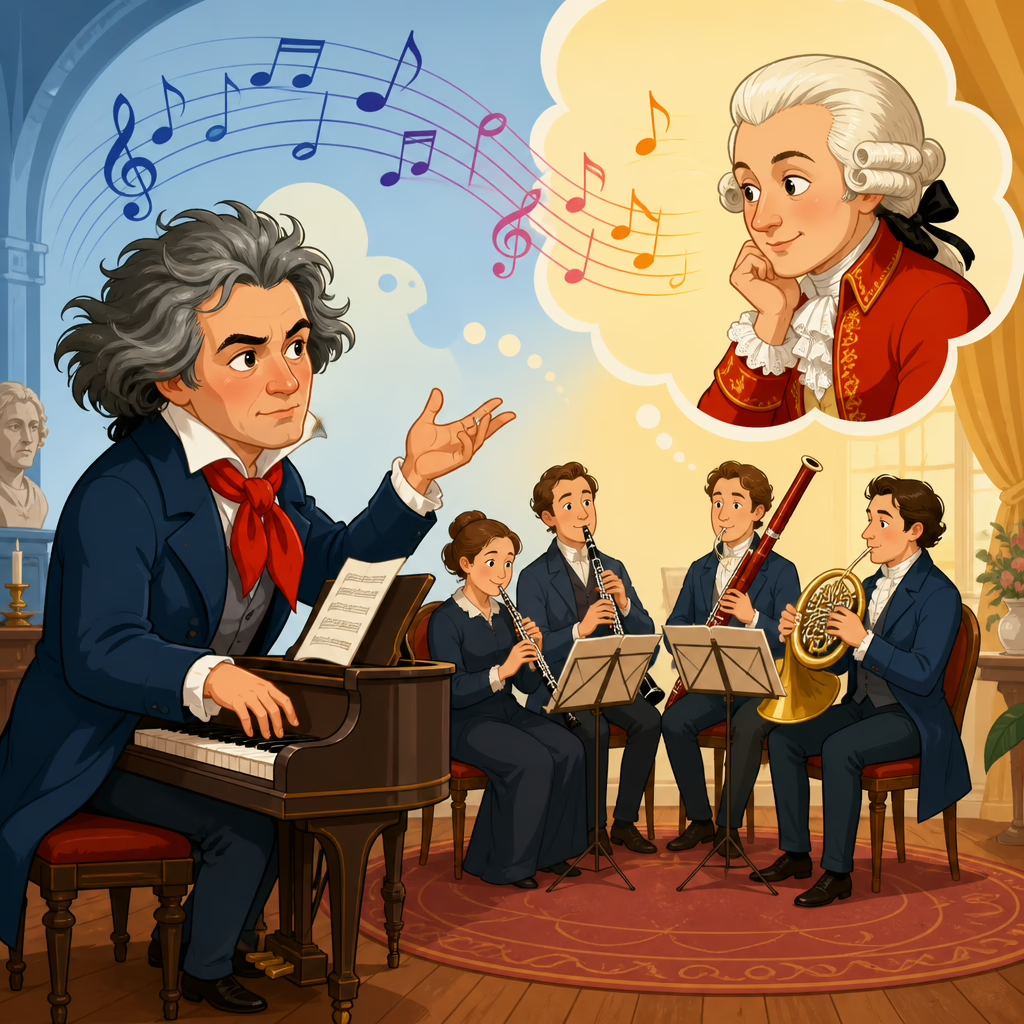
Beethoven’s Quintet for Piano and Winds as a Mozart Reply
Beethoven’s Quintet for Piano and Winds in E-flat major, Op. 16, is best understood as a deliberate reply to Mozart’s Quintet for the same forces, K. 452, because it adopts Mozart’s instrumentation, key, and general formal profile while testing how far a younger composer could reshape a revered model without breaking it. In practical terms, “reply” does not mean parody or mere imitation. It means an engaged compositional response: a work that honors an admired predecessor, absorbs specific technical solutions, and then asserts an individual voice through changes in pacing, texture, pianistic writing, and dramatic emphasis. I have returned to this piece repeatedly in score study, rehearsal rooms, and listening comparisons, and each time the same point becomes clearer: Op. 16 is one of the most revealing documents of Beethoven’s early self-positioning in Vienna.
The quintet matters because it sits at an important intersection of influence, ambition, and public identity. Written in 1796 and published in 1801, it belongs to the period when Beethoven was establishing himself not yet as the revolutionary of the middle years, but as a formidable pianist-composer capable of entering elite Viennese genres on equal terms. The scoring itself—piano, oboe, clarinet, bassoon, and horn—was already marked by Mozart’s prestige. Mozart had called K. 452 one of his best works, and the combination of keyboard with four winds created a chamber texture that was both conversational and brilliant. By choosing exactly that ensemble, Beethoven signaled that he knew the benchmark and intended to meet it directly.
That directness is what makes the quintet so rewarding to study. Many early Beethoven works show the imprint of Haydn or Mozart, but Op. 16 is unusually transparent in its intertextual design. Both quintets are in E-flat major, both open with a stately slow introduction leading to an Allegro, both place a lyrical middle movement before a rondo finale, and both balance chamber intimacy with concerto-like display. Yet the resemblance is only the beginning. Beethoven expands contrasts more sharply, makes the piano part more overtly virtuosic, and presses harder on rhythmic insistence and dynamic rhetoric. The result is not a copy. It is a declaration that he can inhabit Mozart’s framework and still sound unmistakably like himself.
For listeners, performers, and students, this focused comparison answers several practical questions. Why does Op. 16 sound at once familiar and more aggressively profiled than Mozart’s quintet? Why does the piano sometimes seem to push toward concerto territory? Why does the wind writing feel both integrated and strategically oppositional? The best answer is that Beethoven uses Mozart’s model as a public proving ground. He writes within a recognized format, then subtly redirects the terms of expression. Hearing the quintet as a reply sharpens our understanding not only of Beethoven’s craft, but of how composers in the Classical era competed, learned, and announced themselves through genre.
The Mozart model Beethoven chose to answer
Mozart’s Quintet in E-flat major, K. 452, completed in 1784, set an exceptional standard for piano and winds. Its reputation rested not simply on beautiful themes, but on its unusual equilibrium. The piano is prominent without reducing the winds to accompaniment; the winds retain their characteristic colors while participating in tightly organized ensemble dialogue. Oboe and clarinet often share melodic and harmonic responsibility, bassoon reinforces and comments rather than merely doubling, and the horn broadens the sonority with both harmonic support and noble punctuation. In performance, the piece feels like a chamber conversation elevated by concerto sheen.
Beethoven knew exactly what that meant in Vienna. By the mid-1790s, Mozart’s chamber music for winds carried social as well as artistic prestige. Wind players were increasingly prominent, domestic music-making was flourishing, and aristocratic circles valued works that combined refinement with display. Choosing Mozart’s exact instrumentation was therefore not an accidental resemblance. It was a declaration of lineage. Beethoven was entering a room Mozart had already defined and stating that he belonged there.
What Beethoven borrowed most visibly was the work’s architectural outline. The broad introduction in E-flat major, the transition to a substantial sonata-form Allegro, the poised slow movement, and the buoyant rondo finale all mirror Mozart’s large-scale design. Even at the level of affect, Beethoven initially plays the expected game: the opening Adagio projects ceremonial gravity, the Allegro promises wit and motion, the Andante offers lyrical relief, and the finale restores sociable brilliance. If one stopped at this level, the quintet could seem merely derivative. But in every movement Beethoven alters the internal balance.
That alteration is crucial. Mozart tends to persuade by proportion and ease; Beethoven persuades by accent, contrast, and muscular presence. In K. 452, transitions often feel organically breathed. In Op. 16, they are more likely to be marked, prepared through emphatic gestures, or energized by piano figuration. Mozart’s piano writing dazzles while remaining woven into the fabric. Beethoven’s often steps forward more assertively, reminding listeners that the composer at the keyboard was one of Vienna’s most formidable virtuosos. The reply begins, then, from respectful resemblance and quickly turns into competitive differentiation.
How the first movement announces both homage and challenge
The opening movement makes the case most plainly. Beethoven’s Grave introduction, like Mozart’s Largo, frames the work with ceremonial breadth and harmonic poise, but the rhetoric is firmer and more declamatory. Chords land with more weight; pauses carry more tension. From the start, the ensemble sounds less like a gracious salon exchange and more like a public statement. When the Allegro ma non troppo arrives, the piano enters not as a discreet partner but as a protagonist whose figurations help define the movement’s momentum.
In rehearsal, one of the first things that emerges is the different treatment of ensemble hierarchy. Mozart distributes attention with extraordinary tact; Beethoven does too, but he repeatedly lets the piano seize kinetic leadership. This does not mean the winds are secondary. On the contrary, the oboe and clarinet frequently shape the thematic profile, and the bassoon and horn give the texture both bite and grounding. What changes is the drama of interaction. Beethoven likes the sense that the keyboard can trigger, answer, or redirect the ensemble’s argument with visible force.
A concise comparison helps show where the reply is most audible.
| Feature | Mozart, K. 452 | Beethoven, Op. 16 |
|---|---|---|
| Opening rhetoric | Expansive, elegant, ceremonially balanced | Weightier, more declamatory, more sharply profiled |
| Piano role | Brilliant but integrated within ensemble exchange | More overtly virtuosic and directional |
| Transitions | Fluid, organic, conversational | Marked by stronger contrast and propulsion |
| Ensemble drama | Refined parity among voices | Greater sense of contest and rhetorical push |
The development section is especially telling. Beethoven does not abandon Classical clarity, but he intensifies motivic pressure. Short figures are driven harder, harmonic movement feels more goal-directed, and climaxes are prepared with a performer’s instinct for timing. This is where the younger composer’s reply becomes unmistakable: he accepts Mozart’s premise that piano and winds can sustain a large chamber argument, then demonstrates a different method of energizing that argument through compression, insistence, and sharper dynamic contour.
Even the recapitulation and coda reveal competitive purpose. Beethoven wants the return to register decisively, and he uses cadential emphasis to make arrival feel earned rather than merely expected. The first movement therefore serves a double function. It reassures audiences through recognizable genre signals while also announcing that this is not Mozart revisited passively. It is Mozart answered by a composer eager to harden the edges and increase the stakes.
The inner movement and finale: Beethoven’s voice inside Mozart’s frame
The second movement, an Andante cantabile in B-flat major, often receives less analytical attention than the outer movements, yet it is central to understanding the reply. Mozart’s slow movements in this medium typically unfold with vocal poise, and Beethoven clearly acknowledges that ideal. The lines sing; the winds are allowed to phrase expansively; the piano supports, decorates, and occasionally leads. But Beethoven’s lyricism is less effortless and more intentionally sculpted. Phrases are shaped with stronger dynamic inflection, and the harmonic pacing creates slightly more emotional pressure under the surface calm.
That pressure matters because it shows Beethoven resisting the temptation either to imitate Mozart’s serenity or to disrupt it theatrically. Instead, he inhabits the same expressive territory while thickening the profile. The clarinet and oboe often carry the cantabile writing with great warmth, while the horn’s restrained coloring lends breadth rather than brilliance. The bassoon contributes more than harmonic filler; in good performances it becomes a subtle commentator, binding lines and reinforcing the sense of inward continuity. Beethoven learned from Mozart that wind color itself can sustain slow-movement eloquence. His reply is to make the eloquence slightly more deliberate, slightly more weight-bearing.
The finale, a Rondo: Allegro ma non troppo, returns to the public face of the work and perhaps most clearly displays Beethoven’s instinct for audience effect. Like Mozart, he chooses a closing design that permits recurring thematic familiarity, contrast episodes, and opportunities for pianistic sparkle. Yet Beethoven’s refrain carries more attack, and the episodes more obviously court surprise. Rhythmic snap, registral play, and the keyboard’s assertive passagework all push the movement toward extroversion.
This is the point at which some listeners feel Op. 16 leaning toward concerto style. That impression is valid, but it needs precision. Beethoven does not collapse the genre into a chamber concerto; the winds remain indispensable thematic agents. What he does is exploit the tension between chamber reciprocity and soloistic projection more openly than Mozart. In live performance, that tension is exciting because it can be shaped in multiple ways. A pianist can dominate too much and flatten the dialogue, or can calibrate brilliance so that every flourish rebounds into ensemble exchange. The best interpretations make the finale sound like controlled competition among equals.
For readers interested in Beethoven’s smaller-scale keyboard writing, this kind of genre negotiation also illuminates other corners of his output; a broader contextual overview appears in this guide to Beethoven’s bagatelles. In Op. 16, however, the point is specific: Beethoven is proving that he can inherit Mozart’s chamber language, preserve its social grace, and still inject the energetic profile that would become one of his signatures.
Why Op. 16 mattered in Beethoven’s early Vienna career
Understanding the quintet as a reply also clarifies its career function. In the 1790s, Beethoven was building a reputation through performance, improvisation, teaching, publication, and aristocratic patronage. He needed works that displayed compositional seriousness without alienating audiences attached to Mozartian norms. Op. 16 answered that need perfectly. It demonstrated command of a prestigious model, highlighted his brilliance at the keyboard, and offered wind players substantial material suited to accomplished amateur and professional circles alike.
The piece also exists in another version, as a quintet for piano and strings, which reminds us that adaptability was part of its practical life. But the wind original carries the sharper aesthetic message. Winds were not neutral substitutes for strings here; they were the chosen medium through which Beethoven addressed Mozart most explicitly. The coloristic identity of oboe, clarinet, bassoon, and horn is inseparable from the act of reply. Remove those timbres, and some of the historical argument softens.
From a stylistic standpoint, Op. 16 shows Beethoven managing influence with unusual openness. Young composers often hide their borrowings or diffuse them across many works. Beethoven instead places one major influence in full view and then differentiates himself through execution. That confidence is important. He is not anxious about comparison; he invites it. In fact, comparison is the mechanism by which the work succeeds. The more clearly one hears Mozart in the background, the more vividly Beethoven’s departures register.
Modern performers sometimes overstate those departures, playing the quintet as if it already belonged to the middle-period Beethoven of explosive conflict and symphonic scale. That approach misses the elegance the piece still requires. The better view is that Op. 16 occupies a threshold. Its manners are Classical, its discourse remains proportioned, and its wit is genuine. Yet beneath that surface lies an unmistakable urge to intensify rhetoric, sharpen contrast, and foreground instrumental agency. That is precisely what makes the work such a persuasive reply rather than a respectful clone.
How to hear the quintet today
Hearing Beethoven’s Quintet for Piano and Winds as a Mozart reply transforms the listening experience. Instead of asking whether the piece is as original as later Beethoven, the better question is how inventively it converts influence into identity. The answer lies in specifics: the choice of the same key and instrumentation, the parallel three-movement plan, the heightened role of the piano, the stronger rhetorical articulation, and the more competitive ensemble energy. Beethoven enters Mozart’s territory knowingly and leaves his own fingerprints on every page.
The main benefit of this perspective is clarity. It explains why Op. 16 can sound both classically polished and distinctly pressing, both deferential and ambitious. It also restores the work’s historical boldness. Beethoven was not merely learning how to write for piano and winds; he was demonstrating, in a genre Mozart had ennobled, that Vienna now had another composer-pianist who could command attention within the same frame. That is a meaningful artistic statement, and the music communicates it directly.
If you want to appreciate the quintet more fully, listen to Mozart’s K. 452 and Beethoven’s Op. 16 back to back with the score or a movement outline in hand. Notice the shared blueprint, then track where Beethoven hardens accents, expands virtuosity, or makes dialogue feel more contested. Those details are the substance of the reply. They are also the reason this early chamber work deserves close attention as one of Beethoven’s clearest acts of measured, confident self-definition.
Frequently Asked Questions
Why is Beethoven’s Quintet for Piano and Winds, Op. 16, described as a reply to Mozart’s K. 452?
Beethoven’s Quintet for Piano and Winds in E-flat major, Op. 16, is often described as a reply to Mozart’s Quintet, K. 452, because the resemblance begins at the most visible structural level and then extends into deeper compositional thinking. Beethoven chose the same ensemble of piano, oboe, clarinet, horn, and bassoon, the same key of E-flat major, and a broadly comparable three-movement design. Those choices are too pointed to be accidental. They suggest that Beethoven was intentionally placing his work in conversation with Mozart’s celebrated model.
At the same time, “reply” is a more accurate word than “copy.” Beethoven is not simply reproducing Mozart’s ideas or trying to pass within Mozart’s stylistic shadow. Instead, he seems to be testing what can happen when a younger composer accepts a revered precedent and then presses against it. He honors Mozart’s balance, elegance, and chamber-like interplay, but he also introduces a more assertive piano role, stronger contrasts, denser textures, and a more overtly developmental sense of drama. In that way, the quintet becomes a respectful but unmistakably individual response.
This is why the work matters historically as well as musically. It shows Beethoven at a moment when he was deeply aware of Viennese classical standards and eager to prove that he could enter that tradition on serious terms. Op. 16 acknowledges Mozart’s authority while quietly announcing Beethoven’s own. The piece says, in effect, “I know this model, I admire it, and I can extend it in my own direction.”
In what specific ways does Beethoven model Op. 16 on Mozart’s wind quintet with piano?
The most obvious points of contact are instrumentation, key, and general layout. Both works are scored for piano with oboe, clarinet, horn, and bassoon, a combination that produces a distinctive blend of brilliance, warmth, and conversational contrast. Both are in E-flat major, a key often associated in the Classical period with nobility, breadth, and ceremonial richness, especially when winds are involved. Both works also follow a large-scale plan that moves from an expansive opening movement to a lyrical slow movement and then to a lively rondo-style finale.
Beyond those external similarities, Beethoven also engages Mozart’s handling of texture and dialogue. Mozart’s K. 452 is admired for the way it avoids treating the winds as mere accompaniment to a keyboard soloist. Instead, the instruments participate as partners, each with distinctive timbral and melodic identity. Beethoven takes that principle seriously. In Op. 16, the winds are given significant thematic material, and the score repeatedly explores combinations that allow the piano and winds to answer, support, or challenge one another.
Formal pacing is another important connection. Beethoven seems to adopt Mozart’s sense of proportion as a starting point: a ceremonious introduction, a substantial sonata-form first movement, a poised middle movement, and a finale designed to release energy while preserving elegance. Yet he does not stop at imitation. He often intensifies transitions, expands passagework, and gives the piano writing a more public, virtuoso profile. This is one reason scholars hear the piece as a model-based composition rather than a derivative one. Beethoven borrows the frame, but the dramatic pressure inside that frame is increasingly his own.
How does Beethoven make the quintet sound like himself rather than simply like late Mozart?
Beethoven’s individuality comes through in the way he reshapes inherited materials into something more forceful, contrast-driven, and developmental. Even when he begins from a Mozartian premise, he tends to sharpen rhetorical edges. His phrasing can feel more muscular, his dynamic contrasts more emphatic, and his transitions less content to glide smoothly from one idea to the next. There is often a sense that the music wants to test its own boundaries rather than merely inhabit an ideal balance.
The piano writing is especially revealing. Mozart’s keyboard parts in chamber music are brilliant, but they usually remain integrated within a larger fabric of elegant exchange. Beethoven, by contrast, often allows the piano to assume a more commanding presence. Op. 16 has passages that remind listeners of Beethoven the virtuoso performer, not just Beethoven the composer of refined ensemble music. The keyboard part can become more expansive and more assertive, adding a concertante element that slightly alters the social balance of the ensemble.
Beethoven also stamps the work with his characteristic interest in motivic development. Small figures tend to acquire structural weight, and repetition often becomes a means of intensification rather than simple restatement. Even within a classically proportioned design, he pushes themes to work harder. This does not make Op. 16 a fully mature “middle-period” Beethoven piece, but it does make it unmistakably more than a Mozart homage. The quintet reveals a composer still operating within classical decorum while already leaning toward a more interventionist, high-energy, and self-conscious style.
Does calling Op. 16 a “reply” imply that Beethoven was competing with Mozart?
In a sense, yes, but the competition is artistic rather than hostile. In late eighteenth-century and early nineteenth-century composition, writing in response to admired predecessors was a normal and often highly sophisticated practice. Composers demonstrated their seriousness by engaging existing models, measuring themselves against them, and showing how inherited forms could be renewed. Seen in that light, Beethoven’s Op. 16 can be understood as both homage and challenge: homage because it acknowledges Mozart’s quintet as a landmark, and challenge because it asks whether the model can be inhabited differently.
This kind of reply should not be confused with parody, quotation game, or anxious imitation. Beethoven is not mocking Mozart, and he is not helplessly dependent on him. Rather, he is entering a prestigious lineage and proving his command of it. For a rising composer in Vienna, responding to Mozart’s chamber music was a way of demonstrating taste, technical control, and compositional ambition. The point was not to erase the model but to show that one could contribute something new within its orbit.
That is what makes the work so compelling. Listeners can hear both admiration and self-assertion at once. Beethoven accepts Mozart’s quintet as a standard of excellence, but he refuses to be merely deferential. The result is a piece that treats influence as a creative opportunity. It shows Beethoven learning from Mozart not by disappearing into Mozart’s style, but by using that style as a framework through which his own artistic identity could emerge more clearly.
What should listeners pay attention to when comparing Beethoven’s Op. 16 with Mozart’s K. 452?
A useful first step is to listen for the ensemble itself. Because both works use the same five instruments, the comparison immediately brings out each composer’s sense of color and balance. Notice how themes are passed between piano and winds, how often the winds speak as individuals rather than as a block, and how the horn and bassoon help fill out the harmonic space. Mozart often creates an extraordinary sense of poised equilibrium; Beethoven preserves that ideal but sometimes drives it toward greater intensity.
Next, listen to the openings of the first movements and the way each composer establishes scale and character. Both works project dignity and breadth, but Beethoven tends to make the rhetoric weightier and the piano profile more pronounced. As the movements unfold, compare how each composer handles development, transition, and return. Mozart’s procedures often feel seamless and organically balanced. Beethoven frequently adds a bit more edge, momentum, and dramatic insistence, making the music sound as though it is actively working through its material.
The slow movements and finales are equally revealing. In the lyrical central movement, pay attention to melodic contour and expressive restraint: both composers write with elegance, yet Beethoven can sound slightly more pressing, more intent on shaping tension within repose. In the finale, listen for wit, sparkle, and formal control, but also for how Beethoven energizes the closing movement with a stronger sense of pianistic display and forward thrust. Hearing the two quintets side by side makes clear why Op. 16 is best understood as a reply. The relationship is audible not because the pieces are identical, but because Beethoven adopts Mozart’s premise and then demonstrates how a new compositional personality can transform it from within.