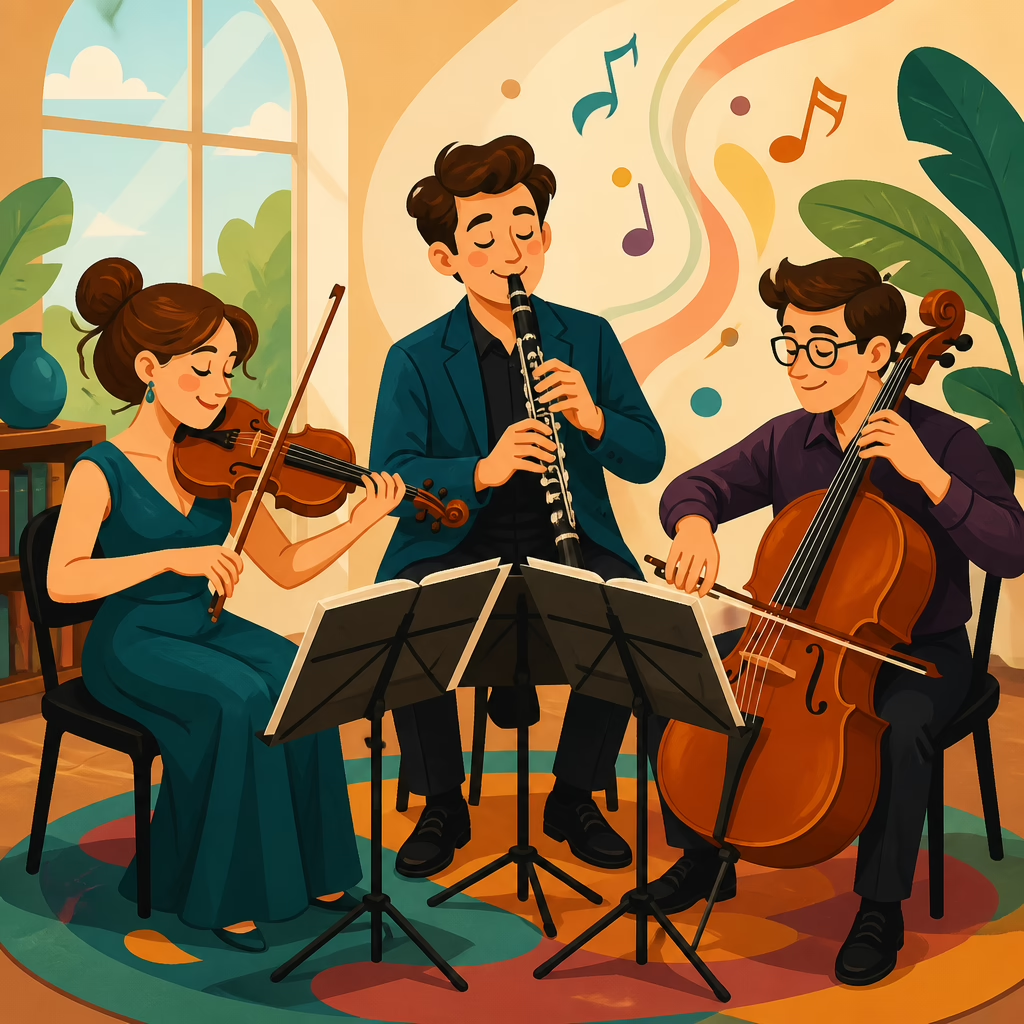
A Listener’s Guide to the Clarinet Trio Op. 11
Beethoven’s Clarinet Trio in B-flat major, Op. 11, is one of those works that rewards close listening because it sounds immediately charming yet reveals a surprisingly sophisticated musical conversation beneath its graceful surface. Often nicknamed the “Gassenhauer” Trio after the tune used in its finale, the piece occupies a distinctive place in Beethoven’s early chamber music: it stands at the crossroads of salon entertainment, Viennese virtuosity, and the sharper, more individual voice he was beginning to assert in the 1790s. For listeners, that combination makes it unusually approachable. You can enjoy it on a first hearing for its melody, sparkle, and wit, then return to it and notice how expertly Beethoven balances the clarinet, cello, and piano while stretching inherited Classical forms in subtle ways.
A listener’s guide should begin with the essentials. Op. 11 was published in 1798 and is scored for clarinet, cello, and piano, though Beethoven also authorized violin as an alternative to clarinet, a practical decision that helped widen the work’s market. A clarinet trio is exactly what it sounds like: a chamber composition for clarinet, cello, and piano, with each instrument taking a distinct role. In this piece the piano often drives the structure and texture, the clarinet supplies brilliance and lyrical flexibility, and the cello anchors the harmony while frequently acting as an equal melodic partner rather than simple bass support. The nickname “Gassenhauer” comes from the finale’s theme, drawn from a then-popular song by Joseph Weigl, “Pria ch’io l’impegno,” from the comic opera L’amor marinaro. In Viennese usage, a Gassenhauer was a street hit, a tune people knew well enough to sing in public.
Why does this work matter? First, it shows Beethoven writing for the clarinet at a moment when the instrument was still establishing itself as a major chamber voice. Second, it demonstrates how he could take apparently light material and shape it with iron control. Third, it offers a vivid snapshot of his early career in Vienna, when he was known not only as a composer but as a formidable pianist writing pieces that could impress cultivated amateurs and professionals alike. I have found that listeners who think of Beethoven primarily in terms of heroic symphonies are often startled by how elegant, conversational, and sly this trio is. That surprise is part of the pleasure. The work is not minor Beethoven in the dismissive sense. It is early Beethoven in concentrated form: alert to fashion, technically resourceful, and already unmistakably personal.
Context: where Op. 11 sits in Beethoven’s early Vienna years
To hear Op. 11 clearly, it helps to place it in Beethoven’s world around 1797 to 1798. He was in his late twenties, recently established in Vienna, and building a reputation through performance, publication, and aristocratic patronage. Chamber music was central to that economy. Composers wrote works suitable for domestic music making, private concerts, and subscription culture, and publishers wanted pieces that could sell to skilled amateurs. Beethoven understood that environment perfectly. Op. 11 is dedicated to Countess Maria Wilhelmine von Thun, an important Viennese patron who had also supported Mozart. The dedication signals social prestige, but the music itself also reflects the practical realities of the market: attractive melodies, idiomatic writing, and instrumentation flexible enough for different performers.
The choice of clarinet was timely. By the late eighteenth century, the clarinet had become increasingly prominent thanks to players such as Anton Stadler and to composers including Mozart, whose Clarinet Quintet and Clarinet Concerto had expanded the instrument’s expressive range. Beethoven knew what the instrument could do: sing across registers, articulate quickly, and shift from warmth to brightness within a phrase. In Op. 11 he uses those strengths constantly. At the same time, he does not treat the clarinet as a permanent soloist with accompaniment. Instead, he builds a genuine trio texture in which themes circulate and gestures are answered, completed, or gently challenged by the other players.
That balance is one reason the work still sounds fresh in performance. If you listen to several recordings, you will hear how differently ensembles distribute emphasis. Some foreground the piano’s brilliance, reminding us that Beethoven himself was likely the keyboard force in mind. Others bring out the clarinet’s vocal quality, making the piece feel closer to operatic dialogue. The best performances keep all three instruments in play, because the score thrives on responsiveness rather than dominance.
How to listen to the first movement: Allegro con brio
The opening movement is in sonata form, the standard large-scale design of the Classical period, but Beethoven animates it with momentum and personality from the first bars. “Allegro con brio” means fast, with vigor, and that instruction matters. The movement should not feel polite or merely decorative. Its energy comes from sharply profiled motives, quick exchanges, and rhythmic decisiveness. The piano introduces the principal material with confidence, but the clarinet and cello are not far behind, and Beethoven quickly establishes a three-way conversation rather than a keyboard-led display piece.
What should you listen for first? Listen for contrast inside continuity. The main theme has lift and propulsion, then Beethoven softens the texture and redirects the line. He is already doing something listeners later associate strongly with him: building coherence not by endless tunefulness alone but by making small rhythmic cells do structural work. Even when the surface seems effortless, the movement holds together because short gestures recur in altered contexts. If a first hearing feels busy, focus on the handoffs. Notice when the clarinet picks up an idea introduced by the piano, or when the cello reinforces a cadence and then suddenly becomes melodic.
The second theme area offers another point of entry. In many Classical works, this section provides lyrical contrast in the new key. Beethoven gives you that contrast, but he also keeps the argument alive through active accompaniment and careful phrase shaping. There is elegance here, yet not passivity. I often advise listeners to track the bass line during this passage because the cello’s movement tells you how grounded or unsettled the harmony really is. The result is a movement that feels buoyant on the surface but is quietly full of directional force.
The development section deserves special attention because it shows Beethoven testing the expressive and structural possibilities of his material. Development in sonata form is where themes are fragmented, sequenced, modulated, and recombined, and Beethoven already handles that process with assurance. He does not merely decorate his themes; he interrogates them. Tension rises through harmonic motion and registral contrast, then the recapitulation restores order without sounding routine. By the end of the movement, what seemed at first like a charming opening has become a persuasive formal argument. That is the signature effect of this trio: accessibility paired with compositional discipline.
How to listen to the second movement: Adagio
The Adagio moves to E-flat major and opens a more inward sound world. If the first movement wins you with poise and animation, the slow movement asks for sustained attention to color, pacing, and breath. The clarinet is especially important here because Beethoven exploits its ability to shape long, singing lines. A good player makes the opening feel almost vocal, as though a Mozart aria had been distilled into chamber music. Yet the cello is equally crucial. It does not simply accompany; it deepens the sonority and often gives emotional weight to transitions and responses.
One of the most rewarding ways to hear this movement is to listen for space. Beethoven allows phrases to settle, and those moments of repose matter as much as the melodic content itself. In performance, timing is everything. If the players rush, the movement can sound merely pretty. If they sustain the harmonic rhythm and let cadences breathe, the music acquires intimacy and gravity. From experience, this is the movement where the quality of ensemble listening becomes most obvious. You can hear whether the clarinetist is shaping a phrase in collaboration with the pianist’s inner voicing and the cellist’s line, or simply playing over accompaniment.
The piano writing also deserves more credit than it sometimes receives. Because the clarinet often carries the melodic spotlight, listeners can overlook how carefully Beethoven supports and comments through the keyboard texture. The pianist controls transparency, balance, and the harmonic undercurrent. In stronger recordings, the left hand never feels heavy, and the right hand’s figurations remain supple enough to sustain the movement’s cantabile character. This is chamber music at its most dependent on restraint. Nothing is underlined too heavily, yet every voice matters.
| Movement | Tempo and Key | What to Listen For | Why It Matters |
|---|---|---|---|
| I | Allegro con brio, B-flat major | Motivic handoffs, energetic piano writing, balanced dialogue | Introduces Beethoven’s blend of charm and structural rigor |
| II | Adagio, E-flat major | Long clarinet lines, supportive cello responses, spacious pacing | Reveals the trio’s lyrical depth and tonal warmth |
| III | Theme and Variations, B-flat major | Familiar tune transformed through texture, rhythm, and instrumental color | Shows Beethoven elevating popular material into artful chamber writing |
How to listen to the finale: the “Gassenhauer” variations
The finale is the movement most listeners remember first, and with good reason. Beethoven takes Weigl’s well-known tune and turns it into a set of variations that are entertaining, inventive, and technically polished. A theme-and-variations movement presents a melody, then repeats it in altered forms. Those alterations may affect rhythm, accompaniment, texture, ornamentation, register, or character. In less capable hands, the form can become repetitive. Beethoven avoids that problem by making each variation a fresh dramatic situation while preserving enough of the theme for the listener to stay oriented.
Because the source tune was popular, contemporaries would have recognized it immediately. That recognition matters. Beethoven was not borrowing an obscure melody for private wit; he was engaging shared musical culture. The achievement lies in what he does next. Rather than simply dressing up a hit tune, he subjects it to a sequence of transformations that test the expressive and social boundaries of the material. Some variations sparkle with virtuosity, some lean into comic lightness, and others momentarily deepen the tone. The trio becomes a miniature theater of character changes.
For listeners today, the key is not to treat the finale as a novelty number. Yes, it is delightful. Yes, the tune’s popularity was part of its appeal. But the movement also demonstrates Beethoven’s control of pacing across a long span. He knows when to thin the texture, when to give the piano brilliance, when to let the clarinet glide above the ensemble, and when the cello should stabilize the whole design. The cumulative effect is stronger than any single variation. By the time the finale reaches its close, the tune has been fully reimagined.
There is also a broader lesson here about Beethoven’s early style. He did not separate “serious” and “popular” material as rigidly as later myth sometimes suggests. He could absorb what audiences knew and liked, then remake it through craft. If you are interested in how this side of Beethoven connects to his shorter, more intimate writing, the larger context in this complete guide to Beethoven’s bagatelles is useful, because it traces how concision, immediacy, and experiment can coexist across very different genres.
Performance, instrumentation, and what separates a great recording from a merely good one
Since Beethoven allowed the clarinet part to be played on violin, some listeners ask which version is better. For this specific work, the clarinet version is generally the more revealing choice because it highlights the timbral identity Beethoven had in mind when he exploited sustained legato, registral bloom, and supple articulation. The violin version can be excellent, and it has historical legitimacy, but it changes the expressive chemistry. A violin can project more edge and sustained pressure; a clarinet can blend speech and song in a way central to this trio’s character.
When comparing recordings, start with balance. If the piano is too dominant, the work can sound like a keyboard trio with decorative winds. If the clarinet is spotlit unnaturally, the inner workings disappear. The cello should be audible not only in bass support but in counterline and phrase endings. Tempo choices also matter. In the first movement, too much haste reduces clarity; too little drive weakens the “con brio.” In the Adagio, broad tempos can be beautiful if the line remains alive. In the finale, precision and lift are more important than sheer speed because the listener needs to hear the variation technique clearly.
Articulation is another dividing line. Beethoven’s humor and elegance often live in tiny details: a clipped response, a delicately placed accent, a phrase ending that smiles rather than declaims. Ensembles with a strong Classical style tend to understand that lightness is not superficiality. They keep textures transparent, observe dynamic gradations carefully, and avoid Romantic overstatement. Historically informed performance practice has sharpened modern ears on exactly these points, even when played on modern instruments. The best result is music that sounds vivid, not museum-like: poised, articulate, and fully alive.
Why Op. 11 stays with listeners
The Clarinet Trio Op. 11 endures because it solves a difficult artistic problem with unusual ease. It is sophisticated without intimidation, popular in material yet refined in execution, and compact enough to grasp while rich enough to revisit. Each movement offers a clear listening path: energetic formal interplay in the first, lyrical inwardness in the second, and imaginative transformation in the finale. Together they create a portrait of Beethoven before the middle-period monumentality, but already in full possession of the instincts that matter most: structural control, rhythmic vitality, and a sharp ear for instrumental personality.
For anyone building a closer relationship with Beethoven’s chamber music, this trio is an ideal place to listen actively rather than passively. Follow who leads, who answers, and how a familiar idea changes under pressure. Notice how often the music smiles without losing rigor. Then return to it with a different recording and compare the ensemble’s balance, pacing, and tone. That simple exercise reveals just how finely made the work is. Op. 11 is not merely an agreeable early piece; it is a masterclass in musical conversation. Put on a strong performance, listen straight through all three movements, and let Beethoven show how much intelligence can live inside apparent ease.
Frequently Asked Questions
Why is Beethoven’s Clarinet Trio Op. 11 called the “Gassenhauer” Trio?
The nickname “Gassenhauer” comes from the trio’s final movement, which is built as a set of variations on a melody that would have been instantly recognizable to many listeners in Vienna. Beethoven borrowed the tune from Joseph Weigl’s popular opera L’amor marinaro, and because it was so catchy and widely sung in the streets, it earned the label “Gassenhauer,” a term often used for a genuine street hit. That name has stuck ever since, even though it highlights only one part of the work.
The nickname can be a little misleading if it causes listeners to think of the trio as lightweight or merely fashionable. In reality, Beethoven uses the popular melody as raw material for something much more inventive. What begins as a familiar tune becomes the basis for a highly imaginative musical conversation among clarinet, cello, and piano. Each variation shifts the character, texture, and balance of the ensemble, allowing Beethoven to display wit, elegance, and structural control all at once. So while the finale explains the title by which the piece is commonly known, the work as a whole deserves attention as far more than a clever arrangement of a hit song.
What should a first-time listener pay attention to in the first movement?
The opening movement is a wonderful place to hear Beethoven balancing classical poise with an emerging personal voice. On first hearing, the movement can sound simply gracious and pleasing, but a closer listen reveals how carefully Beethoven distributes momentum and personality across the ensemble. Rather than allowing the piano to dominate while the clarinet and cello decorate, he creates a true chamber dialogue in which themes are introduced, answered, reshaped, and passed around with remarkable fluency.
One especially rewarding thing to notice is the contrast between elegance and energy. The music unfolds with the kind of polished surface associated with late eighteenth-century Viennese chamber music, yet underneath that surface there is a steady sense of dramatic purpose. Phrases often seem to lean forward, harmonic turns create subtle tension, and the instrumental interplay keeps the texture alive. Listen to how the clarinet sings with flexibility and warmth, how the cello grounds and sometimes shadows or challenges the upper lines, and how the piano does much more than accompany: it often drives the argument. Beethoven’s craftsmanship lies in making all of this sound effortless.
How does the unusual instrumentation shape the character of the piece?
The scoring for clarinet, cello, and piano gives Op. 11 a distinctive sound world. It is not the standard piano trio combination, and that difference matters. The clarinet brings vocal suppleness, color, and a certain conversational brightness; the cello offers resonance, depth, and lyrical warmth; and the piano serves both as harmonic foundation and as an equal participant in the musical exchange. The result is a texture that can feel at once intimate and theatrically expressive.
This instrumentation also allows Beethoven to play with contrast in especially subtle ways. The clarinet can blend beautifully with the cello, creating a mellow, almost duet-like sonority, but it can also stand apart with a more extroverted brilliance. Meanwhile, the piano can either cushion the winds and strings with delicate support or inject strong rhythmic definition and virtuoso sparkle. Listeners will often hear Beethoven exploiting these possibilities movement by movement, and even phrase by phrase. The piece gains much of its charm from this shifting balance of timbres, but its sophistication comes from how intelligently Beethoven uses those colors to shape form, tension, and release.
Is Op. 11 mainly a light salon piece, or does it show Beethoven’s deeper artistic ambitions?
The most accurate answer is that it does both, and that dual identity is part of what makes the trio so interesting. On the surface, the work clearly engages with the world of salon music and public taste. It is attractive, accessible, melodically appealing, and full of the kind of stylish writing that would have pleased audiences in Beethoven’s Vienna. The finale’s use of a popular tune only strengthens that connection. In that sense, the trio participates in a social and entertainment culture in which charm and immediacy mattered.
At the same time, Beethoven is never content merely to please. Even in this relatively early chamber work, he shows an unmistakable interest in pushing beyond convention. The formal handling is alert and purposeful, the instrumental parts are more integrated than one might expect from a piece aimed only at casual enjoyment, and the expressive range is broader than the work’s elegant exterior initially suggests. Beethoven takes familiar materials and gives them shape, tension, and individuality. That is why the trio feels so rewarding on repeated listening: it welcomes the ear immediately, but it keeps revealing deeper levels of craft. Rather than choosing between “salon piece” and “serious Beethoven,” it is better to hear Op. 11 as a work standing at the point where those worlds meet.
What makes the finale so memorable, and how should listeners approach its variations?
The finale is memorable first because the theme itself is irresistibly direct. Its popularity in Beethoven’s day was no accident: it is tuneful, rhythmic, and easy to grasp. But what turns the movement into something more than a pleasing conclusion is Beethoven’s treatment of that melody through variation form. Instead of simply decorating the tune over and over, he uses each variation to rethink the material from a new angle. Character, pacing, texture, and instrumental emphasis all shift, which keeps the movement lively and unpredictable.
A good way to listen is to treat each variation as a change of perspective on the same musical object. Ask what has changed: Is the clarinet now more prominent? Has the piano become more brilliant? Is the cello adding humor, support, or expressive weight? Has the mood turned more graceful, more playful, or more intense? Beethoven’s variations are engaging because they balance familiarity with surprise. You always recognize the underlying tune, but you are constantly invited to hear it differently. This is where Beethoven’s wit and control are especially evident. The finale entertains, certainly, but it also demonstrates how a composer can transform popular material into a rich chamber-music experience without losing any of its original appeal.