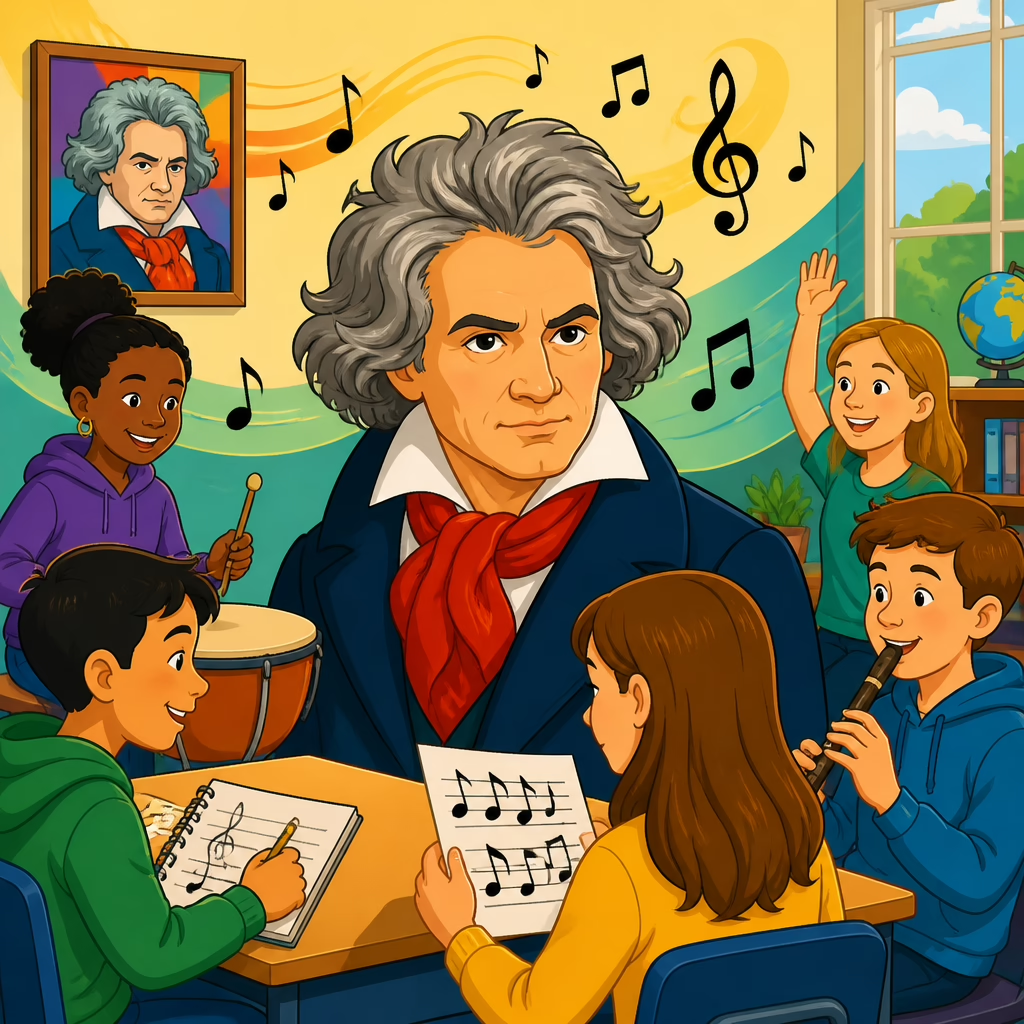
Beethoven Lesson Plans for Middle School General Music
Beethoven lesson plans for middle school general music work best when they move beyond a short composer biography and turn Ludwig van Beethoven into a lens for listening, rhythm, form, social history, and creative work. In this setting, “middle school general music” usually means mixed-ability classes in grades six through eight, limited rehearsal time, and students who are not all band, choir, or orchestra specialists. A strong Beethoven unit therefore needs clear objectives, short listening segments, active responses, and assessments that value musical thinking as much as prior technical skill. I have taught versions of this unit in classes where some students read notation fluently and others had never seen a grand staff, and the difference between a flat lesson and an effective one was always structure. When the lesson sequence is intentional, Beethoven becomes accessible, relevant, and surprisingly engaging.
Beethoven matters in middle school because his music makes abstract concepts concrete. Dynamic contrast, motif development, sonata ideas, theme and variation, tempo change, orchestral color, and emotional narrative are all audible in his works. His life also supports age-appropriate discussion about persistence, disability, changing public taste, and the transition from the Classical style of Haydn and Mozart to a more personal, dramatic musical language. Students can hear the famous four-note opening of Symphony No. 5 and immediately discuss repetition, tension, and recognition. They can compare the refined balance of an earlier piano sonata with the expanded scale of the “Eroica” Symphony and understand that composers respond to their time, audiences, and personal struggles. That combination of strong listening examples and human story is why Beethoven is one of the most teachable composers in general music.
Key terms should be defined early. A motif is a short musical idea that returns and changes. Form is the overall structure of a piece, such as ABA, rondo, theme and variations, or sonata-allegro principles. Dynamics describe volume levels and changes, including piano, forte, crescendo, and sforzando. Timbre is tone color: the quality that makes a flute sound different from a violin. Program music tells a story or paints a scene, while absolute music is not tied to a specific narrative. Students do not need a conservatory-level lecture on Beethoven, but they do need vocabulary they can use in speech and writing. A successful Beethoven lesson plan gives them those tools, then asks them to apply them through listening maps, movement, discussion, and simple composition tasks.
Start with goals, repertoire, and a middle school sequence
The best Beethoven lesson plans begin with a small set of teachable goals rather than a long list of works. In practice, I recommend a five- to eight-class sequence built around four anchor questions: Who was Beethoven, what makes his music recognizable, how did his style change over time, and how can students create using his techniques? Those questions keep the unit focused. They also align well with common music standards that ask students to perform, create, respond, and connect. For grade six, listening and recognition can lead. For grade seven, students can analyze form more explicitly. For grade eight, discussion can include historical context, patronage, the French Revolution’s influence on the “Eroica,” and the meaning of public concert culture in early nineteenth-century Vienna.
Repertoire selection matters. Instead of assigning an impossible survey of everything Beethoven wrote, choose pieces with clear teaching value: Symphony No. 5, first movement, for motif and dramatic development; Symphony No. 6, “Pastoral,” for programmatic listening and tone painting; “Ode to Joy” from Symphony No. 9 for melody, variation, and cultural afterlife; the second movement of Symphony No. 7 for ostinato and emotional pacing; “Für Elise” for rondo-like return and student familiarity; and selected piano sonata excerpts for contrast between Classical order and Beethoven’s expressive expansion. If time allows, the “Moonlight” Sonata can open discussion about why nicknames appear and whether they match the composer’s intentions. Fewer works studied closely always produce stronger understanding than many works mentioned briefly.
A practical sequence keeps each lesson balanced. Open with a bell-ringer such as “What do you notice first?” or “Circle the dynamic words that match this excerpt.” Follow with direct instruction limited to the exact concept students need. Then move to active listening, movement, score or map tracking, collaborative discussion, and a short exit ticket. Middle school students respond especially well when every Beethoven lesson includes one concrete task: clap the motif, trace the form, reorder events from Beethoven’s life, compare two recordings, or compose a four-note idea and transform it. That routine builds confidence. It also keeps the focus on musical evidence rather than passive appreciation.
Teach Beethoven through listening that students can decode
Listening is the center of any Beethoven unit, but passive listening rarely works. Students need a way into the sound. For Symphony No. 5, I use the opening motif as a decoding exercise. Students first tap the rhythm, then identify where the motif returns, then note what changes around it: pitch level, orchestration, dynamics, texture, and harmonic tension. This makes “Beethoven develops ideas” a claim they can actually prove. For the “Pastoral” Symphony, students can sort teacher-provided descriptive words into categories such as mood, weather, motion, and instrument color while listening. Then they explain which moments sound like a brook, a storm, or a peasant dance. This avoids reducing the piece to background music and instead builds analytical listening in plain language.
Recordings should be chosen carefully. One strong modern orchestra recording and one contrasting interpretation are enough. For example, comparing a traditional large-orchestra performance of Symphony No. 5 with a historically informed performance can spark useful discussion about tempo, articulation, vibrato, and ensemble size. Students do not need exhaustive performance-practice detail, but they can hear differences in attack and transparency. The same is true with “Ode to Joy,” which exists in orchestral, choral, classroom recorder, and pop-cultural versions. Ask what remains constant across versions. Usually the melody and phrase shape survive, and students begin to understand how arrangement works.
Visual supports improve comprehension. Listening maps, color-coded motifs, and simplified timelines let mixed-level classes engage quickly. For students with limited notation skills, icons can mark entrances of brass, strings, or percussion. For stronger readers, short notated excerpts help connect ear and eye. In inclusive classrooms, multimodal access is essential. I have found that students who struggle with long verbal explanation often succeed when asked to draw the energy contour of a Beethoven excerpt or stand when the main theme returns. Those responses still assess musical understanding; they simply do not depend on advanced writing skills.
Use active learning: movement, discussion, and composition
Beethoven becomes memorable when students do something with the music. Movement is especially effective in middle school general music because it converts form into a physical experience. In “Ode to Joy,” students can step the pulse, show phrase endings with arm gestures, and switch locomotor patterns when variation changes. In Symphony No. 7, second movement, they can track the repeating rhythmic foundation with body percussion while different groups add layered entrances. These are not filler activities. They help students internalize meter, phrase structure, and texture. They also support students who learn best kinesthetically and need more than a worksheet.
Discussion should be evidence-based and short enough to stay lively. Ask questions with one right answer supported by the recording, then move to interpretation. “Where did the motif return?” is a good first question. “Why do you think Beethoven repeats it so insistently?” can follow. When discussing Beethoven’s hearing loss, keep the framing respectful and historically grounded. Students are often fascinated that he continued composing while facing profound hearing challenges, but the lesson should not turn him into a simplistic hero figure. A better approach is to ask how adversity, ambition, and changing technology affected his career. Mention the Heiligenstadt Testament as a personal document that reveals despair and determination without dramatizing the topic beyond what middle school students can process.
Composition activities make the unit stick. After studying the four-note idea from Symphony No. 5, have students create their own short motif and transform it three ways: change the rhythm, move it to a new pitch level, and pass it to a different instrument or timbre using classroom tools such as barred instruments, keyboards, digital audio workstations, or body percussion. This directly mirrors Beethoven’s developmental thinking at an age-appropriate level. If your classroom uses Soundtrap, GarageBand, Noteflight, or flat.io, students can loop a motif and build contrast with dynamics and texture. If technology is limited, paper composition and performance in small groups works just as well.
| Lesson focus | Beethoven example | Student task | Assessment evidence |
|---|---|---|---|
| Motif and development | Symphony No. 5, movement 1 | Clap, identify returns, compose a four-note motif | Exit ticket labeling two changes to the motif |
| Programmatic listening | Symphony No. 6, “Pastoral” | Match sound events to scene descriptions | Short paragraph citing musical details |
| Melody and variation | “Ode to Joy” | Sing or play melody, compare versions | Checklist for phrase shape and steady pulse |
| Texture and ostinato | Symphony No. 7, movement 2 | Layer body percussion with entrances | Teacher observation of ensemble accuracy |
Build context without losing the music
Historical context should clarify the listening, not replace it. Students need a concise picture of Beethoven’s world: born in Bonn in 1770, active mainly in Vienna, trained within Classical traditions, influenced by Enlightenment ideals, and working during a period shaped by revolution, war, and changing patronage. Explain that he was not a movie-style lone genius operating outside society. He depended on aristocratic support, publishers, performers, instrument makers, and audiences. At the same time, he pushed against expectations, enlarged forms, and helped redefine the composer as a public artistic voice. This balance prevents biography from becoming either trivia or myth.
One useful middle school comparison is Haydn–Mozart–Beethoven. Students can hear how Beethoven inherited Classical clarity yet intensified contrast, length, and emotional force. If you play a concise Haydn symphonic opening next to the start of Beethoven’s Fifth, students notice the difference immediately. Beethoven’s rhetoric is bolder, his gestures more urgent, and his motivic economy more obvious. Another helpful context point involves the piano. Instrument design changed substantially during Beethoven’s lifetime, with expanded range and greater sustaining power. That practical fact helps students understand why later piano works sound larger and more orchestral than earlier keyboard music.
Cultural relevance also matters. “Ode to Joy” has been used as a concert anthem, political symbol, and educational staple around the world. Students may recognize it from ceremonies, cartoons, films, or school performances. Use that familiarity carefully. Ask why some melodies travel across settings and generations. The answer usually includes singable contour, balanced phrase design, and emotional openness. Connecting Beethoven to present listening habits can be effective too. Students understand sampling, remixing, and thematic reuse. Framing motif development as a historical form of musical iteration often makes immediate sense to them.
Assess understanding with clear, manageable evidence
Assessment in a Beethoven unit should show what students can hear, explain, and create. In general music, that means short formative checks are more useful than one large test. A well-designed exit ticket might ask students to define motif, identify one instrument family that carries the theme, and describe one dynamic change they heard. A listening quiz can use thirty-second excerpts rather than full movements. Performance assessment might involve small groups presenting an original motif variation. Written reflection can ask students whether Beethoven is remembered more for melody, drama, or development, and to defend the answer with one named piece.
Differentiation is crucial. Provide sentence frames for emerging writers, challenge advanced students to compare forms or historical interpretations, and allow multiple response modes where appropriate. Rubrics should be transparent and tied to the lesson goal. If the objective is “students will identify and describe motif development,” then grading should not overemphasize spelling, artistic drawing skill, or prior instrumental technique. In my own classes, the strongest Beethoven assessments have been modest in scale but precise in target. They ask students to notice specific musical evidence and communicate it clearly. That is both rigorous and fair.
Beethoven lesson plans for middle school general music succeed when they treat students as active listeners and makers, not as passive recipients of famous facts. The most effective units define a few essential terms, choose a handful of high-value works, and return repeatedly to audible concepts such as motif, contrast, form, timbre, and variation. They also keep biography in proportion: enough context to explain the music, not so much that listening disappears. When students clap the opening of Symphony No. 5, trace a storm in the “Pastoral,” perform “Ode to Joy,” and transform their own motifs, they understand why Beethoven still matters.
The main benefit of a focused Beethoven unit is transferable musical literacy. Students learn how to listen for structure, support opinions with evidence, and connect sound to history and human experience. Those skills apply far beyond one composer. If you are planning your next middle school general music unit, start small, teach deeply, and build each lesson around one musical question students can answer by the end of class. Beethoven gives you excellent material; a clear lesson design turns that material into lasting learning.
Frequently Asked Questions
What should a strong Beethoven lesson plan for middle school general music include?
A strong Beethoven lesson plan for middle school general music should do much more than introduce a few dates from the composer’s life. The most effective units use Beethoven as a practical entry point into core music skills that fit mixed-ability classes in grades six through eight. That usually means combining short, focused listening activities with rhythm practice, form analysis, historical context, and creative student work that does not require advanced performance technique. In a general music setting, students need clear goals, manageable tasks, and frequent variety, so the lesson plan should be organized around essential questions such as how music communicates emotion, how composers build musical structure, and how historical context shapes artistic choices.
In practical terms, a well-designed unit often includes a brief and age-appropriate biography, guided listening excerpts, vocabulary instruction, visual listening maps, and hands-on response activities. Beethoven’s music works especially well for teaching contrasts in dynamics, motif development, form, tempo, and expressive character. Teachers can use short excerpts rather than full works, allowing students to listen actively without losing focus. A lesson might begin with a hook such as the famous four-note opening of Symphony No. 5, move into a rhythm-clapping or notation task, then shift into discussion about why the motif is memorable and how Beethoven develops it. This approach keeps the content musical rather than purely historical.
It also helps to build in opportunities for student creation. Middle school students respond well when they can compose short rhythmic motives, create “fate motif” variations, draw listening maps, compare performances, or write brief reflections about mood and musical choices. Because many general music classes have limited rehearsal time and varied student backgrounds, the best Beethoven lesson plans are flexible, interactive, and skill-based. They help students listen with purpose, connect ideas across activities, and leave with a clearer understanding of both Beethoven and the broader elements of music.
How can teachers make Beethoven engaging for mixed-ability middle school classes?
Teachers can make Beethoven engaging for mixed-ability middle school classes by keeping lessons active, short-segmented, and accessible to students with very different levels of musical experience. In many general music classrooms, some students read notation fluently while others are just beginning to identify basic rhythms or instruments by sound. Beethoven becomes much more engaging when he is presented not as a distant historical figure, but as a musician whose work can be explored through patterns, emotion, storytelling, and creative problem-solving. Students are often interested in the dramatic parts of his life, including his persistence through hearing loss, but that narrative is most effective when paired with musical tasks that let them hear and respond to what made his music powerful.
One effective strategy is to break lessons into short listening sequences with a specific purpose. Instead of asking students to “listen to Beethoven,” ask them to listen for one musical feature at a time: a repeated rhythm, a sudden dynamic change, a fast-versus-slow contrast, or the return of a theme. Graphic organizers, movement cues, and call-and-response rhythm activities make the listening more concrete. Teachers can also use collaborative stations where one group analyzes mood words, another arranges form cards, another practices a rhythmic motive on classroom percussion, and another reads a short historical passage. This structure supports different learning styles and keeps all students involved.
Choice-based and creative extensions are especially useful. Students might create a short soundtrack inspired by Beethoven’s use of contrast, rewrite a program note in student-friendly language, compare Beethoven to modern film music, or debate which excerpt sounds most dramatic and why. These kinds of activities remove the pressure of formal performance while still reinforcing musical understanding. Engagement rises when students feel they are discovering something, making decisions, and participating actively rather than receiving a lecture. For middle school general music, that is the key to making Beethoven relevant and memorable.
Which Beethoven pieces work best for middle school general music listening lessons?
The best Beethoven pieces for middle school general music listening lessons are usually the ones with clear musical features, strong contrasts, and excerpts that can stand alone in a short class period. Teachers do not need to teach entire symphonies or sonatas to create meaningful learning. In fact, well-chosen excerpts often work better because they allow students to focus on a single concept without cognitive overload. Symphony No. 5 is one of the most effective starting points because its opening motive is instantly recognizable and ideal for teaching rhythm, repetition, development, dynamics, and musical tension. Students can clap the rhythm, identify where the motive returns, and discuss why such a short idea can sound so powerful.
Another strong choice is Symphony No. 6, the “Pastoral” Symphony, especially for lessons about mood, imagery, and how music can suggest scenes or nature. This piece supports cross-curricular connections and helps students think about how composers communicate ideas without words. “Ode to Joy” from Symphony No. 9 is also highly useful because the melody is accessible, singable, and easy to analyze for phrase structure and melodic contour. It works well for classroom instruments, recorder, keyboard, or simple arranging tasks. For lessons on form and expressive contrast, excerpts from piano sonatas such as “Moonlight Sonata” can support discussions of texture, tempo, and emotional atmosphere, provided the teacher frames the listening carefully and keeps the focus age-appropriate and skill-based.
Teachers may also use short excerpts from Beethoven’s string quartets, concertos, or Egmont Overture if they align with a specific objective, but the main criterion should be instructional clarity. The piece should offer something students can hear and describe successfully. In middle school general music, the goal is not comprehensive Beethoven coverage. The goal is helping students listen actively, identify musical elements, and build confidence in talking about music. Pieces with strong motives, obvious contrasts, memorable themes, and manageable excerpt lengths will consistently produce the best results.
How long should a Beethoven unit last in middle school general music?
A Beethoven unit in middle school general music does not need to be long to be effective. In most schools, the ideal length is somewhere between three and eight class sessions, depending on schedule, class frequency, and the depth of the teacher’s goals. Because general music classes often meet for limited periods and include students with varying levels of readiness, a concise unit with clearly defined objectives tends to work better than an extended survey. The most successful plans are built around a few key outcomes, such as identifying motifs, recognizing contrasts in dynamics and tempo, understanding basic historical context, and responding creatively to listening examples.
A short three-lesson sequence might introduce Beethoven through a high-interest biography, feature active listening with Symphony No. 5, and end with a student composition or reflection task. A medium-length unit of five or six lessons might add form analysis, instrument identification, and comparison between two contrasting works such as Symphony No. 5 and Symphony No. 6. A longer unit could include broader themes like the Classical-to-Romantic transition, Beethoven’s influence on later music, or connections to social history and artistic independence. The right length depends less on the composer and more on what students should know and be able to do by the end.
It is important not to stretch the unit simply to “cover” more biography or more pieces. Middle school students generally benefit from repeated contact with a few carefully selected excerpts and activity types rather than fast exposure to many works. Teachers should also plan for transitions, formative checks, and student output, not just listening time. If students can explain a motive, describe expressive choices, identify form in a simple way, and create something inspired by what they heard, the unit has likely done its job well. In that sense, a focused Beethoven unit can be both short and highly meaningful.
What are the best assessment ideas for Beethoven lesson plans in middle school general music?
The best assessment ideas for Beethoven lesson plans in middle school general music are practical, varied, and closely tied to what students actually do during the unit. Since these classes often include mixed skill levels and are not always ensemble-based, assessment should emphasize listening, understanding, application, and creative response rather than technical performance alone. Strong formative assessments might include exit tickets asking students to identify a musical element from an excerpt, short listening charts where they track dynamics or form, partner discussions summarized in writing, or quick rhythm tasks based on a Beethoven motive. These checks help the teacher monitor understanding without interrupting the flow of the lesson.
Summative assessments can also remain highly accessible while still being rigorous. For example, students might complete a listening response in which they describe how Beethoven uses repetition, contrast, and mood in a selected excerpt. They might label a simple listening map, compare two Beethoven works using music vocabulary, or explain how a motif changes over the course of a piece. Another effective option is a creative project: composing a short rhythmic or melodic motive, creating a visual representation of a listening excerpt, or producing a mini presentation about how Beethoven’s life connects to one musical example. These tasks allow students to demonstrate understanding even if they are not advanced readers or performers.
Clear rubrics are especially important. Students should know whether they are being assessed on vocabulary use, listening accuracy, explanation of musical ideas, creativity, or participation. In middle school general music, the strongest assessments are usually those that balance structure with choice. They give every student a fair way to show learning while reinforcing the larger goals of the unit. If an assessment asks students to listen carefully, think