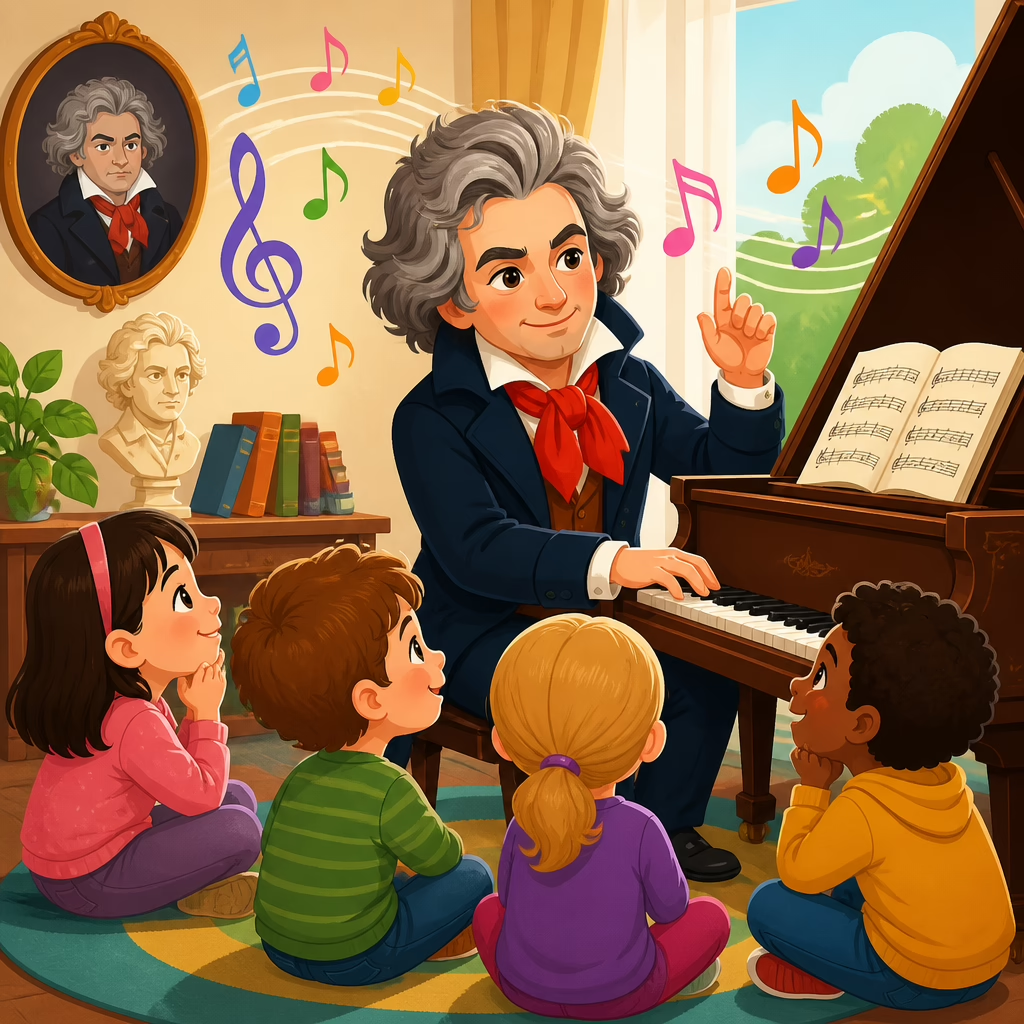
How to Introduce Beethoven to Young Children
Introducing Beethoven to young children works best when adults treat his music as something to feel, move to, and explore rather than something to memorize. For early learners, “introducing Beethoven” means building familiarity with the composer through short listening experiences, stories, rhythm activities, guided questions, and simple creative responses. Young children usually respond first to mood, pulse, contrast, and repetition, not to dates or formal analysis. That matters because Ludwig van Beethoven wrote music full of clear emotional character, memorable rhythmic motives, and dramatic shifts that children can hear immediately. In classrooms, family music times, and community programs, I have found that children engage most deeply when Beethoven is presented as a real person who loved nature, worked hard, solved musical problems, and communicated big feelings through sound. The goal is not to produce miniature musicologists. The goal is to help children recognize a few pieces, connect sound with emotion, and feel that classical music belongs to them too.
Beethoven is especially useful in community and education settings because his music offers strong teaching hooks. The opening of Symphony No. 5 introduces rhythm in a way even preschoolers can echo. “Moonlight Sonata” creates a calm atmosphere for focused listening. “Ode to Joy” is singable, pattern-based, and easy to adapt for movement, bells, or classroom instruments. His “Pastoral” Symphony opens conversations about storms, birds, and countryside scenes that children already understand. These pieces also support foundational musical skills: steady beat, loud versus soft, fast versus slow, instrument recognition, and emotional vocabulary. When adults choose age-appropriate excerpts and keep activities concrete, Beethoven becomes accessible without being diluted. That balance is important. Children deserve authentic music, but they also need structure, brevity, and repetition. A thoughtful introduction can spark long-term interest in music, improve listening stamina, and strengthen confidence in responding to art.
Start with story, sound, and a few child-sized facts
The first step is choosing what children actually need to know. Young children do not need a full biography. They need a small set of vivid, accurate facts: Beethoven was a composer from Germany, he lived more than 200 years ago, he wrote music for piano and orchestra, and he kept composing even when he lost much of his hearing. Present that last point carefully. It is inspiring, but it should not be reduced to a slogan. I usually explain it plainly: Beethoven had serious hearing problems as an adult, yet he continued to imagine music, write it down, and revise it with extraordinary discipline. That framing shows perseverance without turning his life into a simplistic moral lesson.
Storytelling works when it stays connected to sound. For example, before playing “Ode to Joy,” you can tell children that Beethoven liked to build music from small ideas that grow bigger and stronger. Then play the melody once and ask, “Can you hear how it starts simply and becomes fuller?” Before Symphony No. 6, explain that Beethoven loved walking outdoors and noticing weather and birds. Then let children listen for a musical storm. This story-to-sound approach is more effective than listing facts because it gives children a reason to listen. It also builds comprehension. They begin to understand that composers make choices, and that music can represent energy, calm, celebration, or nature.
Images and objects help. A portrait of Beethoven, a map showing Bonn and Vienna, a picture of a piano, and a simple timeline card can ground the lesson. Keep explanations concrete and verbal load low. Instead of “Beethoven bridged the Classical and Romantic eras,” say, “Some of his music is balanced and clear, and some feels bold and dramatic.” That distinction is truer to what children can hear. If you are teaching a group over several sessions, revisit the same facts briefly each time. Repetition builds retention, and young children learn best when information returns in predictable ways.
Choose the right Beethoven pieces for early childhood and elementary learners
Not every famous Beethoven work is suitable as a first introduction. Length, density, and emotional intensity matter. The best starting pieces have a clear pulse, memorable motifs, obvious contrasts, or vivid imagery. In practice, four works consistently succeed with young children: Symphony No. 5, first movement opening; Symphony No. 6 “Pastoral,” especially the storm; “Ode to Joy” from Symphony No. 9; and selected excerpts from “Moonlight Sonata.” These pieces are recognizable, widely recorded, and flexible for movement and classroom adaptation.
Symphony No. 5 works because the opening four-note motive is short, dramatic, and easy to imitate. Children can clap it, tap it, march it, or speak it with syllables. It teaches rhythm, pattern recognition, and the idea that a composer can develop a tiny musical cell into a larger work. “Ode to Joy” is ideal for singing because the melody moves mainly by step and repeats phrases. Even children with no formal training can follow it after hearing it a few times. The “Pastoral” Symphony supports listening for imagery: flowing water, bird calls, a thunderstorm, and a calm ending. “Moonlight Sonata” introduces a quieter side of Beethoven and can support drawing, breathing, or reflective listening.
Use short excerpts first. For preschool through early elementary, sixty to ninety seconds is often enough for one listening round. Older elementary students can handle longer segments if they have a task. I have had the strongest results when each excerpt has one listening purpose only: identify the beat, show the mood with facial expression, raise a hand when the music gets louder, or draw what the storm sounds like. Multiple objectives at once overwhelm beginners. If you need a broader sequence for planning, a useful reference is the main guide on Beethoven lesson plans for elementary music classes, which supports deeper follow-up while keeping the repertoire manageable.
| Piece | Best age range | Main teaching focus | Simple activity |
|---|---|---|---|
| Symphony No. 5 opening | Ages 4–9 | Rhythm and motif | Clap the four-note pattern, then freeze |
| “Ode to Joy” | Ages 5–10 | Melody and singing | Sing on “la,” then add words or hand signs |
| Symphony No. 6 storm | Ages 4–10 | Imagery and dynamics | Move scarves as rain, wind, and thunder |
| “Moonlight Sonata” excerpt | Ages 6–10 | Mood and attentive listening | Draw what the music makes you imagine |
Use movement, play, and guided listening to make the music stick
Young children understand music through the body before they understand it through terminology. That is why movement should not be treated as an extra. It is the teaching method. For Beethoven, movement can be highly structured without becoming rigid. In Symphony No. 5, children can march the steady beat and clap only the famous motive. In the “Pastoral” storm, they can crouch for raindrops, stretch for wind, and stamp for thunder. With “Ode to Joy,” they can pass a beanbag on each phrase or step the contour of the melody with rising and falling arm motions. These actions translate abstract sound into something graspable.
Guided listening questions should be short, observable, and answerable from hearing alone. Ask, “Does this sound loud or soft?” “Is the music smooth or bouncy?” “Do you hear the same idea again?” “What picture comes into your mind?” Avoid asking children to infer advanced concepts they have not learned. The point is to help them attend to audible features. After listening, let them respond in speech, drawing, or movement. I often see deeper understanding in a child’s motion than in a spoken answer. A child who widens their arms during a crescendo has understood a real musical event.
Play also matters. One effective strategy is the “composer detective” game. Tell children they are listening for clues: a repeated rhythm, a surprise loud sound, or music that sounds like weather. Another strategy is call-and-response. Play or sing a short phrase from “Ode to Joy,” and have children echo it on solfege, neutral syllables, or rhythm syllables. If instruments are available, keep the texture simple. Hand drums for pulse, rhythm sticks for motive patterns, and resonator bells for the opening pitches of “Ode to Joy” are enough. The purpose is not to recreate Beethoven’s score. It is to reinforce listening through active participation.
Teach musical concepts through Beethoven without losing the child’s attention
Beethoven is a strong vehicle for teaching core music concepts because his works often make contrasts obvious. Dynamics can be taught through sudden shifts from soft to loud. Tempo can be shown through active versus calm excerpts. Rhythm emerges clearly in Symphony No. 5, and melodic contour is easy to hear in “Ode to Joy.” Form can be introduced in a basic way by asking children when a tune comes back. Instrument families can be addressed by showing what an orchestra looks like and helping children identify strings, woodwinds, brass, and percussion by sound and picture.
The key is sequencing. Teach one concept per encounter, then recycle the music later for a different purpose. For instance, use “Ode to Joy” first for beat, later for melody, and later still for ensemble awareness by comparing a vocal recording with an orchestral one. In my experience, children retain more when the same excerpt appears in several short lessons than when they hear six different pieces once each. This aligns with what early childhood educators already know about spaced repetition and retrieval practice. Familiarity supports confidence, and confidence improves listening quality.
Language should stay precise but simple. Instead of saying “This passage employs motivic development,” say, “Beethoven takes one little rhythm and keeps changing it.” Instead of “programmatic evocation,” say, “This music sounds like a storm on purpose.” Accurate plain language is not dumbing things down. It is translation. Once children can hear the concept, formal terminology can gradually be added. That sequence respects both developmental readiness and musical integrity.
Adapt the approach for home, school, and community programs
The setting shapes the lesson. At home, the best Beethoven introductions are brief and repeatable. A parent might choose one piece for a week, listen during breakfast, and do one tiny activity such as clapping the Symphony No. 5 motive or humming “Ode to Joy” at bedtime. In elementary classrooms, teachers can connect Beethoven to literacy by sequencing story cards, to visual art by painting storm scenes, or to social-emotional learning by naming moods heard in the music. In libraries, museums, after-school clubs, and community centers, rotating stations work well: one listening corner, one movement area, and one instrument exploration table.
Accessibility should always be considered. Some children are sensitive to volume or sudden contrasts, so preview intense excerpts and control playback levels. Visual schedules help children who benefit from predictable transitions. For multilingual groups, rely on gestures, pictures, and repeated keywords. For children with limited prior exposure to live instruments, invite a local pianist, violinist, or youth ensemble when possible. Seeing a musician produce the sounds they have heard on recordings can make Beethoven feel immediate and human.
Assessment can remain informal. Ask children to identify a piece from its opening, show the beat, sing back a phrase, or choose a picture that matches the mood. Those responses reveal whether the introduction is working. Success does not mean they can recite biographical facts. Success means they can recognize Beethoven’s music, describe what they hear in their own words, and respond with attention rather than distance.
Introducing Beethoven to young children succeeds when the music is active, focused, and emotionally legible. Start with a few honest facts, connect each fact to a sound, and choose excerpts with clear rhythms, melodies, or images. Use movement, guided listening, and play so children experience the music physically as well as intellectually. Teach one concept at a time, revisit the same pieces often, and adapt activities to the setting and the children in front of you. Beethoven does not need to be simplified into background culture or elevated into something untouchable. He can be presented as a composer whose music still communicates directly.
The lasting benefit is not only familiarity with a famous name. It is the growth of careful listening, emotional vocabulary, musical confidence, and a sense that great art is accessible from an early age. When children clap the opening of Symphony No. 5, sing “Ode to Joy,” or paint the storm from the “Pastoral,” they are doing more than completing an activity. They are entering a relationship with music that can expand for years. Choose one Beethoven excerpt this week, plan one short interactive response, and let the children hear, move, and wonder.
Frequently Asked Questions
1. What is the best way to introduce Beethoven to young children?
The best way to introduce Beethoven to young children is to make his music feel approachable, active, and emotionally clear. Instead of starting with facts about his life or expecting children to sit still for long listening sessions, begin with short, vivid musical excerpts that invite a natural response. Young children connect most easily through what they can hear and feel right away: a strong beat, a sudden contrast, a repeating pattern, or a change in mood. When adults present Beethoven this way, children begin to recognize his music as something exciting and expressive rather than something distant or difficult.
A strong introduction often includes movement, storytelling, and simple observation. For example, you might play a short section and ask, “Does this sound powerful or gentle?” or “Would you march, tiptoe, or sway to this?” These kinds of questions help children listen with purpose without making the experience feel like a lesson they must “get right.” You can also connect the music to images and actions by inviting them to draw what they hear, move a scarf to the melody, tap a steady beat, or act out a scene the music suggests. This gives children multiple ways to engage, which is especially helpful for early learners.
It also helps to keep introductions brief and repeat favorite selections over time. Familiarity matters. A child who hears the same lively or dramatic passage several times begins to notice patterns, anticipate moments, and build confidence as a listener. In other words, introducing Beethoven successfully is less about delivering information and more about creating repeated, joyful encounters with his music. When adults focus on experience first, children are far more likely to develop genuine curiosity and lasting interest.
2. Which Beethoven pieces are most suitable for young children?
The most suitable Beethoven pieces for young children are usually those with clear contrasts, memorable rhythms, and strong emotional character. Children tend to respond well to music that immediately suggests movement or mood, so short excerpts often work better than long, uninterrupted works. Popular starting points include the opening of Symphony No. 5 for its famous repeated rhythm, “Ode to Joy” from Symphony No. 9 for its singable melody, and lively sections from Symphony No. 6 “Pastoral” because they can be connected to nature, weather, and storytelling. These pieces are recognizable, expressive, and easy to revisit in short segments.
Piano works can also be very effective, especially when they offer a clear atmosphere. Beethoven’s “Moonlight Sonata” first movement may appeal when you want children to notice calm, quiet, or nighttime feelings, while more energetic selections can support marching, clapping, or dramatic play. The key is not choosing music because it is famous alone, but because it gives children something concrete to notice. Can they hear a repeated idea? Does the music sound bold, peaceful, playful, or stormy? These entry points matter much more than the title or the historical significance at the beginning stage.
Adults should also feel free to use only one minute or even thirty seconds of a piece if that is what keeps the listening focused and enjoyable. Young children do not need full-length concert exposure in order to begin appreciating Beethoven. In fact, carefully chosen excerpts can be more effective because they let children listen actively rather than passively. Over time, those excerpts can expand into longer experiences as their attention and familiarity grow. Starting with accessible, expressive passages builds a strong foundation for deeper musical understanding later.
3. How long should young children listen to Beethoven at one time?
For most young children, short listening sessions are the most effective. A few minutes is often enough, especially at the beginning. The goal is not endurance; it is engagement. If a child listens closely to a one-minute passage and responds with movement, comments, or curiosity, that is far more valuable than asking for ten or fifteen minutes of passive attention. Young listeners are still developing concentration, and they typically absorb music best in small, repeated experiences that feel interactive and manageable.
A practical approach is to begin with thirty seconds to two minutes of music, followed by a simple response activity. You might listen once and ask what the music felt like, listen again and tap the beat, and listen a third time while marching, drawing, or using props such as scarves. This keeps the experience dynamic and helps children build listening skills naturally. Repetition is especially important because familiar music becomes more meaningful with each hearing. Children often notice something new the second or third time, and that sense of discovery helps maintain attention.
As children become more comfortable, listening time can gradually increase. Some may be ready to hear longer sections if the piece connects to a story, a mood, or a movement activity. Still, adults should watch for signs of fading interest and end while the experience is still positive. A successful introduction to Beethoven leaves a child wanting more, not feeling overwhelmed. In early music learning, consistency and enthusiasm matter much more than length. Short, enjoyable encounters repeated over days or weeks create stronger musical familiarity than occasional long sessions.
4. Do children need to learn facts about Beethoven’s life in order to appreciate his music?
No. Young children do not need a long list of facts about Beethoven’s life in order to appreciate his music. At the earliest stage, appreciation grows from listening, feeling, moving, and noticing. Children usually connect first to the sound itself: the pulse, the energy, the calmness, the surprise, or the repetition. If adults begin with too much biography or formal explanation, the music can start to feel academic before it feels meaningful. For young learners, emotional and sensory connection should come first.
That said, a few carefully chosen details can be helpful when they support curiosity rather than replace listening. For example, children may enjoy learning that Beethoven was a composer who wrote music that can sound powerful, joyful, stormy, or gentle. They may also be interested in simple human details that make him feel real, such as the idea that he used music to express big feelings. The key is to keep any background brief, age-appropriate, and tied to what they are hearing. Instead of presenting facts to memorize, present them as part of the story of the music.
This approach respects how young children learn. They build understanding from concrete experiences, not from abstract timelines or technical analysis. Once they already enjoy certain pieces, biographical information can be added gradually to deepen interest. In other words, facts are most useful after a connection has been made. When children first experience Beethoven as something vivid and expressive, they are much more open later to learning who he was and why his music still matters.
5. What activities can help children connect with Beethoven’s music at home or in the classroom?
The most effective activities are simple, physical, and open-ended. Movement is one of the best starting points because it lets children show what they hear without needing advanced vocabulary. They can march to a steady beat, sway to a flowing melody, freeze when the music stops, or change their movements when the mood shifts. These activities help children notice pulse, tempo, contrast, and energy in a direct way. They also make Beethoven’s music feel alive, which is especially important for young learners who understand through action.
Art-based responses are also excellent. After listening to a short excerpt, children can draw lines, shapes, colors, or scenes that match what they heard. A dramatic and forceful passage might inspire zigzags and dark colors, while a gentle melody might lead to curved lines and softer tones. This kind of response strengthens listening because it encourages children to translate sound into another form of expression. It also gives adults a window into how children are interpreting the music. There is no need to correct these responses; the value lies in active engagement and personal connection.
Guided questions and imaginative play can deepen the experience even more. Ask things like, “What kind of weather does this sound like?” “Does this music sound like a celebration or a mystery?” or “What might happen next in the story?” You can pair excerpts with scarves, rhythm sticks, stuffed animals, or simple dramatization to create playful listening rituals. Singing a familiar melody such as “Ode to Joy,” clapping repeated rhythms, or taking turns conducting can also help children feel involved. At home or in the classroom, the overall goal is the same: make Beethoven something children can explore with their bodies, voices, imaginations, and emotions. That kind of hands-on musical encounter creates much stronger interest than passive listening alone.