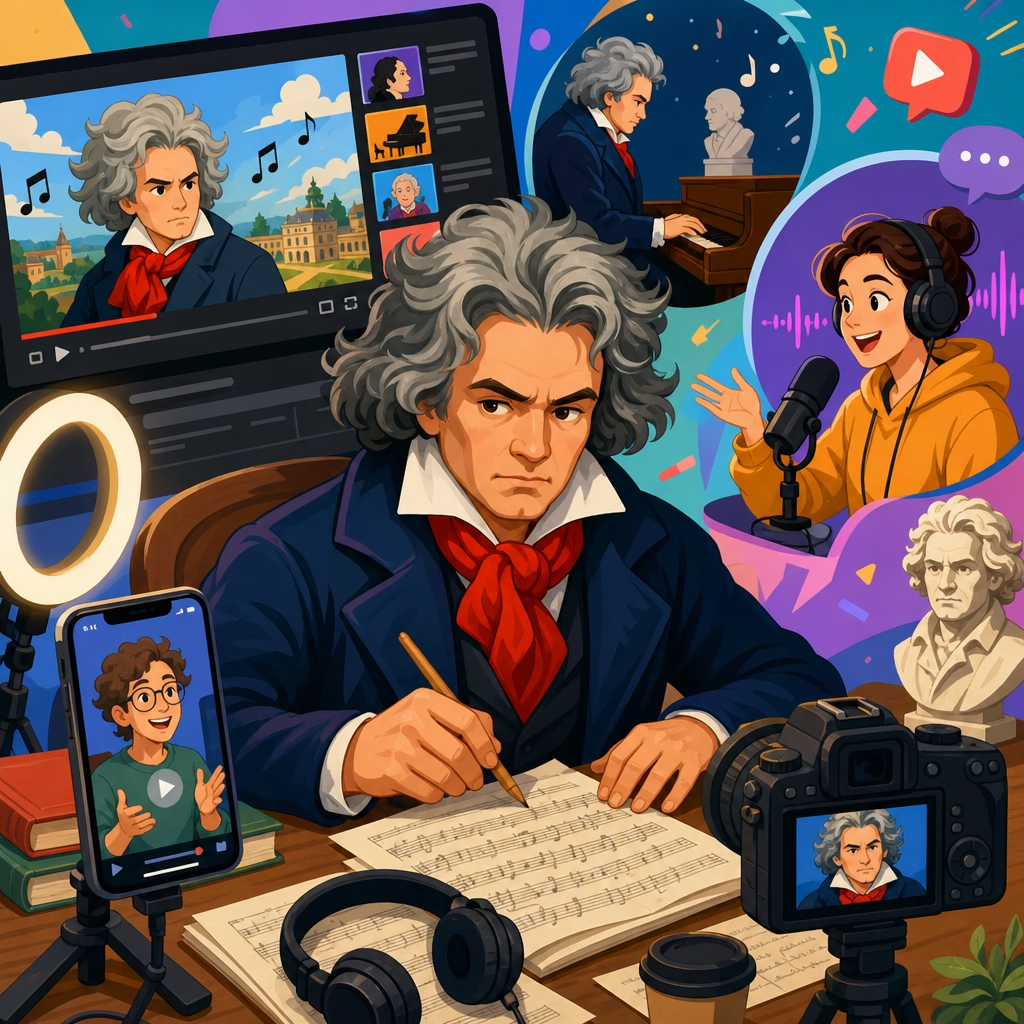
Beethoven in Video Essays Podcasts and Creator Culture
Beethoven has become a surprisingly durable figure in video essays, podcasts, and creator culture because his life and music solve a modern storytelling problem: creators need subjects who are instantly recognizable, emotionally charged, and flexible enough to support many angles. In digital media, Beethoven is not treated only as a composer from the late eighteenth and early nineteenth centuries. He is framed as a symbol of genius, struggle, rebellion, discipline, European high culture, artistic freedom, hearing loss, and personal mythmaking. That range explains why he appears in YouTube explainers, long-form podcast series, TikTok skits, livestream listening clubs, newsletter criticism, and educational channels that usually do not focus on classical music.
When I have worked with culture publishers and audio teams, Beethoven has repeatedly emerged as a reliable editorial choice for one reason above all: audiences think they already know him, yet they are usually curious when a creator reveals that the familiar image is incomplete. The famous wild hair, the Fifth Symphony motif, and the narrative of deafness provide an easy entry point. The deeper material—patronage networks, sketchbooks, changing public concerts, shifting editions, performance practice, and the politics of canon formation—gives serious creators substance. That combination is rare.
Creator culture matters here because it rewards adaptation. A subject must function in short clips, searchable episode titles, thumbnails, transcripts, and recommendation algorithms. Beethoven adapts exceptionally well. His works have memorable hooks. His biography contains conflict. His legacy triggers debate about elitism, universality, authenticity, and access. For digital creators, those traits turn him into more than a historical figure. He becomes reusable cultural infrastructure: a name that can carry analysis, humor, education, controversy, and community conversation across formats.
Understanding Beethoven in creator culture therefore means looking less at monument worship and more at media mechanics. Why do certain pieces recur? Why do some podcast episodes focus on mental health, disability, or productivity? Why do video essayists return to the “genius” story even while critiquing it? And why do creators who are not classical specialists still invoke Beethoven when discussing film music, pop songwriting, fandom, or personal ambition? The answers show how digital platforms reshape cultural memory in practical, measurable ways.
Why Beethoven Fits Digital Storytelling So Well
Beethoven works in digital storytelling because he combines immediate recognizability with interpretive openness. Many historical artists are important, but few can be identified from a single surname, a four-note motif, and a handful of biographical clichés. That familiarity lowers the barrier to entry for general audiences. A creator can title a video “Why Beethoven Still Sounds Revolutionary” or “What Podcasts Get Wrong About Beethoven” and trust that a broad audience will understand the premise without extra framing.
There is also a structural reason. Strong video essays and podcasts need tension. Beethoven’s life offers multiple tensions at once: individual ambition versus aristocratic patronage, physical impairment versus artistic authority, strict craft versus emotional force, private suffering versus public monumentality. Each tension maps cleanly onto a modern creator format. A narrative podcast can build episodes around crisis and breakthrough. A video essay can compare manuscripts, performances, and myths. A short-form creator can stage a joke contrasting “calm classical study music” with the actual volatility of the Eroica or late quartets.
His music translates well too. Creators need excerpts that make a point quickly. The opening of the Fifth Symphony, the “Moonlight” Sonata, the Ninth Symphony, “Für Elise,” and the Seventh Symphony provide instantly legible audio examples. Even non-specialist audiences can hear contrasts in rhythm, dynamics, texture, and form. That makes Beethoven useful for educational channels explaining sonata form, motif development, orchestration, or the shift from Classicism toward Romanticism. It also makes him useful for creators discussing how sound communicates urgency, triumph, suspense, or introspection.
Another advantage is the abundance of public-domain material. Scores, letters, portraits, and older recordings are comparatively accessible. For creators working with small budgets, that matters. They can quote from Beethoven’s correspondence, display manuscript pages, compare editions on screen, and use score-following visuals without the rights complications attached to many modern artists. Accessibility of source material often determines whether a topic gets covered deeply online, and Beethoven benefits from unusually rich documentary survival.
How Video Essays Turn Beethoven into a Narrative Engine
Video essays thrive when they can make abstract ideas visible. Beethoven gives them visual and conceptual anchors: manuscript revisions, portraits, concert halls, metronome markings, changing instrument design, and cinematic uses of his music. The best essays do not simply repeat the “tortured genius” template. They show process. A creator might zoom into a sketchbook to demonstrate how a tiny rhythmic cell grows into a large formal argument. That move matters because it converts admiration into understanding. Viewers see that greatness was built through revision, not mystical spontaneity.
In practice, successful Beethoven essays usually follow one of four models: myth correction, close listening, historical context, or cultural afterlife. Myth-correction videos challenge bad habits, such as reducing his deafness to inspirational branding or treating every late work as incomprehensible prophecy. Close-listening videos explain one movement in concrete terms, often with waveform graphics, annotated scores, or side-by-side performance clips. Historical-context pieces place Beethoven in Vienna’s patronage economy, publication market, and political atmosphere after the French Revolution and Napoleonic wars. Cultural-afterlife essays track how his image gets reused in film, advertising, classroom playlists, and internet memes.
Creators who do this well avoid two common mistakes. First, they do not confuse drama with evidence. The Heiligenstadt Testament, for example, is powerful, but it should be read as a document with context, not as a total key to every composition. Second, they do not flatten performance choices. Beethoven on a modern Steinway, on a fortepiano, with a chamber orchestra, or with a large symphonic ensemble can sound substantially different. Serious essays acknowledge that interpretation shapes what audiences think “Beethoven” means.
For readers who want the broader cultural foundation behind these digital uses, the main guide at https://lvbeethoven.com/why-beethoven-became-a-global-cultural-icon/ provides the larger historical frame that creator-focused analysis builds on.
How Podcasts Use Beethoven to Create Intimacy and Authority
Podcasts handle Beethoven differently because audio invites immersion, voice, and pacing rather than visual annotation. A good Beethoven podcast episode often begins with a problem the listener can feel: What did hearing loss mean for a working composer before audio technology? Why does the Ninth still dominate ceremonial culture? How did one person’s reputation become a benchmark for seriousness in music education? These are intimate questions, and podcasts are well suited to answering them.
From experience, the most effective episodes balance narrative with listening guidance. Too much biography and the music becomes background symbolism. Too much technical analysis and non-specialists disengage. The strongest producers use concise explanations of cadence, motif, harmonic tension, variation, and orchestral color, then immediately connect those features to audible moments. This approach respects the listener’s intelligence without assuming conservatory training.
Podcasting also allows creators to model uncertainty responsibly. Scholars still debate tempo choices, the reliability of conversation books, the implications of later editorial interventions, and the line between Beethoven’s self-fashioning and later hero worship. In audio, a host can explain those disputes naturally, often through interviews with performers, musicologists, or instrument builders. That expert dialogue gives Beethoven coverage depth and credibility, especially when episodes compare historically informed performance with modern symphonic tradition rather than declaring one side correct.
| Format | Common Beethoven Angle | Why It Works | Main Risk |
|---|---|---|---|
| Video essay | Myth correction and score analysis | Visual evidence makes complex points clear | Overediting can oversimplify musical time |
| Narrative podcast | Biography, crisis, and legacy | Voice creates emotional closeness | Music excerpts may be too brief or generic |
| Interview podcast | Performance practice and scholarship | Expert guests add precision | Can become inaccessible without structure |
| Short-form creator content | Memes, hooks, and fast historical claims | Recognizable references spread easily | Context collapses into cliché |
Beethoven as a Creator-Culture Archetype
In creator culture, Beethoven is not only content; he is an archetype. He is repeatedly cast as the uncompromising maker who ignores trends, suffers for the work, and produces something that outlives fashion. That image appeals to writers, video makers, musicians, and commentators who are themselves navigating platforms that reward constant output and personal branding. Beethoven becomes a mirror for modern anxieties about originality, burnout, audience demand, and artistic integrity.
This is why productivity creators sometimes invoke his routines, even when the evidence is partial or romanticized. It is why commentary channels compare “algorithm art” with canonical ambition using Beethoven as shorthand. It is also why disability discourse online returns to him frequently. His hearing loss is not simply a biographical fact in these spaces; it becomes a case study in adaptation, social isolation, assistive workarounds, and the danger of reducing disabled artists to inspiration narratives. Responsible creators stress that Beethoven’s condition changed over time, that he used conversation books later in life, and that his experience should not be generalized to all deaf or hard-of-hearing people.
The archetype can be useful, but it can also distort. Real Beethoven was financially strategic, socially difficult in some contexts, dependent on networks of patrons and publishers, and deeply embedded in the institutions of his era. He was not a lone creator outside systems. When modern creators present him that way, they project contemporary fantasies backward. The strongest cultural criticism points this out while still explaining why the fantasy persists. People reach for Beethoven when they need a language for seriousness under pressure.
The Risks of Memeification, Simplification, and Prestige Signaling
Digital visibility always brings distortion. In Beethoven’s case, three distortions appear constantly. First is memeification: reducing him to “angry genius writes dramatic music.” Second is simplification: repeating inaccurate claims because they are emotionally satisfying, such as the idea that he composed masterpieces in complete silence for most of his career. Third is prestige signaling: invoking Beethoven mainly to borrow cultural weight, with little engagement with the music itself.
These habits matter because they shape public understanding. If Beethoven appears only as a monument, audiences may assume classical music is a closed prestige system. If he appears only as a meme, they may never encounter the structural intelligence of the works. And if creators repeat shaky anecdotes without qualification, they train audiences to prefer legend over evidence. That is bad cultural literacy.
There are practical ways to do better. Name the source of a claim when it is disputed. Distinguish between an autograph manuscript, a later edition, and a modern recording. Explain that “Moonlight” was not Beethoven’s title. Mention that metronome controversies exist instead of pretending tempo is settled. Clarify that the Ninth’s political meanings have changed across regimes, concert traditions, and media uses. Precision does not make content less engaging; it makes the story more durable.
What Creators Can Learn from the Best Beethoven Coverage
The best Beethoven coverage across video essays and podcasts follows a simple discipline: start with a clear question, use concrete evidence, and connect musical detail to cultural meaning. Instead of asking audiences to admire Beethoven in the abstract, effective creators ask answerable questions. Why does the Fifth feel inevitable? What makes the late quartets sound disruptive? How did recordings change the public’s idea of the “correct” Beethoven? Why do filmmakers reach for the Seventh or Ninth at moments of moral scale?
They also respect format. In video, show the score, the hands, the instrument, the hall, the edit. In audio, build listening cues and leave room for the excerpt to breathe. In short-form media, make one accurate point well instead of five shallow points badly. Across all formats, tell audiences what they are hearing and why it matters.
Beethoven remains powerful in creator culture because he rewards that effort. He can survive humor, critique, and demystification without losing significance. In fact, he often becomes more compelling when stripped of pious clichés and approached as a working artist whose music still generates arguments. That is the central lesson for creators and audiences alike. Use Beethoven not as a decorative symbol of greatness, but as a living case study in how art travels through media, accrues myth, and keeps being remade by each new platform. If you want to understand creator culture at a deeper level, start listening to how it keeps reinventing Beethoven, then compare the story with the evidence for yourself.
Frequently Asked Questions
Why does Beethoven appear so often in video essays, podcasts, and creator culture?
Beethoven shows up repeatedly in digital media because he solves several storytelling needs at once. He is instantly recognizable, which matters in crowded online environments where creators have only seconds to establish relevance and emotional stakes. His name carries cultural weight even for audiences who do not regularly listen to classical music, and that makes him an efficient entry point for discussions about art, ambition, struggle, discipline, and legacy. A creator does not need to spend a long time proving that Beethoven matters. The audience already senses that he does.
He is also unusually flexible as a subject. One creator can frame Beethoven as a revolutionary artist who broke rules, while another presents him as a symbol of relentless practice and technical mastery. A podcaster might focus on his deafness and resilience, a video essayist might examine the myth of tortured genius, and a culture commentator might use Beethoven to discuss elitism, canon formation, or the persistence of European high culture in modern taste-making. Few historical figures can support that many angles without feeling forced.
Just as important, Beethoven sits at the intersection of biography and symbolism. His life contains recognizable narrative beats that modern media loves: talent, conflict, isolation, transformation, and posthumous greatness. That makes him easy to adapt into formats built around personal arcs and strong themes. In creator culture, where ideas need to be compelling, searchable, and emotionally legible, Beethoven is not just a composer. He becomes a reusable narrative device that helps creators explain larger questions about creativity, suffering, discipline, reputation, and cultural memory.
How is Beethoven usually framed in modern digital storytelling?
In modern digital storytelling, Beethoven is rarely presented as only a historical composer with a catalog of important works. He is more often framed as a symbol. Depending on the platform and the creator’s goals, he can stand for genius, rebellion, artistic integrity, emotional intensity, or the burden of greatness. This symbolic use is one reason he remains so durable online. Digital media tends to reward ideas that can be quickly recognized and expanded into broader commentary, and Beethoven functions extremely well in that role.
Video essays often use him to explore the construction of artistic myth. They may ask why society celebrates difficult, uncompromising creators or how biographies get simplified into narratives of heroic struggle. Podcasts may take a more intimate approach, emphasizing his hearing loss, temperament, work habits, or place in music history. Meanwhile, creator culture frequently repackages Beethoven into motivational or identity-based content, presenting him as proof that true art requires sacrifice, obsession, or resistance to convention.
There is also a strong visual and rhetorical advantage to using Beethoven in digital media. His image is familiar, his story is dramatic, and his music can instantly create a feeling of seriousness or emotional depth. That combination makes him useful not only for educational content but also for commentary on productivity, taste, prestige, and self-branding. In practice, many creators are not really talking about Beethoven alone. They are using Beethoven to talk about what modern audiences believe artists should be.
What makes Beethoven especially useful for creators compared to other classical composers?
Many classical composers are important, but Beethoven is particularly useful because he combines name recognition, emotional intensity, and a strong public myth in a way few others do. Someone like Bach may represent technical brilliance, and Mozart may represent prodigy and effortless talent, but Beethoven often feels more dramatically modern. His story is easier to align with contemporary values such as perseverance, individualism, disruption, and authenticity. In creator culture, those themes travel well.
His biography also contains details that are easy to turn into compelling content. The most famous example is his hearing loss, which creates an immediate tension between limitation and achievement. That fact alone allows creators to build narratives about resilience, adversity, and artistic willpower. Add in his reputation for intensity, his role in reshaping musical expectations, and the emotional force associated with his major works, and you get a figure who can support both educational treatment and highly personalized interpretation.
Beethoven’s music helps too. It is frequently used in film, advertising, public ceremonies, and popular culture, so audiences often recognize the emotional atmosphere even when they do not know the piece by name. That makes him easier to integrate into storytelling than figures whose cultural presence is more specialized. For creators, this means less friction. They can draw on existing associations of seriousness, grandeur, rebellion, or triumph and then channel those associations into their own argument. In practical terms, Beethoven offers both cultural authority and narrative versatility, which is a powerful combination online.
Does creator culture oversimplify Beethoven’s life and work?
Yes, very often it does, though that oversimplification is partly built into the logic of digital media. Platforms reward clarity, strong hooks, and emotionally direct narratives, while Beethoven’s actual life and work are complex, historically situated, and resistant to easy summary. As a result, creators often compress him into a few familiar ideas: the tortured genius, the deaf master, the rebellious innovator, or the model of artistic discipline. These frames are not entirely false, but they are incomplete.
The problem is that once Beethoven becomes a symbol, the symbolic version can overshadow the historical person. His work may be reduced to background evidence for a broader point about ambition or suffering. His place within patronage systems, performance culture, political change, and European intellectual history can disappear in favor of more portable modern lessons. Even his music can get flattened into a soundtrack for “greatness” instead of being treated as a body of art with formal, historical, and aesthetic complexity.
That said, simplification is not always misuse. A concise video essay or podcast episode has to make choices, and a strong interpretive frame can help audiences connect with difficult material. The more important question is whether creators acknowledge the limits of their framing. The best content uses Beethoven as an entry point rather than a shortcut. It invites audiences into deeper questions about art, myth, and culture instead of pretending that one dramatic anecdote explains everything. So yes, creator culture often simplifies Beethoven, but it can also use that simplification responsibly if it remains aware of what is being left out.
What does Beethoven’s popularity in digital media reveal about contemporary audiences?
Beethoven’s continued popularity reveals that contemporary audiences still respond strongly to stories of exceptional individuals, especially when those stories combine cultural prestige with emotional immediacy. Even in an era shaped by algorithms, short-form attention, and decentralized media, audiences remain drawn to figures who seem to embody big ideas. Beethoven offers a way to engage with art and seriousness without requiring a specialist background from every viewer or listener. He is a familiar door into discussions that might otherwise feel distant or intimidating.
His digital afterlife also shows that modern audiences like historical figures who can be continuously reinterpreted. Beethoven can be inspirational, controversial, aspirational, elitist, human, or mythic depending on the needs of the moment. That adaptability reflects a broader feature of online culture: people want subjects that can support multiple identities and debates. One audience may see him as a model of perseverance, another as a symbol of canonized European authority, and another as proof that great art can still feel urgent in fragmented media ecosystems.
Finally, Beethoven’s popularity suggests that creator culture is not just interested in art objects but in stories about meaning, status, and selfhood. Audiences are often looking for more than historical information. They want frameworks for understanding creativity, suffering, excellence, and recognition. Beethoven remains useful because he seems to gather all of those themes into one highly recognizable figure. His presence in video essays, podcasts, and creator culture tells us as much about contemporary desires and anxieties as it does about classical music itself.