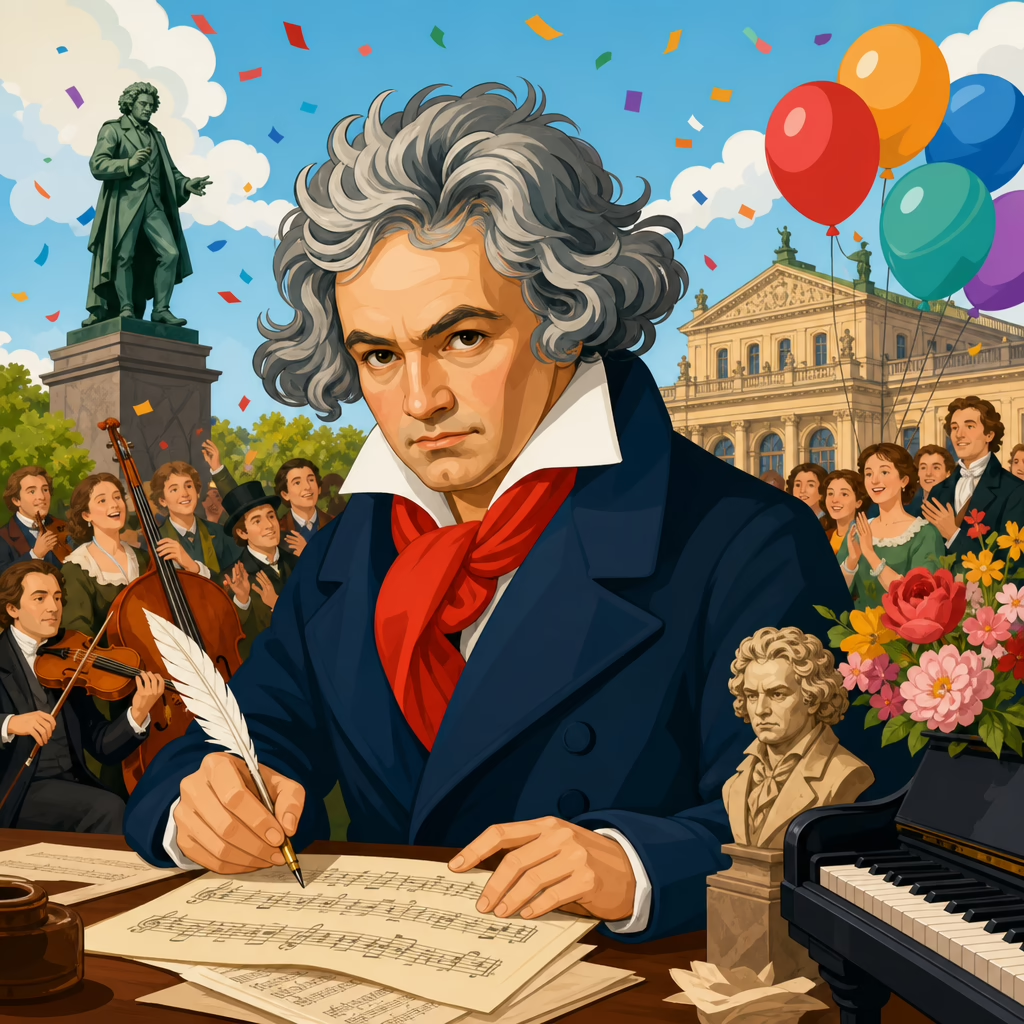
Beethoven and the Culture of Anniversaries
Beethoven anniversaries have never been simple dates on a calendar; they are cultural events that reveal how each generation chooses to remember, market, interpret, and argue over the composer’s place in public life. In this context, an anniversary means more than a birthday or death-year commemoration. It is a coordinated act of remembrance built through concerts, festivals, monuments, broadcasts, exhibitions, scholarly editions, media campaigns, school programs, and political speeches. Working with concert archives and anniversary programming over the years, I have seen that Beethoven’s milestone years consistently function as stress tests for cultural institutions: they expose what orchestras think audiences want, what governments think heritage should do, and what scholars believe still needs correction. That is why the culture of anniversaries matters. It shows not only how Beethoven survives, but how modern societies use him to stage ideas about genius, nationhood, education, European identity, and artistic relevance.
Beethoven is especially suited to anniversary culture because his biography and works lend themselves to ritual repetition. The dramatic arc is familiar: Bonn origins, Vienna career, expanding deafness, moral seriousness, revolutionary reputation, and a late style treated as visionary. Those elements can be simplified for mass audiences yet remain rich enough for specialists to debate. A two-hundred-and-fiftieth birth anniversary, for example, offers endless programming hooks: complete symphony cycles, the piano sonatas, chamber marathons, Fidelio revivals, manuscript displays, and educational projects around the “Ode to Joy.” Institutions value this repertoire because it is prestigious, recognizable, and flexible across budgets. A major opera house can mount a new production, while a local library can curate a small exhibition around facsimiles, recordings, and reception history. The anniversary becomes a shared cultural framework linking elite and popular activity.
At the same time, commemorating Beethoven is never neutral. Every anniversary asks implicit questions. Which Beethoven is being celebrated: the universal humanist, the German master, the European symbol, the difficult modernist, or the marketable brand? Which works dominate, and which are neglected? Who gets invited to speak for Beethoven, and who is left outside the frame? These questions became especially visible in the large-scale commemorations of 1927, 1970, and 2020. Each moment was shaped by its own technologies and politics, from radio and gramophone culture to television, streaming, digital archives, and global tourism. Looking closely at those anniversary cultures reveals how remembrance is produced. It also clarifies why Beethoven remains a reliable instrument for institutions seeking legitimacy, emotional resonance, and historical depth.
Why Beethoven Became an Anniversary Composer
Some composers are admired, but few generate recurring public ritual on Beethoven’s scale. The reason begins with canon formation in the nineteenth century. By the late 1800s, Beethoven was not merely a respected musician; he had become a benchmark for seriousness in concert life. His nine symphonies formed a near-sacred cycle. The sonatas and quartets became tests of artistic maturity. Monuments, collected editions, and biographies reinforced a stable public image that institutions could repeatedly activate. Once a composer becomes central to educational curricula, subscription programming, and national prestige, anniversaries almost organize themselves. Administrators know the repertoire will draw audiences, critics know the symbolic language, and funders recognize the value of attaching themselves to a figure already accepted as major.
Beethoven’s life story also encourages commemorative myth. He can be presented as a self-making artist who fought adversity, as a moral hero who transformed suffering into art, or as a revolutionary whose music seems to address collective freedom. Those narratives are selective, but they are useful. They allow anniversary planners to translate complex works into public themes that fit exhibitions, speeches, and marketing copy. I have watched institutions repeatedly return to a small set of motifs: struggle, triumph, universality, and the future. Even when scholars criticize these formulas, programmers use them because they help non-specialist audiences enter difficult repertoire. The anniversary package is therefore a blend of history and simplification, scholarship and slogan.
Another reason is practical. Beethoven offers enough famous works to sustain long festivals without exhausting audiences. A Mahler anniversary may rely heavily on the symphonies and songs; a Bach anniversary requires balancing sacred and instrumental repertories across specialized forces. Beethoven, by contrast, supports orchestral, chamber, solo, choral, operatic, and educational formats at every institutional level. That breadth makes him uniquely valuable in anniversary planning and helps explain his continuing centrality in discussions of why Beethoven became a global cultural icon.
How Anniversary Culture Took Shape in Practice
The modern Beethoven anniversary was built through media as much as music. Nineteenth-century festivals established the ceremonial template, but twentieth-century technologies expanded its reach. Print publishers issued special editions; record companies produced boxed sets; radio networks broadcast complete cycles; museums assembled traveling exhibitions; tourism boards promoted birthplace and memorial sites. By the time large centenary and sesquicentennial commemorations arrived, anniversary culture had become a coordinated ecosystem. It joined performance, commerce, education, and civic branding. A Beethoven year could boost hotel occupancy in Bonn, fill academic conferences in Vienna, and drive recording sales in London, Tokyo, and New York at the same time.
The process usually follows a recognizable pattern. Planning starts years in advance with a steering committee or consortium linking municipalities, orchestras, archives, broadcasters, and sponsors. A unifying slogan is chosen. Then institutions balance familiar repertoire with novelty: a complete symphony cycle alongside newly commissioned responses, historical instrument performances beside multimedia projects, major exhibitions next to community workshops. The strongest anniversary programs do not merely repeat the classics. They contextualize them through letters, notebooks, reception history, and social background. The weaker ones rely on prestige branding alone and end up sounding interchangeable with ordinary season planning.
Anniversary culture also depends on infrastructure. Beethoven has an advantage because he is supported by major collections, including the Beethoven-Haus in Bonn, the Gesellschaft der Musikfreunde in Vienna, the Staatsbibliothek zu Berlin, and numerous university and broadcasting archives. These institutions provide manuscripts, iconography, correspondence, and critical editions that can anchor serious public interpretation. When a festival exhibits sketch leaves or explains the history of the Ninth Symphony’s text, it gives commemoration intellectual weight. Without that archival spine, anniversary culture risks becoming decorative.
| Anniversary Year | Dominant Media | Typical Public Message | Cultural Effect |
|---|---|---|---|
| 1927 | Print, radio, monument culture | National prestige and heroic genius | Expanded mass listening and civic ceremony |
| 1970 | LPs, television, international festivals | Universal master and modern relevance | Globalized programming and recorded canon building |
| 2020 | Streaming, digital archives, social media | Inclusive access, critical reassessment, global heritage | Hybrid participation despite pandemic disruption |
Three Major Beethoven Anniversaries and What They Revealed
The 1927 centenary of Beethoven’s death demonstrated how powerfully commemoration could serve national and civic identity. Europe was still living with the aftermath of the First World War, and Beethoven could be claimed as both a German cultural hero and a broader emblem of high civilization. Radio mattered enormously. It allowed commemorative concerts to reach listeners who would never attend elite halls, turning remembrance into a mass auditory experience. Yet the framing was often solemn and monumental. Beethoven was elevated into marble, a figure of authority whose complexity was smoothed into certainty. The gains were real: wider access, more public education, and stronger archival work. The limitation was equally real: a tendency to make Beethoven seem untouchable.
The 1970 bicentenary of Beethoven’s birth unfolded in a different climate. Postwar internationalism and the mature recording industry gave it a more global and commercial character. Complete cycles proliferated. Television and LP box sets encouraged the idea that serious listeners should own or hear the whole canon. Historically informed performance practice was emerging, though not yet dominant, so many bicentenary performances still projected a large, post-Romantic Beethoven sound. At the same time, scholarship was becoming more attentive to sources, tempo debates, and reception history. In practical terms, 1970 helped standardize the modern Beethoven package: complete works, educational outreach, documentary media, and international branding.
The 2020 two-hundred-and-fiftieth birth anniversary was meant to be one of the largest music commemorations in recent memory, with Bonn at its symbolic center. Then the pandemic transformed the entire project. Festivals were canceled, halls closed, travel collapsed, and institutions had to rethink commemoration in real time. What looked at first like failure became a revealing experiment. Digital exhibitions, streamed concerts, remote lectures, and online archival access suddenly became essential rather than supplemental. Some projects reached larger international audiences online than they would have in person. The disruption also encouraged more critical framing. Instead of repeating inherited hero worship, many organizers asked how Beethoven had been used politically, how his image circulated globally, and how commemoration could include communities beyond the traditional concert audience.
Politics, Memory, and the Risks of Commemoration
Every Beethoven anniversary carries political meaning, whether organizers admit it or not. Public money, official patronage, and symbolic speeches all shape the event. Beethoven has been used to represent liberal humanism, German cultural prestige, European unity, and even abstract notions of civilization. The Ninth Symphony’s choral finale, in particular, invites appropriation because it appears to speak the language of universal brotherhood. But anniversary culture can flatten history when it presents these ideals without friction. Beethoven lived amid revolution, censorship, patronage dependence, and social hierarchy. Honest commemoration acknowledges those tensions instead of converting him into a harmless mascot.
There is also the problem of selective inclusion. Anniversary programs often overemphasize the symphonies at the expense of less familiar repertory, or they repeat a narrow line of celebrated interpreters while claiming universality. When I review festival plans, the first question I ask is simple: what new understanding will this anniversary generate? If the answer is only more performances of the Fifth and Ninth, the commemoration has missed its chance. Better models pair famous works with context: the political afterlives of “Eroica,” the sketch history of the late quartets, the practical realities of Vienna’s musical economy, or the changing performance traditions around the piano sonatas.
Commercialization is another risk, but it is not automatically corrupting. Souvenirs, tourism campaigns, and branded recordings can fund serious programming. The issue is proportion. When marketing language overwhelms historical content, anniversaries become shallow heritage consumption. The best institutions maintain a clear hierarchy: scholarship first, public communication second, merchandise third. Audiences respond well to that balance because they can sense when commemoration has substance.
What Strong Beethoven Anniversaries Do Well
The most effective Beethoven anniversaries share several traits. First, they define a clear interpretive theme rather than treating the date as self-justifying. A strong anniversary might explore Beethoven and citizenship, Beethoven and technology, or Beethoven in global reception. Second, it combines canonical performance with archival explanation. Hearing the Seventh Symphony is valuable; hearing it alongside a concise exhibition on its early reception is better. Third, it widens access without diluting standards. Livestreams, translated materials, school partnerships, relaxed-format events, and open digital archives all extend reach while preserving intellectual seriousness.
Fourth, the best commemorations embrace debate. Beethoven does not need protection from disagreement. Tempo arguments, instrument questions, editorial disputes, and political interpretations are signs of a living culture, not threats to it. In my experience, audiences appreciate being treated as capable of handling nuance. They do not need a saint; they need a vivid historical figure whose music still generates difficult, rewarding conversation. Finally, strong anniversaries leave durable resources behind. Temporary festivals fade, but digitized collections, new editions, documentaries, teaching materials, and community partnerships continue working after the banners come down.
That long afterlife is the real measure of success. An anniversary should not simply spike ticket sales for one season. It should deepen public knowledge, strengthen archives, broaden interpretive voices, and improve how institutions present Beethoven the next time his name becomes newly topical. When that happens, the date has done more than trigger remembrance. It has renewed culture through disciplined attention to a composer who still organizes listening, argument, and aspiration across borders.
Beethoven and the culture of anniversaries belong together because his music, biography, and reputation provide an unusually powerful framework for public memory. Anniversaries turn him into a mirror in which societies examine their values, from artistic seriousness and educational purpose to nationalism, cosmopolitanism, and market strategy. The record of 1927, 1970, and 2020 shows that commemoration is never just about the past. It is about the present uses of the past. Radio once made Beethoven a mass civic experience, LPs and television globalized his canon, and digital platforms reframed access during crisis. In every case, the anniversary exposed what institutions wanted Beethoven to mean.
The key lesson is straightforward. Good Beethoven anniversaries do not rely on inherited reverence alone. They pair great performances with archival evidence, invite critical discussion, expand access, and acknowledge political and commercial pressures without surrendering to them. Poor anniversaries repeat prestige formulas and call that remembrance. If you program, teach, research, or simply follow Beethoven, use the next milestone year as an opportunity to ask sharper questions about who is commemorating whom, and why. That is how anniversaries stop being ritual noise and become serious cultural work.
Frequently Asked Questions
What does the phrase “the culture of anniversaries” mean in relation to Beethoven?
In the case of Beethoven, “the culture of anniversaries” refers to the larger social machinery that forms around commemorative dates and turns them into public events with cultural meaning. An anniversary is not just the numerical fact of a birth year, death year, or major milestone. It becomes significant because institutions and communities actively build programs around it. Orchestras schedule complete symphony cycles, museums mount exhibitions, publishers issue new editions, scholars revisit old assumptions, broadcasters produce documentaries, schools create teaching materials, and political leaders often use the occasion to make claims about heritage, national identity, or shared values.
That is why Beethoven anniversaries reveal as much about the present as they do about the composer himself. Each generation selects which Beethoven to celebrate: the revolutionary artist, the universal humanist, the German master, the European icon, the deaf genius, or the symbol of artistic freedom. These choices are never neutral. They reflect contemporary tastes, anxieties, ideologies, and cultural priorities. Looking at Beethoven through the lens of anniversary culture helps explain why commemorations can feel celebratory, educational, commercial, and controversial all at once. They do not simply preserve memory; they actively shape it.
Why have Beethoven anniversaries become such major cultural events rather than simple commemorations?
Beethoven occupies an unusually powerful position in music history and public culture, which helps explain why his anniversaries often expand far beyond ceremonial remembrance. He is not only one of the most performed composers in the classical tradition, but also a figure long associated with genius, moral seriousness, artistic autonomy, and cultural prestige. Because of that symbolic weight, commemorating Beethoven offers institutions an opportunity to do many things at once: attract audiences, reinforce educational missions, secure funding, generate media attention, and participate in wider conversations about identity and values.
These anniversaries also lend themselves to large-scale programming. Beethoven’s output includes symphonies, concertos, piano sonatas, chamber music, sacred works, and iconic pieces recognized well beyond specialist circles. That makes him ideal for festivals, themed seasons, scholarly conferences, radio series, public lectures, and cross-disciplinary exhibitions. Cities connected to his life, especially Bonn and Vienna, can use anniversary years to promote tourism and civic identity, while global cultural organizations can present him as a shared reference point in world culture.
Another reason these events become so prominent is that Beethoven commemorations tend to gather momentum across many sectors at once. A concert series may be tied to a museum exhibition; a new scholarly edition may inspire recordings; media coverage may create further demand; public funding may favor heritage programming in milestone years. The result is a coordinated commemorative environment rather than a single event. In that sense, Beethoven anniversaries become cultural ecosystems, not isolated ceremonies.
How do Beethoven anniversaries reflect the values and debates of the time in which they are celebrated?
Every Beethoven anniversary is shaped by the historical moment that produces it. That is one of the most important insights behind studying commemorative culture. When a society celebrates Beethoven, it is not merely recovering an unchanged historical figure. It is reinterpreting him according to current needs and assumptions. In one era he may be presented primarily as a national hero; in another, as a universal humanitarian; in another still, as a figure whose legacy must be critically examined in light of exclusion, canon formation, race, gender, accessibility, or cultural power.
Political conditions often play a major role. Governments and public institutions have frequently used Beethoven to symbolize continuity, prestige, freedom, civilization, or unity. His music, especially works like the Ninth Symphony, has been attached to ideals that different groups have defined in very different ways. At the same time, anniversary culture can reveal tensions. Critics may ask who gets represented in commemorative programming, whose voices are amplified in exhibitions and scholarship, and whether anniversary branding turns complex history into a polished cultural product.
Media and technology also influence how Beethoven is framed. Earlier generations relied on monuments, printed editions, public ceremonies, and concert halls. Later commemorations were shaped by radio, recordings, television, international festivals, and now digital platforms, streaming, and online education. Each medium changes how audiences encounter Beethoven and what kind of authority surrounds the commemoration. So when we study Beethoven anniversaries, we are really studying a moving conversation between the composer’s legacy and the changing priorities of public culture.
What kinds of institutions and activities typically shape a Beethoven anniversary year?
Beethoven anniversary years are usually built by a wide network of institutions rather than a single organizing body. Concert halls and orchestras are often the most visible participants, programming cycles of symphonies, piano sonatas, string quartets, or major choral works. Opera houses, chamber music festivals, conservatories, and university music departments also contribute performances, lectures, and special series. Museums and archives may stage exhibitions devoted to manuscripts, portraits, instruments, reception history, and the visual culture surrounding Beethoven’s image.
Academic institutions play a major role as well. Scholars often use anniversary moments to publish new research, produce critical editions, organize conferences, and revisit long-standing assumptions about biography, style, historical context, and canon formation. Publishers and record labels may release anniversary editions, boxed sets, translations, documentaries, and companion volumes aimed at both specialists and general readers. Schools and public education programs often create curriculum materials that introduce Beethoven to younger audiences through classroom projects, guided listening, and community events.
Beyond the arts and academy, anniversary culture frequently involves tourism boards, municipal governments, broadcasters, cultural ministries, philanthropic foundations, and international organizations. Public monuments may be restored, walking tours developed, commemorative speeches delivered, and city-wide festivals branded around milestone dates. In recent years, digital initiatives have become especially important, including virtual exhibitions, streamed performances, podcasts, and online archives. All of these activities help explain why an anniversary year functions as a coordinated act of cultural production. It is a broad alliance of memory, interpretation, education, and public presentation.
Are Beethoven anniversaries purely celebratory, or can they also be controversial?
They are very often controversial, and that is precisely what makes them historically interesting. On the surface, anniversaries may seem like straightforward acts of admiration, but they almost always involve choices about emphasis, inclusion, interpretation, and ownership. Which works receive attention? Which biography is highlighted? Is Beethoven presented as a timeless genius above politics, or as a historical figure embedded in specific social and ideological worlds? Does the programming invite critical reflection, or does it rely on familiar myths that are easier to market?
Commercialization is one common source of debate. Anniversary years can produce substantial branding, merchandise, tourism campaigns, recording projects, and media packaging. Supporters may see this as a practical way to broaden access and sustain public interest. Critics may worry that Beethoven is being turned into a marketable emblem rather than a complex artistic figure. There can also be disagreement over institutional priorities, especially when large commemorative budgets raise questions about who benefits and which other artists or traditions remain underrepresented.
Scholarly and social criticism can add further layers of complexity. Recent discussions have examined how Beethoven’s prestige was historically constructed, how commemorative traditions support the authority of the classical canon, and how anniversary culture can either reinforce or challenge inherited narratives. That does not diminish Beethoven’s artistic importance. Instead, it encourages a more honest understanding of how memory works in public life. A Beethoven anniversary is never just a tribute. It is also a forum where societies negotiate what cultural inheritance means, who gets to define it, and why it still matters.