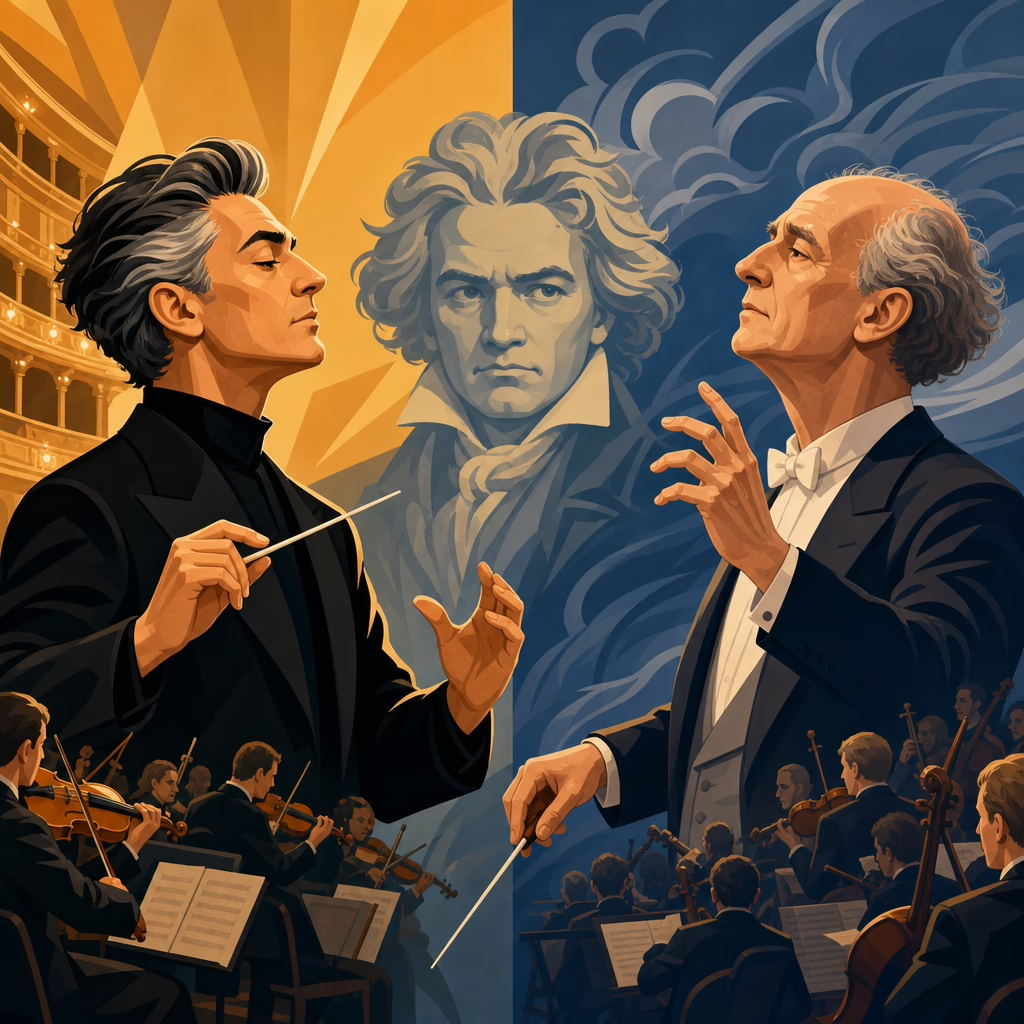
Comparing Karajan and Furtwängler on Beethoven’s Symphonies
Comparing Karajan and Furtwängler on Beethoven’s symphonies means comparing two of the twentieth century’s most influential conducting minds at the point where orchestral interpretation, recording history, and musical philosophy meet. Herbert von Karajan and Wilhelm Furtwängler both made Beethoven central to their public identities, yet they approached the nine symphonies with sharply different assumptions about tempo, orchestral sound, structure, and the conductor’s role. For listeners building a Beethoven collection, for students trying to understand interpretive traditions, and for anyone navigating the crowded field of historic and modern recordings, this comparison matters because these two conductors still define the poles of the debate. One represents sculpted control, surface finish, and long-line architecture achieved through precision; the other represents flexibility, spiritual urgency, and form emerging through tension and release in performance. I have spent years returning to their cycles and individual recordings, and the contrast remains one of the clearest ways to hear how interpretation changes familiar music. Beethoven’s symphonies are not neutral texts waiting to be reproduced. They are frameworks for decisions about pulse, phrasing, articulation, balance, and dramatic pacing. Karajan and Furtwängler made those decisions in ways that still shape modern expectations.
At the most basic level, Karajan is usually associated with the Berlin Philharmonic’s polished sonority and with studio-era control, especially in his major Beethoven cycles from the 1960s and 1970s. Furtwängler is associated with wartime and postwar live performances, broader tempo modification, and an elastic approach to rhythm that many admirers hear as uniquely organic. Those labels are useful, but incomplete. Karajan could be severe, driven, and rhythmically hard-edged, especially in the Fifth and Seventh. Furtwängler could be structurally rigorous beneath the surface volatility, and his best performances do not wander; they accumulate. Any serious comparison should therefore ask practical questions. How do they treat Beethoven’s metrical energy? How do they balance strings, winds, and brass? What happens in transitions, codas, and climaxes? Which recordings best represent each conductor? This hub article answers those questions across the symphonies while also pointing toward the wider miscellaneous territory around performance and recordings: remastering issues, live versus studio tradeoffs, orchestra-specific differences, and repertoire-wide listening strategies. If you want one article that helps organize the broader Beethoven recording conversation before diving into individual symphony pages, this is the place to start.
Interpretive philosophy: pulse, form, and orchestral sound
The cleanest distinction between Karajan and Furtwängler lies in how each conductor makes large-scale form audible. Karajan tends to project structure through steadiness of pulse, terraced dynamics, and finely controlled orchestral blend. In his 1963 Beethoven cycle with the Berlin Philharmonic, inner parts are carefully integrated into a unified sonority, with string sheen and brass weight balanced for cumulative impact. You hear paragraphs of music planned in advance. Even when Karajan broadens a climax, the listener rarely doubts the underlying beat. That consistency gives his Beethoven an almost architectural authority. The Eroica first movement, for example, often feels carved from granite: firm bass foundations, disciplined string attack, and transitions prepared with calculated inevitability.
Furtwängler makes structure audible differently. He stretches and compresses tempo within phrases and across sections, creating the impression that the music is discovering its own direction in real time. On paper, that can look unstable; in performance, at its best, it produces extraordinary narrative tension. His 1944 and 1952 Ninth Symphony performances show this clearly. The line breathes, recedes, and surges, yet climaxes land with overwhelming logic because the flexibility is tied to harmonic pressure and motivic development rather than mere mannerism. Winds and lower strings often emerge more starkly in the texture, and brass can sound raw compared with Karajan’s cultivated blend. But that roughness is part of the effect: Beethoven as struggle rather than monument. The result is less about orchestral perfection than about existential momentum.
These approaches also reflect different recording contexts. Karajan’s legacy is inseparable from high-fidelity studio production and the long-playing era, where repeated takes enabled immaculate balances and exact ensemble. Furtwängler’s reputation rests largely on live or broadcast sources, often in compromised mono sound, where risk and spontaneity are preserved alongside flaws. That does not mean one is objective and the other subjective; both are highly interventionist. It means Karajan intervenes before the listener hears the product, while Furtwängler’s interventions remain audible as moment-to-moment shaping within the event itself.
Symphonies One through Four: Classical roots, emerging personality
In the First and Second Symphonies, Karajan usually sounds more intent on continuity between early Beethoven and the mature symphonic tradition than on stressing Haydnesque wit. His phrasing is smooth, tuttis are full-bodied, and rhythmic articulation can be heavier than what later historically informed practice would prefer. Yet the payoff is stature. He refuses to treat these works as merely preparatory. The Berlin strings play with weight and unanimity, and slow introductions have genuine ceremonial breadth. If you want to hear early Beethoven framed as the opening chapter of a monumental cycle, Karajan is persuasive.
Furtwängler, by contrast, often makes the First and Second feel less polished but more volatile. He emphasizes surprise in accents and harmonic turns, and he is more willing to let transitional passages breathe. In the Second Symphony especially, that can bring out Beethoven’s disruptive energy. The drawback is that ensemble is not always as clean, and some listeners may find the flexible pulse excessive in music still grounded in eighteenth-century proportions. Even so, his best readings remind you that Beethoven’s early symphonies already contain an unstable dramatic charge that later works magnify.
The Third and Fourth sharpen the divide. Karajan’s Eroica is powerful when he keeps the first movement moving and allows the funeral march to grow from controlled restraint. The Berlin brass and timpani provide thrilling backbone, and the scherzo’s lift can be electrifying. Furtwängler’s Eroica can be even more gripping because he treats it as a living drama of expansion, collapse, and renewal. The funeral march under him often feels less like a formal slow movement than a historical tragedy unfolding. In the Fourth, Karajan highlights classical symmetry and sonic beauty, while Furtwängler uncovers darkness beneath the genial surface, especially in the mysterious introduction and the tensile slow movement.
Symphonies Five through Seven: drive, rhythm, and theatrical force
The middle symphonies are where many listeners form lasting allegiances. Karajan’s Fifth is one of the strongest arguments for his style. In the famous 1963 account, the opening is taut and unsentimental, with a concentrated rhythmic attack that avoids rhetorical overstatement. He builds the first movement through disciplined accumulation, keeps the Andante flowing, and drives the scherzo-finale transition with terrifying control. The coda of the finale is not simply loud; it is organized exultation. This is Beethoven as victory through mastery. Karajan’s Seventh is similarly compelling when he emphasizes motor rhythm without turning the work into a machine. The second movement remains grave but moving, and the finale is propelled by enormous orchestral discipline.
Furtwängler’s Fifth can sound less metrically fixed, but in exchange it often feels more dangerous. His openings are rarely clipped in the modern sense; they carry weight and rhetorical breadth. Crescendos swell with a sense of fate rather than mechanical sequence. In the scherzo, he can make the return of the mysterious tread genuinely uncanny, and the finale arrives not as a switch flipped by perfect engineering but as a hard-won breakthrough. His Seventh is among the most controversial readings in the repertoire because he treats rhythm as elastic energy rather than strict repetition. Admirers hear Dionysian sweep and elemental force. Skeptics hear distortion. In my experience, when the performance catches fire, especially in live readings, Furtwängler reveals how the Seventh can feel less like a dance and more like a ritual powered by obsession.
| Symphony range | Karajan typically emphasizes | Furtwängler typically emphasizes | Best for listeners who want |
|---|---|---|---|
| 1-2 | Weight, continuity, orchestral blend | Volatility, surprise, rhetorical flexibility | Either monumentality or early Beethoven’s disruptive edge |
| 3-4 | Architectural control, polished sonority | Drama, tension, dark undercurrents | Either structural clarity or unfolding narrative urgency |
| 5-7 | Rhythmic discipline, cumulative power | Risk, elasticity, theatrical breakthrough | Either precision-driven momentum or high-stakes live drama |
| 8-9 | Classical balance, grandeur, choral integration | Humor with bite, visionary breadth, spiritual intensity | Either sonic authority or transcendent instability |
The practical takeaway is simple: if rhythm for you means pulse held in firm focus, Karajan will usually satisfy more consistently. If rhythm for you means force generated by acceleration, relaxation, and pressure against the bar line, Furtwängler offers revelations that no cleaner performance can replace. Neither approach is universally correct, because Beethoven’s writing invites both discipline and freedom. What matters is whether the chosen method makes the score cohere. Both conductors, in their best middle-period performances, do exactly that by different means.
Symphonies Eight and Nine: wit, monumentality, and final statements
The Eighth Symphony is a useful test because it exposes heaviness immediately. Karajan can make it sound bigger than the work strictly requires, but he also brings remarkable finish to its contrapuntal detail and finale. When he keeps textures light enough, the piece gains confidence without losing humor. Furtwängler often finds more bite in the accents and more unpredictability in the shifts of character. His Eighth is less upholstered, more argumentative, and more obviously connected to Beethoven’s abrupt comic timing.
The Ninth is where the comparison becomes decisive for many collectors. Karajan’s studio recordings, especially the 1963 version, offer extraordinary choral-orchestral coordination, impressive solo quartet integration, and a finale engineered for clarity under pressure. The first movement is stern and coherent, the scherzo sharply profiled, and the Adagio unfolds with luminous string tone. He presents the symphony as a total artwork held together by command. Furtwängler’s great Ninths, especially Bayreuth 1951 and Lucerne 1954, are less even but often more overwhelming. The opening movement can feel primordial, the Adagio suspended outside ordinary time, and the finale charged with human struggle rather than ceremonial uplift alone. Choral execution is not always immaculate, yet the cumulative spiritual voltage is unmatched in the discography.
For that reason, many experienced listeners own both. Karajan supplies a benchmark of orchestral realization; Furtwängler supplies a benchmark of interpretive intensity. If your library includes one polished modern cycle and one urgent historic alternative, you will understand far more about Beethoven performance than by collecting ten similar sets.
Recording history, remastering, and how to choose recordings wisely
Because this page serves as a miscellaneous hub within performance and recordings, it is worth addressing a question collectors repeatedly face: which specific issues or transfers should you buy? With Karajan, the central choices usually involve cycle selection and remastering quality. The 1963 Deutsche Grammophon cycle remains the reference for many because it combines interpretive focus with strong analog-era engineering. Later digital Beethoven from the 1970s and 1980s can sound broader, glossier, and sometimes less urgent, though individual performances remain valuable. With Furtwängler, the source matters even more. Labels such as Tahra, Audite, SWR, Music & Arts, and Warner have issued transfers from different broadcast materials and tapes, and the difference in pitch stability, noise reduction, and dynamic range can alter the listening experience significantly.
As a rule, avoid judging Furtwängler from poor, aggressively filtered transfers that flatten orchestral color and blunt climaxes. His art depends on gradation and tension; bad restoration can make him seem merely vague or muddy. Likewise, avoid judging Karajan from compressed streams alone. His balances, especially low-string weight against brass and timpani, benefit from better playback and careful remastering. If you are starting out, one sensible path is Karajan’s 1963 cycle plus a curated set of Furtwängler performances rather than a complete cycle assembled from uneven wartime sources. Begin with Furtwängler’s Eroica, Fifth, Seventh, and Ninth in respected editions, then expand.
This broader listening strategy also points toward related articles in the subtopic: comparisons of mono and stereo Beethoven, guides to remaster labels, Berlin Philharmonic recordings across conductors, live-versus-studio collecting, and symphony-specific recommendation pages. Use this article as the organizing framework. Once you know whether you respond more to structural polish or interpretive volatility, the rest of the performance-and-recordings landscape becomes easier to navigate.
Karajan and Furtwängler remain central to Beethoven’s symphonies because they answer the same musical problems with opposing but equally serious convictions. Karajan shows how discipline, sonic planning, and orchestral refinement can make Beethoven sound inevitable. Furtwängler shows how flexible tempo, live risk, and dramatic tension can make Beethoven sound discovered anew in the act of performance. Across the nine symphonies, Karajan is usually stronger for listeners seeking consistency, recorded clarity, and a complete cycle that demonstrates orchestral command at the highest level. Furtwängler is indispensable for listeners seeking visionary intensity, extreme expressive range, and performances that turn familiar scores into urgent events.
The main benefit of comparing them is not choosing a winner. It is learning how interpretation works. Once you hear how differently the same transition, coda, or climactic return can function under these two conductors, you start listening more actively to every Beethoven performance that follows. Build your collection with both perspectives in mind, use strong transfers, and then explore the wider performance and recordings hub to deepen your understanding symphony by symphony, conductor by conductor, and issue by issue.
Frequently Asked Questions
What is the biggest overall difference between Karajan and Furtwängler in Beethoven’s symphonies?
The clearest difference is that Karajan generally treats Beethoven as a composer of architectural control, orchestral refinement, and cumulative power, while Furtwängler tends to present Beethoven as a composer of spiritual struggle, volatile drama, and organic transformation. In practice, that means Karajan often favors precision, polish, rhythmic steadiness, and a carefully blended orchestral sound. His Beethoven can feel sleek, inevitable, and symphonically integrated, with lines shaped toward long-term coherence. Furtwängler, by contrast, is famous for elastic tempo relationships, heightened transitions, and an almost improvisatory sense of unfolding. His performances can sound less “perfect” in a studio sense, but often more charged, unpredictable, and emotionally extreme.
Another way to frame it is that Karajan often emphasizes the score as a monumental structure, whereas Furtwängler emphasizes the score as a living process. Karajan’s Beethoven frequently projects command: climaxes are prepared, textures are controlled, and orchestral sonority is central to the experience. Furtwängler’s Beethoven often projects necessity: phrases expand and contract, tension accumulates through tempo flexibility, and the sense of arrival can be overwhelming because it seems discovered in real time rather than predetermined. Neither approach is inherently more “correct.” They represent two major twentieth-century traditions of Beethoven interpretation, and hearing them side by side reveals just how many different truths these symphonies can contain.
How do their tempo choices and rhythmic styles affect the listener’s experience?
Tempo is one of the most revealing points of comparison. Karajan is often associated with steadier pulse, stronger rhythmic discipline, and a more continuous flow across large spans. Even when he chooses broad tempos, the beat usually remains clear and the orchestral machinery stays tightly aligned. This can make his Beethoven feel purposeful and structurally legible. Inner voices are easier to follow, transitions can seem smoother, and the symphony as a whole often registers as a unified arc. For listeners who value balance, momentum, and orchestral control, Karajan’s handling of tempo can be very satisfying.
Furtwängler’s tempo practice is more flexible and, for many listeners, more radical. He is less interested in metrical regularity for its own sake than in breathing life into the music’s inner tensions. He may broaden a transition, accelerate a surge toward climax, or hold back a phrase to intensify harmonic pressure. This flexibility is not random; admirers hear it as a way of revealing the music’s deeper logic and emotional trajectory. Critics, however, sometimes find it subjective or overly interventionist. The result for the listener is dramatic: Furtwängler can make Beethoven sound like an elemental event, full of danger and revelation, while Karajan can make the same passages sound inevitable, lucid, and magnificently built. Much depends on whether you respond more strongly to interpretive freedom or to disciplined continuity.
Which conductor is better for understanding Beethoven’s orchestral sound and structure?
If your goal is to hear Beethoven’s symphonic writing with maximum orchestral clarity and a strong sense of polished ensemble execution, Karajan is often the easier entry point. He was deeply invested in orchestral sound as a medium in itself, and his Beethoven recordings frequently highlight precision of attack, blend among sections, and the cumulative weight of carefully managed dynamics. That approach can be especially helpful in symphonies where motivic development and textural layering matter a great deal, because Karajan often presents the orchestra as a single, highly responsive instrument. For many listeners, this brings out the grandeur and formal mastery of Beethoven’s writing in a very immediate way.
That said, Furtwängler can offer an equally profound, though very different, kind of structural insight. He is less likely to emphasize surface cleanliness than to reveal how one musical idea grows out of another across time. His shaping of tempo and phrase can illuminate the long-range tension of a movement in ways that are not always visible on the page or audible in stricter performances. In his hands, structure is not merely a matter of proportion and clarity; it becomes a drama of emergence, crisis, and resolution. So if “understanding structure” means hearing the score as a dynamic organism rather than a fixed blueprint, Furtwängler may feel revelatory. In short, Karajan often clarifies Beethoven from the outside in, through sound and control, while Furtwängler often clarifies him from the inside out, through tension and transformation.
Are certain Beethoven symphonies especially well suited to Karajan or to Furtwängler?
Yes, and this is one of the most useful ways to compare them. Karajan often makes a strong impression in symphonies that benefit from tensile orchestral unity, sonic brilliance, and monumental sweep. Many listeners are drawn to his accounts of the Fifth, Seventh, and Ninth for exactly those reasons. In these works, his command of momentum and orchestral sonority can produce an extraordinary sense of inevitability. He can also be compelling in the pastoral and lyrical dimensions of the Sixth, where long lines and orchestral sheen help create a broad, immersive landscape. His Beethoven tends to favor cohesion and cumulative grandeur, which can be especially persuasive in the more overtly public symphonies.
Furtwängler, on the other hand, is often considered uniquely powerful in symphonies where metaphysical weight, dramatic instability, and large-scale tension play central roles. His Eroica, Fifth, Seventh, and Ninth are especially revered because they can sound less like performances and more like historical or spiritual encounters. He often finds immense gravity in introductions, transitions, and codas, making familiar works feel newly dangerous. Even in symphonies that can be underestimated, such as the Fourth, he may uncover unusual depth and momentum. Of course, these are tendencies rather than hard rules. A listener building a Beethoven library may discover that Karajan is preferred in one symphony and Furtwängler in another, which is precisely why comparing them is so valuable: their strengths illuminate different dimensions of the same masterpieces.
Where should a newcomer start if they want to compare Karajan and Furtwängler intelligently?
A smart starting point is to choose one or two symphonies with very strong identities and hear both conductors in close succession. The Fifth and the Seventh are ideal because differences in pulse, tension, articulation, and climax are immediately audible. The Eroica is another excellent test case, since it reveals how each conductor handles scale, heroism, and structural breadth. If you want to understand their contrasting visions at the highest level of ambition, compare their Ninths as well. Try to focus on a few specific listening points: how the opening establishes authority, how transitions are handled, whether climaxes feel prepared or discovered, how much the tempo breathes, and what kind of orchestral sound each conductor seems to want.
It also helps to remember that you are not just comparing two conductors, but two recording cultures and two concepts of what conducting means. Furtwängler is often encountered in live or historically limited sound, where interpretive intensity matters more than studio finish. Karajan is closely associated with the modern recording age, where sonic control, balance, and repeatable perfection became central values. So listen with adjusted expectations. Do not ask only which version is cleaner or more exciting. Ask what each conductor believes Beethoven should be: a perfected symphonic edifice, a living dramatic organism, or some combination of both. That question turns a simple preference test into a much richer understanding of Beethoven performance history.