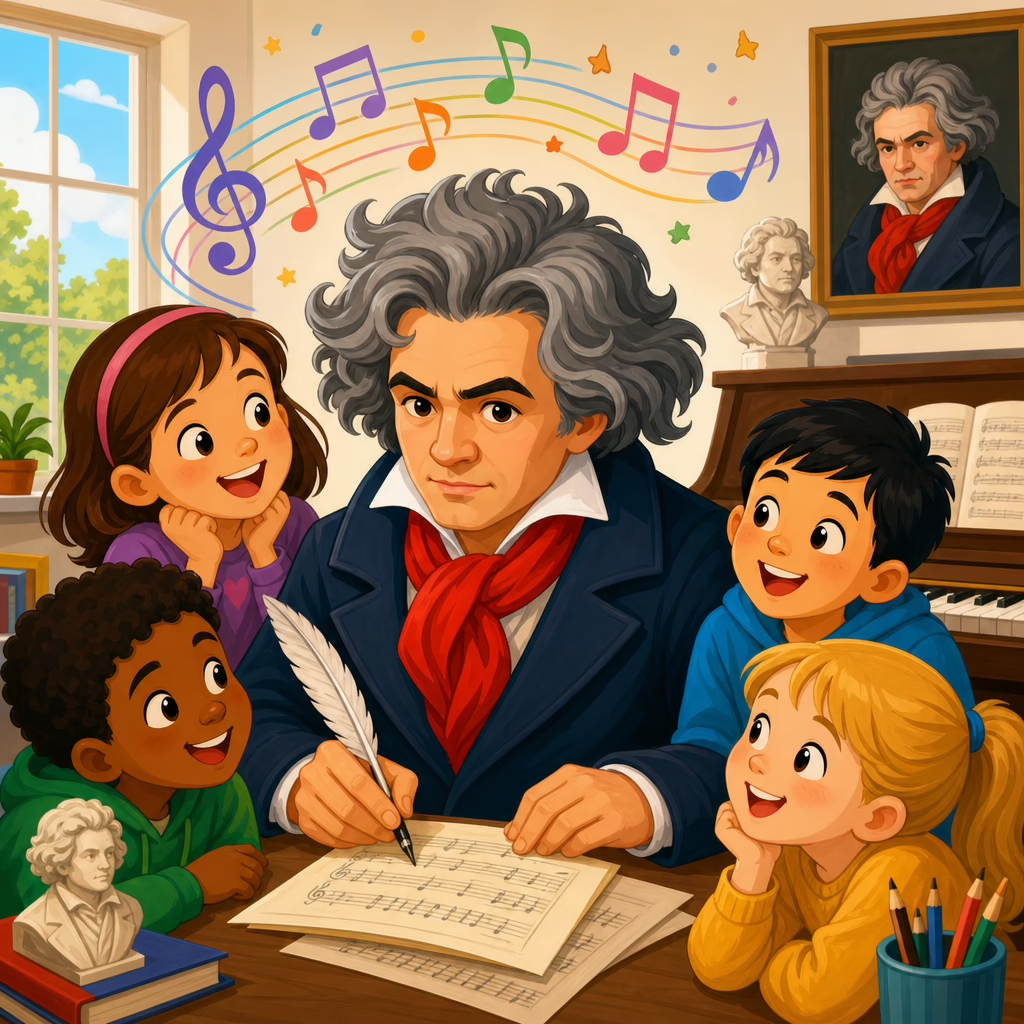
How to Introduce Beethoven to Elementary School Students
Introducing Beethoven to elementary school students works best when teachers treat him not as a distant genius in a powdered wig, but as a real person who made dramatic, memorable music and lived through challenges children can understand. Ludwig van Beethoven was a German composer born in 1770 and active during the transition between the Classical and Romantic eras, a period when composers balanced structure with stronger personal expression. For young learners, the key terms are simple: composer means a person who writes music, symphony means a large work for orchestra, motif means a short musical idea, and orchestra means a large group of instrumental musicians. This topic matters because Beethoven offers far more than music history. He helps children practice careful listening, emotional vocabulary, pattern recognition, persistence, and empathy. In classrooms, assemblies, and community education programs, I have seen students respond most strongly when Beethoven is introduced through stories, movement, and recognizable sound rather than dates alone. They remember the famous four-note opening of Symphony No. 5, the joy of “Ode to Joy,” and the astonishing fact that he continued composing even as hearing loss changed his life. An effective introduction also supports broader arts education goals. It connects music to language arts, social studies, science of sound, and social-emotional learning. As a hub article for miscellaneous community and education resources, this guide explains what to teach first, which works to choose, how to make lessons age-appropriate, and how families, schools, libraries, and youth programs can reinforce learning together.
Start with the story before the timeline
Elementary students need a narrative anchor before they can care about historical details. Begin with a short, vivid story: Beethoven was a boy who studied music seriously, became known as a brilliant pianist, moved to Vienna, wrote powerful music, and later faced hearing loss without giving up composition. That sequence gives children a human frame for everything else they hear. In my experience, this story-first approach keeps attention longer than opening with birthplaces, patronage systems, or formal style periods.
Keep the biography accurate but selective. Students do not need every detail of his difficult childhood, yet they can understand that he practiced hard and had a complicated family life. They should hear that Vienna was a major music city, that he wrote piano sonatas, symphonies, chamber music, and choral works, and that his music often sounds bold, surprising, and emotional. Most important, explain his hearing loss carefully. Do not turn it into a myth of superhuman triumph. Say instead that hearing loss created major challenges, likely emotional strain, and practical barriers, yet he kept working through notebooks, vibration, memory, and imagination. That framing teaches resilience without distortion.
One effective opening question is, “Can music tell a story or a feeling without using words?” Beethoven gives a clear yes. Children can hear storminess, celebration, suspense, and calm in his music even before they know titles. This direct connection helps them understand why he remains important in concert halls, films, schools, and public culture.
Choose a small set of Beethoven pieces that children can grasp
The best Beethoven lesson does not attempt a greatest-hits survey of everything he wrote. Select three to five works with clear contrasts in mood, tempo, texture, and purpose. For younger elementary students, I recommend Symphony No. 5 first movement opening, Symphony No. 6 “Pastoral” excerpts, “Ode to Joy” from Symphony No. 9, Für Elise, and a brief section of the Moonlight Sonata. These pieces are famous for a reason: they contain memorable ideas that children can identify quickly, and they show that one composer can write music that sounds intense, peaceful, cheerful, and reflective.
When presenting each piece, give one listening job only. For Symphony No. 5, ask students to listen for the short-short-short-long rhythm. For the Pastoral Symphony, ask them to imagine a countryside scene and identify which instruments sound like nature. For “Ode to Joy,” ask whether the melody feels singable and why communities still perform it. For Für Elise, ask how repeating patterns help listeners remember the tune. For Moonlight Sonata, ask what words describe the mood. Focused listening works better than broad discussion prompts because it reduces cognitive overload.
It also helps to explain what not to do. Avoid long uninterrupted recordings at the start. A full symphony movement can be too demanding for first exposure. Use excerpts of one to three minutes, then return to them later. Repetition is not a weakness in music education. It is the method that allows children to hear form, recurrence, contrast, and instrumentation over time.
Use active listening, movement, and visuals to make the music concrete
Elementary students learn Beethoven best when listening becomes physical and visible. Instead of asking them to sit still and absorb, invite them to tap rhythms, trace melodic direction in the air, sort feeling words, draw what they hear, or move like the character of the music. The opening of Symphony No. 5 is ideal for clapping and echoing. The Pastoral Symphony works well for drawing landscapes or identifying birdlike sounds. “Ode to Joy” can be sung on a neutral syllable before lyrics are introduced. These strategies turn abstract sound into something children can hold onto.
Visual supports matter. Show a portrait of Beethoven, a map of Bonn and Vienna, pictures of orchestral instruments, and a simple diagram of orchestra families: strings, woodwinds, brass, and percussion. If students can see the instruments while hearing them, recognition improves quickly. Short performance videos from major orchestras are particularly useful because children notice bowing, conducting gestures, and the teamwork involved in ensemble playing.
In community settings, I often use a compare-and-respond routine that gives structure without making music feel like a test.
| Piece or Excerpt | What Students Listen For | Simple Activity | Skill Built |
|---|---|---|---|
| Symphony No. 5 opening | Four-note motif and strong rhythm | Clap the pattern, then find repeats | Pattern recognition |
| Symphony No. 6 excerpt | Nature sounds and calm mood | Draw a scene that matches the music | Sound-to-image connection |
| Für Elise | Recurring melody | Raise a hand when the theme returns | Memory and form |
| Moonlight Sonata excerpt | Slow tempo and sustained mood | Choose three feeling words | Emotional vocabulary |
| “Ode to Joy” | Singable melody and build in texture | Hum together, then discuss why groups sing it | Community listening |
This kind of routine also supports mixed-age groups. Younger students can participate through movement and drawing, while older elementary students can add formal terms such as rhythm, dynamics, tempo, and theme.
Connect Beethoven to subjects beyond music class
Beethoven becomes more meaningful when he is linked to the rest of the elementary curriculum. In language arts, students can write a diary entry from the perspective of a concertgoer in Vienna or describe a piece using strong adjectives and sensory details. In social studies, teachers can place Beethoven in late eighteenth- and early nineteenth-century Europe, explaining that he lived during a period of political upheaval and cultural change. Students do not need a graduate seminar on the Napoleonic era, but they can understand that artists are shaped by the times they live in.
Science offers another strong connection. Sound can be introduced through vibration, pitch, volume, and resonance. A simple classroom demonstration with rubber bands, rulers, or tuning apps can show that sound travels through vibrations. This naturally opens a respectful discussion of hearing and hearing loss. If handled well, students learn both scientific facts and empathy. They also see that music is not magic alone; it is shaped by physical principles and human perception.
Math links are straightforward. Beethoven’s music is full of countable patterns, repeated phrases, and symmetrical structures. Students can count beats, compare phrase lengths, and notice how motifs expand. Art connections are equally strong. Children can create cover art for an imagined Beethoven playlist, sketch instrument families, or make abstract paintings that respond to contrasting excerpts. These integrated lessons are especially effective in community and education programs because they allow classroom teachers, music specialists, librarians, and after-school staff to reinforce one another instead of working in isolation.
Address myths, difficulty, and cultural context honestly
Many adults assume Beethoven is too serious or too difficult for elementary students. The opposite is often true when the material is presented clearly. Children respond to strong contrasts, memorable motifs, and stories of effort. What fails is not Beethoven himself but adult-centered teaching that relies on lecture, passive listening, or exaggerated hero worship. Students do not need to be told that Beethoven is important simply because history says so. They need evidence they can hear.
It is also essential to avoid reducing him to a single stereotype. He was not only the angry composer of Symphony No. 5. He also wrote graceful dances, intimate piano works, humorous moments, lyrical slow movements, and expansive choral music. Presenting these contrasts helps children understand that composers are multidimensional creators, not one-note characters from a textbook.
Cultural context matters as well. Beethoven belongs within a broader music education landscape that includes other composers, folk traditions, contemporary artists, and music from many cultures. When schools present only a narrow European canon, students receive an incomplete picture of musical life. A strong Beethoven introduction should therefore function as one hub within a wider arts curriculum. For example, after studying the motif in Symphony No. 5, students can compare memorable hooks in jazz, film scores, or local community music. After discussing “Ode to Joy” as a communal song, they can examine songs used in ceremonies, protests, worship, and celebrations around the world. This balanced approach preserves Beethoven’s significance without treating him as the sole gateway to serious music.
Build family and community participation around simple experiences
Community and education programs succeed when learning continues beyond a single lesson. Families do not need formal musical training to support Beethoven exploration. They can listen to one short piece at home, talk about the mood, watch a youth orchestra performance online, or attend a free concert in a park, library, school auditorium, or community arts center. In outreach work, I have found that short guided prompts help far more than long packets. A family handout might ask, “Which instrument did you hear first?” “Did the music sound peaceful or dramatic?” and “What picture came to mind while listening?”
Libraries and museums can contribute by pairing Beethoven recordings with picture books about composers, instrument demonstrations, and scavenger hunts based on sound. Youth orchestras and community ensembles can invite children to open rehearsals so they can see how musicians count, cue, repeat passages, and solve ensemble problems. That rehearsal view is valuable because it demystifies classical performance. Students realize that excellent music is built through practice and collaboration, not effortless genius.
Digital tools can help if used selectively. Streaming platforms, the Berlin Philharmonic Digital Concert Hall, Carnegie Hall educational resources, Classics for Kids, and recordings from major public broadcasters provide accessible material. Teachers should preview everything for length, audio quality, and age fit. A two-minute excerpt with one clear purpose usually teaches more than a twenty-minute video with scattered attention.
Beethoven can become one of the most rewarding composers to teach in elementary settings because his music is immediate, varied, and rich with entry points for different learners. Children can meet him first through a compelling life story, then through short, carefully chosen excerpts, and finally through active listening, movement, singing, drawing, and cross-curricular projects. The goal is not to produce miniature musicologists. The goal is to help students hear patterns, name feelings, ask questions, and recognize that great music was created by a real person facing real challenges.
The strongest approach is simple and consistent. Choose a few works, give students one listening task at a time, use visuals and performance clips, connect lessons to science, literacy, and social studies, and invite families and community partners into the experience. Be accurate about Beethoven’s life, honest about limitations and myths, and broad enough in your curriculum to place him alongside many other musical voices. When that happens, Beethoven stops feeling remote and starts feeling discoverable.
If you are building a community and education hub around miscellaneous arts learning, start with one memorable Beethoven excerpt this week and design one interactive question around it. That small step is usually enough to open the door to deeper musical curiosity.
Frequently Asked Questions
1. Who was Beethoven, and how can teachers explain him to elementary school students?
Beethoven was a German composer born in 1770 who became one of the most famous musicians in history. When introducing him to elementary school students, it helps to describe him as a real person first and a great composer second. Children connect more easily when they learn that Beethoven was not just a serious historical figure in old portraits, but someone who worked hard, had big feelings, and turned those feelings into music. A simple explanation is that a composer is a person who writes music, much like an author writes books. Beethoven lived during a time when music was changing from the balanced, elegant style of the Classical era to the more emotional, dramatic style of the Romantic era, so his music often combines clear patterns with strong expression.
For elementary students, teachers can say that Beethoven wrote music that sounds powerful, surprising, and full of emotion. Many children respond well to the idea that his pieces can sound like a storm, a celebration, a mystery, or a brave journey. Instead of focusing immediately on dates and advanced musical history, start with the idea that Beethoven used sound to tell musical stories without words. That approach makes him feel accessible and memorable. Once students are interested, teachers can add a few important facts, such as that he lived in Europe, played piano, and created famous works that people still listen to today.
2. Why is Beethoven a good composer to introduce in elementary music lessons?
Beethoven is an excellent choice for elementary music lessons because his music is vivid, emotional, and easy to react to, even for children with no formal musical training. Young students may not understand musical form or historical periods yet, but they do understand excitement, sadness, surprise, and energy. Beethoven’s music often expresses those feelings very clearly. That makes it ideal for listening lessons, movement activities, classroom discussions, and creative response projects. Students can hear contrasts in loud and soft sounds, fast and slow sections, and calm and dramatic moods, which gives teachers many ways to guide active listening.
He is also a strong subject because his life includes challenges children can understand. Beethoven worked hard, cared deeply about his music, and continued composing even after he began losing his hearing. Teachers can present this carefully and positively as an example of perseverance, determination, and creativity. That message can be inspiring for young learners without becoming too heavy or complicated. In addition, Beethoven connects well to broader curriculum goals. He fits into lessons about history, European culture, famous artists, musical instruments, emotions in the arts, and how people express ideas without words. Because of this combination of memorable music and meaningful life story, Beethoven often holds children’s attention better than composers who feel more distant or less dramatic.
3. What are the best Beethoven pieces for elementary school students to hear first?
Some of the best Beethoven pieces for elementary students are the ones with strong, recognizable musical ideas. A very common starting point is the opening of Symphony No. 5, with its famous short-short-short-long pattern. Children often remember it immediately, and teachers can use it to talk about rhythm, repetition, mood, and how just a few notes can become unforgettable. Another good choice is “Ode to Joy” from Symphony No. 9 because the melody is clear, uplifting, and easy to sing or play on classroom instruments. “Für Elise” also works well because many students recognize it from movies, videos, or piano lessons, and it gives them a chance to hear a softer, more lyrical side of Beethoven.
Teachers may also consider excerpts from Symphony No. 6, often called the “Pastoral” Symphony, because it can lead into conversations about nature, weather, and musical imagery. Students can listen and imagine scenes such as a walk outdoors or a thunderstorm. The key is not to play long works all at once. Instead, choose short excerpts and give students something specific to listen for, such as a repeating rhythm, a change in mood, or instruments entering one by one. Elementary students benefit most when listening is active. Clapping a motif, drawing what they hear, moving to the beat, or describing the music with feeling words can make Beethoven’s works much more engaging and understandable.
4. How can teachers make Beethoven engaging and age-appropriate in the classroom?
Teachers can make Beethoven engaging by building lessons around listening, movement, storytelling, and discussion rather than relying only on facts. One effective strategy is to introduce a short piece of music first and ask students what they notice. They might describe the music as bold, sneaky, happy, serious, or stormy. That kind of response helps children trust their ears and see that classical music is not something mysterious reserved only for experts. After students react to the music, the teacher can connect their observations to Beethoven’s style and explain that he was known for writing dramatic music full of energy and emotion.
Another strong approach is to present Beethoven as a person with a meaningful story. Students can learn that he practiced, performed, composed, and faced difficult obstacles, including hearing loss. This should be framed in a supportive, age-appropriate way: Beethoven found ways to keep creating even when life became harder. Classroom activities can include drawing pictures inspired by a Beethoven excerpt, acting out the mood of a symphony, comparing two pieces with different emotions, or creating simple rhythmic patterns based on Symphony No. 5. Teachers can also connect vocabulary in simple terms, such as composer, orchestra, melody, rhythm, and symphony. When students are invited to listen, imagine, move, and create, Beethoven stops being just a name in history and becomes a meaningful part of their musical experience.
5. What should children learn about Beethoven’s hearing loss, and how should it be discussed?
Children should learn that Beethoven began to lose his hearing as an adult, and that this was a serious challenge for someone whose life centered on music. However, the topic should be presented clearly, simply, and with sensitivity. The most important message for elementary students is not just that Beethoven had a problem, but that he showed remarkable perseverance. Even as hearing became more difficult, he continued thinking deeply about music and composing important works. This helps children understand that people can face obstacles and still create, contribute, and succeed in meaningful ways.
Teachers should avoid making the discussion overly dramatic or confusing. It is enough to explain that Beethoven’s hearing loss made life and work much harder, but he did not give up on music. This can open a thoughtful conversation about determination, problem-solving, and respecting the challenges others may face. In a classroom setting, it can also support empathy and inclusion by reminding students that people experience the world in different ways. When discussed carefully, Beethoven’s hearing loss becomes more than a biographical fact. It becomes a lesson in resilience, dedication, and the power of artistic expression, which is one reason his story continues to matter so much in elementary music education.