Beethoven and the History of Composer Collectibles
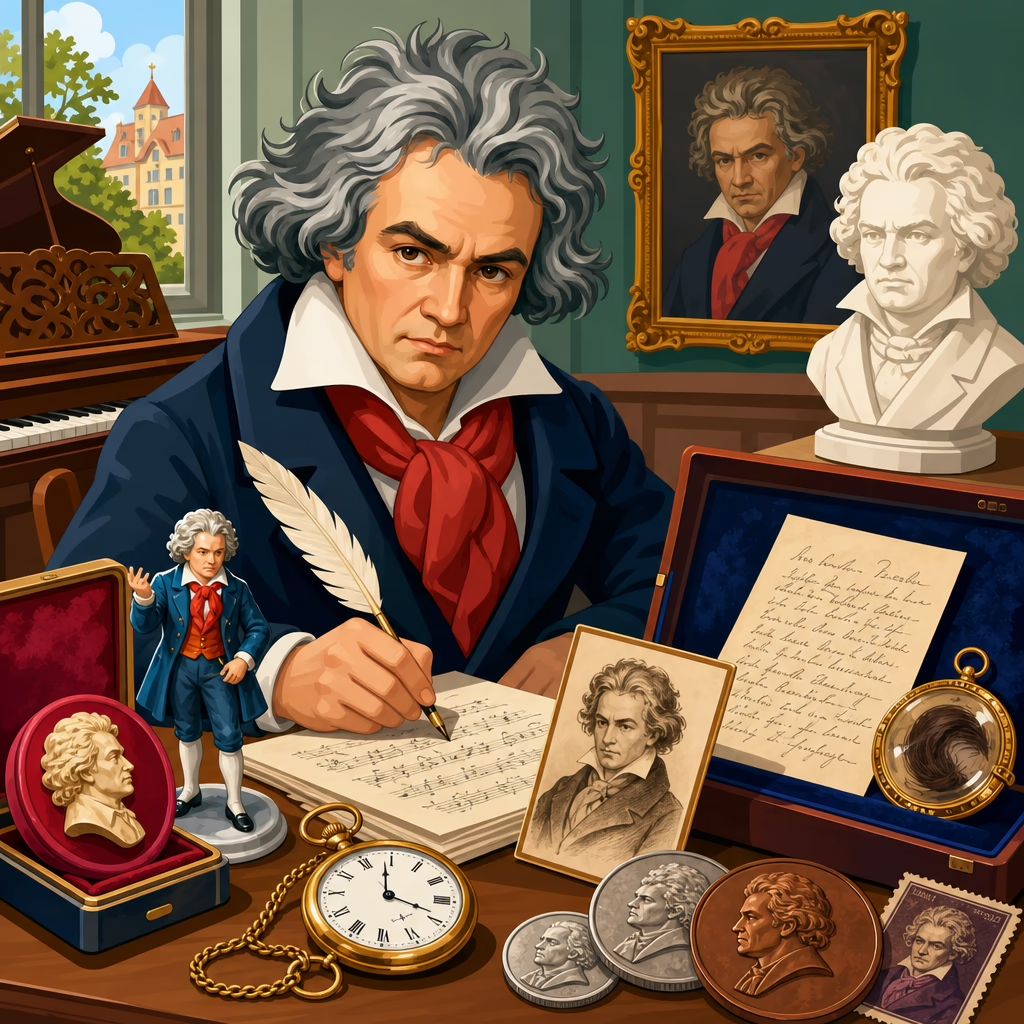
Beethoven collectibles reveal how a composer became a material presence in everyday life, not only through scores and performances but through objects people could buy, display, exchange, and preserve. In this context, composer collectibles means tangible items associated with Ludwig van Beethoven’s image, name, works, reputation, or personal relics: engraved portraits, medals, busts, autographs, commemorative editions, souvenir programs, phonograph sets, postcards, cigarette cards, and later recordings, figurines, posters, and museum-market reproductions. The history of these objects matters because it shows how cultural memory is built through commerce as much as through criticism or education. I have worked with auction catalogs, museum databases, and nineteenth-century print archives, and the pattern is consistent: Beethoven was among the first composers whose likeness circulated with the force usually reserved for monarchs, generals, and saints. Collecting him became a way to own a fragment of genius, to signal cultivation, and to participate in a broader European, then global, culture of remembrance.
That history also explains why Beethoven collectibles remain unusually diverse and resilient. Unlike collectibles tied to a single medium, Beethoven material spans manuscript culture, early mass printing, domestic sculpture, memorial tourism, shellac and vinyl, and modern heritage retail. The appeal is not only rarity. Many collectors are drawn by proximity: a first edition points to the work’s publication history, a medallion reflects civic commemoration, and a lock of hair or signed leaf raises questions of authenticity, preservation, and ethics. Others collect because Beethoven’s image became standardized early, making it easy to compare versions across decades. The severe brow, wild hair, and inward gaze formed a recognizable visual brand before the term existed. To understand Beethoven and the history of composer collectibles, it is necessary to trace how objects moved from elite keepsakes to middle-class souvenirs and finally into a specialized international market shaped by scholarship, provenance, and institutional collecting.
From relic to reproducible image: the first Beethoven collectibles
The earliest Beethoven collectibles emerged during his lifetime, but they were not yet part of a mature celebrity marketplace. Admirers sought autographs, manuscript leaves, visiting cards, portraits, and publications associated directly with the composer. In Vienna, where Beethoven lived most of his adult life, the culture of album signatures and manuscript exchange was already established among aristocratic patrons and musically literate collectors. A Beethoven autograph score or signed letter carried value because it was unique, scarce, and visibly touched by the composer’s hand. That logic resembles religious relic culture more than modern merchandising. Ownership implied intimacy with genius.
At the same time, engraving and lithography began to widen access. Portraits after Joseph Karl Stieler’s 1820 image helped establish the canonical Beethoven face. Printmaking mattered because it transformed Beethoven from a person known in courtly and musical circles into a visual presence in bourgeois interiors. Framed portraits hung in parlors beside poets, statesmen, and family ancestors. Publishers understood that images sold music, and music sold images. A piano owner buying a sonata edition might also purchase a portrait frontispiece or commemorative print. This was an important shift: Beethoven collectibles were no longer only elite relics; they were reproducible cultural goods.
After Beethoven’s death in 1827, the market accelerated dramatically. Death often fixes reputation, and in Beethoven’s case it created a scramble for memorial objects. Death masks, casts, memorial prints, black-bordered announcements, and funeral imagery circulated quickly. Publishers issued commemorative editions. Friends, secretaries, and heirs became custodians of papers and objects, sometimes responsibly, sometimes opportunistically. The line between tribute and trade was thin. That ambiguity has followed composer collectibles ever since. The very act of preserving Beethoven also created incentives to fragment his legacy into saleable parts.
Nineteenth-century memorial culture and the rise of the Beethoven souvenir
By the mid-nineteenth century, Beethoven collecting was inseparable from public commemoration. Festivals, monument unveilings, centenary events, and conservatory culture all generated objects. The 1845 unveiling of the Beethoven Monument in Bonn is a key moment. It was not simply a civic ceremony; it was a marketplace of memory. Visitors bought engraved views, program booklets, medals, ribbons, and printed tributes. Such items were inexpensive enough for broader participation yet specific enough to anchor personal memory. This is where the modern Beethoven souvenir truly takes shape.
Bonn became especially important because birthplace tourism gives collecting a geographic center. Travelers wanted proof of visitation. Local sellers supplied busts, plaques, facsimile manuscripts, and illustrated biographies. Similar patterns later developed around Vienna houses associated with Beethoven, concert halls, and exhibition sites. The souvenir object served two functions at once: it documented movement through cultural space and advertised membership in a cultivated public. Owning Beethoven was not merely decorative; it was social signaling in material form.
Industrial production expanded the range. Parian ware busts, bronze reductions, transfer-printed ceramics, and photographic cartes de visite brought Beethoven into middle-class homes at multiple price levels. Some were serious works of design; others were unabashedly commercial. Yet even modest pieces mattered historically because they normalized the idea that composers, like political leaders, deserved domestic iconography. Franz Liszt and Richard Wagner inspired similar objects, but Beethoven retained special status because his reputation crossed national and ideological boundaries more easily. He could signify German art, universal genius, heroic struggle, or moral seriousness depending on the setting.
Collectors today often underestimate how much ephemera drove that culture. Programs, ticket stubs, exhibition catalogs, publisher advertisements, and memorial postcards survive in greater numbers than deluxe bronzes. These paper traces are invaluable because they reveal demand patterns. A cheaply printed Bonn centenary postcard may tell a more precise story about Beethoven’s popular reach than a museum-quality bust. In practical collecting terms, ephemera also provides entry points for new buyers who cannot pursue manuscripts or major sculpture.
What collectors seek and how value is determined
Not all Beethoven collectibles are valued the same way, and the market is shaped by three factors above all: authenticity, provenance, and historical significance. Authenticity asks whether an item is genuinely what it claims to be. Provenance asks where it has been and who owned it. Historical significance asks how strongly it connects to Beethoven’s life, works, or reception history. In my experience, collectors who ignore any one of these three usually overpay or buy misleading material.
| Category | Typical examples | What drives value |
|---|---|---|
| Autograph material | Signed letters, manuscript leaves, annotated documents | Handwriting certainty, content, date, chain of ownership, condition |
| Lifetime editions | First or early printed scores and parts | Issue priority, completeness, publisher, association copies |
| Portrait and sculptural objects | Engravings, lithographs, busts, medals | Artist, production date, rarity, iconographic importance |
| Commemorative ephemera | Festival programs, postcards, tickets, ribbons | Event significance, survival rate, graphic appeal |
| Relic-type items | Hair, death-mask casts, furniture associations | Documentation quality, scientific testing, legal and ethical clarity |
| Recorded-media collectibles | Early complete symphony sets, special boxed editions | Label, pressing history, performer stature, packaging integrity |
Autograph material occupies the top tier because it offers direct contact with Beethoven’s working life. Auction houses such as Sotheby’s, Christie’s, and specialized manuscript dealers treat autograph letters differently from generic memorabilia because the content can alter musicological understanding. A routine receipt is valuable; a letter discussing a commission, publisher dispute, or performance is far more important. Condition matters, but content can outweigh flaws. By contrast, a later plaster bust may be visually impressive yet common enough that only exceptional casting quality or provenance lifts it above decorative status.
Provenance has become stricter in recent decades. Reputable dealers now expect documentation, old collection labels, published references, or inclusion in recognized catalogs. This is especially important for relic-type items, where romantic stories have historically outpaced evidence. The famous history of Beethoven’s hair, studied scientifically after surviving in private hands, demonstrates both the fascination and the caution required. Scientific testing can illuminate authenticity, but it cannot replace documentary proof. Serious collectors treat extraordinary claims conservatively.
Twentieth-century mass media changed Beethoven collecting
The twentieth century multiplied Beethoven collectibles because new media created new formats for devotion. Recordings transformed music collecting into object collecting on a large scale. Early shellac album sets of the symphonies, later LP cycles by conductors such as Toscanini, Furtwängler, Karajan, Bernstein, and Harnoncourt, and deluxe anniversary boxed editions all became collectible in their own right. Here the object carries layered value: Beethoven’s canon, performance history, label prestige, cover art, and format nostalgia. A first pressing of a landmark cycle is not just a sound carrier; it is evidence of how a period heard Beethoven.
Radio, film, and education markets also expanded visual merchandise. Schools displayed Beethoven portraits; publishers issued classroom busts and wall charts; film studios and record labels standardized graphic motifs. By the time of the 1927 centenary and especially the 1970 bicentenary, Beethoven collectibles were fully international. Japan, the United States, the Soviet Union, and Western Europe all produced commemorative items reflecting local design languages. Some objects emphasized revolutionary heroism, others spiritual depth, others educational uplift. The same composer portrait could serve sharply different cultural narratives.
This period also produced a split between high-end collecting and souvenir abundance. Museums and libraries pursued manuscripts, first editions, correspondence, and authentic personal objects. The consumer market, meanwhile, exploded with pins, posters, mugs, calendars, stamps, and boxed educational sets. That split is crucial for understanding value today. Rarity alone does not guarantee importance. Many twentieth-century promotional items are scarce because they were disposable, not because they were influential. Conversely, some mass-produced LP sets remain significant because they shaped international listening habits. Good Beethoven collecting requires reception history, not just scarcity hunting.
For readers interested in why this single composer generated such a durable object culture, the broader cultural context is well explained in this guide to Beethoven’s global cultural icon status. That larger story helps explain why Beethoven, more than many equally gifted composers, sustained continuous collectible demand across formats and generations.
How museums, archives, and private collectors shape the field today
Today, Beethoven collectibles sit at the intersection of scholarship, preservation, and market activity. Major institutions such as the Beethoven-Haus Bonn, the Austrian National Library, the Library of Congress, and important university special collections preserve manuscripts, letters, first editions, and portraits under professional standards. Their catalogs influence the private market by establishing benchmarks for attribution, dating, and comparative rarity. When a manuscript leaf appears at auction, specialists check paper type, watermarks, handwriting parallels, known work chronology, and prior publication references. The field is therefore more evidence-driven than casual buyers often assume.
Private collectors still matter enormously. Many important Beethoven items have surfaced from family archives, old European collections, and specialized music libraries assembled over decades. The best private collections are built patiently around a theme: early editions of the piano sonatas, iconography from 1827 to 1870, Bonn festival ephemera, or recorded interpretations of the Ninth Symphony. Focus creates intellectual value. A coherent collection can answer historical questions in a way a random assortment cannot. I have seen modest collections of postcards and programs teach more about Beethoven’s public image than expensive but disconnected trophy pieces.
For anyone entering this area, the practical advice is straightforward. Learn the standard portrait types. Study publication history. Compare auction results over time instead of relying on asking prices. Buy documentation as much as objects. Be suspicious of relic claims without chain of custody. Understand condition issues specific to paper acidity, plate marks, binding restoration, shellac breakage, and recast sculpture. Most of all, collect with a thesis. Beethoven collectibles are richest when they illuminate how a composer’s image moved through history, not when they merely fill a shelf.
Beethoven and the history of composer collectibles together tell a precise story about cultural memory becoming tangible. First came relic logic: autographs, manuscripts, portraits, and objects valued for direct contact with the composer. Then came reproduction: prints, busts, medals, and commemorative editions that brought Beethoven into bourgeois homes. Public festivals and birthplace tourism turned remembrance into souvenir culture. Twentieth-century recordings, educational media, and global anniversaries expanded that culture across formats and continents. Throughout every phase, the most important forces have remained the same: recognizable image, durable reputation, and a public desire to possess evidence of artistic greatness.
For collectors, curators, and readers interested in Beethoven’s place in material culture, the main benefit of studying these objects is clarity. Collectibles show not just what people admired, but how they learned to admire it. A letter, festival medal, first edition, or LP set each preserves a different chapter in Beethoven reception history. Taken together, they explain why Beethoven became one of the most collectable figures in all of music. If you want to go deeper, start by choosing one category, studying authentic examples in museum catalogs and major auction archives, and building knowledge before you build a collection.
Frequently Asked Questions
What counts as a Beethoven collectible in historical terms?
In historical terms, a Beethoven collectible is any tangible object made, preserved, or circulated because of its connection to Ludwig van Beethoven’s image, music, reputation, or physical legacy. That includes obvious items such as engraved portraits, sculpted busts, medals, autograph manuscripts, commemorative editions of his works, and early printed scores. It also includes more popular and commercial forms that brought Beethoven into everyday life, such as souvenir programs, postcards, cigarette cards, phonograph album sets, decorative plaques, and later reproduction memorabilia. The important point is that these objects do more than represent a composer; they turn Beethoven into something people can own, display, exchange, gift, or inherit.
What makes these items especially significant is their range. Some were luxury goods intended for collectors, scholars, or wealthy admirers, while others were inexpensive mass-produced objects designed for broad public appeal. A bronze medal might celebrate a centenary, a postcard might carry his familiar stern profile across international markets, and a recorded set of symphonies might function both as entertainment and as a cultural statement in the home. Together, these materials show how Beethoven moved from being known primarily through performance and notation to becoming a visible, material figure in domestic interiors, shops, exhibitions, and collections. In that sense, Beethoven collectibles are not just curiosities; they are evidence of how musical fame became embedded in modern consumer culture.
Why is Beethoven so important to the history of composer collectibles?
Beethoven occupies a central place in the history of composer collectibles because his public image became unusually powerful, durable, and marketable. He emerged at a moment when European print culture, commemorative art, and later industrial reproduction were expanding rapidly. As Beethoven’s reputation grew from celebrated composer to near-mythic artistic genius, objects bearing his likeness or name began to carry meanings far beyond simple fandom. Owning a Beethoven item could signal education, seriousness, patriotism, artistic taste, or devotion to high culture. This helped make him one of the earliest composers whose identity could circulate through a wide variety of collectible forms.
His afterlife also benefited from the strength of his visual brand. The intense expression, unruly hair, and iconic profile familiar from portraits and busts made Beethoven instantly recognizable in ways that translated well into engravings, medals, ceramics, postcards, and later commercial reproductions. Anniversaries, monument unveilings, museum displays, and recording campaigns reinforced that visibility. By the late nineteenth and early twentieth centuries, Beethoven was not only a composer people heard in the concert hall; he was a cultural presence people encountered on mantels, in albums, in libraries, and in display cases. For historians, that makes Beethoven collectibles a particularly rich case study in how celebrity, memory, commerce, and cultural authority came together around a composer.
How did Beethoven collectibles change from the nineteenth century into the age of mass media?
In the nineteenth century, Beethoven collectibles were often tied to memorial culture, printmaking, and elite or semi-elite collecting practices. Engraved portraits, commemorative editions, autograph fragments, medals, and sculpted busts helped shape his posthumous image. These objects often emphasized reverence, permanence, and artistic distinction. Many were connected to publishers, musicians, learned societies, or civic commemorations. They were designed not simply to decorate but to preserve and transmit Beethoven’s stature as a major cultural figure. In this period, collecting Beethoven could resemble a form of cultural guardianship.
As mass media expanded, the field widened dramatically. New printing technologies, photography, advertising, and recorded sound made Beethoven available in forms that were more affordable and more widely distributed. Postcards, souvenir booklets, cigarette cards, popular portrait reproductions, and phonograph sets allowed his image and music to enter ordinary households on a larger scale. In the twentieth century, a Beethoven collectible might be a serious archival artifact or a commercial keepsake sold to tourists and music lovers. This shift did not diminish his prestige; rather, it multiplied the ways people could participate in it. The result was a layered collectible culture in which rare relics and mass-market souvenirs coexisted, each contributing to Beethoven’s continued presence in public memory and private life.
What do Beethoven collectibles reveal about music history and everyday culture?
Beethoven collectibles reveal that music history is not shaped only by compositions, performances, and institutions, but also by objects that carry meaning through daily use and display. A portrait on a wall, a bust on a shelf, a commemorative score on a piano, or a boxed set of recordings in a living room all show how people integrated Beethoven into their routines, values, and self-presentation. These items tell us how audiences related to the composer emotionally and socially. They help explain how admiration for Beethoven moved beyond the concert hall and became part of domestic culture, educational aspiration, and public commemoration.
They also illuminate the broader mechanics of cultural memory. Collectibles mediate between the abstract world of music and the physical world of ownership. They make reputation tangible. Through them, Beethoven could be framed as a genius, a national icon, a moral exemplar, or a symbol of cultivated taste, depending on the setting and era. For historians, these objects provide evidence of changing markets, technologies, and audiences. They show how musical authority was packaged and circulated, how classical music intersected with commercial production, and how people used objects to express belonging to a cultural tradition. In short, Beethoven collectibles offer a concrete way to study how great composers became part of everyday historical experience.
How should collectors and readers evaluate the significance of Beethoven memorabilia today?
Today, the significance of Beethoven memorabilia should be evaluated through both material and cultural lenses. Materially, important questions include authenticity, provenance, condition, rarity, date, maker, and historical context. An autograph manuscript, signed letter, early engraved portrait, or period medal will be assessed differently from a later souvenir postcard or modern reproduction bust. Provenance matters enormously, especially for items claimed to be personal relics or direct documentary traces of Beethoven’s life. Readers and collectors should pay close attention to catalog descriptions, publication history, expert opinions, and any documented chain of ownership. The most valuable objects are not always the most visually impressive; often, their significance lies in what they can reliably tell us about Beethoven’s life, reception, or commemoration.
Culturally, even modest items can be deeply revealing. A cheaply printed postcard or souvenir program may have little monetary value, yet it can say a great deal about how Beethoven was marketed to the public at a particular moment. Likewise, an early phonograph set can document changing listening habits and the role of recording technology in extending Beethoven’s reach. For that reason, evaluation should go beyond price alone. The best approach is to ask what kind of Beethoven story the object tells: Is it about personal relic worship, scholarly preservation, domestic display, national celebration, mass reproduction, or modern nostalgia? When seen this way, Beethoven memorabilia becomes more than collectible material; it becomes a record of how one composer’s legacy was repeatedly made visible, portable, and meaningful across generations.