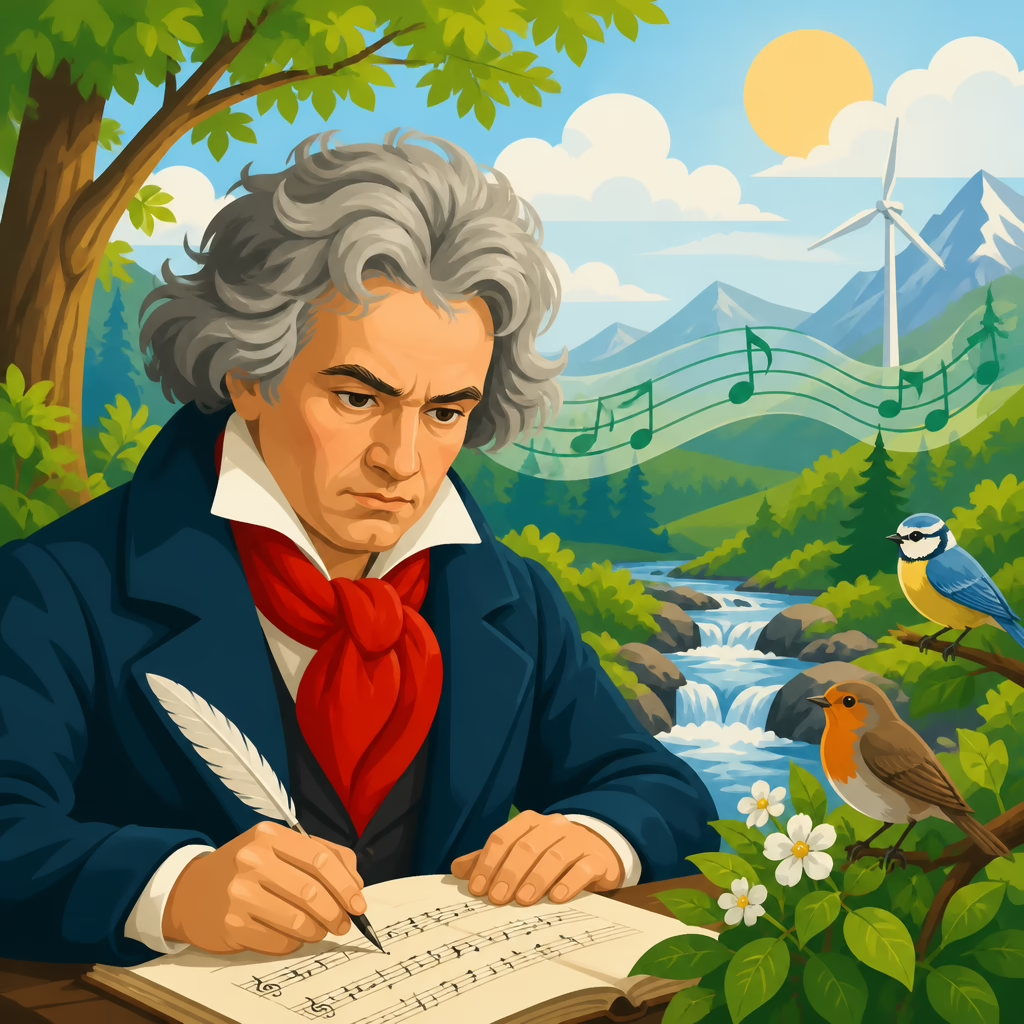
Beethoven and Environmental Readings of Classical Music
Environmental readings of Beethoven ask a precise question: how can music that contains no explicit landscape description still encode ways of hearing weather, terrain, motion, and human relation to the natural world? In Beethoven studies, “environmental” does not mean a loose claim that the composer liked countryside walks, nor does it reduce every brook, storm, or bird call to autobiography. It means interpreting musical structure, orchestration, rhythm, and listening context through ideas associated with place, ecology, embodiment, and soundscape. That approach matters because Beethoven sits at the center of the classical canon. The way listeners describe his music shapes concert programming, music education, recording culture, and even public assumptions about what instrumental music can mean.
From my experience working with concert notes, score analysis, and reception history, environmental interpretation becomes most useful when it stays concrete. Instead of saying Beethoven “celebrates nature,” it asks what specific devices produce that impression. A pedal point can suggest spatial continuity. Repeated rhythmic cells can imply footfall, labor, or elemental persistence. Wind writing can frame air as medium rather than decoration. Silence, register, and dynamic contour can make listeners hear exposure, shelter, distance, or proximity. These are musical facts first, environmental meanings second. When the order is reversed, interpretation quickly turns sentimental.
Beethoven is especially fertile for this kind of reading because his career spans a moment when European thought about nature was changing. Enlightenment ideals of order remained powerful, yet Romantic attitudes toward the sublime, solitude, and organic growth were gaining force. At the same time, industrialization was beginning to alter daily experience of noise, movement, and urban life. Beethoven’s music absorbs these tensions. It can sound pastoral without being simple, violent without being chaotic, and bodily without becoming program music in the narrow sense. Environmental readings help explain why.
The most famous case is the Sixth Symphony, but treating that work as the only relevant example actually weakens analysis. The value of an environmental approach is that it illuminates Beethoven’s habits across genres: symphonies, sonatas, quartets, overtures, and songs. It also clarifies the difference between scenic representation and ecological imagination. A scene is a picture. An ecological imagination is a system of relations among human movement, natural process, memory, and perception. Beethoven often works in the second mode. He invites listeners not merely to see a field or hear a stream, but to inhabit changing conditions.
What environmental interpretation means in Beethoven analysis
An environmental reading begins with sound as situated experience. In practical terms, that means asking four grounded questions. First, what in the score suggests motion through space rather than abstract thematic development alone? Second, how does instrumentation create material environments such as wind, resonance, open air, enclosure, or storm pressure? Third, what did Beethoven’s first listeners associate with these gestures, given late eighteenth- and early nineteenth-century conventions? Fourth, where are the limits of the claim? Good interpretation is specific about evidence and cautious about symbolism.
Musicologists often distinguish between mimesis, topic, and form. Mimesis is imitation, such as thunder effects or bird calls. Topic refers to style codes listeners recognize, including the pastoral convention of drones, compound meter, and simple harmonic fields. Form concerns the large-scale process through which a work organizes time. Environmental readings are strongest when they combine all three. In Beethoven, a brook is not only a fluttering figure in the violins. It is also a pastoral topic and a formal environment in which repetition, extension, and low harmonic tension invite lingering attention.
This matters because Beethoven repeatedly resists the purely pictorial. He famously remarked that the “Pastoral” Symphony was more an expression of feeling than painting. That statement is often quoted but not always understood. It does not reject representation; the symphony plainly contains descriptive markers. Instead, it redirects listening from object to relationship. The brook scene matters because it changes human perception. The storm matters because it reorganizes energy, density, and vulnerability. The peasants’ merrymaking matters because communal rhythm exists within larger natural cycles, not outside them.
Environmental interpretation also intersects with acoustics. Beethoven composed for rooms, theaters, and instruments whose sound profiles differ from modern conditions. Natural horns, wooden flutes, and gut strings produced timbral grain that made wind, roughness, and distance more palpable. Historically informed performances often reveal this vividly. In the Sixth Symphony, for example, timpani and trombones can sound less like cinematic spectacle and more like weather entering the musical field. That distinction is important: the point is not volume alone, but the sense of an environment exerting force.
The Sixth Symphony beyond postcard pastoralism
The Symphony No. 6 in F major, Op. 68, remains the central test case because Beethoven supplied movement titles: “Awakening of cheerful feelings upon arrival in the countryside,” “Scene by the brook,” “Merry gathering of country folk,” “Thunderstorm,” and “Shepherd’s song; cheerful and thankful feelings after the storm.” Those labels encourage direct interpretation, yet the score is more subtle than a sequence of picturesque panels. The first movement unfolds less like a depiction of a view and more like bodily settling into a place. Its repeated accompanimental figures and relaxed harmonic pacing create environmental stability.
The brook movement shows how Beethoven turns convention into process. Murmuring accompaniment figures are common enough in eighteenth-century pastoral writing, but here the continuity matters as much as the motif. Time seems to broaden. Cadences arrive, yet the movement resists urgency. Near the end, woodwinds articulate named bird calls often linked to nightingale, quail, and cuckoo. These moments are real examples of imitation, but they are brief and almost secondary. The larger environmental effect comes from sustained flow, delicate layering, and an acoustical impression of listening outward rather than pressing ahead.
The storm movement is equally revealing. Beethoven does not simply add loud dynamics and rapid notes. He destabilizes meter, compresses texture, and activates brass and timpani to produce pressure. Cellos and basses contribute grounded turbulence, while piccolo and trombones sharpen the upper and lower extremes of the spectrum. The result is meteorological not because it copies literal thunder perfectly, but because it stages exposure. In performance, audiences feel that the musical world has lost shelter. That is a stronger environmental effect than any single sound effect.
The finale then matters ethically as well as formally. Gratitude after the storm is not triumph over nature. It is reintegration within a restored order. The shepherd-like melody, the return of stable meter, and the clearer phrase structure all signal recovery, but not conquest. This is one reason the work still rewards modern ecological reading. It imagines humans as responsive participants in a larger field of forces. For readers interested in Beethoven’s lived habit of outdoor movement, the broader context is developed in this guide to Beethoven’s walking and its musical meaning.
How other works support environmental readings
Limiting environmental analysis to the “Pastoral” misses important evidence elsewhere. The “Tempest” Sonata, Op. 31 No. 2, for instance, is not a nature piece in any explicit programmatic sense, yet its volatile arpeggiation, registral space, and recitative-like interruptions create an atmosphere of unstable elements. The opening can feel like listening under changing pressure systems, with silence functioning as charged air rather than simple pause. That does not prove a scenic narrative, but it does support the claim that Beethoven knew how to compose environments of exposure, suspense, and release.
The Fourth Piano Concerto offers a different case. Its lyrical opening, where the solo piano begins alone, can be heard as establishing a fragile human voice within an enveloping orchestral field. In the second movement, the stark exchange between piano and strings has often attracted mythic interpretations, yet environmental hearing shifts focus to texture and resistance. The strings occupy a hard, collective space; the piano answers with porous, singing lines. Whether one hears social drama or not, the movement dramatizes how a voice inhabits and transforms an acoustic environment.
Late Beethoven is perhaps the richest area for environmental reading because large formal spaces become intertwined with fragility, threshold states, and resonance. In the String Quartet in A minor, Op. 132, the “Heiliger Dankgesang” alternates chorale-like stillness with livelier passages marked “Neue Kraft fühlend,” or “feeling new strength.” The music’s environmental force lies in breath, spacing, and recovery. Listeners do not simply observe a scene; they undergo altered conditions. Illness, convalescence, and renewed motion become audible as changing habitats of sound.
| Work | Environmental cue | Why it matters |
|---|---|---|
| Symphony No. 6 | Pastoral topic, storm texture, bird calls | Turns nature from scenery into lived relation |
| Piano Sonata Op. 31 No. 2 | Silence, arpeggiation, registral distance | Creates exposure and atmospheric instability |
| String Quartet Op. 132 | Breath-like pacing, renewal contrasts | Models recovery as environmental change |
| Violin Sonata Op. 24 | Open textures, lyric ease | Suggests cultivated pastoral space without literal program |
Pastoral convention, walking rhythm, and embodied listening
One persistent misunderstanding is that environmental reading means importing modern ecological politics into old scores. In fact, the first layer is historical. Eighteenth-century audiences already recognized the pastoral as a coded musical language. Drones, lilting meters such as 6/8, parallel thirds and sixths, rustic dances, and simple harmonic grounding signaled countryside life. Beethoven inherited those devices from composers including Haydn and earlier operatic traditions. What makes his treatment distinct is the degree to which these signs become engines of form instead of surface markers.
Walking is central here, not as biographical trivia but as embodied rhythm. Anyone who has spent time with Beethoven’s sketchbooks and the testimony of friends knows that walking structured his thinking. Musically, this matters because recurring tread-like patterns can function as more than accompaniment. They can stabilize perception, pace thematic unfolding, and place listeners inside ongoing movement. In the first movement of the Sixth Symphony, for example, the rhythmic regularity feels less like a decorative pastoral groove and more like arrival through repeated steps, breath, and visual scanning.
Embodied listening also explains why Beethoven’s environmental music rarely depends on lush harmony alone. He often builds effect through muscular repetition and articulation. Short motifs return with slight variation, creating the sense of terrain encountered from shifting angles. This resembles actual walking experience: the path continues, yet light, incline, and attention change. In performance, conductors who understand this avoid over-romantic smoothing. They let patterns retain definition. When phrasing becomes too generalized, the environmental dimension disappears because listeners no longer sense body, resistance, and place.
There is also a social dimension to pastoral rhythm. Country dances and peasant gatherings in Beethoven are not neutral backdrops. They present organized communal motion, sometimes sturdy, sometimes awkward, always situated. The third movement of the Sixth Symphony is a clear example. Its accents and roughness keep the music from sounding idealized. The countryside is not pure abstraction; it contains people whose bodily movement belongs to the environment. Environmental readings therefore work best when they include labor, festivity, and vulnerability, not only scenic calm.
Limits, debates, and why the approach still matters
Environmental readings of Beethoven are persuasive only when they avoid two extremes. The first is naive realism, the idea that instrumental music straightforwardly depicts rivers, storms, or fields. The second is formal isolation, the claim that music means nothing beyond internal relationships. Beethoven’s works defeat both positions. They are too structurally rigorous to be reduced to illustration, and too saturated with recognizable topics, titles, and listening cues to be treated as sealed systems. The task is to show how musical organization produces environmentally meaningful experience without pretending the score is a photograph.
Scholars also debate whether environmental criticism risks anachronism. That caution is fair. Beethoven did not write under modern ecological science, climate discourse, or environmental justice frameworks. Yet he did compose within traditions of natural philosophy, landscape aesthetics, and bodily engagement with rural space. The distinction is crucial. Responsible interpretation does not claim Beethoven was an environmental activist in a contemporary sense. It argues that his music offers models of relation: dependence, exposure, gratitude, disturbance, recovery, and coexistence. Those models remain analytically valuable and culturally resonant.
For performers and listeners today, this approach sharpens practical decisions. Tempo choices affect whether a brook flows or merely drags. Articulation determines whether repeated figures feel like tread, machinery, or generic accompaniment. Instrument balance can make the storm oppressive or merely noisy. Program notes can frame the Sixth Symphony as more than a pleasant escape piece, highlighting its dynamic view of humans inside changing conditions. In teaching, environmental reading also helps students move beyond plot summaries toward evidence-based listening grounded in timbre, rhythm, form, and historical convention.
Beethoven and environmental readings of classical music belong together because his scores repeatedly transform nature from backdrop into relationship. The strongest analyses start with the music itself: pastoral topics, formal pacing, acoustic texture, bodily rhythm, and historically recognizable signs. From there, they show how Beethoven invites listeners to inhabit weather, space, motion, and renewal rather than merely observe them. The Sixth Symphony remains the clearest example, but sonatas, quartets, and concert works confirm the pattern across his output.
The main benefit of this approach is precision. It replaces vague claims about Beethoven loving nature with demonstrable listening evidence and richer historical context. It also restores balance: nature in Beethoven is not sentimental decoration, yet it is not irrelevant to form. It is a way of organizing experience. If you want to hear these works more deeply, return to the score or a trusted recording and listen for tread, airflow, pressure, shelter, and release. Those details reveal why environmental interpretation remains one of the most illuminating ways to understand Beethoven.
Frequently Asked Questions
What does an environmental reading of Beethoven actually mean?
An environmental reading of Beethoven asks how his music can organize listening around ideas of weather, space, terrain, movement, and human relationship to the nonhuman world, even when no text explicitly describes a landscape. This approach does not depend on proving that Beethoven was “writing about nature” in a literal or autobiographical sense. Instead, it looks closely at the musical means themselves: rhythmic propulsion that suggests walking or flowing movement, orchestral color that creates a sense of atmosphere, dynamic contrast that can feel like sudden meteorological change, and formal design that places the listener inside patterns of tension, exposure, shelter, expansion, or return.
In other words, environmental criticism in Beethoven studies is less about attaching a scenic label to every passage and more about understanding how music shapes ecological perception. A symphonic texture can make listeners feel immersion, distance, instability, openness, or resistance. A repeated figure can evoke cyclical processes rather than linear narrative. Harmonic motion can produce sensations comparable to crossing difficult ground, entering a clearing, or confronting disruptive force. These interpretations become especially compelling when they are grounded in close listening, historical ideas about nature, and the cultural settings in which Beethoven’s music was heard. The result is a precise, musically responsible way of asking how instrumental sound can encode environmental ways of hearing without turning the music into mere illustration.
How is this different from simply saying Beethoven loved nature or enjoyed country walks?
The difference is one of method and evidence. It is certainly true that Beethoven has long been associated with nature, pastoral retreat, and walking outdoors. But environmental interpretation becomes much more rigorous when it moves beyond biographical anecdote. Knowing that Beethoven liked the countryside may provide useful background, yet it does not by itself explain how a particular musical passage produces a sense of exposure, flow, turbulence, or groundedness. A serious environmental reading focuses on the composition: how motifs behave, how instrumental layers interact, how temporal pacing affects perception, and how listeners are positioned within sonic space.
This matters because otherwise criticism can become vague and sentimental. If every lyrical passage is called “natural” and every energetic one a “storm,” the analysis loses precision. Environmental readings avoid that problem by asking what exactly in the music supports the claim. Does the orchestration create a differentiated sonic field, like foreground and horizon? Does a pulse suggest bodily locomotion or collective motion through space? Does instability in harmony feel episodic, cyclical, or overwhelming? These are analytical questions, not lifestyle assumptions about the composer. By keeping attention on structure, context, and listening experience, scholars can discuss Beethoven and environment in a way that is intellectually disciplined rather than merely picturesque.
Which Beethoven works are most often discussed in environmental terms?
The most obvious example is the Sixth Symphony, the “Pastoral,” because it openly invites listeners to think about countryside scenes, flowing water, peasant festivity, and storm. Yet even here, environmental interpretation should not stop at title or program. The real interest lies in how the symphony manages motion, texture, recurrence, and contrast to create a dynamic world rather than a sequence of static pictures. The “Scene by the Brook,” for instance, can be heard not just as imitation of water but as an experiment in sustained, layered listening. The storm movement, likewise, is powerful not only because it sounds dramatic, but because it reorganizes spatial and temporal perception through orchestral density, rhythmic pressure, and abrupt transformation.
Other works also reward environmental analysis, even without explicit pastoral labeling. The Eroica Symphony can be read through questions of scale, force, and mobility. The Fifth Symphony’s famous economy of motive has encouraged interpretations focused on pressure, propulsion, and the experience of moving through hostile or unstable conditions. String quartets, piano sonatas, and overtures can all become relevant when they shape sonic environments that listeners inhabit rather than simply observe. In this broader sense, environmental readings are not limited to pieces with bird calls or storms. They include any Beethoven work in which musical process encourages reflection on material forces, embodied listening, and the relation between human agency and a larger world that exceeds it.
Can instrumental music really represent nature if it has no words or explicit description?
Yes, but “represent” may not be the best word in every case. Instrumental music often does more than depict an external object. It can model processes, produce sensations, and organize relations. Rather than asking whether a passage literally means “wind,” “river,” or “mountain,” environmental critics often ask how the music makes listeners hear motion, pressure, continuity, interruption, or immersion. A tremulous texture may not denote a specific storm cloud, yet it can still create an atmosphere of uncertainty and charged air. A broad harmonic field may not draw a landscape in the visual sense, but it can evoke spaciousness and altered scale.
This distinction is important because Beethoven’s music frequently operates through transformation rather than pictorial clarity. Environmental significance may emerge from how materials evolve over time, how repetition accumulates, how instrumental timbres interact, or how formal thresholds feel like crossings between different conditions. In that sense, instrumental music can encode environmental imagination without speaking in sentences or painting scenes. It teaches listeners how to attend: to change, recurrence, friction, resonance, and interdependence. That is precisely why environmental readings of classical music are valuable. They show that music can participate in ecological thought not only by naming nature, but by shaping habits of perception that make the world’s forces audible in nonverbal form.
Why do environmental readings of Beethoven matter for modern listeners and scholarship?
They matter because they expand both music analysis and environmental humanities in productive ways. For scholarship, this approach challenges the old habit of treating instrumental masterworks as purely abstract objects detached from history, embodiment, and world-making. It opens Beethoven to questions about materiality, listening practice, and cultural ideas of nature without reducing the music to crude illustration. That makes analysis richer. It becomes possible to talk about form and orchestration alongside atmosphere, mobility, vulnerability, and human-nonhuman relation. Environmental readings also encourage more careful distinctions between representation, affect, and perception, which strengthens interpretive precision.
For modern listeners, these readings offer a compelling reason to hear familiar works differently. Instead of asking only what a symphony “expresses” emotionally, we can ask what kind of world it builds around us and what modes of attention it invites. Beethoven’s music can then become a site for thinking about exposure to force, coexistence with larger systems, and the limits of human control. In an era shaped by climate anxiety and renewed attention to ecological thought, that perspective feels especially urgent. It does not mean forcing contemporary politics onto historical music. It means recognizing that Beethoven’s works, through their extraordinary command of motion, scale, tension, and release, can still help us reflect on how humans listen within environments rather than outside them.