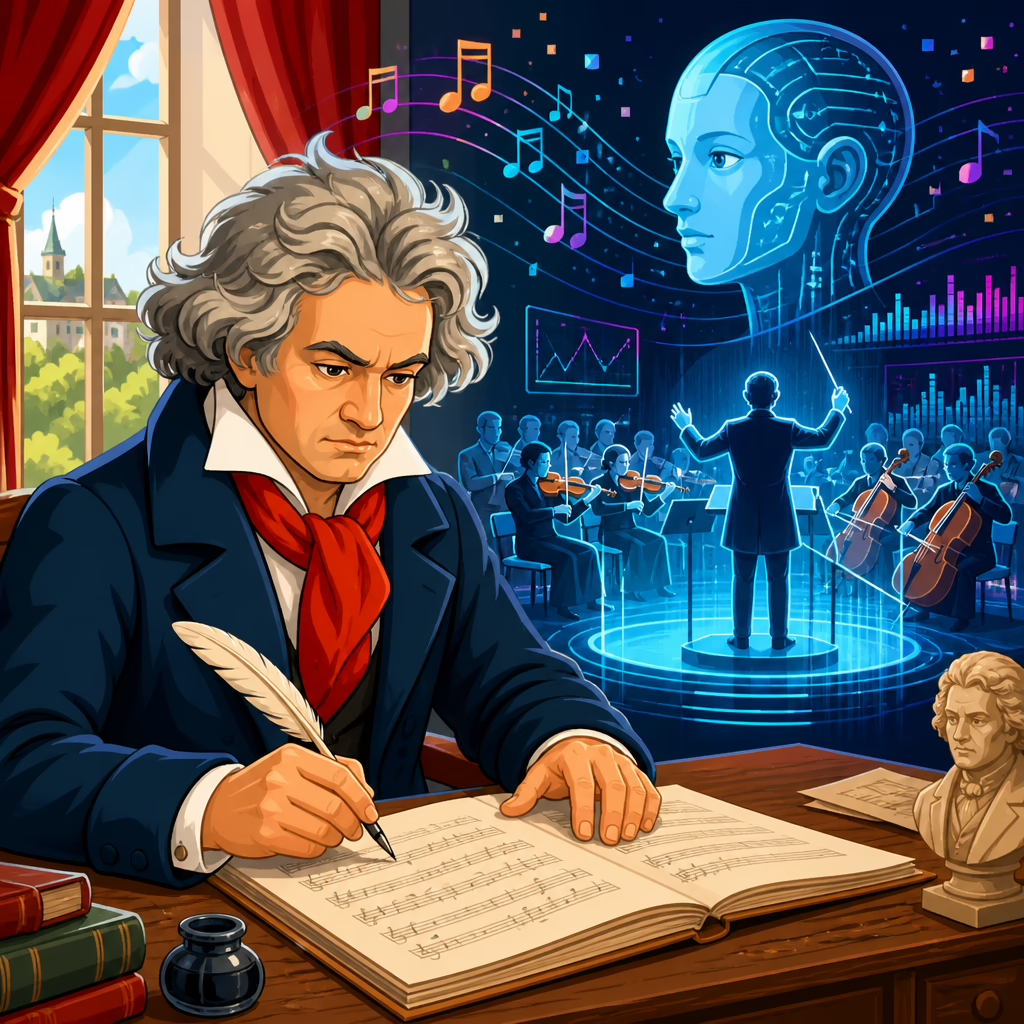
Beethoven and AI Performance Simulation
Beethoven and AI performance simulation meet at a fascinating point where musicology, performance practice, and machine learning all try to answer the same question: how might a performer shape a Beethoven work in sound rather than on the page? In this context, AI performance simulation means using computational models to generate or predict expressive choices such as tempo fluctuation, dynamics, articulation, timing, pedaling, balance, and phrasing. It does not mean replacing pianists, conductors, or ensembles. It means building systems that can model interpretive behavior from data, rules, or both, then render that behavior as audio, MIDI, or notation-based playback. For Beethoven, this matters because his scores are detailed yet still leave critical room for judgment, especially in transitions, accents, structural pacing, and the relationship between written markings and audible effect.
I have worked with score-following tools, symbolic datasets, and high-resolution MIDI renderings, and Beethoven exposes the limits of naive playback faster than almost any composer. A mechanically quantized performance can present the notes accurately while completely missing the architecture of a sonata exposition or the tension of a delayed cadence. By contrast, a strong simulation can make analytical claims audible. It can test whether a local ritardando clarifies phrase structure, whether sharply terraced dynamics support motivic contrast, or whether a lighter left-hand touch in Op. 111 reveals inner-voice motion. This is why AI performance simulation has become useful not only for listening experiments, but also for scholarship, teaching, rehearsal planning, and digital publishing.
Any serious discussion needs clear terms. Symbolic performance models work on note events, durations, velocities, pedaling, and onset deviations, usually from MIDI or encoded scores such as MusicXML, MEI, or Humdrum. Audio performance models work directly from sound and may infer expressive patterns from recorded performances. Rule-based systems encode stylistic assumptions explicitly, while data-driven systems learn them from examples, often using recurrent networks, transformers, or probabilistic sequence models. Hybrid systems combine both. In Beethoven, hybrid approaches tend to work best because his notation encodes many instructions precisely, but not enough to determine a convincing performance by itself.
The stakes are unusually high with Beethoven because listeners already carry strong expectations. Pianists debate metronome marks, string players negotiate bow distribution around sforzandi, and conductors make radically different choices in symphonic tuttis without violating the score. A useful simulator therefore must do more than sound polished. It must represent uncertainty, stylistic boundaries, and historically informed constraints. Otherwise, the output is just decorative automation. The real value is deeper: AI performance simulation can reveal how interpretive choices interact with Beethoven’s structure, where the notation underdetermines expression, and which decisions consistently shape what listeners hear as coherence, urgency, wit, or grandeur.
What AI Performance Simulation Means in Beethoven Practice
For Beethoven, simulation begins with a score representation rich enough to capture meter, phrase boundaries, harmony, voice leading, texture density, and written instructions. If a model only sees a stream of pitches and durations, it will miss why a crescendo into a dominant arrival matters more than the same dynamic contour over a passing sequence. In practical systems, features often include bar position, note importance, melodic salience, registral height, articulation marks, slur spans, fermatas, repeats, and harmonic tension estimates. Some research pipelines also derive structural labels from Roman numeral analysis or formal segmentation so the model can distinguish a transition from a codetta.
The output side is equally important. Most Beethoven simulations generate expressive timing, velocity, and pedaling for keyboard works, because those dimensions map well onto high-resolution MIDI and can be rendered convincingly with sampled pianos. Orchestral simulation is harder. It requires balancing sections, shaping attacks, controlling vibrato proxies, and modeling ensemble coordination. Even then, good systems can support comparative listening. A scholar can render the opening of the Fifth Symphony with narrower versus broader tempo elasticity and hear how the famous rhythmic cell changes rhetorical character. A pianist can compare stricter and more speech-like rubato in the “Pathétique” Sonata slow movement without having to record every variant manually.
One important use case is analytical audition. When I evaluate a Beethoven sonata with students, we often test interpretations by simulating several performance profiles against the same score. A plain playback may hide phrase direction. A profile trained on modern concert recordings may overuse sustain pedal and legato. A profile constrained by early nineteenth-century instrument behavior may produce clearer bass articulation and sharper dynamic contrast. Hearing those differences back-to-back makes abstract analysis concrete. It also reduces a common teaching problem: students can see slurs, accents, and sf markings, yet still struggle to imagine their cumulative sonic effect.
For readers exploring adjacent tools, the broader guide at https://lvbeethoven.com/how-ai-tools-can-help-analyze-beethoven-scores/ gives useful context on how computational analysis and score study connect. Performance simulation is a narrower task, but it depends on the same principle: Beethoven’s notation becomes more meaningful when machine methods expose patterns that are difficult to hear, compare, or quantify unaided.
How Models Learn Expressive Choices from Beethoven Performances
Most modern systems learn from aligned pairs of score and performance. For piano music, the standard workflow starts with a digital score, a recorded MIDI or audio performance, and an alignment stage that matches performed notes to notated notes. Once aligned, the system can measure tempo curves, onset deviations, duration ratios, dynamic shaping, and pedaling behavior. Datasets such as the MAESTRO collection are useful for expressive modeling in general, though they are not Beethoven-specific. More specialized corpora come from performance research labs that annotate canonical repertoire at high temporal resolution. These resources allow the model to infer patterns such as phrase-final lengthening, metric accent emphasis, melody accompaniment balance, or local accelerando into cadential release.
In Beethoven, training data quality matters more than raw size. A thousand recordings of mixed stylistic assumptions may teach average tendencies that flatten the repertoire’s rhetorical sharpness. A smaller but carefully curated set of performances, labeled by instrument type, editorial source, school of playing, and recording era, often produces better results. For example, a model trained only on late twentieth-century Steinway performances may treat legato and sustain as default solutions. Add performances informed by fortepiano technique and the model learns a different relationship between articulation and resonance. That distinction changes how it handles works like Op. 31 or Op. 110, where texture and register are central to expression.
Model architecture also influences what comes out. Sequence models such as LSTMs were once common because expressive timing unfolds over time and depends on local context. Transformers improved long-range dependency handling, which matters in Beethoven because a phrase’s interpretation often reflects a destination many measures ahead. Graph-based approaches can represent contrapuntal voices and harmonic relationships more explicitly. In my experience, the best Beethoven results usually come from systems that combine sequential prediction with handcrafted musical features. Pure end-to-end learning can sound smooth, but it often underexplains why the model shaped a transition a certain way. For scholars and performers, interpretability is not optional.
| Approach | Strength in Beethoven | Main Limitation |
|---|---|---|
| Rule-based | Clear handling of accents, cadences, phrase endings, and style constraints | Can sound rigid in ambiguous passages |
| Data-driven | Learns nuanced timing and dynamics from real performances | Can inherit modern habits or dataset bias |
| Hybrid | Combines score intelligence with expressive flexibility | Requires careful design and expert validation |
Evaluation should go beyond “does it sound musical?” Researchers commonly test note-level prediction error, tempo curve correlation, and listening-study preference ratings. For Beethoven, those metrics need supplementation. I look for structural faithfulness: does the simulation differentiate exposition material from developmental turbulence, and does it project climaxes proportionately rather than making every bar equally expressive? Good systems also preserve motive identity. The opening gesture of the “Appassionata” cannot be shaped arbitrarily without weakening the movement’s logic. If a model smooths away those edges, it may be statistically competent yet musically unconvincing.
Where Beethoven Creates Unique Simulation Challenges
Beethoven is difficult for AI performance simulation because his scores sit between precision and productive ambiguity. He gives extensive dynamic, articulation, and tempo information, yet performers still confront unresolved questions. How literally should one take controversial metronome marks? How should sf differ from fp in rapid succession? When a slur spans a syncopated figure, is the effect vocal, rhetorical, or technical? These are not minor details. They affect the listener’s sense of form. A model that ignores those distinctions can reproduce notes correctly while misrepresenting Beethoven’s musical argument.
Another challenge is instrument history. Beethoven composed across a period of rapid piano development, and the action, range, decay, and sustaining behavior of Viennese instruments differ substantially from modern concert grands. On older instruments, registral contrast speaks differently, repeated chords bite more quickly, and pedaling cannot be modeled as a simple wash of resonance. A simulation trained on modern recordings alone may exaggerate blend and understate articulation. Historically aware systems need instrument-conditioned parameters or separate rendering profiles. Without them, the same expressive commands can produce misleading sonic results, especially in works where resonance management shapes harmony perception.
Symphonic and chamber Beethoven add ensemble complexity. Real performers do not execute expressive timing as one unified machine. They coordinate through micro-adjustments, leadership cues, breathing, and section-specific response times. A credible simulation of the Seventh Symphony, for instance, must model how lower strings articulate ostinati differently from winds sustaining harmonic color, and how those behaviors change in different halls or tempi. Current AI can approximate these relationships, but it still struggles with the interactive decision-making that live ensembles produce. That limitation matters because Beethoven’s drama often emerges from coordinated resistance rather than uniform compliance.
Editorial variance further complicates the task. Different urtext editions may resolve slurs, dynamics, and articulations differently based on source evaluation. If a model is trained on one editorial tradition and applied to another without adjustment, it may produce inconsistent expressive logic. In professional workflows, I treat the edition as part of the input, not a neutral container. That may sound technical, but it has a practical effect: simulation becomes more trustworthy when users know which source assumptions are being rendered.
Best Uses, Limits, and Responsible Interpretation
The strongest use of AI performance simulation in Beethoven is comparative inquiry. It helps performers test options, teachers demonstrate consequences, and scholars make hypotheses audible. It can also support accessibility by giving readers with limited keyboard skills a more expressive way to hear a score. In publishing, simulated excerpts can illustrate analytical essays when commercial recordings are unavailable or rights-restricted. For rehearsal, conductors can pre-audition balance ideas, and chamber groups can preview tempo relationships before first read-through. These are concrete, high-value applications.
What simulation should not do is claim historical certainty. No model can tell us exactly how Beethoven expected every phrase to sound, and no training set can dissolve the gap between notation and lived performance. There is also a real risk of stylistic homogenization. If conservatories, apps, and publishers all rely on a narrow set of model defaults, students may absorb one polished but flattened version of Beethoven. Responsible systems should expose adjustable parameters, cite dataset sources, and distinguish learned tendencies from score-anchored constraints.
Used well, Beethoven and AI performance simulation form a productive partnership. The machine handles comparison, consistency, and large-scale pattern extraction; the musician supplies judgment, historical awareness, and artistic purpose. That division is healthy. Beethoven’s music gains value when technology makes interpretive choices easier to hear, question, and refine, not when it pretends interpretation has been solved. If you work with Beethoven scores, test a simulation tool on a short passage, compare multiple expressive profiles, and let the results sharpen your own listening.
Frequently Asked Questions
What does “AI performance simulation” mean in the context of Beethoven?
In the context of Beethoven, AI performance simulation refers to the use of computational models to estimate or generate the expressive decisions a performer might make when turning a written score into sound. Beethoven’s notation gives the essential musical structure, but it does not fully determine how a performance should breathe, accelerate, hesitate, sing, or project drama. That is where interpretation begins. An AI system can be trained to model choices involving tempo rubato, dynamics, articulation, timing deviations, pedaling, voicing, phrasing, and ensemble balance, helping researchers explore how a Beethoven passage might unfold in real time rather than only on the page.
This does not mean the system is “composing” new Beethoven or claiming to discover one definitive correct performance. Instead, it simulates plausible interpretive behavior based on evidence such as annotated scores, historical recordings, performance traditions, treatises, stylistic analysis, and performer data. In practical terms, that might mean predicting how a pianist could shape a transition in a sonata movement, how a conductor might pace a symphonic crescendo, or how phrase endings may be softened or stretched for expressive effect. The value of AI here is not that it settles interpretation, but that it offers a structured way to test hypotheses about performance practice and compare different expressive possibilities in a rigorous, repeatable way.
Can AI really tell us how Beethoven should be performed?
No, and that distinction is essential. AI can suggest, simulate, and analyze patterns in performance, but it cannot pronounce a final verdict on how Beethoven “should” sound. Beethoven interpretation has always involved a combination of textual fidelity, historical awareness, instrumental realities, aesthetic judgment, and performer imagination. Even when scholars agree on the notes, there is often meaningful disagreement about pacing, articulation, dynamic weight, accentuation, and rhetorical shape. AI can participate in that conversation, but it cannot end it.
What AI can do very well is expose tendencies and possibilities. For example, if a model is trained on performances from a certain lineage, it may reveal how that tradition tends to handle cadences, transitions, sforzandi, or large-scale tempo architecture. If it incorporates historical information, it may help distinguish modern habits from period-informed approaches. If it compares many recorded performances, it can show where interpreters converge and where they diverge. That makes AI useful as an analytical tool and a creative aid. But Beethoven performance remains an artistic act, not a solved computational problem. The most responsible way to use AI in this area is as a source of insight, not authority.
What kinds of musical details can an AI model simulate in a Beethoven performance?
A sophisticated AI performance model can simulate a wide range of expressive dimensions that shape how Beethoven is heard. These include tempo fluctuation at both local and large scales, such as slight expansions at phrase peaks or broader pacing changes across a movement. It can model dynamics, including crescendos, subito contrasts, terraced weight, and long-range intensity planning. It may also simulate articulation choices such as legato connection, detached touch, accent behavior, attack sharpness, and note-length variation, all of which are especially important in Beethoven because his musical rhetoric often depends on fine contrasts in gesture.
More advanced systems can also account for pedaling, texture balance, chordal timing, melodic voicing, and expressive asynchrony between parts. In piano music, for instance, AI might estimate how a performer brings out an inner voice, shapes repeated chords differently over time, or uses pedal to support resonance without blurring motivic clarity. In orchestral or chamber settings, simulation can extend to balance between sections, timing coordination, and the relationship between structural rhythm and expressive flexibility. The most meaningful models do not treat these variables in isolation. They attempt to capture how tempo, articulation, dynamics, and phrase structure interact, because that interaction is where Beethoven interpretation becomes convincing rather than mechanical.
How is AI performance simulation useful for musicologists, performers, and listeners?
For musicologists, AI performance simulation provides a powerful way to test interpretive ideas against large amounts of musical and performance data. Instead of discussing expression only in descriptive terms, researchers can model specific questions: How consistently do performers broaden before a recapitulation? Do certain sonata movements invite similar timing strategies across traditions? How do recordings from different eras handle Beethoven’s dynamic markings? AI can make those questions measurable while still respecting the complexity of musical expression. That opens new possibilities for empirical musicology, historically informed research, and comparative performance studies.
For performers, AI can function as an exploratory partner rather than a replacement. A pianist, conductor, or teacher might use simulated renderings to compare different phrase shapes, test tempo relationships, or identify interpretive assumptions that have become habitual. It can also highlight underexamined options in passages that seem overfamiliar. For listeners and students, AI can make interpretation more audible and more understandable by demonstrating how small changes in timing, touch, balance, or pedaling alter a movement’s character. In that sense, AI performance simulation can deepen musical literacy. It helps people hear that a score is not a finished object until it is brought to life through choices, and Beethoven’s music is especially rich because those choices matter so profoundly.
Does AI performance simulation threaten human musicianship in Beethoven interpretation?
Not inherently, and in its best applications it does the opposite: it highlights the sophistication of human musicianship. Beethoven interpretation is not just a matter of following instructions. It involves judgment, timing, physical control, historical imagination, structural hearing, and emotional intelligence. When AI attempts to simulate performance, it quickly encounters how many subtle, interdependent decisions expert musicians make. That can actually increase appreciation for artistry, because it shows how difficult it is to translate notation into a compelling sonic experience.
The real risk lies not in the technology itself but in using it simplistically. If AI output is treated as a substitute for listening, study, or artistic decision-making, then it can flatten interpretation into formula. But if it is treated as a research instrument, pedagogical aid, or creative comparison tool, it can enrich the field. In Beethoven performance, the goal should not be automation for its own sake. The goal should be better questions, better listening, and more informed artistic choices. Human performers remain central because they do more than execute parameters: they persuade, communicate, and take responsibility for meaning in the moment of performance. AI can simulate aspects of that process, but it cannot replace the artistic presence that makes Beethoven feel urgent and alive.