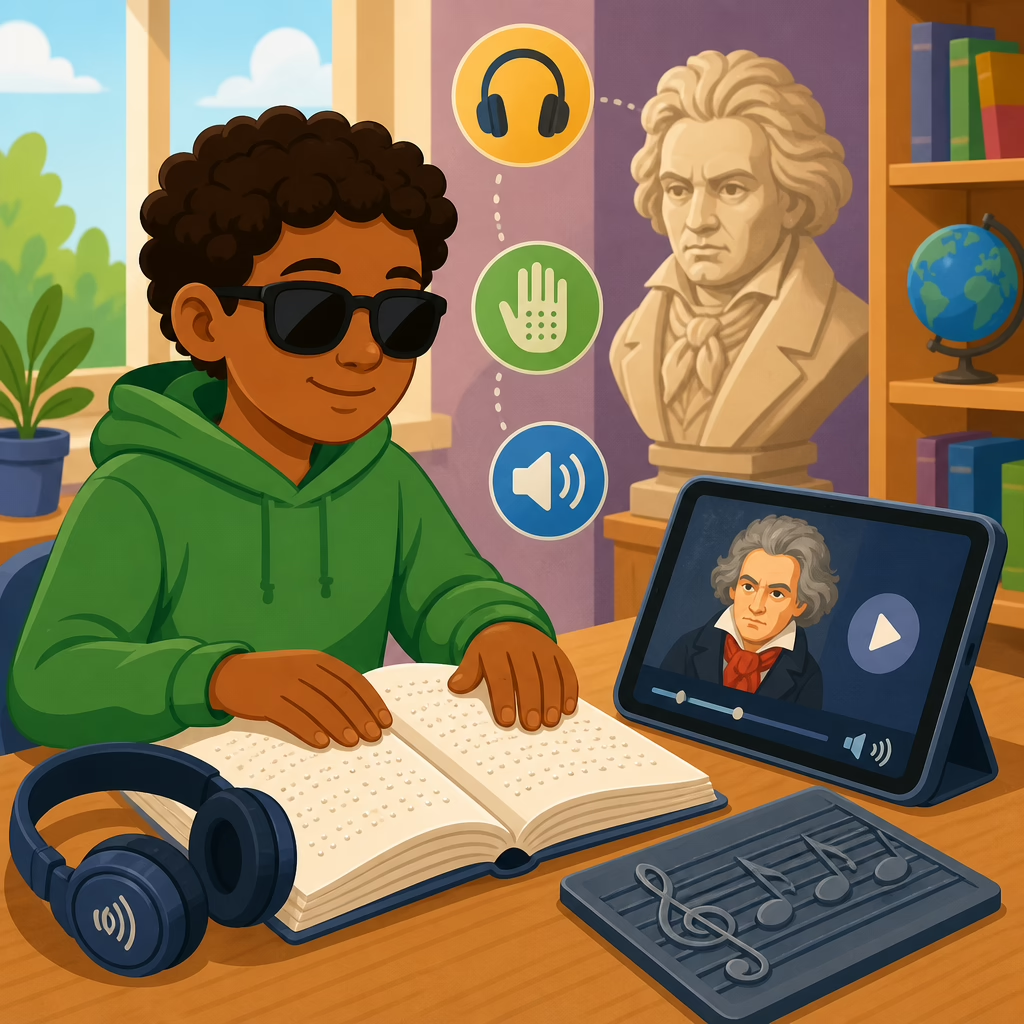
Accessible Beethoven Resources for Visually Impaired Students
Accessible Beethoven resources for visually impaired students are no longer limited to a few adapted scores or simplified biographies; today, teachers, families, and community music programs can build rich, rigorous Beethoven study using braille music, audio description, tactile materials, screen-reader-friendly archives, and carefully structured listening activities. In practical terms, “accessible” means a student can obtain the same musical ideas, historical context, and expressive detail as sighted peers without depending on visual print alone. For Beethoven instruction, that includes access to notation, lyrics, timelines, portraits, forms, and classroom routines. “Visually impaired” covers a wide range of needs, from low vision to total blindness, so no single format works for every learner. Some students read braille fluently, some use large print and high contrast, and some learn best through recorded modeling, tactile graphics, and verbal explanation. The stakes are high because Beethoven often appears early in general music and remains central through secondary study. If resources are inaccessible, students miss not just one composer unit but repeated opportunities to discuss form, motif, dynamics, historical change, and the idea of artistic resilience.
I have seen this gap firsthand in school music settings: a class may enthusiastically study the opening of Symphony No. 5, yet the visually impaired student receives only the audio while everyone else gets notation, movement maps, and composer background sheets. That is not equal access. Effective Beethoven resources let the student analyze the famous four-note motive, follow sonata or rondo structure, compare instrumentation, and participate in creative responses with independence. The best materials are also efficient for teachers. When a worksheet is compatible with a screen reader, when a listening map is converted into a tactile sequence, and when repertoire choices align with available braille editions, the lesson becomes smoother for the whole class. Accessibility matters here because Beethoven’s music is structurally rich, emotionally varied, and frequently taught. With thoughtful resource selection, visually impaired students can engage deeply with the same canonical works their classmates study, while developing listening precision, musical vocabulary, and historical understanding on equal terms.
What accessible Beethoven study actually requires
Accessible Beethoven instruction starts with a simple rule: identify the learning goal before choosing the format. If the goal is recognizing the motive in Symphony No. 5, a clean audio excerpt with verbal cueing may be enough. If the goal is tracing phrase structure or harmonic rhythm, the student may need braille notation, enlarged notation, or a tactile representation of recurring sections. Teachers often assume accessibility means converting every handout into braille. In reality, a strong resource set combines multiple formats. Core categories include braille scores and thematic excerpts, accessible text biographies, alt-text-rich images, tactile diagrams for forms and instruments, audio recordings with clear indexing, and digital documents that function with JAWS, NVDA, or VoiceOver. For low-vision learners, formatting details matter: sans-serif fonts, 18-point or larger print when appropriate, high contrast, uncluttered page design, and avoidance of image-only PDFs.
It also helps to separate “music access” from “classroom access.” Music access covers notation, lyrics, and listening examples. Classroom access covers how students receive instructions, submit responses, join discussions, and navigate group work. A Beethoven lesson can fail a visually impaired student even if the music itself is available, simply because the teacher says, “Look at the timeline on the board,” or distributes an unlabeled worksheet. Direct verbalization solves many problems. Instead of “this section,” say “measures one through eight” or “the opening motive in the violins and clarinets.” Instead of a decorative portrait handout, offer a concise description linking the image to the composer’s era and public image. This precision improves teaching for everyone. Beethoven study becomes more inclusive when every resource is intentionally designed to communicate through sound, touch, and well-structured language rather than relying on visual inference.
Best source types: braille, audio, tactile, and accessible digital materials
The most reliable Beethoven resources usually come from established accessible media providers and major music libraries. For braille music in the United States, the National Library Service for the Blind and Print Disabled, often accessed through partner libraries, remains a foundational source for scores, music appreciation materials, and playback technology information. Students in school settings may also receive braille transcriptions through district vision services or specialized agencies. For digital notation, MusicXML can be more useful than static PDF because it supports conversion and flexible output, though quality control is essential. IMSLP is valuable for public-domain Beethoven scores, but many scans are image based and require remediation before they are accessible. Recordings from Naxos, the Berlin Philharmonic Digital Concert Hall, or major streaming platforms can work well if the teacher provides exact movement timings and contextual notes.
Tactile resources are especially effective for elementary and middle grades. A tactile listening map for “Für Elise” might use distinct textures for the A theme, contrasting middle section, and return, allowing students to feel the recurring pattern while listening. A raised-line diagram can represent orchestra seating for a Beethoven symphony, helping a student connect instrumental placement to timbre. For composer history, accessible text matters more than flashy design. A one-page biography with headings, chronological order, and concise explanations of Vienna, patronage, deafness, and the transition from Classical to Romantic style is more usable than a colorful poster. When building a digital folder, include tagged PDFs, properly structured headings in Word or Google Docs, descriptive link text, and filenames that make sense when read aloud by a screen reader. These basics save time and prevent students from needing an adult intermediary for tasks that should be independent.
| Resource type | Best use in Beethoven lessons | Key accessibility standard | Common mistake to avoid |
|---|---|---|---|
| Braille music | Motives, themes, short piano excerpts, ensemble preparation | Accurate transcription with measure numbers and clear formatting | Assigning print notation tasks without an equivalent braille version |
| Large-print notation | Low-vision students reading melodic contours or rhythm patterns | High contrast, adequate spacing, minimal page clutter | Enlarging a blurry scan that becomes harder to read |
| Audio excerpts | Listening analysis, form identification, timbre comparison | Precise timestamps and spoken directions | Playing long tracks with no cueing or section markers |
| Tactile graphics | Form maps, instrument layouts, timelines | Simple shapes, clear labels, limited information per page | Overloading one diagram with too many symbols |
| Accessible digital texts | Biographies, discussion prompts, assessments | Heading structure, readable links, screen-reader compatibility | Posting image-only PDFs or unlabeled worksheets |
Choosing Beethoven works that translate well for visually impaired learners
Not every Beethoven piece is equally practical for every classroom, especially when access time is limited. The most teachable works are those with clear motives, audible contrasts, and readily available accessible materials. Symphony No. 5 in C minor is ideal because the opening motive is unmistakable, the dynamic drama is easy to hear, and recordings are abundant. “Für Elise” works well for form, recurring themes, and keyboard texture; students can track the return of the opening material through braille notation, verbal listening guides, or tactile patterns. The “Ode to Joy” theme from Symphony No. 9 is useful because its melodic contour is singable, memorable, and available in many educational arrangements. By contrast, very dense late quartets may be rewarding for advanced students but often require more extensive scaffolding and better notation access than a general education class can provide.
When I plan Beethoven lessons for visually impaired students, I prioritize pieces where the main idea can be grasped through repeated listening and then deepened through accessible analysis. For example, with Symphony No. 6, the “Pastoral,” students can discuss scene painting, mood, and orchestral color through carefully chosen excerpts such as the brook scene or storm movement, even if they are not reading full score. Piano Sonata No. 8, the “Pathétique,” offers dramatic contrast and clear formal sections for students comfortable with keyboard listening. Choral Fantasy can support interdisciplinary work if accessible text for the vocal portion is prepared in advance. The key is alignment. Choose Beethoven repertoire based on the concept being taught, the formats available, and the student’s literacy mode. Accessibility is strongest when the work itself supports close listening, pattern recognition, and meaningful participation without forcing the student to reconstruct essential information from inaccessible visuals.
How teachers can adapt lesson materials without diluting rigor
Adapting Beethoven resources does not mean reducing complexity. It means changing the delivery system so students can reach the same intellectual goal. Start by converting visual-only tasks into verbal, tactile, or auditory equivalents. If a worksheet asks students to circle repeated themes, create an audio response version where the student identifies timestamps and describes where the theme returns. If classmates complete a listening map, prepare a tactile strip with labeled sections A, B, and C or use textured cards that can be arranged in sequence. Replace “draw what you hear” with “describe the change in dynamics, texture, and tempo.” These are not watered-down tasks; in many cases, they require more precise thinking. For notation-based lessons, provide measure-numbered braille excerpts rather than entire scores when time is short. This supports focused analysis of motive, rhythm, or interval pattern while remaining manageable.
Assessment should also be accessible from the start. I recommend oral check-ins, screen-reader-compatible quizzes, and performance-based demonstrations alongside written work. A student can show understanding of Beethoven’s use of contrast by singing or playing themes, labeling formal returns verbally, or comparing two interpretations with specific vocabulary. Rubrics should evaluate the musical concept, not the visual method. If the class identifies crescendo markings from print, the accessible equivalent is hearing and describing the crescendo in context, possibly reinforced through braille notation for students who read it. Teachers should coordinate with teachers of students with visual impairments, braillists, and assistive technology staff early, especially for concert preparation or cross-curricular units. Useful planning tools and age-appropriate teaching ideas can be found in this broader guide: Beethoven lesson plans for elementary music classes. The lesson remains rigorous when the adaptation preserves analysis, vocabulary, listening discrimination, and independent response.
Community and family supports that strengthen access beyond the classroom
Because this topic sits within community and education, it is important to look beyond school-issued materials. Local public libraries, state accessible book services, youth orchestras, university music departments, and blindness organizations can all expand Beethoven access. I have seen families make rapid progress when a school unit is reinforced at home with the same excerpts, the same vocabulary, and a reliable playback routine. A parent does not need formal music training to help. They need organized materials: labeled recordings, a short biography in accessible text, and simple prompts such as “What instrument introduces the theme?” or “Where does the opening idea return?” Community concerts can also become accessible if staff provide program notes in digital text before the event, reserve seating with good acoustics, and offer pre-concert touch tours for instruments when possible.
Partnerships matter most when they are specific. A piano teacher can prepare a braille excerpt from “Für Elise.” A library can help locate an audio biography or NLS service registration. A university music education program may have students who can create tactile listening maps under supervision. Even informal supports, such as a shared folder with teacher-recorded listening cues, reduce barriers. Families should ask for exact titles, movement names, and timings rather than generic recommendations to “listen to Beethoven.” Precision prevents frustration and makes repetition productive. Community ensembles and museums can also improve accessibility by posting tagged program notes and avoiding image-based promotional materials. The broader lesson is clear: visually impaired students benefit most when Beethoven resources are coordinated across school, home, and local institutions. Access becomes consistent, expectations stay high, and the student’s musical identity grows through regular, independent engagement rather than occasional accommodation.
Accessible Beethoven resources for visually impaired students work best when they are planned as a complete learning system rather than added as last-minute fixes. The essential ingredients are straightforward: choose repertoire with clear teachable features, match each learning goal to the right format, and make every biography, score excerpt, listening guide, and assessment usable without visual guesswork. Braille music, large-print notation, tactile graphics, tagged digital texts, and precisely cued recordings each solve different problems. Used together, they allow students to study Beethoven’s motives, forms, expressive contrasts, and historical significance with the same depth expected of any serious learner. The payoff is not only compliance or convenience. It is genuine participation. Students can discuss why the Symphony No. 5 motive is compelling, trace the return of themes in “Für Elise,” and connect Beethoven’s life to the music in ways that are independent and intellectually honest.
For teachers, the practical next step is to audit one Beethoven lesson and rebuild it around access from the beginning. Check whether documents work with screen readers, whether listening tasks include timestamps and verbal directions, whether visuals have tactile or descriptive equivalents, and whether the student can complete the core task independently. For families and community partners, start with one high-quality piece, one accessible biography, and one repeatable listening routine. Small improvements compound quickly when they are consistent. Beethoven’s music rewards close attention, and visually impaired students deserve tools that let them give that attention fully. Build the resource set carefully, collaborate early, and expect depth. When access is designed well, Beethoven becomes not a barrier-filled unit but a powerful shared musical experience.
Frequently Asked Questions
What kinds of accessible Beethoven resources are available for visually impaired students today?
Accessible Beethoven resources now extend far beyond a small number of adapted scores. Students can work with braille music editions of selected piano works, chamber pieces, and themes from larger compositions; screen-reader-friendly digital texts about Beethoven’s life and historical context; high-quality audio recordings paired with guided listening notes; tactile graphics that show keyboard layouts, melodic contour, rhythmic patterns, or orchestra seating; and audio-described concert videos or performance demonstrations. Many teachers also use enlarged notation for students with low vision, digital scores that function well with magnification software, and structured listening guides that break down form, motif, dynamics, and expressive character in a way that is easy to follow without relying on visual notation alone.
In strong learning environments, these resources are combined rather than used in isolation. For example, a student might listen to a movement from a Beethoven sonata, study a braille excerpt of its main theme, explore a tactile representation of phrase shape, and then discuss the historical and emotional context through accessible reading materials. This layered approach helps visually impaired students gain not only basic access, but also the same depth of musical understanding expected in a general music, piano, theory, or history setting. The best resources are those that preserve Beethoven’s complexity while presenting it in formats the student can independently use.
How can teachers make Beethoven’s music accessible without oversimplifying it?
The key is to adapt the format, not the intellectual content. Beethoven’s music is rich in structure, contrast, development, and emotional intensity, and visually impaired students should be able to engage with all of that. Teachers can begin by identifying the essential musical ideas in a piece: the main motive, the formal design, important rhythmic features, dynamic contrasts, harmonic tension, and expressive markings. Those elements can then be delivered through braille notation, verbal description, aural modeling, tactile supports, and repeated guided listening. Instead of removing complexity, the teacher reorganizes how information is presented so the student can access it fully and systematically.
For instance, if a class is studying Beethoven’s Symphony No. 5, a teacher might present the opening motive through singing, clapping, and braille rhythm reading; describe how that motive returns and changes across the movement; provide a tactile map of the orchestra or the movement’s large-scale form; and assign listening prompts that direct attention to instrumentation, texture, and dramatic pacing. In a piano setting, the teacher might break a sonata movement into manageable sections while preserving original articulation, phrasing, and harmonic analysis. This ensures the student studies Beethoven as a serious composer rather than a simplified symbol of “classical music.” Accessibility works best when it supports rigor, independence, and artistic interpretation.
What should families look for when choosing accessible Beethoven materials for home or private study?
Families should first look for materials that match the student’s actual mode of access. A braille reader may need a reliable braille score or theory supplement, while a student with low vision may benefit more from high-contrast enlarged notation or a digital file compatible with zoom and contrast tools. Students who learn primarily by ear may need carefully organized recordings, spoken listening guides, and lesson materials that are compatible with screen readers. It is also important to check whether the resource is complete and musically accurate. A good accessible Beethoven resource should communicate tempo, articulation, dynamics, phrasing, and historical context, not just note names or a general summary.
Families should also consider usability and independence. Can the student navigate the material without constant sighted assistance? Are file names, menus, and chapters clearly labeled for assistive technology? Does the resource support serious study rather than offering only a simplified overview? The most helpful home materials often include multiple access points, such as an audio recording, an accessible text explanation, and a music format the student can read directly. If possible, families should ask private teachers, teachers of students with visual impairments, music therapists, or disability support specialists for recommendations. The ideal resource helps the student build musicianship, confidence, and a genuine connection to Beethoven’s work over time.
How do braille music and listening-based instruction work together in Beethoven study?
Braille music and listening-based instruction are most effective when they reinforce one another. Braille music gives students direct access to the score’s structure and details, allowing them to study pitch, rhythm, articulation, fingering, phrasing, and form in a precise way. Listening, on the other hand, brings the notation to life by revealing tempo relationships, sonority, expressive timing, balance, and interpretation. In Beethoven study, where motives evolve and emotional contrasts often drive the musical argument, students benefit greatly from moving back and forth between what they read and what they hear.
For example, a student learning a Beethoven piano piece in braille might first read a short section to understand the notes and rhythmic shape, then listen to one or more recordings to hear the phrasing and dramatic character, and finally return to the braille score to examine how Beethoven’s markings support what they heard. In ensemble or music history contexts, listening can also prepare students to understand larger-scale forms that may be difficult to absorb all at once in notation alone. Teachers can strengthen this process by asking focused questions: Where does the motive return? How does the dynamic level change the mood? What happens when the texture thickens? This combination of score study and active listening supports both technical literacy and artistic insight.
Why is accessible Beethoven instruction important for music education and inclusion?
Accessible Beethoven instruction matters because it affirms that visually impaired students deserve full participation in the core repertoire of Western music education, not just limited or specially reduced alternatives. Beethoven appears frequently in piano lessons, theory classes, music appreciation courses, youth orchestra programs, and general arts curricula. When his works are made accessible through braille music, audio description, tactile supports, and inclusive teaching methods, students with visual impairments can join those shared musical conversations on equal footing. That access improves not only academic inclusion, but also artistic identity, confidence, and long-term engagement with music.
It is also important because Beethoven’s music offers exceptional educational value. His works are ideal for teaching form, thematic development, expressive contrast, historical change, and the relationship between technical craft and emotional communication. If visually impaired students are excluded from those learning opportunities, they miss more than a composer; they miss a major pathway into musicianship and cultural literacy. Inclusive Beethoven instruction helps schools, teachers, and community programs move from accommodation as an afterthought to access as a standard practice. In that sense, accessible resources are not simply helpful add-ons. They are a foundation for equitable, rigorous, and meaningful music education.