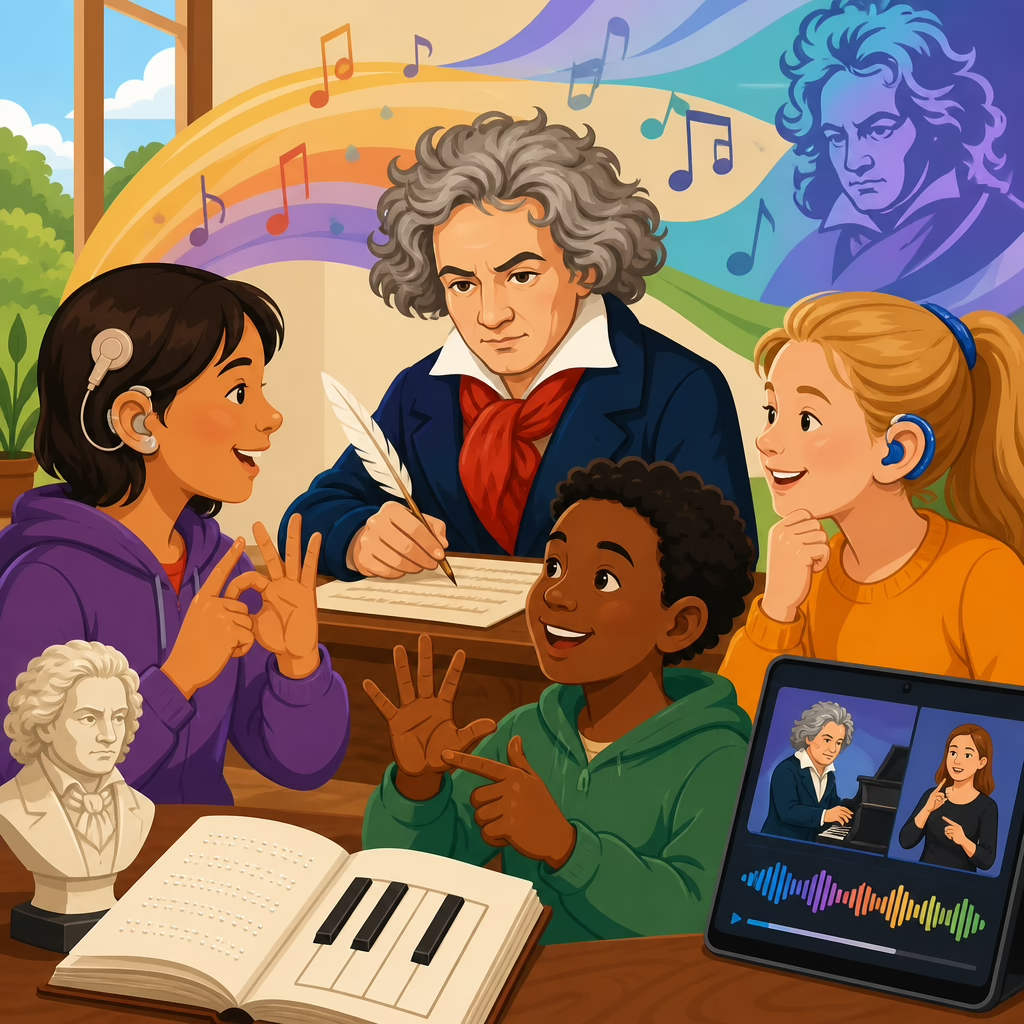
Accessible Beethoven Resources for Deaf and Hard of Hearing Learners
Accessible Beethoven resources for Deaf and hard of hearing learners are no longer a niche concern in music education; they are a practical requirement for any classroom, community program, museum, or family study plan that wants every student to participate meaningfully. In this context, accessible resources include captioned video, sign-supported instruction, vibration-based listening tools, clearly structured visual materials, plain-language historical summaries, tactile activities, and lesson formats that do not assume pitch perception is the only path to understanding music. Deaf and hard of hearing learners are not one group with one profile. Some students use American Sign Language, some rely on hearing aids or cochlear implants, some prefer spoken language with captions, and many move fluidly across methods depending on setting and fatigue. That matters when teaching Beethoven because his work is often introduced through listening-first activities, while his life story is frequently simplified into a single point: he lost his hearing. In my experience designing arts lessons, that framing misses both the learner and the composer. Students need resources that make rhythm, form, emotion, history, and creative response visible and touchable. They also need Beethoven presented as a complex musician whose deafness shaped his work without reducing his identity to a slogan.
Why does this matter so much? First, accessibility changes outcomes. When materials are captioned accurately, paced visually, and paired with tactile or movement-based options, students retain more and participate more confidently. Second, Beethoven is especially relevant for Deaf and hard of hearing learners because his biography opens real conversations about adaptation, persistence, communication, and the limits of defining music only by auditory experience. Third, accessible Beethoven resources support all learners, not only students with documented accommodations. Visual sequencing, concise vocabulary support, gesture, and graphic organizers improve comprehension for multilingual students, younger children, and mixed-ability groups. A strong resource set therefore serves inclusion, historical understanding, and better pedagogy at the same time.
What makes a Beethoven resource genuinely accessible
An accessible Beethoven resource does more than add captions to a concert clip. It gives students multiple ways to receive information, process ideas, and show understanding. In practice, I look for five features. The first is language access: captions, transcripts, and if possible sign language interpretation. Auto-captions alone are not enough for music content because composer names, period terms, and movement titles are often mistranscribed. The second is visual clarity: large readable text, high contrast, uncluttered slides, and images that directly support the point being taught. The third is musical translation: rhythm shown with icons, conducting patterns, body percussion, notation highlights, or animated listening maps. The fourth is tactile or kinesthetic design: resonance boards, balloons near speakers for vibration, drum-based pulse work, and movement pathways that let students feel structure. The fifth is flexible assessment: drawing, signing, sequencing cards, short written reflection, or performance tasks that do not depend entirely on hearing melodic detail.
For Beethoven specifically, accessible materials should address common barriers. Many introductions lean heavily on symphonic excerpts without scaffolding. Instead, students benefit from short segments tied to one observable concept at a time, such as the famous four-note motive from Symphony No. 5, the pulse of an allegro section, or the visual pattern of crescendo in a score excerpt. Historical resources also need care. Statements like “Beethoven composed great music despite total silence” are inaccurate and unhelpful. His hearing loss was progressive, variable across time, and documented through letters and conversation books. Presenting that nuance respects history and avoids turning disability into mythology.
Best formats and tools for classroom and community use
The strongest accessible Beethoven resources usually combine several formats instead of relying on one medium. Captioned short-form video works well for biography, instrument families, and demonstrations of motifs. Interactive slides are effective for sequencing Beethoven’s life events, identifying emotional contrasts, and matching musical symbols to movement tasks. Printable card sets help younger learners sort tempos, dynamics, or major life milestones. Museum educators and library program leaders often succeed with tactile stations: portrait reproductions with raised elements, replicas of quill pens and manuscript paper, and floor activities where students arrange phrase shapes physically across space.
Technology can support access when chosen carefully. Nearpod and Pear Deck allow teachers to embed images, polls, and drawing responses into a lesson so students can show comprehension visually. Flip enables signed or captioned video responses, which is useful for learners who communicate more easily through sign than extended writing. Chrome captioning tools, YouTube manual subtitle editing, and transcript generators can reduce preparation time, but every transcript still needs review for names like Heiligenstadt, Bonn, and Für Elise. In music rooms, Soundbrenner-style metronome vibration, Bluetooth haptic wearables, and simple subwoofer setups can help students perceive pulse and accent through the body. None of these tools replace thoughtful teaching, but they make abstract concepts concrete.
| Resource type | How it supports access | Best Beethoven use |
|---|---|---|
| Captioned video | Provides language access and repeat viewing | Biography, orchestra demonstrations, motif introduction |
| Listening map | Shows structure visually in real time | Symphony No. 5 motive tracking, tempo contrasts |
| Tactile sound tools | Conveys pulse, accent, and intensity through vibration | Rhythm work, forte versus piano, march patterns |
| Signed or captioned response tools | Lets students demonstrate understanding in preferred language mode | Reflection on Beethoven’s life, comparing excerpts |
When selecting tools, the key question is simple: does this resource reveal the musical idea more clearly, or is it merely decorative? A dramatic animation with poor captions is less useful than a plain slide deck with crisp visuals and well-paced teacher modeling. Accessibility is rarely about expensive equipment alone. It is usually about deliberate design choices made before the lesson begins.
Teaching Beethoven without making hearing the only doorway
Many educators were trained to start Beethoven with a listening prompt, then ask students what they heard. For Deaf and hard of hearing learners, that can unintentionally frame participation as partial from the first minute. A better approach is to start with something observable by everyone. Begin with the visual pattern of short-short-short-long for Symphony No. 5, clap or tap it, sign an agreed classroom gesture for the motive, and place it on a board using four symbols. Students can then identify where the pattern returns in a visual score, on a flashing listening map, or through felt vibration from a drum or speaker. This turns a famous musical idea into a shared anchor rather than an exclusion point.
The same principle works with expressive concepts. To teach dynamics in Beethoven, assign physical scale and movement to volume changes: small hand shapes for piano, expanded arm motions for forte, and rising pathways for crescendo. For form, use colored blocks representing sections of a piece and let students reorder them after a viewing. For tempo and mood, pair excerpts with facial expression cards, movement qualities, or scene illustrations. These strategies are not diluted musicianship. They are rigorous translation methods that reveal form, contrast, repetition, and emotional intent.
Biography lessons also benefit from this approach. Instead of centering a tragic narrative about hearing loss, build a timeline that includes Bonn, Vienna, patrons, public performance, sketchbooks, the Heiligenstadt Testament, and late works. Students can analyze how Beethoven communicated through notebooks, worked with performers, and revised intensely. That gives Deaf and hard of hearing learners a fuller picture of adaptation and artistic process. For educators building broader elementary activities, this practical guide to Beethoven lesson plans for elementary music classes can support age-appropriate sequencing while you adapt each step for visual and tactile access.
Where to find high-quality accessible Beethoven materials
The best sources tend to come from organizations already committed to educational access rather than from random music clips. Major orchestras often publish family guides, short videos, and classroom notes that can be adapted if captions are corrected and context is added. Public broadcasters and arts organizations sometimes provide composer documentaries with transcripts suitable for excerpting. Museum education departments may offer downloadable worksheets on Beethoven’s life and era. University libraries and archives can supply public-domain portraits, manuscript images, and letters that enrich visual lessons. IMSLP is useful for public-domain scores, especially when teachers need enlarged excerpts for motive or form study, though raw scores should be simplified for younger learners.
For Deaf-specific support, schools and programs should consult local Deaf educators, itinerant teachers of the deaf and hard of hearing, educational interpreters, and family organizations before finalizing materials. They can identify whether a resource is linguistically appropriate, whether captions are accurate, and whether classroom pacing allows time for visual attention shifts. National associations focused on deaf education and caption quality also publish guidance that helps teachers avoid common mistakes, such as talking over videos, darkening the room so much that signs are hard to see, or requiring simultaneous note-taking during signed instruction. In practice, the most successful resource collections are curated locally: a set of teacher-reviewed clips, caption files, tactile activities, vocabulary cards, and response options tested with actual learners.
Common mistakes and how to avoid them
The most common mistake is assuming that access equals simplification. Deaf and hard of hearing learners do not need Beethoven made easier; they need Beethoven made clearer. Another mistake is overreliance on biography at the expense of musical substance. Students should not leave with only the idea that Beethoven was a deaf composer. They should know recognizable works, understand at least one structural device such as motive development, and connect music to historical context. A third mistake is using captions that are technically present but educationally weak. If “Fate motif” becomes “fake motive,” the lesson loses precision. Manual editing matters.
I also see classrooms move too quickly between visual targets. Students cannot watch an interpreter, read a slide, examine notation, and observe a teacher model all at once. Effective pacing builds in pauses, repeats key information, and keeps the visual field organized. Finally, avoid treating one accommodation as universal. Some learners will love vibration tools; others may find them distracting or inaccessible due to sensory preferences. Offer options, ask students what works, and revise after each lesson. That feedback loop is the difference between nominal inclusion and genuine access.
Building a lasting Beethoven resource set
A durable Beethoven resource set should include editable captions, reusable visual organizers, short excerpt libraries, tactile rhythm materials, and multiple assessment formats. Start small: one biography slideshow, one listening map for Symphony No. 5, one movement-based dynamics lesson, one timeline activity, and one signed or captioned reflection prompt. Test each resource with learners, note where attention drops or confusion rises, then refine. Over time you will build materials that are faster to teach, easier to differentiate, and more accurate historically.
The central lesson is clear: accessible Beethoven resources for Deaf and hard of hearing learners do not lower standards; they open the subject through better design. When rhythm is visible, form is touchable, history is nuanced, and communication options are respected, students can engage Beethoven on equal intellectual ground. Audit your current materials, fix captions, add visual and tactile pathways, and create one lesson this week that does not depend on hearing alone. That single change can transform who gets to belong in music learning.
Frequently Asked Questions
What makes a Beethoven learning resource accessible for Deaf and hard of hearing learners?
An accessible Beethoven resource is designed so learners can engage with the music, history, and creative ideas without depending on sound alone. In practice, that means using multiple ways to present information. Strong resources often include accurate captions for videos, transcripts for audio content, sign-supported or sign-led instruction when possible, visual guides that explain musical structure, and plain-language summaries of Beethoven’s life and works. Accessibility also improves when lessons use images, timelines, color coding, graphic organizers, and clearly labeled sections so students can follow the material step by step.
For music-specific learning, accessible resources should translate listening concepts into visual and physical experiences. Examples include showing rhythm through movement or light cues, representing dynamics with size or color changes, and exploring tempo through gesture, pulse charts, or vibration tools. Tactile activities, such as feeling resonance through speakers or surfaces, can also help learners connect with musical form and energy. The goal is not to create a simplified version of Beethoven, but to provide equivalent access to the richness of his work through captioning, visuals, touch, structure, and clear communication.
How can teachers introduce Beethoven in a way that includes Deaf and hard of hearing students from the start?
The best approach is to plan for inclusion before the lesson begins rather than adding accommodations afterward. Teachers can start by presenting Beethoven as both a historical figure and a creative problem-solver, using visual biographies, maps, portraits, key dates, and short plain-language explanations of his major works. Instead of opening with an audio-only listening activity, educators can begin with a visual timeline, an image-based overview of instruments, or a discussion of emotion, movement, and pattern in music. This gives all students a shared entry point and avoids making hearing the default requirement for participation.
Inclusive lessons also work well when they combine several modes of learning. A teacher might pair a captioned performance clip with a projected rhythm map, a conductor’s gesture analysis, and a tactile activity that lets students feel pulse or vibration. Students can compare how a piece looks, feels, and is described, not just how it sounds. Small adjustments such as facing the class while speaking, using uncluttered slides, pre-teaching vocabulary, and providing written instructions make a major difference. When these methods are built into the lesson, Deaf and hard of hearing learners are not separated from the group; they are fully part of the same exploration of Beethoven’s music and historical importance.
Are there effective ways to experience Beethoven’s music without relying only on hearing?
Yes. Beethoven can be taught and experienced through visual, tactile, and movement-based methods that communicate musical ideas in meaningful ways. Rhythm can be represented through clapping patterns, body percussion, flashing light sequences, or animated notation. Musical form can be shown with charts that break a piece into sections, helping learners see repetition, contrast, and development. Dynamics can be illustrated through expanding shapes, color intensity, or physical gesture, while tempo can be explored through walking, drumming, or visual pulse markers. These approaches allow students to understand what the music is doing structurally and emotionally, even when sound is not the primary access point.
Vibration-based tools can also add an important physical layer to the experience. Learners may feel low frequencies through resonant surfaces, vibration platforms, balloons, handheld devices, or speakers placed safely for tactile feedback. While these tools do not replace the full complexity of hearing, they can convey energy, pulse, and contrast in powerful ways. Captioned performance videos, sign interpretation, and side-by-side visual commentary are also highly effective because they turn musical events into observable ones. In many cases, combining tactile access with visual explanation gives students a fuller understanding of Beethoven than audio-only instruction would provide on its own.
What types of Beethoven materials should families, schools, and museums look for when choosing accessible resources?
They should look for resources that are clear, flexible, and intentionally designed for multiple forms of access. High-quality materials often include captioned videos, readable transcripts, visual lesson guides, plain-language historical summaries, and images that explain key concepts rather than decorate the page. If a resource discusses a symphony, sonata, or historical event, it should provide context in writing and visuals so learners can understand the significance without depending on spoken narration. Strong materials also use legible fonts, logical headings, consistent layout, and concise vocabulary support, which makes them easier to navigate for a wide range of learners.
It is also helpful to choose resources that support active participation. Good options include tactile activities, printable rhythm cards, composer timelines, movement prompts, visual listening maps, and discussion questions that do not assume everyone has the same sensory experience. Museums and programs should value exhibits with captioned media, sign language access when available, touch-friendly components where appropriate, and staff prepared to communicate clearly. Families may benefit from resources that are easy to use at home, such as short captioned clips, illustrated biographies, and hands-on projects about rhythm, instruments, or Beethoven’s life. The strongest materials treat accessibility as part of the core design, not as an extra feature added at the end.
Why is accessibility especially important when teaching Beethoven to Deaf and hard of hearing learners?
Accessibility matters because Beethoven is one of the most widely taught composers in music education, and excluding learners from that content limits their participation in a major part of cultural and academic learning. When accessible resources are missing, Deaf and hard of hearing students may receive only fragments of the lesson or be positioned as observers rather than active learners. That is not just an instructional gap; it affects confidence, belonging, and the ability to contribute to discussions about art, history, creativity, and expression. Accessible teaching ensures that every learner can engage with Beethoven’s ideas, influence, and artistic legacy in a meaningful way.
There is also a deeper connection in teaching Beethoven accessibly. His life is often discussed in relation to hearing loss, but that topic should be approached thoughtfully and without reducing him to it. For Deaf and hard of hearing learners, accessible instruction creates space to explore Beethoven as a complex composer, historical figure, and creator whose music can be understood through many channels. It shifts the focus from what students cannot access to what they can analyze, interpret, and experience. In modern classrooms, community programs, and family learning environments, accessibility is not a niche add-on. It is a practical standard that opens Beethoven’s work to fuller participation, richer interpretation, and more equitable music education.