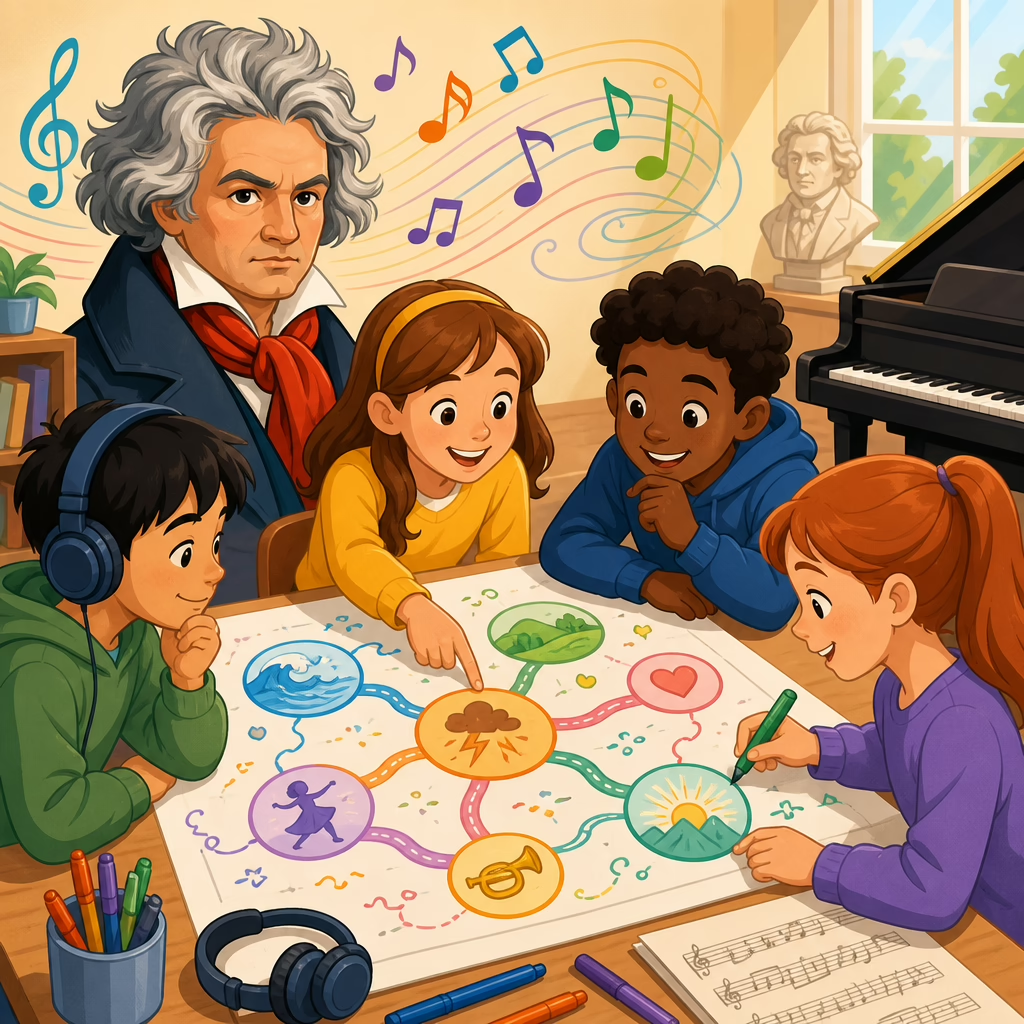
Teaching Beethoven Through Active Listening Maps
Teaching Beethoven through active listening maps gives elementary music teachers a practical way to turn a long instrumental work into something students can follow, describe, and remember. An active listening map is a visual guide that helps children track what they hear in real time by pairing musical events with shapes, icons, colors, words, or movement cues. In Beethoven lessons, the map becomes a bridge between sound and understanding. Students are not asked to sit silently through unfamiliar classical music and somehow infer structure on their own. Instead, they learn to hear contrasts, recurring themes, dynamic changes, tempo shifts, and instrumental color through a sequence they can see and respond to.
This approach matters because Beethoven’s music is often introduced too early as cultural importance rather than musical experience. Children hear that he was a famous composer, maybe that he was deaf, and perhaps they recognize the opening of Symphony No. 5. Yet recognition is not listening. In classrooms where I have used active listening maps, the difference is immediate. Students who usually lose focus after twenty seconds begin anticipating the return of a motif, raising their hands for a sudden forte entrance, or tracing the shape of a melody in the air. The map organizes attention. It lowers cognitive load while preserving musical complexity, which is exactly what young listeners need.
Teaching Beethoven this way also supports core music standards. Students identify form, analyze expressive qualities, connect music to historical context, and respond using discipline-specific vocabulary. Just as important, active listening maps create evidence of learning. A teacher can observe whether students track ABA form, notice sequence, or distinguish theme from transition. For a composer like Beethoven, whose works often develop small ideas through repetition and transformation, this kind of guided listening is especially effective. The goal is not merely that students enjoy a famous piece. The goal is that they hear how it is built, and that they gain tools they can use with every future listening experience.
Why Beethoven Works So Well With Listening Maps
Beethoven’s music lends itself to active listening because it is driven by strong motifs, dramatic contrasts, and clearly shaped sections. In elementary settings, those features are more teachable than long lyrical lines with subtle structural cues. The famous four-note motive from Symphony No. 5 is the obvious example, but it is not the only one. The second movement of Symphony No. 7 offers a steady pulse and layered texture that children can track visually. “Ode to Joy” from Symphony No. 9 presents a melody built from repeated pitches and stepwise motion, which makes phrase mapping straightforward. Even short excerpts from piano sonatas can work if the teacher selects passages with vivid changes in register, articulation, or dynamic level.
Another advantage is that Beethoven wrote music with a strong sense of forward motion. Students can hear tension and release even before they know those terms. A listening map lets you name what they are already sensing. For example, if a passage grows louder, rises in pitch, and thickens in texture, the map might show an ascending staircase widening into a bold block of color. If a transition feels like travel, the map can use a road or arrow. These are not decorative choices. They are representations of musical function. When children connect a symbol to a repeated listening event, they begin forming analytical habits without feeling that they are doing formal analysis.
Beethoven also provides useful access points for story, emotion, and historical context, but those should serve the listening, not replace it. It is tempting to spend a whole class on biography. A better sequence is to introduce only the context that sharpens what students are about to hear. If you tell students Beethoven pushed musical forms toward greater drama and contrast, they can test that claim through the map. If you mention his gradual hearing loss, frame it carefully and avoid turning disability into mythmaking. The listening map keeps the lesson grounded in music itself, where the most meaningful understanding begins.
How to Build an Effective Active Listening Map
An effective map starts with a specific excerpt and a single listening objective. That objective might be identifying rondo form, tracking repeated motives, noticing dynamic contrast, or following instrument entrances. Trying to teach all of those in one map usually weakens the lesson. I build the map only after score study and repeated listening. Even if you are teaching elementary students, your planning should be musically exact. Mark phrase lengths, cadences, major transitions, and any deceptive spots where students may lose the thread. Then decide which events are essential enough to represent visually.
The best maps are simple, sequential, and tied to audible cues. If students cannot hear the moment a symbol changes, the map is too abstract. Use no more than three or four symbol types in one lesson. For younger grades, color blocks and shape repetition work better than text-heavy labels. For older elementary students, you can add formal terms such as theme, transition, coda, forte, or staccato. Keep the layout left to right unless there is a clear reason to use another path. Predictable layout helps students synchronize eye movement with the music.
I also recommend planning for participation. A map should invite an action: point, trace, clap, tap, conduct, whisper-count, or show a hand sign when a section returns. Active listening is not worksheet listening. In practice, students follow the map more successfully when the motor response is built into it. In “Ode to Joy,” for instance, students can tap the beat during the opening phrase, lift a finger when the melody repeats, and sweep both hands outward when the phrase expands. The map becomes a performance scaffold as much as a visual aid.
| Beethoven excerpt | Best listening focus | Map design choice | Student action |
|---|---|---|---|
| Symphony No. 5, Movement 1 opening | Motif repetition and contrast | Four bold icons repeated across sections | Clap the motif, freeze on rests |
| “Ode to Joy” theme | Phrase repetition and contour | Ascending and descending line shapes | Trace melody in the air |
| Für Elise opening | Return of A section | Color-coded ABA blocks | Raise card when A returns |
| Symphony No. 7, Movement 2 excerpt | Steady pulse and texture layering | Pulse grid with added symbols for entries | Tap beat and point to new layer |
Lesson Design for Elementary Classrooms
A strong Beethoven listening-map lesson usually unfolds in three passes. In the first pass, students hear the excerpt without interruption and give a quick reaction using plain language: calm, stormy, sneaky, strong, repeated, or surprising. In the second pass, the teacher introduces the map and models how to follow it. In the third pass, students track independently or in partners while performing the planned action. This sequence respects both intuition and analysis. Children first experience the music, then organize what they heard, then demonstrate understanding.
Grade level affects complexity. In kindergarten through second grade, choose excerpts under ninety seconds and focus on one salient feature such as loud and soft, same and different, or returning section. In grades three through five, students can manage longer excerpts and more explicit structural language. They can compare two maps of the same piece, revise a map after listening, or design a partial map themselves. That shift from following to creating is important. It reveals whether they can convert sound into representation, which is a higher-order musical skill.
Materials do not have to be elaborate. I have used projected slides, printed strips, floor cards, and whiteboard sketches. The key is visibility and timing. If using a projector, advance only when the music reaches the next event unless the entire sequence is already visible. If using cards on the floor, let students physically move along the form. That body-scale version is especially useful for Beethoven because the music often feels architectural. Students sense sections more clearly when they travel through them. For broader planning ideas and classroom-ready resources, teachers can connect this focused strategy to the main guide at Beethoven lesson plans for elementary music classes.
Choosing Repertoire and Matching It to Learning Goals
The most successful repertoire choices are not always the most famous ones. Teachers should select Beethoven excerpts based on what students can audibly track. “Ode to Joy” is excellent for melodic contour, phrase repetition, and theme recognition. “Für Elise” works well for rondo-like return and mood contrast, though it requires careful explanation because many simplified classroom versions alter the form. The opening of Symphony No. 5 is unmatched for motif work, but because it is intense and fast, younger students need very short segments. Symphony No. 6 can support listening for mood and instrumental color, particularly if you isolate sections with clear pastoral character rather than assigning the entire movement.
One common mistake is choosing a piece because it is iconic, then forcing a vague activity around it. Start with the listening target instead. If you want students to hear sequence, choose an excerpt where a pattern repeats at different pitch levels. If you want them to hear orchestral build, select a passage with clear textural layering. If your goal is ABA form, pick something with unmistakable return. Beethoven offers all of these, but not in equally accessible doses.
Audio quality matters more than many teachers expect. A compressed, noisy classroom recording can flatten the very contrasts your map depends on. Use a reputable recording from a major orchestra or pianist, and preview tempo choices because they affect map pacing. Leonard Bernstein’s Beethoven recordings can be instructive for dramatic shaping, while Claudio Abbado, Herbert von Karajan, and John Eliot Gardiner offer different orchestral balances that may change what students notice first. For piano works, performances by Daniel Barenboim or Alfred Brendel often present phrase structure clearly. You do not need to discuss performers with young students every time, but your selection influences what they can successfully hear.
Assessment, Differentiation, and Common Pitfalls
Assessment in listening-map lessons should measure listening, not just compliance. A student who points at the right time may be copying peers. Build in quick checks that require individual processing. Ask students to circle the section that returned, draw the next expected symbol after a repeated phrase, or explain in one sentence why two map boxes look different. Exit tickets can be verbal in primary grades and written in upper elementary. If students can connect a symbol to a sonic reason, they understood the map.
Differentiation is straightforward when the map itself is layered. Some students need only color-coded sections and gesture cues. Others can handle notation fragments, dynamic markings, or measure numbers. English learners often benefit from icon-based maps with a small vocabulary bank: repeat, change, loud, soft, fast, smooth. Students with attention or processing challenges may follow best with a personal laminated strip and a movable marker. In inclusive classrooms, I have found that active listening maps reduce anxiety because the task is transparent. Students know what to listen for and when it matters.
The main pitfall is over-explaining before the music starts. If a teacher spends ten minutes narrating every symbol, students enter the listening already fatigued. Keep the first explanation brief and let the second hearing do the teaching. Another pitfall is making the map too literal, as though every image needs a story meaning. Beethoven’s music does not need cartoons. Symbols should clarify sound, not distract from it. Finally, do not treat the map as the destination. Once students can follow it, remove support gradually. Ask them to predict a return before it happens or sketch their own reduced version from memory. That is how guided listening becomes independent musicianship.
Teaching Beethoven through active listening maps works because it respects both the music and the learner. It accepts that elementary students need structure, but it does not dilute the substance of Beethoven’s writing. A well-made map helps children hear recurring motives, formal returns, dynamic architecture, and expressive contrast with unusual clarity. It also gives teachers a reliable way to make listening visible, participatory, and assessable. Instead of hoping students stay engaged through a famous excerpt, you design a path that shows them where to place attention and why.
The strongest results come from careful repertoire choice, tightly defined objectives, simple visual design, and repeated hearings with purposeful action. Beethoven is especially rewarding in this format because his music is built from memorable ideas that change shape across time. When students track those changes on a map, they begin to understand form from the inside. They are not memorizing facts about a composer; they are learning how to listen. That is the lasting benefit, and it transfers far beyond one unit or one grade level.
If you teach elementary music and want students to connect with Beethoven in a concrete way, start with one short excerpt and one clear map. Listen, revise, and teach it again. The process is manageable, the engagement is real, and the musical understanding it produces is deep.
Frequently Asked Questions
1. What is an active listening map, and why does it work so well for teaching Beethoven to elementary students?
An active listening map is a visual tool that helps children follow a piece of music as it unfolds in real time. Instead of asking students to simply listen and remember abstract musical ideas, the map gives them something concrete to track. A teacher might use lines for flowing melodies, dots for repeated beats, icons for instrument entrances, color blocks for contrasting sections, or simple words and movement prompts that match what students hear. This structure is especially effective with Beethoven because his music often includes strong contrasts, memorable motifs, repeated patterns, and clear changes in dynamics, tempo, and character. Those features are ideal for visual representation.
For elementary learners, Beethoven can feel long and unfamiliar at first. An active listening map breaks that barrier by turning the experience into a guided musical journey. Students are no longer passive listeners. They are following the form, noticing changes, anticipating returns, and building vocabulary as they go. This process supports listening stamina, musical memory, and comprehension. It also makes sophisticated classical music developmentally accessible without oversimplifying it. In practice, the map becomes a bridge between sound and understanding, helping children connect what they hear to musical concepts such as form, repetition, contrast, motif, dynamics, and expressive intent.
2. Which Beethoven pieces are best for active listening maps in the elementary music classroom?
The best Beethoven selections for active listening maps are pieces with clear contrasts, recognizable themes, and manageable excerpts. Elementary teachers do not need to begin with an entire symphony movement from start to finish. Shorter sections often work best, especially when students are first learning how to listen actively. Popular choices include the opening motif from Symphony No. 5, selected sections of Symphony No. 6 “Pastoral,” themes from Ode to Joy in Symphony No. 9, the final movement of Piano Sonata No. 8 “Pathétique” in excerpted form, and portions of Für Elise. These works contain repeated ideas and strong character shifts that can be represented visually and kinesthetically.
When choosing a piece, teachers should think less about fame alone and more about listenability for children. Ask whether students can hear obvious repeated patterns, whether the form can be simplified into sections, and whether the music invites descriptive language or movement. A short, dramatic Beethoven excerpt with a bold rhythmic identity may be more successful than a longer, subtler passage. It is also helpful to choose excerpts that align with lesson goals. If the focus is form, select music with easy-to-hear repeated sections. If the goal is dynamics, choose a passage with noticeable loud and soft contrasts. If the lesson emphasizes mood or imagery, a piece like the “Pastoral” Symphony can be especially effective. The strongest selections are the ones that allow students to listen with purpose and respond with confidence.
3. How do you create an effective active listening map for a Beethoven lesson?
Creating an effective active listening map starts with careful teacher listening. Before making the visual, listen to the chosen Beethoven excerpt several times and identify the most important musical events students should notice. These might include recurring motifs, changes in dynamics, contrasting sections, instrument entrances, tempo shifts, or moments of tension and release. Once those anchor points are clear, design a map that reflects the sequence of events in a way elementary students can understand at a glance. Keep the design simple and consistent. For example, one color might always represent a returning theme, a zigzag line could show a sharp or energetic idea, and a circle might signal a sustained or lyrical phrase.
The map should match the instructional purpose. If the lesson is about form, label sections with icons or letters and make repeated sections visually obvious. If the lesson highlights expression, use symbols and colors to reflect mood and intensity. If students are very young, pictures and movement cues may work better than formal labels. If students are older, the map can include a little more musical vocabulary, such as crescendo, motif, or ABA form. During instruction, introduce the map gradually. Students often benefit from hearing the excerpt once without the visual, then again while the teacher guides their attention, and finally one or more times while they independently track the music. A strong map is not cluttered with every detail. It focuses student attention on the most meaningful musical features and helps them experience success while listening to complex music.
4. How can active listening maps support broader music skills beyond just one Beethoven lesson?
Active listening maps do much more than help students survive a classical listening example. They build foundational musicianship. When students track a listening map, they are practicing auditory discrimination, sequencing, form recognition, pattern awareness, musical memory, and descriptive listening. They learn to hear music as organized sound rather than as background noise. Over time, this strengthens their ability to identify recurring themes, compare sections, discuss expressive choices, and understand how composers organize musical ideas. Those are transferable skills that support singing, performing, improvising, and composing.
In a broader curriculum, listening maps can also reinforce literacy and cross-curricular thinking. Students learn to interpret symbols, follow left-to-right or top-to-bottom sequences, connect visual information to time-based events, and explain what evidence in the music supports their observations. In group settings, active listening maps encourage discussion and collaborative meaning-making. One child may notice the return of a theme, while another identifies a change in instrument color or energy. These conversations deepen musical thinking. With repeated use, students become more independent listeners and begin to expect structure in what they hear. That independence is one of the most valuable outcomes. Instead of relying completely on the teacher to explain the music, students start asking informed questions, making predictions, and drawing conclusions from listening itself.
5. What are the best classroom strategies for using active listening maps so students stay engaged with Beethoven’s music?
The most effective classroom strategies combine structure, repetition, and active participation. Start by setting a clear listening purpose. Tell students exactly what they are listening for, such as a returning rhythm, a loud-to-soft change, or a new section. Then introduce the map in a way that feels interactive rather than static. Teachers might point as the music plays, invite students to trace the map with a finger in the air, use simple body percussion on recurring motifs, or pair each section with a gesture or locomotor movement. These actions keep students physically and mentally involved, which is especially important when teaching longer instrumental works.
Repetition is also essential. Beethoven’s music becomes more understandable and enjoyable when students hear it multiple times with a different task each round. On the first hearing, students might simply notice the overall mood. On the second, they follow the map. On the third, they identify repeated sections or perform matching movements. On the fourth, they use musical vocabulary to describe what happened. This layered approach prevents overload and helps students move from basic familiarity to deeper understanding. It is also helpful to pause strategically, ask quick reflection questions, and let students explain what on the map helped them follow the music. When students feel successful, their engagement rises.
Finally, teachers should keep the map developmentally appropriate and flexible. Not every class needs the same level of detail, and not every student responds best to the same type of visual. Some groups thrive with bold colors and icons, while others benefit from words, arrows, or story-based cues. The best strategy is to use the map as a scaffold, not a script. It should guide attention without limiting curiosity. When used well, active listening maps transform Beethoven from something distant and difficult into something vivid, trackable, and memorable for young learners.