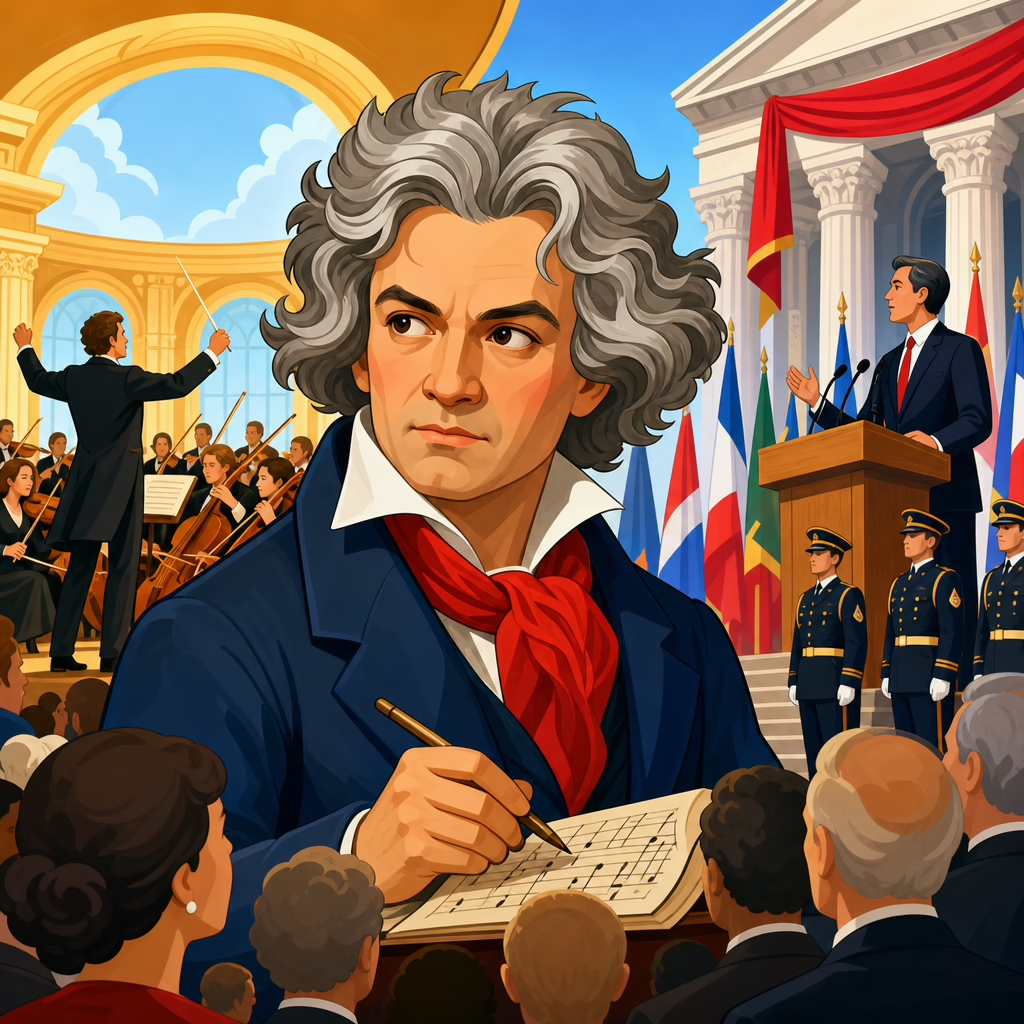
Why Beethoven Appears in Political Speeches and State Ceremonies
Beethoven appears in political speeches and state ceremonies because his music and public image carry a rare combination of moral seriousness, emotional force, and international recognizability. In official settings, leaders need symbols that feel larger than party conflict yet still communicate values such as sacrifice, freedom, dignity, unity, and historical continuity. Ludwig van Beethoven, especially through works like the Ninth Symphony, the “Eroica,” the Fifth Symphony, and the “Egmont” Overture, supplies exactly that symbolic vocabulary. His music can sound triumphal without seeming frivolous, solemn without becoming inert, and idealistic without being tied to one nation alone.
To understand why Beethoven is so often present at inaugurations, memorials, parliamentary commemorations, diplomatic events, and speeches about national purpose, it helps to define two related ideas: political symbolism and ceremonial repertoire. Political symbolism refers to the use of objects, language, music, and ritual to represent values that a state wants to project. Ceremonial repertoire means the recurring body of music chosen for formal occasions because it is widely legible and emotionally reliable. In my work analyzing concert programming and public commemorations, Beethoven consistently appears where institutions want gravity plus meaning. He is not background music. He functions as a message.
That message has been built over more than two centuries. Beethoven’s biography as the independent artist, struggling against adversity while pursuing high ideals, became central to nineteenth-century culture and remained useful to modern states. His deafness, his resistance to aristocratic subservience, and his reputation for artistic integrity all helped create a narrative of principled greatness. At the same time, his compositions entered public life through conservatories, military bands, civic orchestras, radio broadcasts, school curricula, and major anniversaries. By the twentieth century, many listeners did not need technical musical knowledge to recognize that Beethoven signaled importance.
State ceremonies especially depend on shared recognition. A leader cannot assume every audience member knows a specialized modern composer, but Beethoven is different. The opening motive of the Fifth Symphony, the choral close of the Ninth, and the heroic breadth of the “Eroica” are familiar across borders. That familiarity matters because official ritual must communicate instantly. When a president, monarch, parliament, or international body invokes Beethoven, it borrows an established cultural code. The code says: this moment concerns the common good, historical responsibility, and aspirations larger than immediate political advantage.
Why official institutions rely on Beethoven’s symbolic power
Beethoven is useful to official culture because he sits at the intersection of prestige and accessibility. Bach is revered, but his music often carries stronger liturgical or learned associations. Mozart is beloved, yet his elegance can read as theatrical rather than civic. Wagner is powerful but politically hazardous because of explicit nationalist appropriation and anti-Semitic ideology. Beethoven occupies a more adaptable middle ground. He conveys seriousness and emotional breadth while remaining broadly acceptable in democratic, monarchical, and international contexts.
Another reason is structural. Ceremonies need music that can frame entrances, pauses, memorial silence, and climactic declarations. Beethoven wrote in forms that suit public ritual: overtures that establish dramatic expectation, symphonic movements that shape collective feeling, and choral finales that turn private emotion into communal statement. I have seen event planners return to Beethoven because his music is architectonic. It gives shape to time. In a state funeral, remembrance service, or anniversary observance, that capacity is not ornamental; it is operational.
His symbolism also remains flexible enough to serve conflicting causes. Revolutionaries, liberals, conservatives, nationalists, federalists, and international organizations have all claimed Beethoven. That may seem contradictory, but it explains his durability. Political actors prefer symbols that can be stabilized around broad virtues rather than narrow programs. Beethoven can represent resistance to tyranny through “Egmont,” civic heroism through the “Eroica,” perseverance through the Fifth, and universal brotherhood through the Ninth. Because the associations are strong but not singular, institutions can adapt him to different ceremonial goals.
The Ninth Symphony and the language of unity
No Beethoven work appears more often in political and ceremonial life than the Ninth Symphony. Its final movement, setting Friedrich Schiller’s “Ode to Joy,” is the clearest example of music functioning as civic language. The text celebrates joy, brotherhood, and human connection, and Beethoven’s setting turns those ideals into an expansive, collective proclamation. That is why governments and supranational bodies repeatedly use it when they need to express reconciliation, democratic aspiration, or shared destiny.
The most famous modern example is the adoption of the “Ode to Joy” melody as the anthem of the Council of Europe in 1972 and later the European Communities, now the European Union. The tune was chosen precisely because it could symbolize common European culture without favoring one national language. In ceremonial practice, that matters enormously. A texted anthem can divide; an instrumental melody can unite while remaining legible. Beethoven thus became embedded in treaty culture, parliamentary symbolism, and continental diplomacy.
Another defining case came in 1989, when Leonard Bernstein conducted Beethoven’s Ninth in Berlin after the fall of the Wall, changing the word “Freude” to “Freiheit” for “freedom” in performance symbolism. Whatever one thinks of the textual alteration, the event demonstrated Beethoven’s political elasticity. The symphony could absorb an immediate historical meaning while retaining its established moral weight. It did not merely accompany reunification. It interpreted reunification for a global audience.
That pattern continues because the Ninth answers a practical ceremonial question: how do leaders express unity without sounding merely administrative? Beethoven offers an answer that feels elevated rather than bureaucratic. For readers interested in the wider cultural story behind this symbolism, the broader context appears in this guide to why Beethoven became a global cultural icon. In speeches and ceremonies, the Ninth remains the strongest shorthand for collective ideals that exceed borders, parties, and generations.
Heroism, struggle, and the political reading of instrumental music
Political ceremonies do not rely only on sung texts. Beethoven’s instrumental music is repeatedly used because listeners hear drama, conflict, and resolution even without words. The “Eroica” Symphony is central here. Originally linked to Napoleon before Beethoven angrily removed the dedication, it acquired a durable aura of heroic striving. States have used that aura to honor military sacrifice, constitutional founding, and national perseverance. The power lies partly in biography, but also in musical design: expansive scale, tension, rupture, and hard-won arrival.
The Fifth Symphony functions similarly but more compactly. Its famous four-note opening has often been interpreted as fate knocking at the door, though that phrase is historically shaky. What matters is that the symphony stages an unmistakable movement from struggle to victory. During the Second World War, the opening motive gained extra resonance because its rhythm matched the Morse code for the letter V. Allied propaganda used it as a sonic emblem of victory. Once that association entered public memory, the Fifth became even more available for speeches about resolve under pressure.
The “Egmont” Overture adds another layer. Written for Goethe’s drama about resistance to Spanish oppression in the Low Countries, it has often been programmed in contexts involving liberation and civic courage. After the 1956 Hungarian uprising, “Egmont” carried special significance for many Hungarian listeners. Here Beethoven’s political use was not abstract prestige alone. It was rooted in a specific narrative of resistance that audiences could map onto modern events.
| Work | Common ceremonial meaning | Typical public use |
|---|---|---|
| Ninth Symphony | Unity, reconciliation, shared ideals | International events, anniversaries, political transitions |
| Fifth Symphony | Resolve, endurance, victory over crisis | War remembrance, speeches during national strain |
| Eroica Symphony | Heroism, public sacrifice, historical turning points | State commemorations, civic memorial programs |
| Egmont Overture | Resistance to oppression, liberation | Democracy events, remembrance of uprising or occupation |
How speeches borrow Beethoven’s authority
Beethoven appears in political speeches both directly and indirectly. Direct use includes quoting his name, invoking a work, or placing a speech before or after a performance. Indirect use happens when the speech adopts concepts already attached to Beethoven: destiny, freedom, fraternity, sacrifice, and moral courage. A leader standing in front of an orchestra performing Beethoven inherits part of the composer’s authority. The setting suggests that the speech belongs to a serious historical register, not just the daily news cycle.
Speechwriters understand this effect. Ceremonial rhetoric needs support from staging, sequence, and cultural memory. If a head of state addresses a nation after a major tragedy, a Beethoven adagio or overture can prepare the emotional frame before any words are spoken. If a parliament marks an anniversary of liberation, the Ninth can transform abstract references to unity into something physically felt by the audience. In these moments, music does argumentative work. It persuades by shaping mood and scale.
There is also a legitimizing function. Beethoven’s canon status signals continuity with respected institutions: orchestras, conservatories, national theaters, public broadcasters, and commemorative traditions. In practice, that means a speech paired with Beethoven does not seem improvised or opportunistic. It appears anchored in a larger civilizational inheritance. That is one reason democratic states and international bodies use him so consistently. They need symbols that elevate public language without tying it to sectarian doctrine.
The risks, limits, and contested meanings of Beethoven in politics
Beethoven’s ceremonial power does not make him politically neutral. The same qualities that invite use also invite appropriation. Authoritarian regimes have used Beethoven to claim cultural legitimacy, and democratic movements have used him to signify freedom. During the Third Reich, Beethoven was folded into official German cultural prestige. After 1945, however, the same music was reclaimed for reconstruction, mourning, and democratic rebirth. This history matters because it shows that Beethoven does not contain one permanent political message. Institutions assign meanings through context, programming, and rhetoric.
There are practical limits as well. Overuse can empty symbolism of force. If every summit, memorial, and national address reaches for the Ninth, audiences may hear cliché rather than conviction. Cultural inclusion is another issue. In diverse societies, relying too heavily on European classical repertoire can narrow the representational field and imply that national dignity speaks in only one tradition. The strongest planners I have worked with understand this tradeoff. They use Beethoven selectively, often alongside contemporary, regional, military, sacred, or vernacular music to reflect the full public.
Still, Beethoven remains in rotation because few alternatives match his mix of grandeur, recognizability, and interpretive openness. He can solemnize grief, dignify institutions, and dramatize hope without requiring extensive explanation. That efficiency is invaluable in state ritual, where every element must carry meaning quickly and before heterogeneous audiences.
Why Beethoven still works in modern state ceremonies
Beethoven continues to appear in political speeches and state ceremonies because he offers leaders and institutions a tested symbolic instrument. His music communicates that an event matters, that it belongs to history rather than mere publicity, and that the values being invoked aspire to broad human significance. The Ninth supplies a language of unity; the Fifth embodies endurance; the “Eroica” frames public heroism; “Egmont” speaks to resistance and liberation. Across these works, Beethoven gives official culture a repertoire of seriousness that remains immediately legible.
The deeper reason is that Beethoven joins emotion to legitimacy. Ceremonies succeed when they make audiences feel something while confirming that the state, parliament, or international body speaks in a credible register. Beethoven helps accomplish both tasks at once. His canon status lends authority, and his music’s dramatic design creates collective experience in real time. That is why he is still chosen for commemorations, diplomatic occasions, constitutional anniversaries, and speeches meant to outlast the moment.
For anyone studying political culture, the lesson is clear: music in state ritual is never decorative. It is part of the argument. Beethoven endures in that role because generations of listeners have learned to hear in his work the sound of struggle, dignity, and common purpose. If you want to understand modern public symbolism more sharply, start listening to where Beethoven appears, when he is chosen, and what leaders need him to say.
Frequently Asked Questions
Why is Beethoven so often referenced in political speeches and state ceremonies?
Beethoven appears so often in political rhetoric and ceremonial life because he represents something unusually useful to public leaders: a cultural symbol that feels morally elevated, emotionally powerful, and broadly recognizable across national borders. In political speeches and state events, officials usually want references that rise above day-to-day partisanship. They need language, music, and historical figures that can suggest seriousness without sounding narrowly ideological. Beethoven serves that role exceptionally well.
His music is associated with struggle, resolve, sacrifice, freedom, human dignity, and ultimate triumph over adversity. Those themes translate easily into public messaging. A leader commemorating a national tragedy, marking a democratic transition, honoring military sacrifice, or calling for social unity can invoke Beethoven because his work already carries those emotional meanings in the public imagination. Even for people who are not classical music experts, the sound world of Beethoven often signals importance, gravity, and historical weight.
There is also a practical reason for his continued presence in official culture: Beethoven’s name is internationally legible. He is one of the few composers whose image and reputation can function almost like civic shorthand. Referencing him can communicate continuity with European intellectual tradition, artistic excellence, and a shared moral vocabulary. In ceremonial settings, that combination is extremely valuable. It allows leaders to wrap a political moment in the aura of something larger, older, and more enduring than immediate conflict.
What makes Beethoven’s music especially effective in official and ceremonial settings?
Beethoven’s music works especially well in official settings because it combines emotional intensity with structural clarity and symbolic flexibility. Ceremonies need music that can fill a room, command attention, and suggest significance without requiring lengthy explanation. Beethoven’s major works often do exactly that. They sound public rather than private, monumental rather than casual, and purposeful rather than decorative. That makes them ideal for inaugurations, memorials, diplomatic events, anniversaries, and state commemorations.
Another reason is that Beethoven’s music can support several kinds of ceremonial meaning at once. It can sound heroic, solemn, hopeful, defiant, mournful, or unifying depending on the context and the excerpt chosen. That versatility matters. A state ceremony may need to honor the dead while also affirming national endurance. A political speech may need to acknowledge hardship while pointing toward renewal. Beethoven’s music often carries exactly that arc: struggle leading toward resolution. This dramatic pattern allows officials to reinforce a narrative of perseverance and collective purpose.
His music also feels historical without seeming obsolete. Many ceremonial references draw legitimacy from the past, but they also need to remain emotionally accessible to contemporary audiences. Beethoven occupies that middle space remarkably well. He is unquestionably part of the cultural canon, yet his music still feels immediate and forceful. For that reason, official institutions use him not simply because he is famous, but because his music can transform a public event into something that feels more consequential, dignified, and memorable.
Why is Beethoven’s Ninth Symphony particularly important in political symbolism?
Beethoven’s Ninth Symphony holds a special place in political symbolism because it joins immense musical grandeur with an explicit message of human brotherhood. The final movement, with its setting of Friedrich Schiller’s “Ode to Joy,” has become one of the most recognizable statements of unity in Western music. In political and ceremonial contexts, that makes it extraordinarily useful. Leaders and institutions can draw on the symphony when they want to signal reconciliation, shared humanity, peace, or supranational cooperation.
The Ninth is especially powerful because it can function on multiple levels. On the surface, it is grand, uplifting, and familiar, which already makes it suitable for major public events. But it also carries a deeper symbolic history. It has been used to mark moments of liberation, democratic aspiration, postwar rebuilding, and international solidarity. The music therefore comes with layers of accumulated public meaning. When it appears in a state ceremony, it does not arrive as neutral background sound; it arrives with decades of association to historic turning points and collective ideals.
That said, the Ninth’s symbolism is not fixed or innocent. Different regimes, movements, and governments have used it for very different purposes. Its meaning can be universalist, nationalist, democratic, imperial, or commemorative depending on the setting. That adaptability is part of why it remains so prominent. The symphony offers leaders a language of unity that feels culturally prestigious and emotionally overwhelming, while still leaving room for interpretation. In official life, that combination is extremely powerful.
How do works like the “Eroica,” the Fifth Symphony, and the “Egmont” Overture contribute to Beethoven’s political image?
These works help define Beethoven as more than a great composer; they establish him as a public symbol of heroic struggle, moral courage, and historical seriousness. The “Eroica” Symphony is central because it has long been associated with ideas of heroism, political transformation, and the individual confronting history. Even people who do not know the work in detail often understand it as “big,” “noble,” and “revolutionary.” That reputation makes it highly useful in public discourse whenever leaders want to frame events in terms of sacrifice, destiny, or national purpose.
The Fifth Symphony contributes a different but equally potent image. Its famous opening has become one of the clearest musical emblems of conflict and determination in world culture. Over time, it has been interpreted as the sound of fate, crisis, resistance, and eventual victory. In political messaging, that dramatic profile is ideal. It can underscore wartime resilience, economic endurance, democratic resolve, or a nation’s capacity to overcome severe trials. The work’s familiarity makes its symbolic impact immediate.
The “Egmont” Overture adds a more explicitly political dimension because it is tied to a drama about resistance to oppression and the moral legitimacy of freedom. In ceremonial and rhetorical contexts, that connection gives Beethoven a reputation not just for grandeur but for principled defiance. When these pieces are considered together, they create a durable public portrait: Beethoven as the composer of struggle ennobled by purpose. That is precisely the kind of image political culture tends to borrow when it wants to elevate a message beyond ordinary debate.
Is Beethoven used because of his actual beliefs, or because later generations turned him into a political symbol?
The honest answer is both, but the second factor is often more important in state ceremony and political speech. Beethoven did hold strong views about liberty, dignity, and the moral stature of the individual, and those values shaped how many listeners have understood his work. He lived during an age of revolution, empire, reform, and intense debate about human freedom. That historical setting matters. It helps explain why his music became associated with moral seriousness and civic aspiration rather than with mere entertainment.
At the same time, the Beethoven that appears in public ceremonies is not simply the historical man; it is also a cultural construction built over two centuries. Critics, educators, governments, conductors, and institutions have repeatedly presented him as a heroic figure who overcame suffering, spoke to universal humanity, and gave musical form to the highest political and ethical ideals. That public image has been reinforced through concert culture, textbooks, commemorations, monuments, films, and diplomatic events. In other words, political leaders are often drawing on the Beethoven tradition as much as on Beethoven himself.
This distinction matters because it explains why the same composer can be invoked by very different political actors. Beethoven’s image is powerful precisely because it is elevated, flexible, and widely trusted. He can symbolize democratic freedom, national unity, cultural prestige, historical continuity, or collective mourning depending on the moment. So while his life and work supply the raw material, later generations have expanded him into a broader emblem. In political speeches and state ceremonies, that symbolic afterlife is often what gives Beethoven his enduring usefulness.