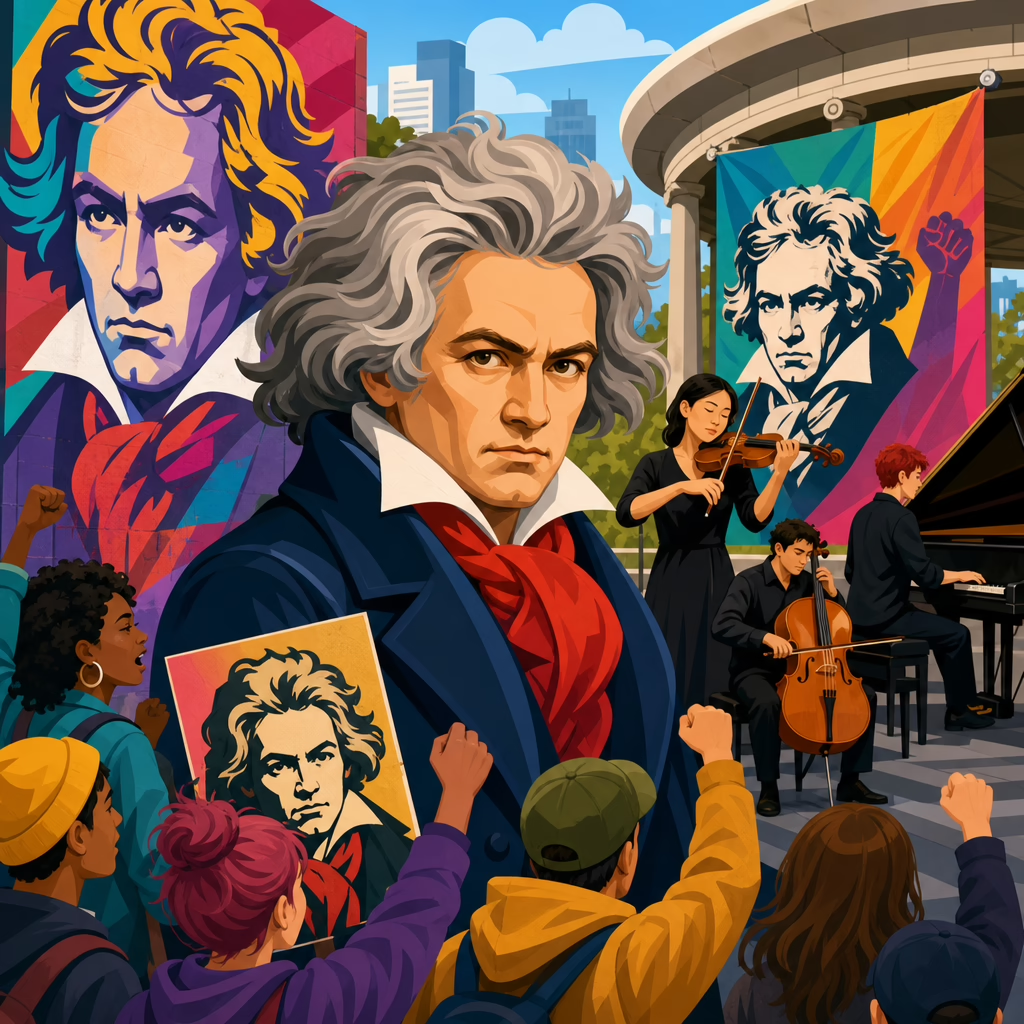
Beethoven in Protest Art and Public Performance
Beethoven in protest art and public performance reveals how a canonical composer became a living political language rather than a museum relic. In this context, protest art means visual, musical, theatrical, or site-specific work created to criticize power, rally collective feeling, or reclaim public space. Public performance refers to concerts, flash mobs, marches, commemorations, staged interventions, and spontaneous acts in streets, squares, campuses, and civic venues. Beethoven matters here because his music carries unusually dense symbolic associations: freedom, struggle, heroism, mourning, revolution, human dignity, and the possibility of solidarity across class and national lines. Few composers have been quoted so often by demonstrators, dissidents, labor organizers, antiwar artists, and state institutions seeking legitimacy.
I have worked with archives of concert programs, documentary footage, and activist performance planning, and the recurring pattern is unmistakable: Beethoven enters protest culture when words alone feel insufficient. Organizers use him because audiences often recognize the emotional arc immediately, even if they cannot name the opus number. The opening motive of the Fifth Symphony suggests fate, pressure, and defiance. The “Ode to Joy” from the Ninth Symphony can signal fraternity, but in contentious settings it also invites irony, exposing the gap between official ideals and lived injustice. Fidelio, his lone opera, supplies another durable frame through its prison-rescue plot and its insistence that liberty is not abstract but embodied.
The subject matters now because public culture is increasingly contested, and familiar symbols are constantly repurposed. A Beethoven quotation at a climate march, a string quartet outside a courthouse, or a choral sing-in after police violence does more than decorate an event. It compresses history into a present-tense act. It also raises hard questions: when does using Beethoven democratize culture, and when does it reproduce elitism? When does performance build coalition, and when does it become empty spectacle? Understanding how Beethoven functions in protest art helps explain why nineteenth-century music still shapes twenty-first-century political imagination.
Why Beethoven Became Useful to Protest Movements
Beethoven became useful to protest movements because his public image fused artistic genius with moral struggle early in modern mass culture. Biographies, monument campaigns, school curricula, and concert traditions turned him into a shorthand for resistance to adversity. That mythology is simplified, but politically effective. Activists need symbols that can travel quickly across media and borders, and Beethoven travels well. His music moves between orchestral halls and street brass arrangements, between elite institutions and amateur choirs. It can be played by a symphony orchestra, sampled by sound artists, sung by workers, or quoted by a solo violinist on a picket line.
Specific works support different protest needs. The Eroica Symphony is often invoked when a movement wants the language of civic heroism without religious framing. The Fifth Symphony works when pressure, danger, or determination must be dramatized in seconds. The slow movement of the Seventh can function as a public lament. Fidelio is especially potent in campaigns focused on imprisonment, censorship, or political detention. The Ninth Symphony occupies the most unstable territory. Its final movement can affirm universal brotherhood, but because states, corporations, and supranational bodies have also adopted it, artists often use it critically. In practice, that ambiguity is an advantage, not a flaw.
Historical timing matters too. Beethoven was canonized during eras of nationalism, liberal reform, labor politics, radio broadcasting, and postwar reconstruction. Each era attached new meanings to his music. As a result, protest artists inherit not one Beethoven but several: republican Beethoven, humanist Beethoven, European Beethoven, anti-tyranny Beethoven, establishment Beethoven, and dissident Beethoven. Effective public performance usually succeeds by choosing one of these versions clearly or by deliberately colliding them.
Street Performance, Choral Action, and the Politics of Recognition
In public protest, recognition is power. A melody that people know can transform passive bystanders into participants within moments. This is why choral adaptations of “Ode to Joy” appear repeatedly in demonstrations, vigils, and occupation-style gatherings. The tune is singable, structurally cumulative, and emotionally legible even in rough amateur delivery. I have seen organizers choose it not because everyone loves Beethoven, but because it allows nonprofessional performers to generate instant scale. A small choir can sound like a civic body when a crowd joins on the refrain.
Street performance also changes hierarchy. In a concert hall, Beethoven usually reinforces trained expertise, ticketed access, and behavioral rules. In a square, those conventions loosen. Brass bands paraphrase symphonic motives. Drummers interrupt expected phrasing. Dancers and sign-bearers overlay visual argument onto the sonic event. The meaning of the piece shifts from faithful rendition to strategic use. This does not necessarily cheapen the music. Often it restores qualities dulled by routine concert consumption: risk, physicality, surprise, and collective breath.
That said, recognition cuts both ways. Because Beethoven is associated with prestige, some communities experience his appearance in protest as exclusionary or imported from outside local culture. Skilled organizers answer this by placing Beethoven in dialogue with vernacular forms rather than in competition with them. A protest set might move from spoken testimony to local folk song to a Beethoven quotation to a new commissioned chant. The strongest public performances avoid implying that legitimacy arrives only when a European master enters the frame.
How Protest Artists Reframe Specific Beethoven Works
Context determines whether Beethoven sounds liberating, mournful, accusatory, or ironic. Protest artists rarely present works neutrally; they curate framing through location, instrumentation, sequencing, and speech. A string quartet performing the “Heiliger Dankgesang” from Op. 132 in a hospital workers’ demonstration will be heard differently from the same music in a gallery. Outside a medical setting, it can honor exhaustion and survival. Inside one, it may expose the mismatch between noble rhetoric and underfunded care.
Fidelio has been especially adaptable. The Prisoners’ Chorus, “O welche Lust,” is often used in human rights programming because it dramatizes the sensation of brief daylight after confinement. Directors sometimes stage it in courtyards, detention-adjacent spaces, or in front of government buildings to emphasize the fragility of freedom. The effect can be stronger than a speech because the chorus embodies regulated movement and restrained hope. Audiences hear not an abstract principle but the acoustics of captivity.
The Ninth Symphony is more complicated. When performed at commemorative protests, it can symbolize a still-unfinished promise of equality. When fragmented, distorted, or electronically processed, it often critiques official unity. Sound artists have looped “Freude” into stuttering repetition to suggest broken social contracts. Satirists have placed the theme against images of border violence or surveillance architecture. These uses succeed when the audience recognizes the original ideal and then feels the friction created by its failure in practice.
| Beethoven work | Common protest use | Typical effect in public performance |
|---|---|---|
| Symphony No. 5 | March openings, antiwar actions, urgent announcements | Creates tension, resolve, and immediate attention |
| Symphony No. 3 “Eroica” | Civic memorials, democracy rallies | Frames sacrifice and public courage |
| Symphony No. 7, second movement | Vigils after violence or disaster | Produces collective mourning without sentimentality |
| Fidelio / Prisoners’ Chorus | Human rights campaigns, prison reform events | Embodies constrained hope and the value of liberty |
| Symphony No. 9 / “Ode to Joy” | Mass sing-ins, ironic interventions, pro-democracy events | Signals solidarity or exposes hypocrisy, depending on framing |
Monuments, Murals, and Visual Protest Using Beethoven
Protest art involving Beethoven is not limited to sound. Murals, posters, projection mapping, and statue interventions have repeatedly turned his face and scores into visual arguments. His recognizable features—wild hair, stern gaze, manuscript in hand—function almost like a political logo. Artists can quote the canon while altering its meaning through juxtaposition. A mural might place Beethoven beside contemporary protesters, implying continuity between artistic dissent and civic action. A poster might overlay the Fifth Symphony motive onto a slogan about austerity, using notation as graphic rhythm.
Monuments are especially contested sites. Beethoven statues in Bonn, Vienna, and other cities usually symbolize cultural prestige, but during demonstrations they can be temporarily re-authored. Banners, candles, flowers, projected text, or taped testimonies can convert a commemorative monument into a platform for urgent speech. I have seen this tactic work best when the intervention acknowledges the monument’s original authority and then redirects it. The point is not vandalism for its own sake; it is semiotic capture. Protest artists borrow civic legitimacy from the statue while exposing the exclusions built into heritage culture.
Visual artists also exploit manuscript imagery. Beethoven’s sketchbooks and heavily revised pages stand for labor, persistence, and unfinished thought. In protest contexts, that materiality matters. Clean perfection suggests closure; crossed-out drafts suggest struggle. For campaigns about democratic reform, environmental repair, or reparative justice, the image of a score still being worked can be more useful than a polished bust. It says that history is composed through revision.
Real-World Patterns, Risks, and Strategic Use Today
Across the twentieth and twenty-first centuries, Beethoven has appeared in anti-authoritarian concerts, labor commemorations, memorials after state violence, and symbolic performances at political turning points. Leonard Bernstein’s 1989 Berlin performance altering “Freude” to “Freiheit” remains the most cited example of Beethoven in a public moment of ideological rupture. Yet smaller actions are often more instructive. University protests have used chamber ensembles outside administrative buildings to challenge budget cuts. Community choirs have sung from the Ninth in solidarity events for refugees. Artists opposing prison abuse have staged excerpts from Fidelio near courthouses and detention centers. These examples work not because Beethoven is universally revered, but because the music can anchor a narrative quickly.
Still, there are real risks. Beethoven can be co-opted by the very institutions protesters oppose. Official ceremonies, luxury branding, and nationalist pageantry have all used the same repertoire. If activists ignore that history, a performance may read as naive or contradictory. There is also the issue of access. Mounting Beethoven in public often requires trained players, arrangements, permits, amplification, and rehearsal time. Grassroots groups with fewer resources may find other musical languages more practical. The strategic question is never “Is Beethoven inherently radical?” It is “What does Beethoven do here, for these people, under these conditions?”
For readers exploring the wider cultural story, the most useful background appears in the main guide, why Beethoven became a global cultural icon, because protest usage depends on that larger symbolic infrastructure. In practice, successful protest performance follows four rules I have learned repeatedly: choose a piece whose public meaning matches the demand; stage it where the site intensifies the message; explain the choice briefly so audiences catch the frame; and accept adaptation over purity. Protest is not a recital. Its standard is not textual fidelity but civic force.
Beethoven endures in protest art and public performance because his music offers more than prestige; it offers a shared grammar of struggle, mourning, hope, and contradiction. Activists, directors, muralists, and community musicians return to him when they need a symbol large enough to hold conflict and familiar enough to mobilize a crowd. The most effective uses are not generic tributes. They are sharply contextual decisions that align a specific Beethoven work with a specific political problem, site, and public.
The deepest lesson is that Beethoven’s protest value lies in reinterpretation, not reverence. A courthouse performance of Fidelio, a vigil shaped by the Seventh Symphony, or an ironic “Ode to Joy” outside a ministry does not simply borrow classical music for decoration. It tests whether inherited cultural authority can be redirected toward accountability. Sometimes the result is genuinely unifying; sometimes it is deliberately dissonant. Either way, the act forces audiences to hear familiar music against unfamiliar realities.
That is why this subject remains important for artists, presenters, and organizers. If you want protest performance to resonate beyond the event itself, study how Beethoven has been framed, contested, and reclaimed in public space. Use the repertoire carefully, explain your choices clearly, and make the performance answer the moment in front of you.
Frequently Asked Questions
Why does Beethoven appear so often in protest art and public performance?
Beethoven appears so often in protest art and public performance because his music carries an unusual mix of cultural authority, emotional intensity, and political flexibility. He is widely recognized across national and class boundaries, so artists and organizers can invoke him without needing long explanation. A few notes from a symphony, a choral passage, or even his name can immediately signal seriousness, struggle, dignity, or collective aspiration. That recognizability makes him useful in public space, where a performance or intervention has only seconds to capture attention and frame its message.
Just as important, Beethoven has long been associated with ideas such as freedom, heroism, resistance, conscience, and human solidarity. Those associations did not emerge by accident; they were built through centuries of performance, criticism, education, nationalism, and political reuse. Because of that history, Beethoven functions less as a fixed historical figure and more as a symbolic language that can be repurposed. Protest artists can quote him sincerely to call for unity, or critically to expose how official culture claims moral greatness while tolerating injustice. In both cases, the power lies in the tension between canon and street, prestige and urgency, monument and living action.
Another reason is that Beethoven’s works often feel structurally dramatic in ways that suit public expression. They move from conflict to release, fragmentation to gathering force, darkness to affirmation. That arc can mirror the emotional logic of protest itself. A march, vigil, occupation, or flash performance often seeks to transform isolated frustration into visible collective presence. Beethoven’s music can amplify that transformation, whether through a full orchestral rendition, a brass arrangement, a chantable motif, or a theatrical reworking. In this sense, he matters not because he belongs to the past, but because artists continue to use him as a shared civic vocabulary for making claims in the present.
What does “protest art” mean in relation to Beethoven?
In relation to Beethoven, protest art refers to visual, musical, theatrical, or site-specific work that uses his image, biography, reputation, or compositions to criticize power, mobilize public feeling, or reclaim symbolic space. It is not limited to concert music. A mural that recasts Beethoven among demonstrators, a performance installation that layers his symphonies with testimonies from marginalized communities, or a street intervention that interrupts ceremonial culture with a politically charged quotation can all count as protest art. The defining feature is not medium but purpose: the work uses Beethoven to confront authority, reveal contradiction, or make collective demands visible.
This can happen in several ways. Some artists appropriate Beethoven as a symbol of universal human dignity and place that symbol in direct conversation with contemporary struggles over democracy, labor, race, migration, war, education, or public funding. Others work more ironically, using his status as a canonical “great composer” to question who gets included in official culture and who gets excluded from its institutions. For example, a performance that stages Beethoven in a neglected neighborhood rather than a formal concert hall may challenge assumptions about who classical music is for and where cultural legitimacy resides. Likewise, visual artists may deform, remix, or satirize Beethoven’s iconic face to expose the gap between civilizational pride and social inequality.
Protest art involving Beethoven also often turns on the clash between permanence and immediacy. Beethoven is tied to monuments, archives, and elite memory, while protest art is often temporary, mobile, and responsive. Bringing them together creates friction that can be politically productive. It asks whether cultural heritage belongs only to institutions or can be reclaimed by communities in struggle. In that sense, Beethoven becomes less a sacred object than a contested public resource, available for reinterpretation by people who want art to act in the world rather than simply decorate it.
How is Beethoven used in public performances such as marches, flash mobs, and civic interventions?
In public performance, Beethoven is used both musically and symbolically. Musically, performers may present excerpts from well-known works in streets, squares, campuses, transit hubs, government plazas, or outside institutions associated with power. These performances can be highly organized, as in a coordinated flash mob or activist orchestra, or improvised and spontaneous, as when demonstrators sing, play, or broadcast a Beethoven theme during an occupation or rally. Symbolically, the act of placing Beethoven in public space changes the meaning of the music. What might seem ceremonial in a concert hall can become confrontational, mournful, hopeful, or ironic when played at a protest site.
One common strategy is to use Beethoven to create instant collectivity. Familiar melodies can draw passersby into a performance, making them listeners, witnesses, or participants. In marches and commemorations, this can produce a sense of shared purpose, especially when instrumental performance is joined with speech, projected text, banners, choreography, or community singing. Beethoven’s music can also mark the seriousness of a moment: a vigil for victims of violence, a demonstration against censorship, or a gathering defending public institutions may use his work to frame grief and resolve without needing overt slogans at every moment.
Public interventions also use Beethoven to challenge ownership of civic space. Performing canonical music outside parliament buildings, corporate headquarters, museums, or universities can reclaim those environments from routine authority and make them newly legible. The message is often that public culture should not remain confined to elite venues or insulated from political life. In some cases, artists deliberately contrast polished Beethoven excerpts with noise, testimony, movement, or disruption, revealing social conflict beneath official narratives of harmony. In others, they stage participatory versions that break down the distance between performer and audience. Across these formats, Beethoven becomes a tool for occupying attention, re-signifying place, and turning public performance into a civic argument.
Is using Beethoven in protest contradictory, given his status as a canonical classical composer?
Yes, and that contradiction is precisely part of the point. Beethoven’s canonical status can seem at odds with protest, especially because classical music is often associated with institutions, hierarchy, tradition, and cultural prestige. But protest art frequently works by seizing established symbols and making them speak differently. Using Beethoven in dissent does not necessarily affirm the authority of the canon; it can expose, complicate, or redistribute that authority. When protesters, community ensembles, or interdisciplinary artists bring Beethoven into contested public settings, they are often asking who gets to define culture, who gets to inherit it, and whose voices are recognized as politically meaningful.
This contradiction can operate in multiple directions. On one level, Beethoven can lend legitimacy to a cause by invoking values that audiences already regard as elevated or universal. On another, his presence can be used critically to reveal how societies celebrate freedom in art while denying freedom in practice. That irony can be powerful. A state ceremony may claim Beethoven as part of national glory, while an activist intervention using the same composer may highlight repression, exclusion, or broken democratic promises. The gap between official reverence and lived reality becomes the argument.
There is also a deeper historical lesson here: canonical figures are never politically neutral. Their meanings are produced through institutions, education, performance habits, commemorations, and ideological struggles. Beethoven has been claimed by liberals, revolutionaries, humanists, nationalists, reformers, and establishment powers alike. Protest artists do not enter a pure space when they use him; they enter an already contested field. Rather than treating Beethoven as a museum relic, they reveal him as a site of ongoing interpretation. That makes his use in protest not a contradiction to be solved, but a dynamic tension that gives the work much of its force.
What does Beethoven’s presence in protest art tell us about culture, memory, and public space?
Beethoven’s presence in protest art tells us that culture is not static inheritance but active social practice. A composer becomes politically meaningful not simply because of what he wrote, but because people keep reusing, reframing, and arguing through his work. When Beethoven appears in a demonstration, street performance, campus action, or commemorative intervention, it shows that collective memory is not locked inside archives or concert halls. It is negotiated in public, often under pressure, by communities trying to define what values should govern civic life.
It also shows that public space is symbolic space. Streets, plazas, monuments, museums, and civic buildings are never just physical locations; they are places where legitimacy is staged and contested. Bringing Beethoven into those spaces can alter their emotional and political charge. A square associated with state authority may be transformed into a site of mourning, solidarity, or resistance by a strategically placed performance. A canonical score may become a means of opening public conversation about belonging, exclusion, or historical responsibility. In that sense, protest performance does not merely happen in public space; it reinterprets public space through sound, image, movement, and memory.
Finally, Beethoven’s recurring role in these contexts suggests that cultural prestige remains valuable, but not in a simple top-down way. People still turn to canonical material because it carries weight, recognition, and emotional depth. Yet that material gains new life only when it is put at risk—taken out of safe settings, exposed to conflict, and made answerable to present struggles. Beethoven in protest art therefore reveals a larger truth: cultural heritage matters most when it can be argued over, inhabited by many kinds of people, and used to make urgent claims about justice, citizenship, and the shared meanings of public life.