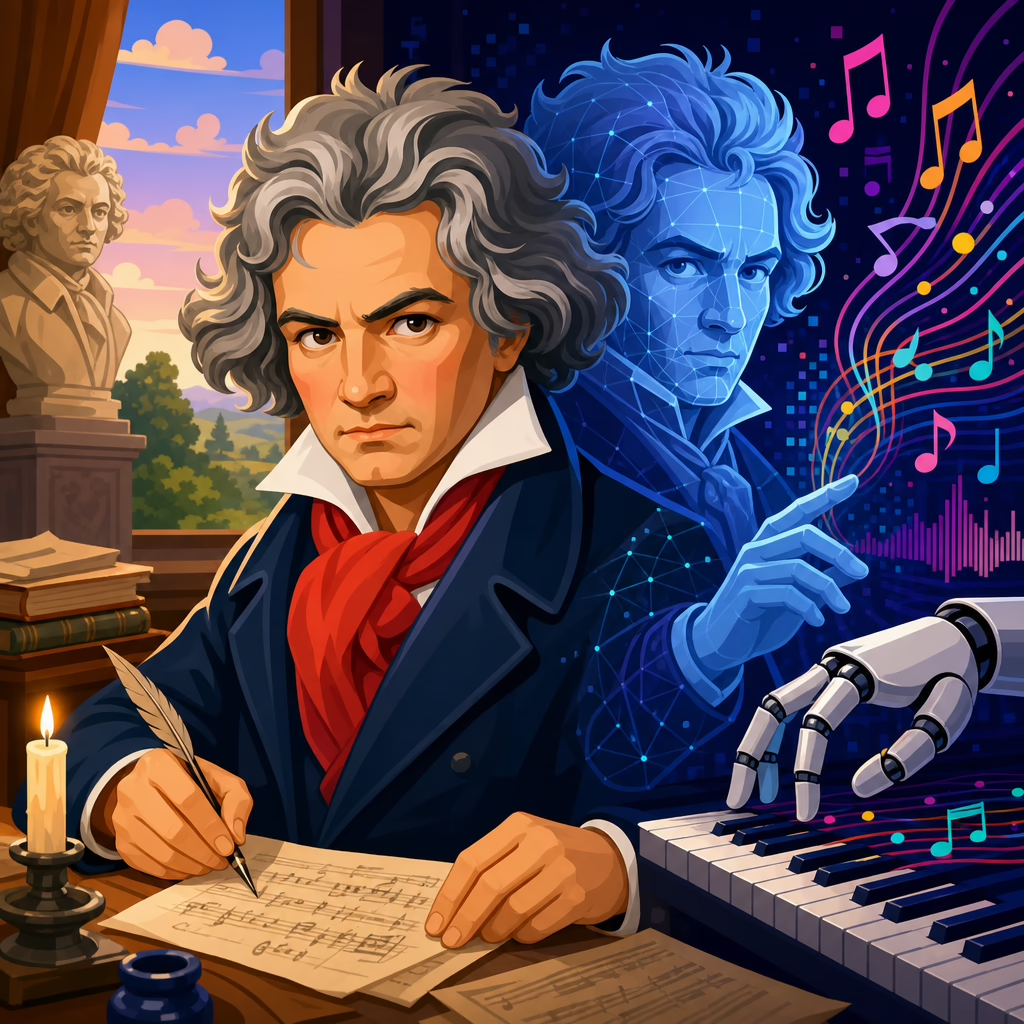
Deepfake Beethoven: What Happens When AI Mimics the Maestro
Deepfake Beethoven sits at the uneasy intersection of music history, machine learning, copyright, and cultural memory. The phrase describes synthetic media that reproduces Ludwig van Beethoven’s face, voice, handwriting, compositional style, or public persona so convincingly that audiences may believe the result is authentic. In practice, that can mean an AI-generated interview with Beethoven, a newly “discovered” sonata assembled by a model trained on his late quartets, or a museum avatar that answers visitor questions in a reconstructed nineteenth-century accent. I have worked on digital heritage projects where curators loved the educational possibilities yet worried, correctly, that realism can blur into deception. That tension is why deepfake Beethoven matters. It is not simply a novelty in the growing field of AI music. It raises difficult questions about what counts as scholarship, who controls a dead artist’s likeness, how listeners judge authenticity, and whether imitation can deepen appreciation or flatten genius into content. As a hub within Technology and Beethoven, this article maps the major issues, explains the tools and standards involved, and points to the practical choices institutions, educators, musicians, and audiences now face.
What counts as a Beethoven deepfake?
A Beethoven deepfake is any AI-assisted simulation that makes it appear Beethoven created, said, performed, or endorsed something he did not. The category is broader than face-swapped video. It includes cloned speech generated from actors and historical descriptions, image models producing “photographs” of Beethoven, music systems composing in a Beethoven-like style, handwriting generators imitating his manuscripts, and chat interfaces presenting confident but invented responses as if they came from the composer himself. The core issue is not the software used but the misleading effect. If the output invites a reasonable viewer to think, “this is genuinely Beethoven,” it enters deepfake territory.
That definition matters because not every simulation is deceptive. A transparent classroom demonstration titled “AI interpretation of Beethoven’s sketches” is fundamentally different from a viral clip claiming “newly restored audio of Beethoven speaking.” Museums, broadcasters, and music platforms should separate reconstruction, interpretation, parody, and fabrication. In digital preservation work, we usually ask three practical questions. Was the source material documented? Is the synthetic step disclosed at the point of viewing or listening? Could an average person mistake it for a primary source? Those questions are clearer than abstract debates about whether all generated media is fake.
The technology stack is now mature enough that convincing outputs are cheap. Voice cloning tools can produce multilingual speech from short reference samples. Diffusion image models can generate period portraits with painterly consistency. Large language models can mimic epistolary tone. Symbolic music models trained on MIDI or encoded scores can extend motifs, harmonize themes, and generate full piano textures that sound stylistically adjacent to Beethoven, especially to non-specialists. When these systems are combined in a single pipeline, the result can feel documentary even when every layer is synthetic.
How AI reconstructs the Maestro
Most Beethoven simulations begin with data. For visual likeness, developers compile portraits, death masks, busts, engravings, and written descriptions. For language, they collect letters, conversation books, biographies, and contemporary criticism. For music, they ingest symbolic encodings of scores, performance data, harmonic analyses, and sometimes orchestrational annotations. The model then learns patterns: facial proportions, lexical choices, cadential habits, motivic development, rhythmic compression, and preferred modulations. The better the curation, the more coherent the output. The worse the curation, the more likely the system blends Beethoven with generic “classical” stereotypes.
In my experience, the most persuasive outputs do not come from one giant model but from layered systems. A historian constrains the corpus. A musicologist tags opuses by period. An actor records neutral voice material. A speech model synthesizes delivery. A language model drafts responses grounded in verified documents. Finally, a producer adds room tone, period clothing, and camera grain to create credibility cues. None of those steps guarantees historical truth. In fact, each step introduces interpretive decisions. Which portrait is treated as authoritative? Which translation of a letter shapes vocabulary? Which performance tradition informs tempo? Deepfake realism often hides those choices.
Music generation deserves special attention because Beethoven’s style changed radically across his early, middle, and late periods. A model trained indiscriminately may produce an incoherent hybrid: early Classical phrasing with late-period harmonic audacity and middle-period motivic propulsion. Human composers notice these seams immediately. Listeners usually do not. That asymmetry explains why “AI Beethoven” demos impress broad audiences while leaving specialists unconvinced. The model may capture surface signals, like stormy arpeggios or emphatic sforzandi, yet miss large-scale architecture, thematic transformation, and the dramatic pacing that makes Beethoven Beethoven.
Where deepfake Beethoven is already appearing
The most visible examples are educational and promotional. Museums use animated portraits to narrate exhibitions. Streaming platforms commission “Beethoven explains his symphonies” clips for social media. YouTube channels publish AI voiceovers reading letters or reacting to modern culture. Classical labels experiment with recommendation engines that introduce listeners to works “in Beethoven’s voice.” None of this is hypothetical. Across cultural heritage, institutions increasingly use synthetic media because audiences respond to character-driven storytelling more than static wall text.
There are also commercial uses in composition and advertising. Brands may want the prestige of Beethoven without licensing a modern recording, so they commission original music “evoking Beethoven” generated with AI tools and polished by arrangers. Game studios use style transfer to create adaptive scores that feel symphonic without quoting protected recordings. Film marketers test dubbed historical cameos for regional campaigns. Each use seems minor in isolation. Collectively, they normalize a world where Beethoven is not a historical person studied through evidence but a reusable interface optimized for engagement.
Academic projects form the most defensible category when they are transparent. Researchers have used machine learning to complete fragmentary sketches, compare disputed attributions, and model performance possibilities on period instruments. These projects can illuminate process rather than impersonate certainty. A responsible reconstruction states where surviving manuscript material ends and algorithmic inference begins. That distinction is crucial for a sub-pillar hub like this one, because readers exploring technology and Beethoven need a map of the gray zones, not a simplistic claim that all AI use is either brilliant or fraudulent.
Benefits, risks, and the line between interpretation and deception
Used carefully, synthetic Beethoven can improve access. A well-designed avatar can help schoolchildren ask basic questions without intimidation. A stylized reconstruction can show how deafness progressed, how conversation books worked, or how thematic motives are developed. AI can also assist scholars by testing hypotheses quickly: what happens if a fragment is orchestrated using patterns found in the Seventh Symphony, or if tempo relationships across a sonata cycle are modeled computationally? These are legitimate uses because they clarify that the machine is supporting inquiry.
The risks are broader and more immediate. First, false authority spreads fast. A polished clip of “Beethoven” praising a cryptocurrency or commenting on current politics could travel widely before fact-checkers respond. Second, synthetic abundance can dilute primary sources. If students encounter more invented Beethoven quotes than documented ones, historical literacy declines. Third, generated music may crowd out careful listening. Audiences may start to treat Beethoven as a vibe, detached from opus numbers, source criticism, or performance practice. Finally, creators can exploit ambiguity. Once synthetic pieces circulate, some promoters will imply authenticity without explicitly claiming it.
The cleanest ethical line is disclosure at the moment of encounter, not buried in a credits page. If the media is reconstructed, say so in the title, caption, audio introduction, and metadata. If it is speculative, explain the basis and the uncertainty. If it is parody, make the humor unmistakable. In archival practice, provenance is everything. The public does not need a seminar on generative models; it needs simple signals that distinguish evidence from interpretation. Without those signals, trust erodes not only in AI outputs but in digital cultural heritage broadly.
Legal and ethical questions institutions cannot ignore
Because Beethoven died in 1827, his underlying compositions are in the public domain in many jurisdictions. That does not mean every Beethoven deepfake is legally uncomplicated. New recordings, scholarly editions, translations, critical notes, and visual assets can carry their own rights. A cloned performance trained on a specific orchestra’s recordings may implicate neighboring rights or contractual restrictions. A museum’s digital portrait may be owned even if Beethoven’s face is not. Developers who assume “public domain” equals “free for anything” often discover too late that the surrounding materials are protected.
Ethics go further than black-letter law. Many European cultural institutions now use provenance standards, consent frameworks, and risk assessments when digitizing collections. Similar discipline should apply to synthetic historical figures. Ask whether the representation distorts disability, temperament, class, or ethnicity. Ask whether imagined speech is being put in Beethoven’s mouth to endorse modern causes without evidence. Ask whether users can download the model and strip away safeguards. These questions mirror guidance from responsible AI frameworks such as model cards, dataset documentation, and content provenance systems.
| Use case | Main benefit | Primary risk | Best safeguard |
|---|---|---|---|
| Museum avatar | Accessible visitor engagement | Confusion with primary evidence | On-screen disclosure and source citations |
| AI-completed fragment | Research hypothesis testing | False claims of authenticity | Separate original material from generated additions |
| Marketing video | Broad audience reach | Commercial misrepresentation | Clear labeling and approval workflow |
| Style-based composition | Affordable new music production | Reduction of Beethoven to cliché | Human editorial review and attribution limits |
One emerging technical safeguard is content provenance metadata, including standards advanced by the Coalition for Content Provenance and Authenticity. These systems can attach cryptographically verifiable information about edits and origin. They are not universal, and they can be stripped, but they create an auditable trail. For cultural organizations, that is better than relying on goodwill alone.
How to evaluate an AI Beethoven project responsibly
Start with sources. A credible project names the manuscripts, editions, recordings, portraits, and scholarship it used. If a site presents an uncanny Beethoven clip with no citation trail, skepticism is warranted. Next, examine claims. Does the project say “inspired by Beethoven,” “reconstructed from sketches,” or “new Beethoven piece”? Those phrases are not interchangeable. Serious work defines the status of the output precisely. Then assess methodological fit. A language model can summarize letters; it cannot recover a lost conversation verbatim. A music model can extrapolate patterns; it cannot prove authorial intention.
Also look for human governance. The strongest projects involve curators, musicologists, performers, and legal reviewers, not just engineers. In one heritage prototype I reviewed, the team improved trust simply by adding annotated footnotes beneath each avatar response. Visitors could click from a synthetic answer to the exact letter or diary entry behind it. That design choice turned a potentially deceptive experience into a guided interpretation tool. Good interfaces reduce mystery rather than amplifying it.
Finally, judge outputs by musical and historical specifics. Does the generated sonata understand sonata form, motivic economy, registral drama, and developmental logic, or is it merely cycling through familiar cadences? Does the avatar acknowledge uncertainty where biographical records conflict? Does pronunciation reflect period-informed decisions, or just generic “European” styling? Precision is the difference between an intellectually honest experiment and a shallow impression. For readers navigating the wider Technology and Beethoven landscape, this evaluative habit is the most useful filter you can build.
Deepfake Beethoven is not a fringe curiosity. It is a practical challenge for anyone who teaches music history, manages cultural collections, builds AI products, or simply wants to know whether a compelling clip is real. The technology can serve learning, restoration, and creative exploration when it is openly framed as reconstruction or interpretation. It becomes harmful when realism is used to smuggle speculation past audiences as fact. That distinction should guide every project in this miscellaneous hub and every linked article under Technology and Beethoven.
The durable lesson is straightforward. Treat Beethoven as a documented historical figure, not a frictionless brand asset. Demand source transparency, point-of-view disclosure, and human editorial accountability. Prefer projects that separate surviving evidence from algorithmic completion. Be especially cautious with generated quotations, cloned voices, and “new works” presented without manuscript proof. If an AI Beethoven experience makes strong claims, it should show its work clearly enough that a teacher, critic, or curator can verify the chain of reasoning.
As synthetic media improves, the burden on creators and institutions will only grow. The best response is not fear or blanket rejection. It is disciplined use. Explore the related articles in this subtopic, compare case studies, and apply the same question every time: does this technology illuminate Beethoven, or does it only imitate him? That single test keeps the maestro’s legacy legible in an age of convincing machines.
Frequently Asked Questions
What does “Deepfake Beethoven” actually mean?
“Deepfake Beethoven” refers to AI-generated media that convincingly imitates some recognizable part of Ludwig van Beethoven’s identity. That identity can include his face in a video, his voice in a fabricated interview, his handwriting in a forged-looking manuscript, his musical language in a newly generated composition, or even a broader public persona assembled from historical sources and modern machine-learning systems. The key issue is not simply that AI is inspired by Beethoven, but that the output can be realistic enough to make people think it is genuinely connected to the historical composer.
In practical terms, this could take many forms. A museum might create a digital avatar that appears to “speak” as Beethoven for educational purposes. A content creator might release a supposedly lost piano work generated by a model trained on Beethoven’s sonatas and sketchbooks. A video producer could synthesize his likeness for a documentary scene that never really happened. Each example sits on a spectrum between interpretation, reconstruction, simulation, and deception.
That is why the phrase carries both fascination and concern. Beethoven is not just a composer; he is a cultural symbol. When AI mimics him, it affects how audiences understand originality, authorship, and historical truth. A respectful educational reconstruction may help people engage with music history, while a misleading deepfake may distort the public record. So “Deepfake Beethoven” is ultimately about more than technology. It is about what happens when a machine can imitate cultural memory so persuasively that authenticity itself becomes harder to judge.
Is it possible for AI to create a truly authentic new Beethoven piece?
No, not in the strict historical sense. AI can generate music that resembles Beethoven’s style, but it cannot produce an authentically new Beethoven work because authenticity depends on authorship, intention, and historical origin. Beethoven’s real compositions emerged from his lived experience, his artistic development, his revisions, his philosophical outlook, and the specific musical world of late eighteenth- and early nineteenth-century Europe. A model can analyze patterns in harmony, rhythm, form, motivic development, and orchestration, but pattern imitation is not the same thing as being Beethoven.
That distinction matters because people often confuse stylistic plausibility with genuine authorship. If a machine produces a sonata that sounds convincingly “Beethovenian,” listeners may feel they are hearing a lost work from the master. In reality, they are hearing a modern computational reconstruction based on surviving data and design choices made by engineers, curators, producers, or musicians. The training set, the prompts, the editing process, and the final arrangement all shape the result. Human decisions remain embedded in every so-called AI Beethoven composition.
Still, AI can be useful in a narrower, more honest sense. It can help scholars and artists explore how Beethoven might have continued a sketch, how certain motifs could be developed, or what stylistic features define his late period. Those experiments can be illuminating, even musically rewarding, as long as they are clearly labeled as speculative or interpretive. The danger begins when the output is presented as discovery rather than invention. AI can simulate Beethoven’s style; it cannot restore Beethoven’s own authorship or consciousness.
Are there copyright issues with deepfake Beethoven if Beethoven himself is long in the public domain?
Yes, there can be, even though Beethoven’s original compositions are in the public domain. Public-domain status means the underlying works of Beethoven are generally free to use, but that does not automatically make every Beethoven-related AI project legally simple. Copyright can still attach to modern recordings, critical editions, translations, performances, visual artwork, films, datasets, software, and other contemporary materials used to build or present a deepfake. For example, while Beethoven’s Fifth Symphony is not copyrighted, a specific modern orchestra’s recording of it almost certainly is.
There are also important issues beyond classic copyright. If an AI system is trained on copyrighted recordings, manuscripts, or documentary footage without permission, legal questions may arise about training data use, reproduction, and derivative outputs, depending on the jurisdiction. Likewise, if a synthetic Beethoven appears in a film, app, game, or museum installation, the creators may need to consider licensing for source materials, trademark-related branding concerns, contractual rights in performances, and platform rules governing synthetic media.
Another layer is moral and reputational, even where legal restrictions are weak. Historical figures do not generally hold privacy or publicity rights in the same way living people do, but institutions, archives, estates linked to later adaptations, and cultural organizations may still push back against misleading commercial uses. So the legal answer is not simply “Beethoven is free to use.” The more accurate answer is that Beethoven’s original works may be public domain, but the ecosystem around a deepfake Beethoven project can still be shaped by copyright, licensing, attribution, and disclosure obligations.
Why do deepfake versions of Beethoven raise ethical concerns if they are used for education or entertainment?
The ethical concerns come from the possibility that realism can blur into misinformation. Even when the goal is education or entertainment, a convincing synthetic Beethoven can easily create false impressions about what is historically documented and what has been creatively invented. If a museum avatar speaks with confidence about Beethoven’s beliefs, emotions, or intentions, audiences may assume those words are supported by evidence when they may actually be modern speculation. The more polished and lifelike the presentation, the easier it becomes for fiction to borrow the authority of history.
There is also the issue of cultural stewardship. Beethoven occupies a major place in global musical memory, and representations of him shape how new generations understand the canon. If AI-generated works crowd out careful scholarship, nuanced performance practice, or transparent interpretation, they can flatten a complex historical figure into a marketable digital mascot. That may be efficient for engagement, but it can also reduce a difficult, contradictory artist into a simplified brand voice designed for clicks, novelty, or commercial scale.
Ethics also involve consent and dignity, even with long-deceased individuals. Beethoven cannot approve an AI-generated interview, endorse a synthetic composition, or object to being made to say something absurd, political, or promotional. Because he cannot speak for himself, the burden falls on creators and institutions to act responsibly. Best practice usually includes clear labeling, strong source transparency, careful separation of documented fact from imaginative reconstruction, and sensitivity to the difference between interpretation and impersonation. Educational or entertaining uses can be valuable, but they become ethically shaky when they trade on implied authenticity without enough honesty about how the illusion was made.
How can audiences tell whether an AI-generated Beethoven project is responsible or misleading?
A responsible project is usually transparent from the start. It explains what parts are based on historical evidence, what parts are speculative, what materials were used to train or construct the system, and what human experts shaped the final result. If you encounter an AI Beethoven interview, composition, or avatar, look for plain-language disclosure. Does the creator clearly state that the output is synthetic? Do they identify whether the words, music, or images are reconstructed, interpreted, or entirely generated? Responsible producers do not hide the fact that AI was involved.
It is also worth checking whether historians, musicologists, performers, archivists, or curators were involved. Expert participation does not guarantee accuracy, but it often signals that the project takes historical context seriously. Good projects tend to distinguish between “this is documented in letters or manuscripts” and “this is an informed imaginative extrapolation.” Misleading projects often rely on vague phrases such as “lost Beethoven revealed” or “what Beethoven really said,” especially when there is no supporting evidence. Sensational framing is often a warning sign.
Finally, consider the project’s purpose and incentives. Is it designed to educate, explore, and invite critical thinking, or mainly to shock, monetize, and exploit the prestige of a famous name? Does it provide citations, provenance, and context, or does it depend on viewers not asking too many questions? In the age of synthetic media, audiences need a habit of informed skepticism. With Beethoven in particular, the safest approach is to treat AI-generated outputs as interpretations unless proven otherwise. When a project is honest about its methods and limits, it can deepen engagement with music history. When it pretends to be authentic discovery, it risks turning cultural heritage into confusion.