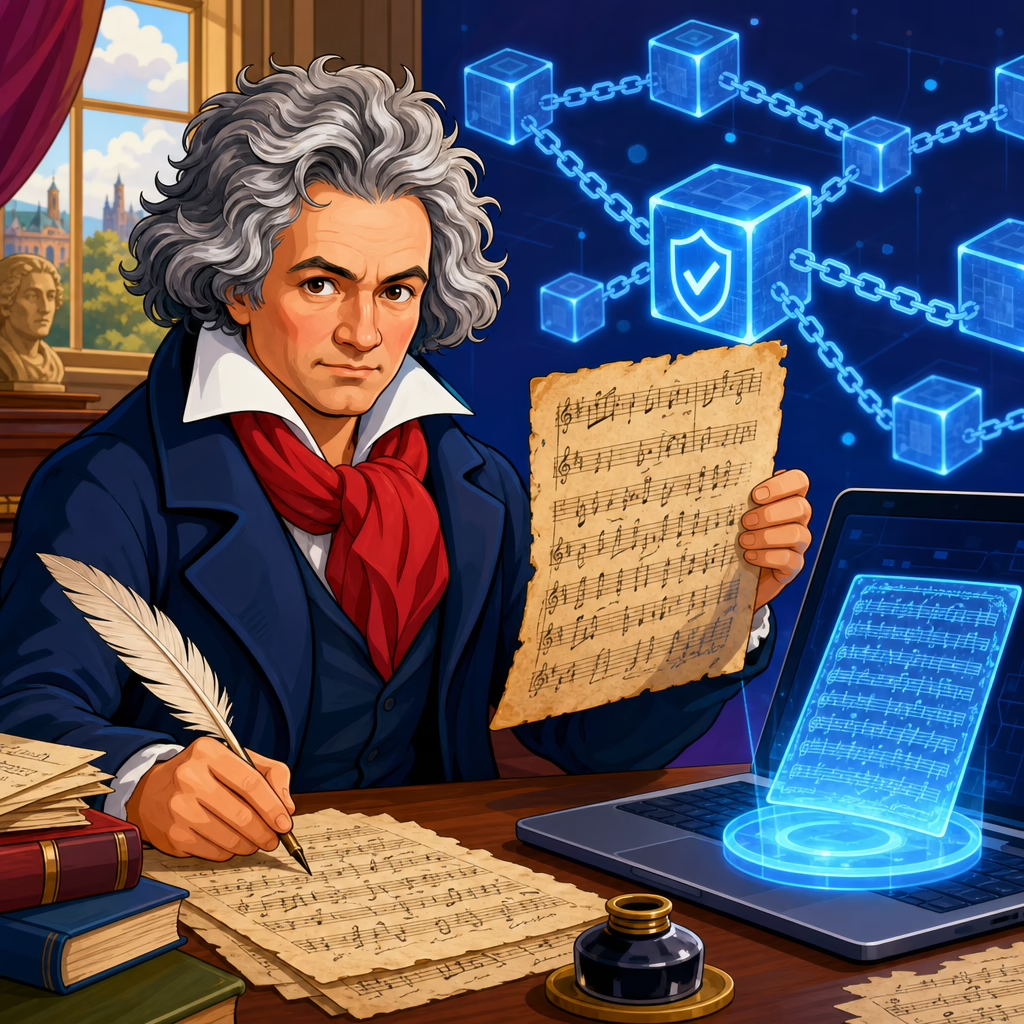
Beethoven and the Blockchain: Authenticating Manuscripts Digitally
Beethoven’s surviving manuscripts are among the most studied cultural artifacts in music history, yet proving their provenance, condition history, and chain of custody remains surprisingly difficult without a shared digital record. In practical terms, authenticating manuscripts digitally means combining established archival methods—paper analysis, watermark identification, scribal comparison, conservation reporting, and catalog metadata—with tamper-evident technologies that record when evidence was created, reviewed, and transferred. Blockchain enters this conversation not as a magical replacement for scholarship, but as an audit layer that can preserve hashes of images, ownership events, exhibition loans, restoration notes, and licensing permissions. For libraries, auction houses, scholars, estates, and collectors, that matters because a single disputed folio can affect attribution, insurance value, publication rights, and public trust. I have worked on digitization projects where the hard part was not scanning a page at high resolution; it was keeping every later annotation, conservation intervention, and rights decision connected to the same authoritative object record. This article serves as the hub for the broader miscellaneous branch of Technology and Beethoven, explaining how digital authentication works, where blockchain helps, where it does not, and which related topics deserve deeper reading across cataloging, imaging, copyright, conservation, access, and market verification.
Why Beethoven Manuscripts Need Digital Authentication
Authenticity questions around Beethoven materials arise for several reasons. First, manuscripts are fragmented across institutions such as the Staatsbibliothek zu Berlin, the British Library, the Beethoven-Haus Bonn, private collections, and auction archives. Second, many items exist in multiple forms: autograph score pages, copyist manuscripts, annotated proofs, sketch leaves, and later facsimiles. Third, provenance records are often uneven. A manuscript might have a strong nineteenth-century sale trail, then a vague mid-twentieth-century private ownership gap, followed by modern auction documentation. In that gap, pages can be separated, rebound, restored, or misdescribed.
Digital authentication addresses these weaknesses by creating a persistent evidentiary trail. At a minimum, a trustworthy record should include a unique identifier, descriptive metadata, image files, technical capture data, conservation notes, provenance statements, and rights information. The Getty Categories for the Description of Works of Art, CIDOC CRM for cultural heritage relationships, and IIIF for interoperable image delivery all help structure this information. When those records are standardized, a Beethoven sketch leaf in Bonn can be compared consistently with a related bifolio in Vienna or a former lot image from Sotheby’s or Christie’s.
The biggest misunderstanding is that blockchain proves a manuscript is real. It does not. A ledger can prove that a certain file hash existed at a certain time and that specified parties recorded a transaction. The manuscript still requires physical and scholarly examination. Paper fiber, chain lines, ink behavior under multispectral imaging, known handwriting habits, and contextual musicological analysis remain decisive. The value of blockchain is narrower and useful: it preserves integrity of digital evidence, clarifies sequence of custody events, and reduces silent alteration of records after the fact.
What “Authenticating Digitally” Actually Includes
In manuscript work, digital authentication is a stack, not a single tool. The base layer is capture: color-calibrated imaging, often with targets such as X-Rite ColorChecker cards, raking light documentation, and file preservation in TIFF with embedded technical metadata. The next layer is description: title, folio count, dimensions, watermark data, date range, notation type, associated works, and links to authority records like VIAF or ISNI. Then comes verification: expert review, version control, signatures on condition reports, and comparison against catalog raisonnés, thematic indexes, and prior sale records. Only after these layers are stable does a distributed ledger make sense.
A robust workflow usually starts with the institution’s collection management system, not with a token. Archives commonly use systems such as ArchivesSpace, TMS Collections, CollectiveAccess, or bespoke library infrastructure. From there, derivative public records may be published through IIIF manifests and searchable catalog entries. A blockchain component can anchor hashes of these records so that later viewers can confirm nothing material was altered. If a conservation lab updates a report after discovering iron gall ink corrosion, the revised report gets a new hash and timestamp, while the earlier version remains visible in the chain of record.
This distinction matters especially for Beethoven because manuscript value often lies in revision traces. Erasures, overwritten bars, marginal instructions, and pasted slips can reveal compositional process. A system that flattens everything into a single “authentic” image misses the point. Good digital authentication preserves states over time. It lets researchers see what the object looked like before treatment, after stabilization, during exhibition prep, and after rebinding. That chronology is where a ledger can be genuinely helpful.
Blockchain’s Real Role in Manuscript Provenance
For cultural heritage, blockchain is best understood as an append-only notarization and transaction log. Institutions can record a cryptographic hash of a manuscript image set, catalog record, or loan agreement on a public or permissioned chain. Because even a tiny file change produces a different hash, later auditors can verify integrity. This is useful in disputes over altered images, post-sale edits to condition language, or uncertainty about when a rights statement changed.
In practice, I recommend storing only hashes and key identifiers on-chain, while keeping master files and sensitive legal documents in trusted repositories. Putting high-resolution manuscript images directly on-chain is expensive, slow, and often incompatible with privacy, donor restrictions, and preservation policy. A better pattern is off-chain storage in institutional repositories, cloud object storage with fixity checks, or digital preservation systems such as Preservica, Archivematica, or DuraCloud, paired with on-chain hash anchoring. That design supports authenticity without forcing archives into a technology stack that is difficult to govern long term.
There are tradeoffs. Public chains offer transparency and independent verification, but transaction fees, sustainability concerns, and governance uncertainty can deter museums. Permissioned chains offer tighter control and lower operational risk, but they require trust in consortium members and may provide weaker public verifiability. For Beethoven manuscripts, where institutions often collaborate across borders and legal regimes, a hybrid model is usually the most realistic.
Evidence Used to Verify Beethoven Manuscripts
No digital system can compensate for weak source criticism. Experts authenticate Beethoven manuscripts by weighing converging evidence. Handwriting analysis compares letter forms, note stems, clef habits, dynamic markings, and correction patterns against secure autographs. Paper studies examine size, ruling, chain line spacing, and watermarks. Ink analysis can distinguish contemporaneous writing from later additions. Musical content matters too: thematic consistency, draft sequence, and links to known notebooks or correspondence can strengthen or weaken attribution.
The digital layer improves these methods by making comparison faster and more reproducible. Multispectral imaging can reveal erased notation and distinguish inks. Reflectance Transformation Imaging can help surface impressions and stylus marks. High-resolution side-by-side viewers let scholars compare slur shapes or articulation patterns across dispersed sources. Machine learning can assist with handwriting clustering, but it should never operate as sole proof. In my experience, algorithmic matches are useful prompts, not verdicts.
| Evidence type | What it shows | Digital method | Main limitation |
|---|---|---|---|
| Handwriting comparison | Whether notation and script align with known Beethoven habits | High-resolution imaging, annotation layers, pattern analysis | Variation across dates, health, haste, and copyist intervention |
| Paper and watermark study | Date range, region, possible paper batch connections | Transmitted light imaging, watermark databases | Paper stocks circulated widely and were reused |
| Ink and material analysis | Relative chronology of entries and later additions | Multispectral imaging, conservation microscopy | Requires careful interpretation and sometimes invasive testing |
| Provenance records | Ownership chain and custody events | Linked metadata, on-chain timestamps, digitized sale catalogs | Historical gaps and inconsistent documentation |
| Musicological context | Fit with known works, sketches, revisions, and chronology | Thematic databases, encoded musical comparison | Strong similarity does not guarantee autograph status |
Building a Trustworthy Digital Chain of Custody
A credible chain of custody starts before the scan. The item should be accessioned, photographed in housing, measured, and condition-checked. Each handling event needs a dated record with responsible staff, purpose, and location. If a folio moves from vault to imaging studio to conservation bench to exhibition crate, those transitions should be logged in the collection system and, where appropriate, anchored with hashes. This approach mirrors practices already familiar in archives and museums; blockchain simply hardens the audit trail.
For Beethoven materials, loans and exhibitions are high-risk moments. A score page may travel internationally, receive a new mount, or be temporarily disbound for display. Each action changes the manuscript’s risk profile. A digital custody record should therefore include packing images, courier reports, environmental readings, and post-loan condition comparisons. If an insurer later asks when a tear first appeared, the answer should come from a synchronized sequence of signed reports, not scattered email attachments.
Rights and reproduction control also belong in the chain. Even when the underlying composition is public domain, the physical manuscript image may carry contractual use restrictions or institutional licensing terms. Recording these permissions with versioned timestamps prevents confusion when publishers, documentary producers, or education platforms seek reuse. It also supports downstream internal linking across a technology-and-Beethoven content hub: digitization standards, image licensing, archival metadata, and conservation workflows all connect here.
Use Cases for Archives, Auction Houses, and Scholars
Archives benefit first from integrity verification. If a repository publishes a IIIF manifest for a Beethoven sketchbook, it can hash the manifest and core images, then later prove the files shown to researchers match the approved release. Auction houses benefit from provenance transparency. A consignor’s documentation—prior invoices, export papers, expert letters, and condition images—can be hashed on receipt, reducing later claims that records were quietly amended. Scholars benefit from citation stability. A footnote can point not only to a manuscript shelfmark but to a verified digital object state tied to a date.
Consider a hypothetical but realistic case: a single leaf attributed to the late string quartets appears in private hands. The paper and notation look plausible, yet the provenance begins only in the 1970s. A digital authentication workflow would capture the leaf under standardized imaging, compare watermarks to secure Beethoven paper stocks, link notation to known compositional patterns, and record every expert opinion with timestamps. If the owner later sells the leaf, the buyer inherits a transparent evidence bundle, not just a dealer’s summary. The ledger does not settle the attribution alone, but it prevents later uncertainty about what evidence existed at the time of sale.
This model extends beyond autograph scores. It can support sketchbooks, corrected proofs, letters discussing musical decisions, and even associated objects such as publishers’ engravings. As a hub topic, miscellaneous technology applications around Beethoven include not just authentication but also digital editions, AI-assisted handwriting study, immersive exhibitions, and rights management. Authentication is the connective tissue because every advanced use depends on trusted source records.
Limits, Risks, and Best Practices
The strongest digital provenance system can still fail if governance is weak. Bad metadata entered immutably remains bad metadata. Anonymous expert opinions are less valuable than signed, reviewable reports. Proprietary blockchain vendors may disappear, leaving institutions with difficult migrations. Environmental cost and legal uncertainty also matter, especially when institutions must justify public spending and data retention policy.
Best practice is conservative and standards-based. Use persistent identifiers. Preserve master files in trusted repositories with routine fixity checks. Publish interoperable metadata through recognized schemas. Record who made each assertion and on what evidence. Anchor hashes at meaningful milestones rather than every trivial edit. Keep sensitive owner data off public ledgers. Most important, separate object authenticity from record integrity in every policy document and public explanation.
For Beethoven institutions, collaboration will matter more than novelty. Shared authority files, watermark datasets, manuscript concordances, and imaging guidelines will improve authentication more than any standalone app. The most successful projects I have seen combine musicologists, conservators, registrars, rights staff, and digital preservation specialists from the start. That interdisciplinary design produces records that are useful in the reading room, in the lab, in court, and in the marketplace.
Beethoven and the blockchain is not a story about replacing connoisseurship with code. It is a practical framework for protecting evidence around some of music history’s most valuable primary sources. The manuscript itself still speaks through paper, ink, notation, and context. Digital systems simply help us preserve what was observed, when it was observed, and who attested to it. For institutions stewarding Beethoven materials, the immediate benefit is clarity: clearer provenance, clearer custody, clearer rights, and clearer accountability when records move across departments or borders. For researchers and collectors, the benefit is confidence that the digital object they are consulting reflects a documented, reviewable state rather than an opaque file assembled after the fact. As the hub page for miscellaneous topics under Technology and Beethoven, this article points toward connected work in imaging, metadata, conservation tracking, digital editions, and market documentation. Start with the fundamentals: standardize metadata, capture high-quality images, preserve version history, and add blockchain only where an immutable audit trail solves a real problem. Done that way, digital authentication strengthens scholarship instead of distracting from it.
Frequently Asked Questions
What does “authenticating Beethoven manuscripts digitally” actually mean?
Authenticating Beethoven manuscripts digitally means creating a trustworthy, well-documented record of what a manuscript is, where it has been, what experts have observed about it, and how that evidence has changed over time. In the case of Beethoven, this does not replace traditional scholarship or conservation science. Instead, it brings together established archival practices—such as paper and ink analysis, watermark identification, handwriting and scribal comparison, cataloging, condition assessments, and provenance research—into a shared digital framework that can be verified by multiple parties.
The “digital” part becomes especially important when institutions, collectors, conservators, and scholars need to compare findings across time and across collections. A manuscript may have moved through private hands, auctions, libraries, and museums over two centuries. Along the way, labels can be lost, descriptions can vary, and documentation can become fragmented. A digital authentication system can record each new examination, image set, conservation treatment, or ownership update in a structured and time-stamped way, making it easier to see not just a current claim of authenticity, but the evidence trail behind that claim.
When blockchain or similar tamper-evident technology is involved, the goal is not to put the physical manuscript “on the blockchain.” Rather, it is to anchor critical records—such as hashes of high-resolution images, conservation reports, expert opinions, or accession updates—into a system designed to show whether records have been altered after the fact. This can support confidence in the integrity of the documentation, particularly when multiple institutions contribute evidence. For Beethoven manuscripts, whose scholarly and market value depend heavily on provenance, textual authority, and physical characteristics, that kind of durable, shared record can be extremely useful.
Why is provenance and chain of custody so difficult to prove for historic music manuscripts?
Proving provenance and chain of custody for historic manuscripts is difficult because the documentary record is often incomplete, inconsistent, or dispersed across many repositories. Beethoven’s manuscripts have had long and complicated lives. Some remained in institutional collections, others were broken up, sold, inherited, cataloged under different systems, or described in ways that reflected the knowledge standards of their own era. Even when records do exist, they may be handwritten, unpublished, privately held, or difficult to reconcile with modern catalog descriptions.
There is also a difference between knowing that a manuscript is broadly associated with Beethoven and being able to document an uninterrupted chain of custody with confidence. A manuscript might be accepted as genuine based on stylistic, paleographic, and material evidence, yet still have gaps in ownership history. Conversely, a manuscript may have paperwork that appears strong at first glance but contains ambiguities, outdated attributions, or unsupported assumptions repeated over time. In music history, these issues are common because composers often worked with copyists, revised drafts, circulated fragments, and left materials that were later reorganized by publishers, family members, or collectors.
Digital systems help by making it easier to aggregate evidence from different sources into one auditable timeline. If archival findings, auction records, institutional accession notes, conservation reports, and image-based comparisons are all linked in a secure and consistent format, researchers can identify where certainty is high and where questions remain. This does not magically fill historical gaps, but it does reduce confusion, improve transparency, and make it harder for unsupported claims to gain authority simply through repetition.
How would blockchain be used in the authentication of Beethoven manuscripts without oversimplifying the scholarship?
Used properly, blockchain would function as a verification layer for documentation, not as a substitute for expert judgment. Scholarship on Beethoven manuscripts depends on nuanced analysis: the paper stock, watermarks, notation habits, revision patterns, scribal involvement, ink characteristics, physical wear, and institutional history all matter. Blockchain cannot determine authorship, date a manuscript on its own, or resolve a disputed attribution. What it can do is help preserve a reliable record of when evidence was submitted, by whom, and in what form.
For example, a library or archive might generate high-resolution scans, produce a condition report, and add technical findings about paper fibers or watermarks. Rather than relying solely on an internal database that can be edited without an external audit trail, the institution could create cryptographic fingerprints of those files and register them in a tamper-evident ledger. Later, if a scholar or conservator wants to verify that a report or image is the same one originally logged, the files can be checked against those recorded fingerprints. If a new conservation treatment occurs, a new entry can be added, creating a transparent sequence of updates rather than overwriting earlier states.
This approach is most valuable when many stakeholders are involved. Museums, libraries, auction houses, private owners, conservators, and scholarly editors often maintain their own records, and these records do not always communicate well with one another. A shared digital record anchored by tamper-evident technology can support interoperability and trust, especially if it is paired with robust metadata standards and clear governance rules. In other words, blockchain is useful only when it supports the real work of archives and musicology: documenting evidence carefully, preserving version history, and allowing qualified experts to interpret what the data means.
What kinds of evidence would be included in a digital record for a Beethoven manuscript?
A serious digital record would include far more than a simple title and image. At the core would be catalog metadata: the work or fragment represented, dating information, physical dimensions, folio count, current repository, shelf mark, previous identifiers, and known relationships to sketches, drafts, copies, or published editions. It would also include provenance data such as prior owners, sale history, accession records, donor information, and references in scholarly catalogs or archival inventories.
Material and forensic evidence would also be essential. That can include paper analysis, watermark documentation, chain-line measurements, ink observations, fiber testing where appropriate, and comparisons with known manuscript groups from similar periods. Handwriting and scribal analysis would be especially important for Beethoven materials, since autograph pages may appear alongside copyist intervention, annotations, editorial markings, or later collector inscriptions. A robust record should distinguish original features from later additions rather than flattening everything into one undifferentiated description.
Condition and conservation history are equally important. If a manuscript has tears, repairs, stains, trimming, rebinding, fading, or past restoration work, those details can affect both interpretation and valuation. Recording conservation reports over time creates a documented condition history, which helps scholars understand physical change and helps custodians prove that an item has been responsibly managed. High-resolution imaging, multispectral imaging where available, and linked reports from curators or conservators can all be associated with the object record.
Finally, the system should preserve the history of interpretation itself. Authentication is rarely a single event; it is an evolving scholarly process. A digital record should note who made specific claims, when they were made, what evidence supported them, and whether later experts revised those conclusions. That level of transparency is one of the most important benefits of digital authentication, because it shows not only what is currently believed about a Beethoven manuscript, but how that understanding was established.
Can digital authentication prevent forgery, disputes, or market confusion around Beethoven manuscripts?
Digital authentication can reduce risk substantially, but it cannot eliminate forgery or disagreement entirely. Historic manuscripts are complex objects, and disputes may arise over attribution, dating, completeness, or ownership even when everyone is acting in good faith. A digital system cannot change the fact that some records are lost, some objects are fragmentary, and some expert interpretations will differ. What it can do is make the documentary environment far more transparent and resistant to manipulation.
Forgeries and misleading claims often thrive where documentation is opaque, scattered, or easy to alter. If trusted institutions and recognized experts contribute to a shared record that logs reports, images, provenance updates, and condition histories in a tamper-evident way, it becomes much harder to introduce fabricated paperwork or quietly revise prior descriptions. Buyers, sellers, researchers, and curators can evaluate not just a claim that a manuscript is authentic, but the supporting chain of evidence behind that claim. That alone can improve due diligence in the market and reduce confusion around high-value cultural artifacts.
At the same time, no technology should be treated as a guarantee stamp. The strength of any digital authentication system depends on the quality of the underlying data, the credibility of the contributors, and the standards used to review and update records. Bad data entered into a blockchain is still bad data. The real value lies in combining careful archival methods with durable digital accountability. For Beethoven manuscripts, that means better preservation of evidence, clearer provenance timelines, more trustworthy condition reporting, and a stronger foundation for scholarly and institutional decision-making over the long term.