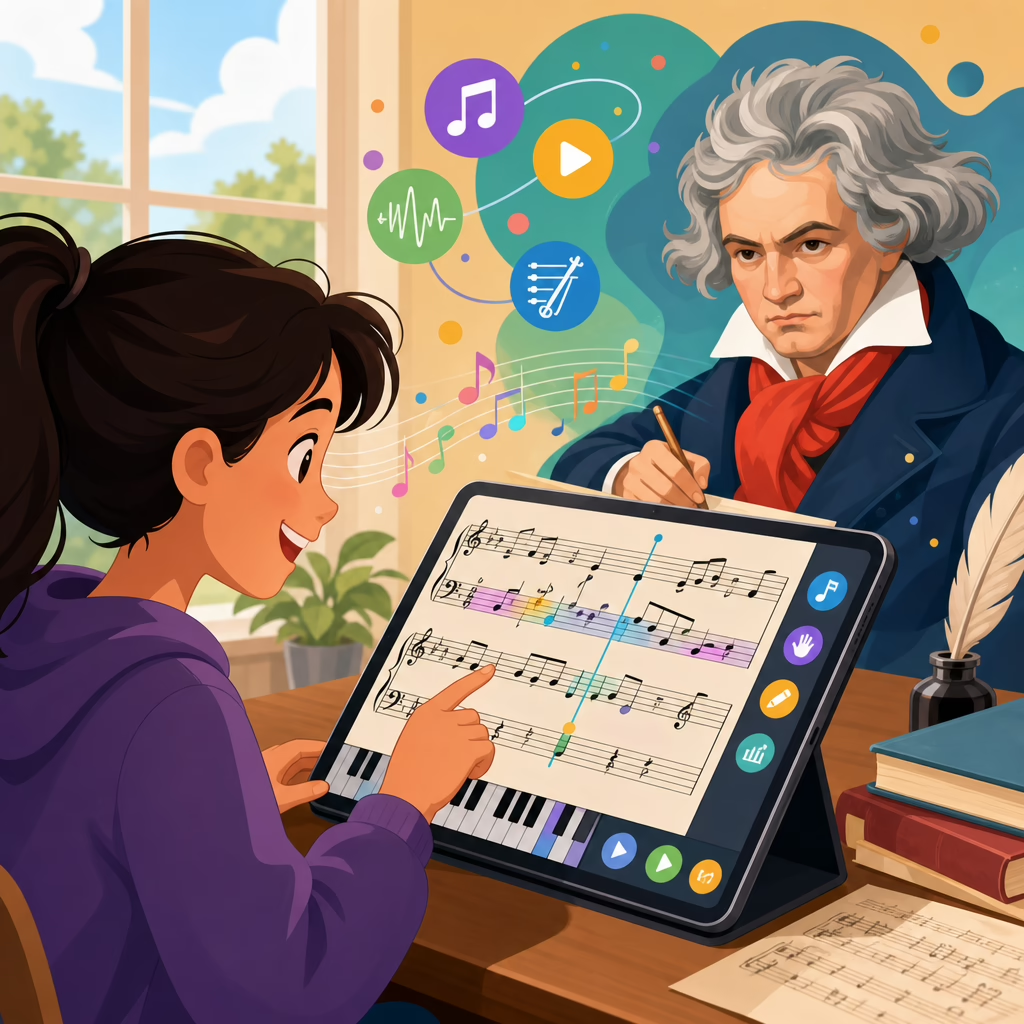
Interactive Platforms for Exploring Beethoven’s Scores
Interactive platforms for exploring Beethoven’s scores have transformed how musicians, students, scholars, and curious listeners approach one of the most studied bodies of music in Western history. Instead of relying only on printed editions, readers can now compare manuscripts, hear synchronized playback, inspect editorial markings, zoom into sketch pages, and trace how a motif evolved from draft to published score. In practical terms, an interactive platform is any digital environment that lets users do more than passively view notation. It may include linked audio, variant readings, source images, analytical overlays, annotation tools, or search functions across movements, themes, and catalog data. For Beethoven, these capabilities matter because his works survive in multiple forms: autograph manuscripts, copyists’ scores, first editions, revised editions, sketchbooks, and modern critical editions.
I have used these tools in teaching, score study, and repertoire preparation, and the difference is immediate. A student who struggles to understand a sforzando in a sonata often grasps it once the platform aligns the bar with a recording and shows the same passage in a manuscript image. A pianist comparing articulations in the “Pathétique” Sonata or a conductor checking dynamic inconsistencies in the Fifth Symphony can move faster and make better-informed decisions when sources are linked instead of scattered across books and library sites. This matters beyond convenience. Beethoven’s notation is famously rich but sometimes messy, and digital interfaces help users separate what Beethoven wrote, what editors inferred, and what performers tradition has added. For a sub-pillar hub under Technology and Beethoven, this topic connects archival access, digital humanities, notation software, listening pedagogy, and performance research in one place.
The best way to evaluate interactive platforms for exploring Beethoven’s scores is to ask three direct questions. First, what sources are included: urtext editions, facsimiles, sketches, or public-domain reprints? Second, what interactions are possible: playback, side-by-side comparison, annotation, export, or thematic search? Third, who is the platform really for: beginners, conservatory students, professional performers, teachers, or researchers? A useful hub page should answer these questions plainly while pointing readers toward specialized articles on score apps, digital archives, manuscript databases, and educational tools. Beethoven is an ideal case because his catalog spans piano sonatas, string quartets, symphonies, concertos, sacred works, and fragments, creating a broad testing ground for digital score technology. When a platform handles Beethoven well, it usually handles complexity well in general, because his sources demand precision, context, and flexible navigation.
What makes a Beethoven score platform genuinely interactive
A scanned PDF alone is not an interactive platform. True interactivity begins when the score becomes searchable, linkable, and responsive to a user’s questions. In my own work, the most useful systems let me jump from a movement title to a measure range, click a bar number to hear audio, and open a facsimile without leaving the page. Features such as synchronized cursor playback, encoded notation in MusicXML or MEI, source metadata, and persistent measure numbering save time and reduce errors. For Beethoven, measure-level precision is essential because analytical discussions often hinge on one cadence, one accent pattern, or one altered accompaniment figure.
Interactivity also means editorial transparency. Beethoven’s scores often exist in contradictory forms, and a platform should identify whether a staccato, slur, dynamic, or tempo mark comes from the autograph, a copyist, an early print, or a later editor. This distinction is not academic trivia. It affects bowings in the violin sonatas, pedaling choices in the piano sonatas, and even large formal judgments in the late quartets. Good platforms expose variant readings instead of flattening them into a single unquestioned text. They also provide context, such as work numbers, dates, instrumentation, source provenance, and links to authoritative catalogs.
Accessibility is another practical test. A conservatory scholar may want critical commentary and source sigla, while a schoolteacher may need clean notation, audio support, and multilingual navigation. The strongest Beethoven tools support both. They render clearly on desktop and tablet, allow zoom without image degradation, and keep navigation stable across long works like the Ninth Symphony or the Missa solemnis. If users cannot move easily between systems, movements, and source layers, the platform becomes a static archive with extra clicks.
Core types of platforms used to explore Beethoven’s scores
Most Beethoven score platforms fall into five categories, and each serves a different purpose. Digital libraries such as IMSLP provide broad access to public-domain editions and scans. Critical edition portals associated with scholarly publishers or research institutions focus on vetted texts and commentary. Manuscript and archival databases emphasize high-resolution source images and provenance. Practice-oriented apps combine notation with playback, transposition, page turns, and annotation. Educational platforms simplify navigation and integrate listening guides, thematic labels, and classroom tools. No single category replaces the others, which is why a hub article on miscellaneous resources is useful: readers often need a stack of tools rather than one destination.
IMSLP remains the starting point for many users because it is free, extensive, and fast for locating Beethoven sonatas, symphonies, and chamber works. Its strength is breadth, not editorial control. You may find multiple editions of the same work, but the burden of judging reliability falls on the reader. By contrast, resources tied to Bärenreiter, Henle, or institutional digital projects usually offer stronger text-critical grounding, though access may be limited by subscriptions or licensing. For manuscripts, collections linked to major libraries and museums can reveal details no engraved score shows, including cancellations, revisions, and page layout decisions.
| Platform type | Best use | Main strength | Main limitation |
|---|---|---|---|
| Public-domain digital library | Quick access to many Beethoven editions | Large catalog and free entry | Variable editorial quality |
| Critical edition portal | Reliable study and performance decisions | Scholarly apparatus and vetted text | Often paywalled or partial |
| Manuscript archive | Source comparison and research | High-resolution primary materials | Can be hard for beginners to interpret |
| Practice app | Daily rehearsal and annotation | Playback, markup, page management | Usually weak on source history |
| Education platform | Teaching form, themes, and listening | Guided explanations | May simplify complex editorial issues |
In real use, these categories overlap. A pianist preparing Op. 110 might begin with a urtext edition, check a manuscript image for phrasing, listen with synchronized notation in a practice app, and then read commentary on fugue entries in an educational resource. That layered workflow reflects how Beethoven is actually studied today.
Best features for students, performers, and researchers
Students usually need clarity first. For them, the most important features are synchronized audio, visible bar numbers, selectable parts, tempo control, and simple annotations. When I teach Beethoven’s bagatelles or easier sonata movements, students progress faster if they can isolate a passage, hear it repeatedly, and mark fingering or harmonic cues directly on the score. Playback is not a substitute for reading, but it is extremely effective for orientation, especially in dense textures or unfamiliar formal designs.
Performers need reliability and flexibility. A serious player wants clean page turns, stylus annotation, offline access, version control, and perhaps Bluetooth pedal support for hands-free turning on stage or in rehearsal. Apps such as forScore, Newzik, and nkoda have become common because they solve practical problems around library management and markup. Their value rises when they host Beethoven editions from trusted publishers rather than miscellaneous scans. Performers also benefit from source-linked comments that explain disputed articulations or tempo indications, since Beethoven interpretation often turns on those details.
Researchers need precise metadata and interoperable formats. Searchable incipits, stable identifiers, downloadable citation data, IIIF image support, and machine-readable encodings make a major difference for scholarship. Platforms using MEI or well-structured MusicXML can support analytical projects, motif searches, and comparative studies across versions. For Beethoven sketch studies, image quality and manuscript organization are critical. A researcher examining the development of the “Eroica” Symphony or the late piano sonatas must be able to trace leaves, folios, and chronology accurately. Without that infrastructure, digital abundance becomes digital clutter.
How major Beethoven resources fit together in practice
A useful hub should explain not only what each platform does, but how readers can combine them. Consider a common scenario: you want to study the opening movement of the “Moonlight” Sonata. Start with a reliable modern edition to establish a clean reading of notes, slurs, dynamics, and pedaling guidance. Then consult a manuscript or early print source to see what is secure and what remains debated. Next, use an interactive playback environment to hear pacing choices and locate harmonic arrivals by measure. Finally, review commentary or analysis to understand how performers shape the movement’s long line. The platform ecosystem works best as a sequence, not a contest.
The same principle applies to orchestral repertory. A conductor examining Beethoven’s Seventh Symphony might use a publisher-backed digital score to mark cues, compare period and modern editorial practices through archival scans, and rely on a rehearsal app for part distribution and annotations. Teachers can assign the same movement through a classroom platform that highlights rhythmic cells and formal divisions, while advanced students inspect autograph details separately. One work, several interfaces, different goals.
Named resources matter here because readers need concrete starting points. IMSLP is broad and immediate. Henle Library offers polished digital scores with annotations and respected editorial standards. nkoda aggregates licensed editions from established publishers in an app-centered environment. forScore is widely used for performance workflow on Apple devices. Institutional archives and library digitization projects provide manuscript depth. Each serves a distinct function, and understanding that division prevents frustration.
Limitations, rights issues, and quality control
Interactive access does not eliminate old problems; it simply changes their form. Copyright and territorial licensing still affect which Beethoven editions are visible, even when the music itself is public domain. Critical notes, engravings, fingerings, and scholarly commentary may remain protected, so a platform can offer one edition in one country and a different option elsewhere. This is especially relevant for users who assume every digital score is universally available and identical.
Quality control is another major issue. Optical music recognition has improved, but it still misreads dense notation, cue-sized passages, ledger lines, and unusual spacing. Beethoven’s manuscripts can be notoriously difficult for automated systems because of revisions, overwriting, and inconsistent layout. If a platform offers transposition, playback, or search based on encoded notation, users should ask how that encoding was created and checked. Human review still matters. I have seen wrong accents, missing ties, and barline errors propagate from a bad scan into teaching materials and rehearsal files.
There is also a risk of false certainty. Interactive interfaces can make one reading look definitive even when the source situation is contested. Clean design is helpful, but it can hide ambiguity. The best platforms counter this by labeling editorial interventions, linking notes to sources, and preserving access to facsimiles. For Beethoven, ambiguity is sometimes part of the truth, and a serious resource should reflect that rather than smoothing it away.
How to choose the right platform for your Beethoven goals
If your primary goal is listening-led discovery, choose a platform with synchronized notation, thematic navigation, and clear movement-level summaries. If your goal is performance preparation, prioritize trusted editions, annotation tools, and dependable page management. If you are writing on Beethoven, favor source-rich environments with metadata, citation support, and manuscript access. Beginners should not start with the most complex archive available; they should start with a readable score and guided listening, then branch into source comparison as their questions become more specific.
A practical selection method is to test one work across several platforms before committing. Open the first movement of Op. 31 No. 2, for example, and compare navigation speed, editorial labeling, zoom quality, annotation responsiveness, and search precision. Can you jump to measure 21 instantly? Can you tell whether pedal markings are editorial? Can you compare two editions without losing your place? Can you export notes or share a marked passage with a teacher or ensemble colleague? Those basic tasks reveal far more than marketing language.
For a Technology and Beethoven sub-pillar hub, the main benefit of interactive platforms is not novelty; it is better musical judgment. These tools let readers connect sound, notation, source history, and interpretation in one workflow. Used well, they reduce friction, sharpen analysis, and make Beethoven’s scores more legible without oversimplifying them. Explore a few leading platforms with one familiar work, compare their strengths, and let your musical purpose determine which digital environment becomes your regular Beethoven desk.
Frequently Asked Questions
What are interactive platforms for exploring Beethoven’s scores?
Interactive platforms for exploring Beethoven’s scores are digital tools and online environments that let users do much more than simply view a static sheet of music. Instead of reading a single printed edition from start to finish, users can often switch between different sources such as autograph manuscripts, early editions, modern scholarly editions, sketchbooks, and annotated reproductions. Many platforms also include synchronized audio playback, so a listener can follow the score in real time while hearing a performance or computer-rendered realization. This makes it easier to connect what is written on the page with what is heard in performance.
These platforms are especially valuable because Beethoven’s music exists in a rich and sometimes complicated documentary history. His works often survive in multiple forms, including rough sketches, revised drafts, copyists’ manuscripts, first editions, and later edited scores. An interactive platform can bring these materials together in one place and allow users to compare them side by side. For musicians, that means a clearer understanding of phrasing, articulation, and structural design. For students, it creates a more engaging way to learn notation, form, and thematic development. For scholars, it supports source study and editorial research. For general listeners, it opens a window into Beethoven’s creative process that would otherwise remain hidden behind traditional print formats.
How do these platforms help users understand Beethoven’s compositional process?
One of the greatest strengths of an interactive score platform is its ability to reveal composition as a process rather than a finished product. Beethoven is famous not only for the power of his final works, but also for the intensity of his revisions. His sketch materials often show motifs being tested, reshaped, discarded, and rediscovered. On an interactive platform, users may be able to zoom into sketch pages, inspect overwritten passages, trace thematic fragments across drafts, and compare early ideas with the final published version. This turns composition from an abstract concept into something visible and concrete.
That matters because Beethoven’s music is often discussed in terms of development, transformation, and motivic logic. When users can actually see how a small rhythmic figure expands into a major theme, or how a passage changes from one source to another, they gain a deeper appreciation for his craftsmanship. Instead of accepting a polished score as inevitable, they begin to understand the decisions behind it. This can be especially illuminating in works where there are substantial revisions, disputed readings, or notable differences between manuscript and print. In that sense, interactive platforms do not just present Beethoven’s music; they document the living history of how the music came into being.
Who benefits most from using interactive platforms for Beethoven’s scores?
These platforms serve a remarkably broad audience. Performers benefit because they can move beyond a single edited edition and explore questions of interpretation with greater confidence. If a pianist, string player, or conductor wants to understand why a phrase mark appears in one source but not another, or whether a dynamic marking reflects Beethoven’s hand or a later editorial decision, an interactive platform can provide direct visual evidence. This supports more informed performance choices and encourages a thoughtful relationship with the text rather than blind reliance on any one edition.
Students and educators also gain a great deal. In a classroom setting, interactive features can make Beethoven’s music more accessible and less intimidating. Teachers can use synchronized playback to demonstrate form, highlight recurring motifs, or show how harmonic tension builds across a movement. Students can compare source materials, follow thematic transformations, and learn how editorial practice shapes what appears in modern printed scores. Scholars benefit from the ability to inspect primary materials remotely, organize comparisons efficiently, and integrate digital research methods into traditional musicological study. Even non-specialist listeners benefit, because these platforms can make Beethoven’s scores feel less like museum objects and more like living documents that invite exploration.
What features should users look for in a high-quality platform for studying Beethoven’s scores?
A strong platform should combine reliable source material with tools that genuinely improve understanding. First, source quality matters. Users should look for access to high-resolution images of manuscripts, sketch pages, first editions, and trusted scholarly editions. Clear metadata is also important, including information about dates, provenance, editorial history, and the relationship between one source and another. Without that context, a platform may look impressive visually while offering limited scholarly value.
Second, the interface should make comparison easy. Useful features include side-by-side viewing, zoom controls, synchronized audio, page linking across different sources, searchable notation or metadata, and annotations that distinguish Beethoven’s markings from later editorial additions. Some of the most effective platforms also let users trace motifs, compare variants, or navigate by movement, measure number, or thematic section. For advanced users, citation tools and stable references are important for research and teaching. In short, the best platforms do not overwhelm users with digitized material; they organize that material in a way that supports close reading, listening, and critical interpretation.
Can interactive platforms replace printed editions of Beethoven’s music?
Interactive platforms are highly valuable, but they are best understood as a complement to printed editions rather than a complete replacement. Printed scores still offer practical advantages, especially for rehearsal, performance, and sustained analytical reading away from a screen. Many musicians prefer the physical stability of a printed page, and many authoritative editions remain essential because they present an editor’s carefully reasoned interpretation of complex source evidence. A well-made print edition can distill years of scholarship into a form that is immediately usable.
That said, interactive platforms extend what printed editions can do. They allow users to test editorial decisions against source images, move quickly among variant readings, and connect notation with sound and historical documentation. This is especially important in Beethoven, where a single printed text can sometimes conceal a complicated network of revisions and source relationships. Rather than replacing traditional editions, digital platforms deepen and contextualize them. For most serious users, the ideal approach is to use both: printed editions for clarity and practicality, and interactive platforms for comparison, discovery, and a fuller understanding of Beethoven’s evolving musical thought.