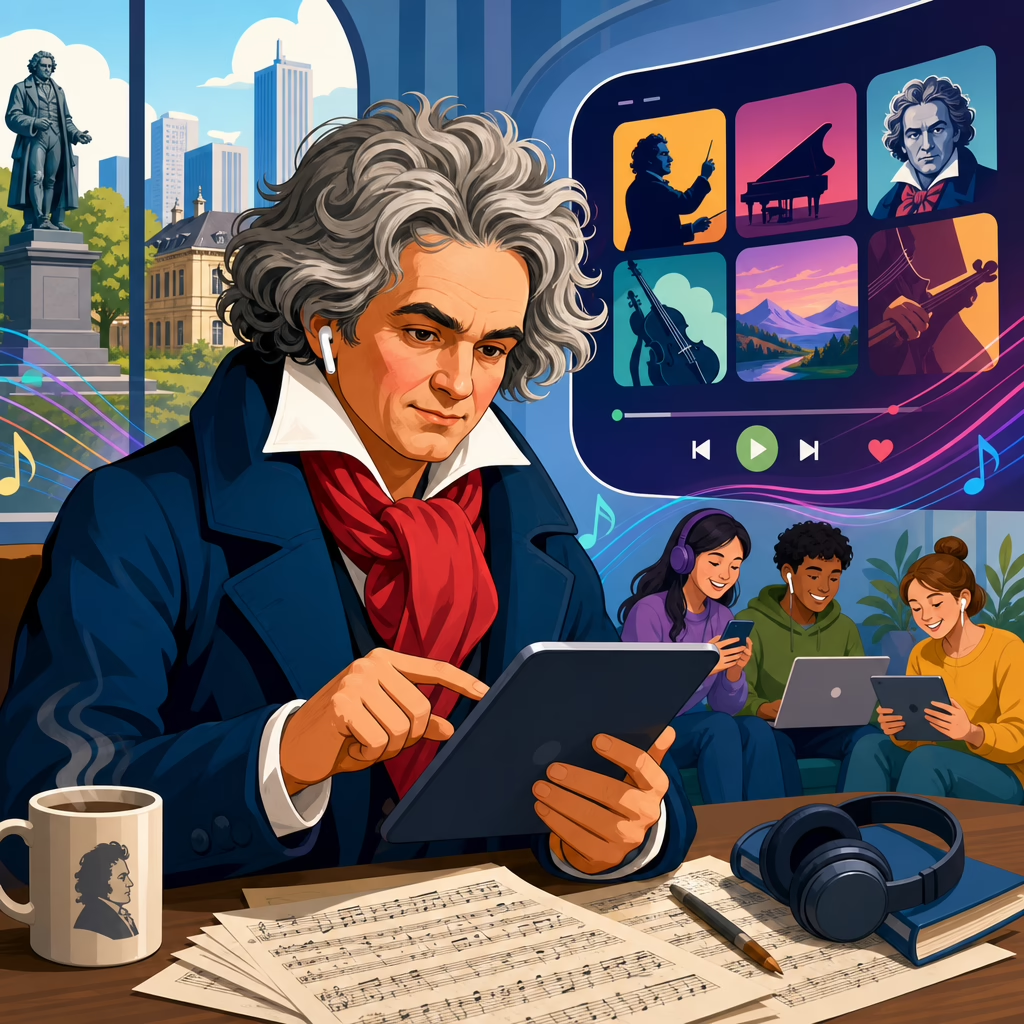
Beethoven in the Digital Age: Streaming and Modern Access
Beethoven in the digital age is no longer confined to concert halls, CD shelves, or specialist radio programming; his music now lives across streaming services, video platforms, digital libraries, podcasts, online courses, and social media feeds. When people talk about streaming and modern access, they mean the systems that let listeners discover, play, compare, and study recordings instantly on connected devices. For Beethoven, that shift matters because his catalog is both universally recognized and unusually complex. A casual listener may search for “Moonlight Sonata,” while a conservatory student needs a specific Op. 27 No. 2 edition, a historically informed symphony cycle, or a comparison of late quartet interpretations. Digital access has widened the audience, but it has also created new problems around metadata, attribution, rights management, and listening habits.
I have worked with classical catalogs on major platforms, and Beethoven exposes every strength and weakness of digital distribution. A pop track usually has one title, one artist, and one definitive recording. Beethoven’s works often exist in multiple movements, key signatures, opus numbers, nicknames, arrangements, live versions, remasters, and editorial variants. A single search for Symphony No. 5 can return studio recordings by Carlos Kleiber, Herbert von Karajan, John Eliot Gardiner, and dozens more, each shaped by different orchestral forces, tempos, and recording philosophies. Listeners benefit from unprecedented choice, yet they also need guidance to navigate it intelligently. That is why this hub matters within performance and recordings: it connects the practical realities of modern listening with the artistic questions that have always defined Beethoven interpretation.
This article surveys the main ways Beethoven reaches contemporary audiences and explains how to use those channels well. It covers the role of major audio platforms, video and live-stream ecosystems, digital archives, recommendation systems, metadata standards, rights and revenue, education-driven access, and the specific challenges of preserving context in algorithmic environments. It also serves as a hub for related articles in this subtopic, including focused pieces on recording history, landmark interpreters, remastering, live capture, performance practice, and collecting editions. If you want to understand how Beethoven moved from printed score and physical album to searchable, on-demand digital presence, the key idea is simple: technology has made access easier than ever, but meaningful access still depends on accurate information, thoughtful curation, and informed listening.
How streaming changed Beethoven listening
Streaming transformed Beethoven from a repertoire people often encountered through institutions into one available at any hour, on any device, at almost no marginal cost per listen. Services such as Spotify, Apple Music, Amazon Music, YouTube Music, Idagio, and Qobuz made the core catalog permanently available to broad audiences. That changed listener behavior in three important ways. First, discovery became frictionless. A person who hears the “Ode to Joy” theme in a film can locate the full Ninth Symphony within seconds. Second, comparison became normal. Instead of owning one Fifth Symphony, listeners can audition ten. Third, access became portable. Beethoven now accompanies commuting, exercise, study, and casual background listening, contexts far removed from the formal listening environments that once shaped classical consumption.
This convenience has expanded the audience, but it has also flattened distinctions that matter. Beethoven’s works were built around structure, tension, and long-range development. A sonata movement pulled from its larger form or a symphony excerpt dropped into a generic focus playlist can lose its dramatic function. I have seen this repeatedly in platform analytics: famous movements and nickname pieces vastly outperform complete cycles, while deep catalog works remain underexposed unless editorial teams or specialist services surface them deliberately. Streaming therefore democratizes access but does not automatically create understanding. The best platforms compensate through better work-level metadata, composer pages, editorial notes, movement grouping, and performer credits that let users move from a famous theme to a full work and then to competing interpretations.
Where listeners find Beethoven today
Modern access to Beethoven is spread across several digital environments, each serving a different need. General streaming platforms deliver reach and convenience. Specialist classical services improve search, work grouping, and credit accuracy. Video platforms add visual context and live performance energy. Digital libraries support study, source comparison, and historical research. No single channel is complete, which is why serious listeners often combine them.
| Platform type | Best use | Main strength | Common limitation |
|---|---|---|---|
| General audio streaming | Everyday listening | Massive reach and convenience | Weak classical metadata |
| Specialist classical streaming | Comparing recordings | Better work and movement organization | Smaller user base and ecosystem |
| Video and live platforms | Watching performances | Visual interpretation and concert access | Variable audio quality |
| Digital score libraries | Study and reference | Immediate access to editions and manuscripts | Edition quality varies |
| Institutional archives | Historical research | Primary sources and curated context | Less intuitive for casual users |
For broad listening, Spotify and Apple Music dominate because they are already part of users’ daily media habits. For classical-specific needs, Idagio and Primephonic’s legacy influence on Apple Classical-style interfaces showed the value of indexing by work, conductor, orchestra, soloist, and ensemble rather than only by album and track. Qobuz appeals to collectors and audiophile listeners because it emphasizes high-resolution audio and strong editorial writing. On the video side, YouTube remains indispensable, not because it is the cleanest archive, but because it hosts historic uploads, masterclasses, score videos, performance excerpts, and full concerts from orchestras, festivals, and broadcasters. Medici.tv and Digital Concert Hall add a more curated, premium layer, especially for viewers who want stable production quality and documented performance details.
For study, listeners move beyond streaming entirely. IMSLP provides public-domain scores that help performers and students follow form, motifs, and articulation choices while listening. The Beethoven-Haus Bonn digital archives offer manuscripts, letters, and scholarly resources that deepen understanding of the works’ historical lives. Major labels such as Deutsche Grammophon, Decca, Sony Classical, and Warner Classics also matter because their own digital catalogs, reissue programs, and anniversary campaigns shape what recordings remain visible. In practice, modern access to Beethoven is an ecosystem, not a single app.
Why metadata determines discoverability
If one issue defines Beethoven in digital distribution, it is metadata. Metadata is the information attached to a recording: composer, work title, opus number, key, movement, performers, ensemble, conductor, recording date, label, and rights data. When metadata is accurate, a listener can find Piano Sonata No. 14 in C-sharp minor, Op. 27 No. 2, compare movements, and identify the pianist immediately. When metadata is poor, the same work may be split across inconsistent titles like “Moonlight Sonata,” “Sonata quasi una fantasia,” or “Piano Sonata #14,” making search and recommendation unreliable.
Classical music stresses data systems because the underlying “work” and the “recording” are not the same thing. Beethoven wrote the Eroica Symphony once, but it has been recorded hundreds of times. Platforms built for pop often prioritize track and artist; classical listeners need work-level structure and multi-role credits. Industry standards such as DDEX messaging, ISRC identifiers for recordings, and IPI data for rights holders help with backend consistency, but they do not solve every front-end problem. I have seen excellent recordings disappear in search simply because movement titles were inconsistent or conductor fields were incomplete. Conversely, when labels maintain disciplined metadata and services expose it well, discovery improves dramatically.
Good metadata also affects educational use. Students searching for late Beethoven string quartets need opus-based retrieval, not nickname-based approximations. Performers comparing historically informed recordings of the Seventh Symphony need to filter by ensemble and conductor. Researchers tracing recording history need dates, remaster information, and venue data. In digital Beethoven, metadata is not administrative trivia. It is the infrastructure of access.
Algorithms, playlists, and the risk of decontextualization
Recommendation systems have introduced millions of people to Beethoven, especially through mood playlists, focus playlists, sleep collections, and algorithmic radio. This has obvious advantages. Short, recognizable works such as Für Elise, the “Moonlight” Adagio sostenuto, or the slow movement of the “Pathétique” Sonata provide easy entry points. Once a user shows interest, platforms can recommend complete sonatas, concertos, or symphonies. In data terms, this is efficient audience development.
Yet Beethoven is especially vulnerable to decontextualization. His music is built on contrast, architecture, and transformation over time. A movement extracted for ambience may still sound beautiful, but it no longer communicates the full design Beethoven intended. Playlists can also skew repertoire toward the same small cluster of famous pieces, reinforcing a narrow public image. The listener may know Symphony No. 9, Symphony No. 5, Für Elise, and one sonata while never encountering the Missa solemnis, Diabelli Variations, or the late quartets, which are central to Beethoven’s artistic legacy.
The practical solution is curation with context. Strong editorial playlists group complete works, explain why one interpretation differs from another, and link familiar pieces to adjacent repertoire. A useful Beethoven pathway might begin with the Fifth Symphony, continue to the Seventh for rhythmic drive, then move to the Eroica for scale and formal innovation. Another might connect the “Moonlight,” “Pathétique,” and “Appassionata” sonatas while clarifying that nicknames are often later marketing additions rather than Beethoven’s own titles. Good digital curation does not fight convenience; it turns convenience into informed discovery.
Video, live streams, and visual interpretation
Video has become one of the most powerful entry points to Beethoven because it restores performance as a visible act. Watching a string quartet negotiate the late quartets, a conductor shape the opening of the Ninth, or a pianist balance pedaling in Op. 111 reveals interpretive decisions audio alone can hide. During the pandemic era especially, live streams from orchestras, conservatories, and chamber ensembles kept Beethoven performance public when physical venues were closed. That period accelerated institutional investment in digital capture, multicamera production, and archived concert access.
Visual media also broadens the audience by lowering the intimidation factor sometimes associated with classical music. A young listener may first encounter Beethoven through a short rehearsal clip on Instagram, a YouTube explainer on sonata form, or a livestreamed youth orchestra performance. From there, the path to complete works becomes easier. Educational channels that synchronize score and audio are especially effective because they train listeners to hear motif development, harmonic pacing, and structural return in real time. This is where modern access goes beyond convenience and becomes literacy.
There are limits. Not every streamed performance is licensed globally, and production values vary widely. Compression can flatten orchestral detail, and amateur uploads sometimes misidentify performers or use unauthorized copies. Even so, video has permanently changed Beethoven reception. It makes interpretation visible, invites repeat viewing, and turns performance history into a searchable public record.
Digital archives, remastering, and historical recordings
Modern access is not only about the newest stream. It also means better access to the past. Historical Beethoven recordings once circulated through specialist collectors, radio archives, or expensive box sets. Today many are available digitally through label reissues, archival channels, and library partnerships. That matters because Beethoven interpretation is inseparable from recording history. To understand current performance styles, listeners should hear benchmark figures such as Artur Schnabel, Wilhelm Furtwängler, Claudio Arrau, Emil Gilels, Carlos Kleiber, and the Busch Quartet alongside recent artists.
Remastering plays a major role here. Good remastering reduces noise, stabilizes pitch, and improves clarity without erasing the original acoustic character. Done badly, it can strip warmth, exaggerate high frequencies, or create an artificial surface that misrepresents the source. Labels with deep archival experience usually document transfer methods and source provenance, which helps listeners judge reliability. For Beethoven, where phrasing, dynamic range, articulation, and ensemble balance carry interpretive meaning, these technical choices are not trivial.
Digital archives also support scholarship. Manuscript scans, first editions, correspondence, and premiere documentation place recordings within a broader historical frame. A listener can move from hearing the Hammerklavier Sonata to viewing source materials and reading commentary on tempo indications, instrument design, and editorial debate. That integration of sound, text, and image is one of the greatest achievements of the digital era.
Access, rights, and the economics of classical streaming
Beethoven’s compositions are in the public domain, but most recordings are not. That distinction shapes everything. The notes of the Fifth Symphony can be performed by anyone, yet a specific recording by the Berlin Philharmonic under a particular conductor is protected as a sound recording and often as an audiovisual asset if video is involved. Streaming services therefore license recordings from labels and distributors, then pay according to contract structures that can be opaque to performers and estates.
Classical economics are especially difficult because track-based payment models rarely reflect the genre’s structure. A four-minute pop song and a seventy-minute symphony do not fit neatly into the same revenue logic, especially when works are split into movements and listened to unevenly. Specialist services and labels have long argued for work-aware approaches and stronger crediting, not only for fairness but for discoverability. When soloists, orchestras, engineers, and producers are properly credited, audiences can follow artistic lineages and the market becomes more transparent.
For listeners, the key implication is simple: access feels frictionless, but it is built on complicated rights systems. Supporting labels, artists, orchestras, and archives through subscriptions, ticketed streams, downloads, physical purchases, and donations remains important if high-quality Beethoven performance and preservation are to continue.
Beethoven’s digital presence proves that technology can widen access without diminishing artistic seriousness, but only if listeners use the available tools well. Streaming services make the repertoire instantly available, specialist platforms organize it more intelligently, video restores the visible dimension of performance, and archives connect recordings to history, sources, and scholarship. At the same time, metadata failures, algorithmic narrowing, and weak crediting can obscure as much as they reveal. Modern access is therefore not just about quantity. It is about the quality of navigation, context, and attribution.
As a hub within performance and recordings, this page points toward the broader miscellaneous terrain surrounding Beethoven in modern media: how classic recordings are remastered, how live performances are captured and distributed, how platforms classify works, how recommendation systems shape taste, and how audiences can build informed listening habits. The main benefit of the digital age is not merely convenience. It is the ability to move fluidly between listening, watching, reading, comparing, and studying in one connected ecosystem. Use that advantage deliberately: start with a favorite Beethoven work, explore at least two contrasting recordings, follow the score, and let digital access lead you toward deeper listening rather than faster consumption.
Frequently Asked Questions
How has streaming changed the way people discover and listen to Beethoven?
Streaming has transformed Beethoven from something many listeners once approached through formal concerts, boxed CD sets, or curated radio broadcasts into something available on demand at almost any moment. A listener can move from the Fifth Symphony to the late string quartets, then to a piano sonata, and then to a historical lecture about Beethoven’s life without leaving the same device. That level of immediate access lowers the barrier to entry for newcomers while also giving experienced listeners far more tools for comparison and exploration than earlier generations had.
One of the biggest changes is the role of recommendation systems, playlists, and search-driven discovery. Instead of needing prior knowledge of conductors, ensembles, opus numbers, or recording labels, users can begin with broad categories such as “classical essentials,” “focus music,” or “great symphonies” and encounter Beethoven organically. From there, platform metadata can lead them toward specific works like the “Eroica” Symphony, the “Moonlight” Sonata, or the Ninth Symphony. This makes Beethoven more visible in everyday listening habits and allows his music to reach people who may never have intentionally sought out classical repertoire before.
Streaming also encourages comparative listening in a way that is especially important for Beethoven. Because his music has been recorded so extensively, listeners can hear how different pianists shape the same sonata or how different conductors pace the same symphony. A person can compare historically informed performances with modern orchestral interpretations in minutes. That kind of side-by-side access deepens understanding and highlights how Beethoven’s music remains alive through interpretation, not just preservation. In short, streaming has made Beethoven more accessible, more searchable, and more open to personal exploration than ever before.
What makes Beethoven especially well suited to modern digital access?
Beethoven fits the digital age remarkably well because his catalog combines familiarity, emotional range, and artistic depth. Many people recognize at least a few signature themes, which gives them an easy point of entry, but the body of work is large and varied enough to support lifelong study. He wrote symphonies, sonatas, concertos, string quartets, overtures, chamber works, choral music, and shorter piano pieces, so digital platforms can present him in many different listening contexts. A casual listener might encounter Beethoven in a motivational playlist, while a student might use the same ecosystem to study score analysis or performance history.
Another reason Beethoven thrives online is that his music exists in an enormous number of recordings spanning more than a century of audio history. That means digital archives and streaming services can offer not just the works themselves, but also a history of interpretation. Users can listen to legendary twentieth-century recordings, newly released performances, period-instrument ensembles, solo recitals, educational podcasts, and filmed concerts all within the same broader digital environment. For a composer whose works invite strong interpretive choices, this abundance is a major advantage.
Beethoven also benefits from being both universally recognized and endlessly discussable. His music supports short-form discovery on social media, where a famous motif can circulate widely, but it also rewards long-form engagement through digital courses, essays, annotated scores, and lectures. That combination makes him unusually adaptable to the fragmented attention patterns of the modern internet without reducing him to a mere background presence. In practical terms, modern access works for Beethoven because his music can meet listeners at many levels, from instant recognition to serious analysis.
What are the biggest challenges of listening to Beethoven on streaming platforms?
While streaming has made Beethoven easier to access, it has also introduced some real complications. One major issue is metadata. Classical music often does not fit neatly into platform systems designed around pop songs, individual artists, and album-driven consumption. Beethoven recordings may be listed inconsistently by work title, key, opus number, movement name, conductor, orchestra, soloist, or ensemble. As a result, listeners can have trouble finding the exact recording they want, distinguishing complete works from excerpts, or understanding how one version differs from another.
Another challenge is that algorithmic recommendation can flatten distinctions that matter in classical music. A platform may group radically different recordings together because they share the same title, even though tempo, style, instrumentation, recording quality, and interpretive approach may vary dramatically. For Beethoven, that matters a great deal. The difference between a historically informed performance of a symphony and a large-scale modern orchestral interpretation is not minor; it can reshape the listener’s entire experience of the work. Without context, newcomers may miss these distinctions and treat all versions as interchangeable when they are not.
There is also the risk of fragmentation. Beethoven’s music is often best understood as complete works with structural and emotional progression, yet digital listening habits can encourage users to sample only famous openings, isolated movements, or playlist-friendly excerpts. That can be useful for discovery, but it may also obscure the architecture that makes Beethoven so powerful. Finally, sound quality, licensing gaps, and shifting catalog availability can affect what listeners hear. In other words, streaming offers unprecedented convenience, but getting the most out of Beethoven still requires some intentional listening and a willingness to go beyond the first search result.
How can listeners use digital tools to understand Beethoven more deeply, not just hear his music?
Modern access is about much more than pressing play. Today’s digital environment allows listeners to pair recordings with scores, program notes, biographies, podcasts, lecture series, documentaries, and performance videos. That combination is especially valuable with Beethoven because his music often becomes more compelling as listeners understand its structure, historical setting, and expressive ambitions. Someone listening to a piano sonata can follow a digital score in real time, read commentary on the form of the first movement, and then compare how different pianists handle the same passage. This turns listening into an active form of study without requiring formal conservatory training.
Video platforms and online courses also make Beethoven more approachable by showing how performers and scholars think about the music. A conductor might explain balance and tempo in a symphony rehearsal, a pianist might discuss pedaling and articulation in a sonata, and a music historian might place a work in the context of Beethoven’s life, deafness, politics, or patrons. These resources help listeners understand that Beethoven is not just a monument of “great music,” but a working composer whose pieces emerged from specific artistic and historical pressures. That perspective can make even famous works feel fresh and human.
Digital libraries and archives add another layer by preserving manuscripts, early editions, letters, and historical recordings. For serious enthusiasts, this means access to materials that were once limited to specialists or major institutions. For general audiences, it means reputable information is easier to find than ever before. The best approach is to combine platforms: stream the work, watch a performance, read a trustworthy guide, and compare interpretations. Used well, digital tools do not dilute Beethoven; they give listeners more ways to hear what is in the music and why it continues to matter.
Does modern digital access strengthen Beethoven’s legacy, or does it risk reducing his music to background content?
The honest answer is that it does both, depending on how platforms and listeners engage with the music. On one hand, digital access unquestionably strengthens Beethoven’s legacy by making his works available to a global audience at minimal cost and with extraordinary convenience. Students, casual listeners, performers, and researchers can all reach Beethoven quickly through phones, tablets, laptops, smart speakers, and connected televisions. This kind of availability keeps his music culturally present and allows new generations to encounter it outside elite or highly specialized settings.
On the other hand, digital culture can encourage passive listening. Beethoven can appear in productivity playlists, relaxation streams, short clips, and algorithmic mood categories that remove the music from its broader artistic context. There is nothing inherently wrong with first hearing Beethoven while studying or scrolling, but if the music remains only ambient, listeners may miss the drama, tension, and formal innovation that define his achievement. A symphony or quartet can become just another track in a feed if platforms present it that way and users never move beyond convenience listening.
Still, the long-term effect is more positive than negative. Modern access does not automatically trivialize Beethoven; it creates multiple entry points. A short clip can lead to a full performance, a playlist placement can inspire deeper curiosity, and a streamed recording can send someone toward a live concert, score study, or documentary. Beethoven’s legacy has always depended on reinterpretation and renewed contact with audiences. In the digital age, the challenge is not simply preserving the music, but guiding listeners from instant availability toward meaningful engagement. When that happens, streaming and modern access do not diminish Beethoven’s significance; they extend it.