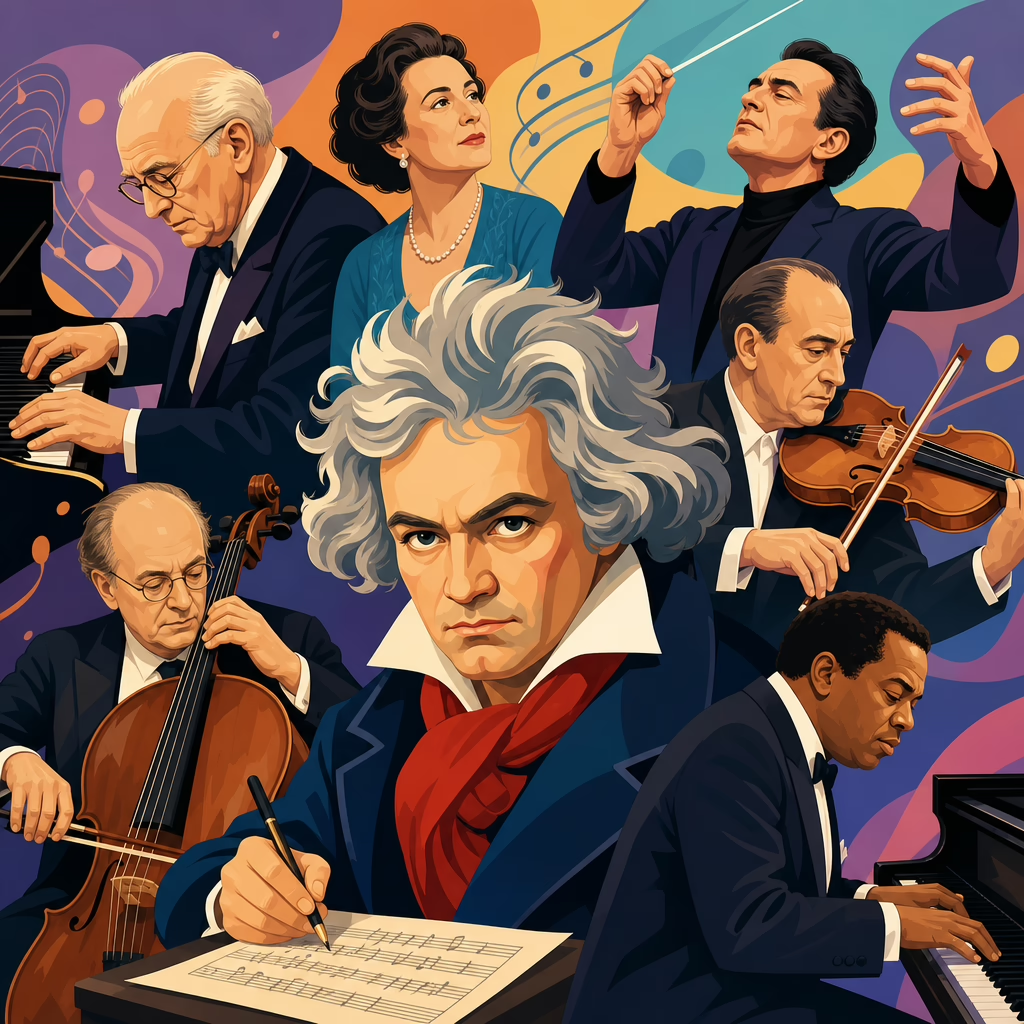
Great Beethoven Performers of the 20th Century
Beethoven performance became one of the defining artistic battlegrounds of the 20th century, and the greatest Beethoven performers of the period did far more than preserve a canon: they reshaped how listeners hear tempo, structure, drama, lyricism, and even the physical sound of the piano, string quartet, and orchestra. In this hub for Performance and Recordings, “miscellaneous” means the figures and interpretive traditions that do not fit neatly into a single instrument or one narrow school, yet together explain why Beethoven remained central to concert life, radio broadcasting, LP culture, and the modern recording industry. The term performer here includes pianists, violinists, string quartets, conductors, and singer-conductors whose Beethoven set standards for subsequent generations. The 20th century matters because it was the first era in which Beethoven interpretation can be studied not only through reviews and memoirs, but through an enormous recorded archive, from acoustic discs to stereophonic cycles. Having worked through those recordings repeatedly, comparing remakes across decades, I have found that the most revealing issue is not who played “correctly,” but how each artist balanced fidelity to the score with the need to project Beethoven’s volatility and formal logic. This article maps the key performers, the major interpretive debates, and the recordings that anchor the wider Performance and Recordings cluster.
Pianists who defined Beethoven on record and in the recital hall
No 20th-century survey can begin anywhere but with Artur Schnabel, whose complete Beethoven piano sonata cycle, recorded between 1932 and 1935 for HMV, changed expectations permanently. Schnabel was not valued for polished perfection; he was valued because he treated the sonatas as serious thought in sound. His rhythms press forward, inner voices speak, and structural transitions feel inevitable. In the “Hammerklavier,” Op. 106, or the late Sonata in C minor, Op. 111, he makes clear that Beethoven’s keyboard writing is symphonic in argument, not merely pianistic display. If a listener asks which performer first established the sonatas as a spiritual and intellectual summit rather than salon repertory, the direct answer is Schnabel.
Wilhelm Kempff offered a very different, equally influential path. His mono and stereo Beethoven sonata cycles remain touchstones because they combine transparency, cantabile touch, and an almost improvised naturalness. Kempff did not usually emphasize granite force; he illuminated line. In the “Pastoral” Sonata, Op. 28, and the final trilogy Opp. 109–111, he showed that Beethoven can sound inward without losing backbone. Claudio Arrau, by contrast, brought weight, dark sonority, and philosophical breadth. Arrau’s Beethoven is broader in tempo and denser in texture, especially in Op. 111 and the Diabelli Variations, where his control of harmonic tension makes the architecture audible over long spans.
Other major pianists widened the field. Rudolf Serkin projected tensile energy and moral intensity, particularly in the concertos and middle-period sonatas. Wilhelm Backhaus represented an older Germanic strength, direct and unsentimental. Annie Fischer’s sonata cycle, recorded over many years and issued posthumously, fused spontaneity with rigor and is now recognized as one of the century’s most compelling complete traversals. Emil Gilels brought sovereign tone and command, especially in the concertos and late sonatas, while Sviatoslav Richter could make Beethoven sound monumental, dangerous, and unpredictable. By the century’s close, Alfred Brendel synthesized textual care, wit, and structural overview, helping audiences hear humor and irony alongside heroism.
Violinists, cellists, and the chamber partners who made Beethoven conversational
Beethoven’s chamber music thrives when performers understand that its drama comes from argument among equals. The violin sonatas were transformed in the 20th century by partnerships that treated piano and violin as co-authors of the discourse. Adolf Busch, often with Rudolf Serkin, set an enduring model of integrity, rhythmic firmness, and expressive restraint. Their “Kreutzer” Sonata avoids empty bravura; its excitement comes from tension within the written line. David Oistrakh brought a broader sonority and deeply human warmth, qualities heard vividly in the Spring Sonata and in his larger Beethoven collaborations with Lev Oborin. Yehudi Menuhin, especially in earlier recordings, contributed singing line and emotional immediacy, though not always the same structural discipline as Busch.
On cello, Pablo Casals occupies a foundational place. Although more closely identified with Bach and the cello literature generally, Casals’s Beethoven trios and sonatas helped establish chamber music as morally serious, collaborative art. Later, Pierre Fournier brought elegance and classical balance to the cello sonatas, while Mstislav Rostropovich emphasized scale, rhetorical projection, and modern instrumental power. In Beethoven, those differences matter. A lean, speech-like approach clarifies motivic interplay; a fuller, more romantic style can heighten grandeur but risks smoothing the music’s jagged edges. The best partnerships solved this by listening acutely. When Rostropovich and Richter played the A major Sonata, Op. 69, one hears not accompaniment and solo line but continual negotiation, exactly the quality Beethoven’s chamber writing demands.
Trio playing also became a crucial testing ground. The Beaux Arts Trio, the Istomin-Stern-Rose Trio, and the Fischer-Schnabel circles each reflected different ideals of Beethoven style, from polished urban refinement to rougher, higher-risk immediacy. Across these performances, one lesson recurs: Beethoven in chamber form succeeds when individuality serves argument, not vanity.
String quartets and the evolution of Beethoven quartet style
No repertoire reveals changing 20th-century taste more clearly than the Beethoven string quartets. The Busch Quartet, active in the interwar years, was pivotal because it played with fierce concentration, flexible rubato, and a feeling that every phrase carried ethical weight. Their recordings of the late quartets, despite historical sound, still communicate urgency unmatched by many technically superior later accounts. The Budapest Quartet, in contrast, offered smoother ensemble, tonal blend, and patrician control. For many mid-century listeners, this became the mainstream image of “classical” Beethoven quartet playing.
Postwar ensembles diversified the tradition. The Végh Quartet probed volatility and silence, especially in Op. 131 and Op. 132, where their willingness to let textures fray slightly makes the music feel discovered in the moment. The Amadeus Quartet presented polish, continuity, and warm recorded sound that brought Beethoven to a broad LP audience. The Juilliard Quartet pursued analytical clarity and modern precision, qualities that suited the contrapuntal density of the late quartets. By the late 20th century, groups such as the Alban Berg Quartet combined technical exactitude with expressive intensity, benefiting from improved instruments, recording techniques, and a more international performance culture.
The core interpretive question for Beethoven quartets is simple: should they sound like elevated conversation, public declaration, or private revelation? Great ensembles answer all three at different moments. In Op. 59 No. 1, the opening must establish symphonic breadth without losing chamber transparency. In the “Cavatina” from Op. 130, players must sustain extreme intimacy while preserving line. In the Grosse Fuge, they must articulate rhythmic violence and formal coherence at once. The quartets that lasted in the catalog did not merely play accurately; they made Beethoven’s radicalism audible.
Conductors who shaped the orchestral and symphonic Beethoven tradition
The 20th century inherited 19th-century Beethoven traditions but subjected them to constant revision. Arturo Toscanini was central because he insisted on rhythmic discipline, textual scrutiny, and propulsion. His NBC Symphony performances, especially the Fifth and Seventh Symphonies, were leaner and more driven than many earlier accounts, countering the idea that Beethoven required heavy, monumental treatment. Yet Toscanini was not simply “fast.” His insistence on articulation and line exposed orchestral details that had long been obscured.
Wilhelm Furtwängler represented the opposing pole, though the contrast is often overstated. Furtwängler’s Beethoven relied on elastic tempo, long-breathed architecture, and a powerful sense of becoming. The 1943 and 1951 Ninth Symphony performances remain reference points because they make the symphony sound less like a fixed object than a living struggle toward resolution. Otto Klemperer brought another model: granitic steadiness, structural majesty, and refusal to sentimentalize. His Philharmonia cycle is indispensable for listeners who want to hear the symphonies as large-scale constructions whose power comes from proportion and weight.
Bruno Walter, Herbert von Karajan, Erich Kleiber, Carlos Kleiber, and Leonard Bernstein each added distinct emphases. Walter humanized Beethoven through warmth and flow. Karajan pursued orchestral sheen and integration, most famously in his 1960s Berlin cycle, though some listeners find the smoothness too homogenized. Erich Kleiber offered taut classicism; Carlos Kleiber, though he recorded only a small amount of Beethoven, delivered incandescent rhythmic life in the Fifth and Seventh. Bernstein emphasized existential drama, broadening emotional extremes, especially in the Ninth. These conductors matter not just as names but as schools of listening: objective drive, organic flexibility, architectural command, or emotional immediacy.
Landmark recordings and what they reveal
Because this hub supports wider reading across Performance and Recordings, a practical overview helps anchor the field.
| Performer | Key Beethoven recording | Why it matters |
|---|---|---|
| Artur Schnabel | Complete piano sonatas | First truly canonical cycle; prioritizes structure over finish |
| Wilhelm Kempff | Stereo sonata cycle | Natural phrasing, lyrical clarity, enduring accessibility |
| Busch Quartet | Late string quartets | Historic benchmark for intensity and moral seriousness |
| Furtwängler | Ninth Symphony, Bayreuth 1951 | Iconic example of flexible, high-stakes orchestral Beethoven |
| Toscanini | Symphonies with NBC Symphony | Textual discipline, speed, and rhythmic precision |
| Oistrakh and Oborin | Violin sonatas | Balances warmth, breadth, and chamber dialogue |
| Serkin | Piano concertos | Combines virtuosity with uncompromising intensity |
Several broader points emerge from these recordings. First, recording technology shaped interpretation. Acoustic-era limits favored compression and clarity; electric recording allowed more dynamic range; LPs enabled complete cycles that encouraged listeners to compare entire repertoires rather than isolated favorites. Second, remakes are often more revealing than first versions. Kempff’s stereo remakes are not mere duplicates of his earlier cycle; they show how an artist refines pedaling, tempo relationships, and voicing over time. Third, no single “authentic” 20th-century Beethoven style exists. The tradition contains real disagreement, and that disagreement is musically productive.
Interpretive debates: tempo, instruments, vibrato, and the score
The biggest questions surrounding Beethoven performance in the 20th century concerned how literally to treat the score and how much inherited tradition should count. Beethoven’s metronome marks, especially in the symphonies and some piano works, generated intense dispute. Conductors such as Toscanini and later historically informed specialists took them seriously as evidence of kinetic intent. Others argued that some marks are impractical or reflect faulty equipment, and they chose broader tempos to preserve articulation and grandeur. Both positions have evidence behind them, which is why the debate never disappeared.
Instrument design also mattered. Modern concert grands allowed pianists like Arrau, Gilels, and Richter to project sonorities impossible on Beethoven’s own instruments. That can illuminate orchestral thinking in the piano writing, but it also creates the temptation to over-sustain or over-pedal. In strings, continuous vibrato became a norm during much of the century, then came under challenge as musicians reexamined 18th- and early-19th-century practice. Lighter articulation, reduced vibrato, smaller orchestras, and attention to period bows and timpani sticks changed the sonic profile of Beethoven late in the century.
These developments did not invalidate earlier masters. Instead, they sharpened listening. After hearing period-instrument Beethoven from conductors such as Roger Norrington, John Eliot Gardiner, or Nikolaus Harnoncourt, one returns to Klemperer or Furtwängler with clearer ears, noticing what belongs to Beethoven and what belongs to a historical performance culture. For a hub page, that is the key takeaway: great Beethoven performers of the 20th century are best understood as participants in an evolving argument about truthfulness, rhetoric, and sound.
How to explore this hub and build a Beethoven listening path
If you are using this page as an entry point into Performance and Recordings, begin with one work in several interpretations rather than one artist in isolation. Compare Schnabel, Kempff, and Brendel in Op. 111; compare Busch, Budapest, and Alban Berg in Op. 131; compare Toscanini, Furtwängler, and Klemperer in the Eroica or Fifth Symphony. Listen for recurring questions: Does the performer clarify form? Is rhythmic tension maintained? Are lyrical passages merely beautiful, or do they lead somewhere? Does the finale sound earned?
The benefit of this approach is practical. Beethoven can absorb radically different temperaments, and hearing those contrasts builds judgment faster than reading abstract description. As you move through the wider subtopic, use this hub to connect piano sonatas, concertos, string quartets, symphonies, and major recorded cycles into one history of interpretation. The greatest Beethoven performers of the 20th century were not interchangeable virtuosos. They were translators of a difficult language, each revealing different truths about struggle, wit, tenderness, and form. Start with the landmark names here, follow the recordings that still provoke debate, and let comparison become your guide to deeper listening.
Frequently Asked Questions
Who are considered the great Beethoven performers of the 20th century?
The list varies depending on whether the focus is on pianists, conductors, string quartets, violinists, cellists, or singers, but several names appear again and again because they fundamentally shaped modern Beethoven interpretation. Among conductors, Arturo Toscanini, Wilhelm Furtwängler, Otto Klemperer, Bruno Walter, Herbert von Karajan, and Carlos Kleiber are central figures, each representing a distinct approach to Beethoven’s orchestral drama, architecture, and momentum. Toscanini emphasized precision, drive, and textual discipline; Furtwängler became synonymous with flexibility, spiritual breadth, and large-scale tension; Klemperer brought granitic structure and weight; Karajan contributed orchestral polish and sonic power.
On the piano side, Artur Schnabel is often treated as one of the most historically important Beethoven pianists because his recordings of the sonatas and concertos helped establish a serious, intellectually rigorous model of Beethoven playing in the recording age. Wilhelm Kempff offered a more lyrical, inward, and singing Beethoven, while Claudio Arrau explored philosophical depth and tonal richness. Later in the century, Emil Gilels, Alfred Brendel, Maurizio Pollini, Rudolf Serkin, and Stephen Kovacevich each expanded the range of what Beethoven piano playing could sound like, from granite strength to classical balance to fierce modern clarity.
In chamber music, the Busch Quartet, the Budapest Quartet, the Végh Quartet, the Alban Berg Quartet, and the Amadeus Quartet all left major marks on the Beethoven quartets. For violin and cello repertoire, artists such as Yehudi Menuhin, David Oistrakh, Isaac Stern, Mstislav Rostropovich, Pierre Fournier, and Pablo Casals helped define the sonatas, concerto tradition, and broader Beethoven performance culture. What unites these artists is not a single style but the fact that they made Beethoven a living arena of interpretive debate. Their recordings still matter because they do not merely “play the notes”; they propose answers to enduring questions about rhythm, sonority, human struggle, lyricism, and form.
Why was Beethoven performance such an important artistic battleground in the 20th century?
Beethoven stood at the center of the classical canon, so how musicians performed him became a test of broader musical values. In the 20th century, artists argued through performance about whether Beethoven should sound monumental or urgent, classical or romantic, objective or highly personal, architecturally strict or flexibly expressive. These were not minor disagreements. They touched on the purpose of interpretation itself. A conductor choosing taut tempos and sharply articulated rhythms was making a statement about Beethoven’s modernity and discipline. A conductor shaping long rubato-laden paragraphs was asserting that Beethoven’s music lives through tension, breath, and metaphysical expansiveness.
Recording technology intensified these debates because performances could now be preserved, compared, and studied in detail. Listeners no longer relied only on memory or reputation; they could hear different conceptions of the Fifth Symphony, the late quartets, or the “Hammerklavier” Sonata side by side. As a result, Beethoven became a kind of proving ground. Great performers measured themselves against him, and critics often judged an artist’s seriousness by the strength of that artist’s Beethoven.
There was also a historical dimension. The 20th century experienced war, political upheaval, exile, and major cultural change, and Beethoven’s music was often treated as a repository of struggle, heroism, moral seriousness, and human freedom. Different performers projected different meanings onto that legacy. Some emphasized stoic order; others highlighted revolutionary turbulence; others found intimacy, tenderness, and spiritual transcendence. That is why Beethoven performance was never just about accurate execution. It became a vivid argument about tradition, modern identity, and the emotional and ethical possibilities of music itself.
How did 20th-century performers change the way audiences hear Beethoven?
They changed Beethoven by changing the listener’s ear. One major area was tempo. Some artists favored relentless propulsion and dramatic urgency, convincing audiences that Beethoven’s music depends on rhythmic backbone and forward motion. Others used broader pacing and flexible transitions to reveal weight, tension, and large-scale design. Once those contrasting models were recorded and disseminated, audiences began hearing tempo not as a fixed technical matter but as an interpretive philosophy.
They also changed the perceived structure of Beethoven’s works. Great performers clarified inner voices, emphasized long-range harmonic direction, and shaped climaxes so that symphonies, sonatas, and quartets felt less like sequences of episodes and more like unfolding arguments. This was especially important in the late works, where performers had to persuade listeners that abrupt contrasts, fugues, variations, and strange transitions belonged to a coherent expressive world. Through repeated performances and recordings, artists taught audiences how to follow Beethoven’s logic.
Another transformation involved sound itself. Pianists in the 20th century brought a wider range of tonal color to Beethoven, using modern instruments to project greater power, resonance, and dynamic contrast than earlier generations could have imagined. String quartets refined ensemble precision and textural transparency, revealing the complexity of Beethoven’s part-writing. Orchestras developed broader dynamic ranges, more blended string sound, and stronger brass presence, all of which changed how Beethoven’s symphonic drama registered in the concert hall and on recordings.
Finally, performers reshaped the emotional expectations attached to Beethoven. Some highlighted nobility and heroic struggle; others exposed volatility, tenderness, humor, brutality, or even fragmentation. By doing so, they moved Beethoven away from a fixed image of granite monumentality and toward a more human, unstable, and searching presence. That interpretive expansion is one of the great achievements of 20th-century Beethoven performance.
Which recordings are most important for understanding 20th-century Beethoven interpretation?
There is no single definitive set of recordings, but certain interpretations are indispensable because they capture major strands of 20th-century Beethoven thought. For the piano sonatas, Artur Schnabel’s pioneering cycle remains essential despite its imperfections because it embodies a fearless commitment to structure, seriousness, and spiritual intensity. Wilhelm Kempff’s recordings offer a contrasting lesson in lyricism, intimacy, and poetic line, while Alfred Brendel and Claudio Arrau deepen the sense of philosophical reflection and formal clarity. Emil Gilels and Rudolf Serkin are also crucial for listeners interested in power, concentration, and the tension between muscularity and refinement.
In the symphonies, Toscanini’s Beethoven is often recommended for its discipline, rhythmic electricity, and insistence on clean articulation. Furtwängler’s wartime and postwar recordings are central for anyone wanting to hear Beethoven treated as existential drama on a monumental scale. Otto Klemperer’s cycle remains a touchstone for architectural strength and implacable seriousness. Karajan’s multiple Beethoven cycles show how orchestral sheen, control, and modern recording values affected the reception of Beethoven in the later 20th century. Carlos Kleiber, though less comprehensive in Beethoven, is indispensable for the Fifth and Seventh Symphonies because of his extraordinary combination of tension, lift, and theatrical instinct.
For the string quartets, listeners often begin with the Busch Quartet for historical importance and interpretive urgency, then move to ensembles such as the Budapest Quartet, Végh Quartet, Amadeus Quartet, Juilliard Quartet, and Alban Berg Quartet to hear how style evolved over the century. For concerto and sonata repertoire, recordings involving David Oistrakh, Yehudi Menuhin, Mstislav Rostropovich, Pierre Fournier, and others illuminate how Beethoven’s chamber and solo literature was shaped by strong instrumental personalities.
The most useful approach is comparative listening. Rather than searching for one “best” Beethoven recording, it is better to hear how different artists solve the same problems: pacing a first movement, balancing lyricism and force, articulating transitions, or making a coda feel inevitable. That comparative method reveals why 20th-century Beethoven performance is so rich and why its greatest recordings remain educational as well as deeply moving.
What should listeners pay attention to when comparing different Beethoven performers from the 20th century?
Start with tempo, but do not stop there. The important question is not simply whether a performance is fast or slow, but what that tempo choice accomplishes. Does it create propulsion, grandeur, nervous tension, dance character, or rhetorical breadth? A fast tempo can sound exhilarating in one artist’s hands and superficial in another’s. A broad tempo can sound profound or merely heavy. Listen for whether the pacing supports the shape of the movement as a whole.
Next, pay close attention to rhythm and articulation. Beethoven’s music often lives through accent, attack, and the relation between pulse and disruption. Some performers stress sharply defined rhythms and crisp articulation, making the music sound urgent and modern. Others use more legato phrasing and elastic timing, emphasizing continuity and emotional breadth. Neither approach is automatically superior. What matters is whether the performer reveals the tension between discipline and expressive freedom that is so central to Beethoven.
Also listen for structure. Great Beethoven performers make you aware of where the music is going. They connect paragraphs, prepare climaxes, and make returns feel meaningful rather than routine. In sonata form movements, ask whether the exposition, development, recapitulation, and coda feel like