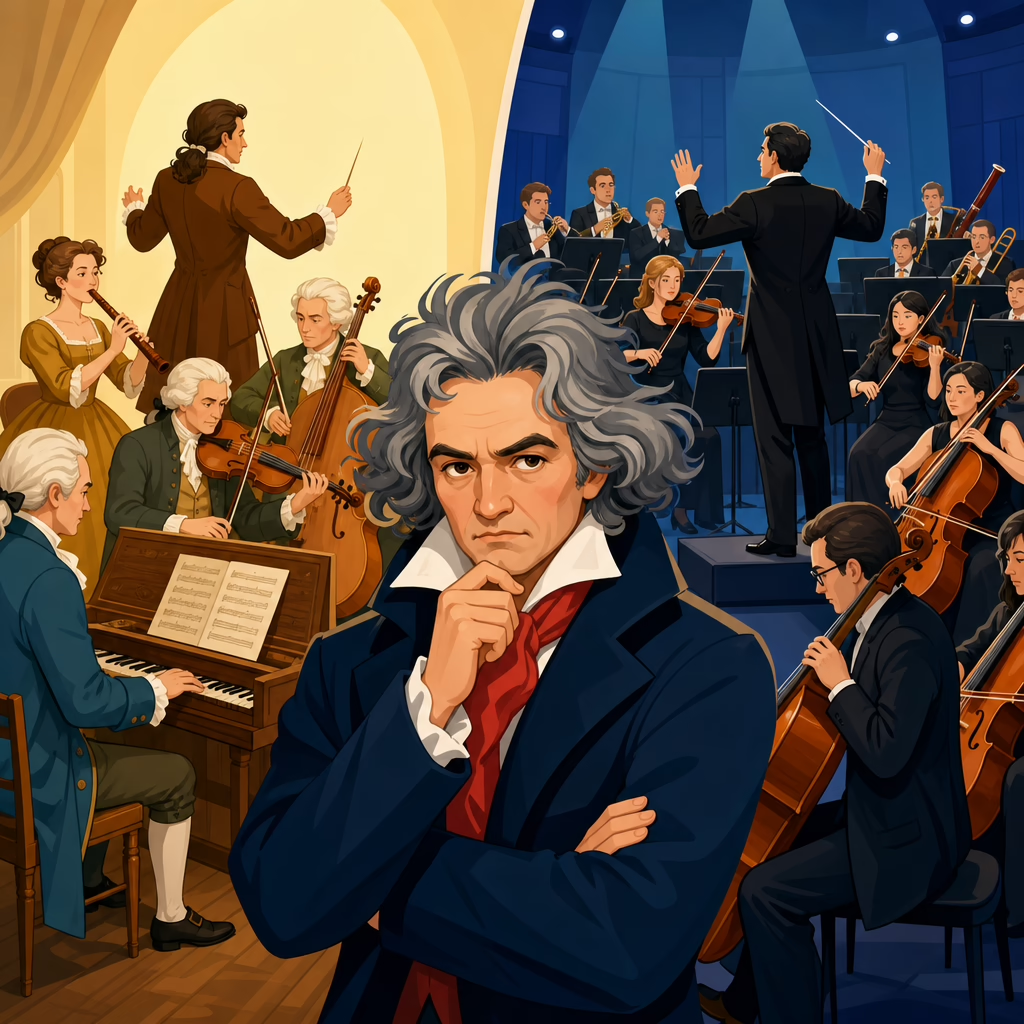
Period-Instrument vs. Modern-Instrument Beethoven Performances
Period-instrument versus modern-instrument Beethoven performances remains one of the most revealing debates in classical music because it touches sound, style, scholarship, and the listener’s basic idea of what Beethoven meant. In practical terms, a period-instrument performance uses instruments from Beethoven’s era, or accurate replicas, and applies historically informed techniques drawn from early nineteenth-century treatises, surviving parts, venue knowledge, and performance practice research. A modern-instrument performance uses contemporary orchestral instruments and the performing traditions that developed through the late nineteenth and twentieth centuries, often in larger halls and with larger ensembles. I have worked with both approaches in rehearsal rooms, recording sessions, and score study, and the difference is never merely academic. It affects articulation, balance, tempo, phrasing, vibrato, brass color, timpani impact, and even how a cadence lands in the body. For readers exploring Beethoven performance and recordings, this miscellaneous hub matters because almost every related article branches from this central contrast: symphony cycles, concerto recordings, chamber interpretations, overtures, editions, conducting styles, recording technology, and listening guides all depend on understanding these two sound worlds.
Beethoven sits at the center of the issue because his music arrives at a historical crossroads. He inherited Classical forms from Haydn and Mozart, yet he stretched orchestral scale, dynamic range, motivic development, and rhetorical intensity so forcefully that later musicians heard him as the start of modern symphonic thinking. That dual identity explains why both camps can claim legitimacy. Period advocates argue that Beethoven’s notation, metronome marks, and sharply profiled orchestration make the most sense on the leaner, quicker-speaking instruments he knew. Modern-instrument advocates answer that Beethoven’s expressive ambition points beyond his hardware, and that improved intonation, sustaining power, and richer blend can serve the architecture just as convincingly. The result is not a simple right-versus-wrong choice but a field of performance decisions. If you want a reliable framework for evaluating Beethoven recordings, start here: what instruments are being used, what size is the ensemble, how are tempi handled, what kind of articulation predominates, how much vibrato is present, and what acoustic environment shapes the final impression? Those questions unlock the broader Performance and Recordings topic and provide the context for every specialist page linked from this hub.
What defines a period-instrument Beethoven performance
A period-instrument Beethoven performance is defined less by antique appearance than by a chain of interlocking musical consequences. Gut strings respond with less uniform tension than modern steel-core strings, so attacks speak differently and dynamic swells feel more grainy and immediate. Natural horns and trumpets, without modern valves, produce uneven but vivid color across harmonic series notes; the “imperfections” are part of the rhetoric. Early woodwinds are narrower, reedier, and less homogenized than modern counterparts, which means inner lines can cut through without overplaying. Hard-stick timpani with calfskin heads articulate rhythmic figures with startling bite, especially in works such as the Seventh Symphony or the finale of the Eighth. When conductors and players build an interpretation around these materials, Beethoven’s textures often become more transparent, and counterpoint emerges with unusual clarity.
Historically informed performance also involves documentary evidence. Conductors routinely consult Czerny, Spohr, Türk, Quantz, Leopold Mozart’s continuing influence, and Beethoven’s own letters, conversation books, and metronome indications. No single source dictates a complete style, but together they support certain tendencies: speech-like phrasing, cleaner articulation, restrained continuous vibrato, and sharper differentiation between accents, sforzandi, and hairpin dynamics. Ensembles such as the Orchestre Révolutionnaire et Romantique under John Eliot Gardiner, the Academy of Ancient Music under Christopher Hogwood, and the Anima Eterna project under Jos van Immerseel demonstrated how these principles change the listening experience. In the “Eroica,” for example, the opening chords can sound less monumental in a late-Romantic sense yet more dangerous, because the attack is dry, the pulse urgent, and the horn writing rough-edged in exactly the way the score suggests.
What defines a modern-instrument Beethoven performance
A modern-instrument Beethoven performance begins from today’s standard orchestra: metal-supported strings, valved brass, Boehm-system woodwinds, larger bass sections, and halls built to project to big audiences. These tools encourage sustained legato, wider dynamic floors, smoother timbral transitions, and a more blended orchestral image. In Beethoven, that can create a broad symphonic arc that many listeners still find overwhelmingly persuasive. Think of the Berlin Philharmonic under Herbert von Karajan, the Vienna Philharmonic under Carlos Kleiber in the Fifth and Seventh, or the Cleveland Orchestra under George Szell. These performances shape Beethoven as a composer of long structural spans, intense cumulative energy, and polished ensemble precision. The grain of individual lines is sometimes less exposed than in period performances, but the sense of mass, control, and tonal saturation can be extraordinary.
Modern practice is not a monolith, and that point is often missed. Toscanini’s taut NBC readings, Furtwängler’s elastic wartime Beethoven, Klemperer’s granite weight, Harnoncourt’s hybrid experiments with modern orchestras, and Paavo Järvi’s leaner Deutsche Kammerphilharmonie cycle all fall under the modern-instrument umbrella while sounding radically different. The main distinction is that the instruments themselves are contemporary, not that the style is necessarily old-fashioned. In the last forty years, many modern orchestras absorbed lessons from historical practice: lighter bowing, less indiscriminate vibrato, more observance of repeats, smaller string desks, and stronger rhythmic profile. As a result, the real comparison today is often not “traditional versus authentic,” but different blends of evidence, taste, and orchestral technology. For anyone navigating Beethoven recordings, that nuance is essential, because some of the most compelling accounts occupy the middle ground rather than either pole.
Key musical differences listeners actually hear
The most useful way to compare period-instrument and modern-instrument Beethoven performances is to focus on audible outcomes. First, tempo. Period-informed conductors tend to take Beethoven’s metronome marks more seriously, though not slavishly, resulting in outer movements that feel urgent and dance-derived rather than ceremonial. Second, articulation. Short notes are usually shorter, accents cleaner, and slurs more consequential, so motifs gain profile. Third, balance. Natural brass and timpani can dominate climaxes with a raw edge, while woodwinds emerge as individual characters rather than part of a blended wash. Fourth, vibrato. On period strings, vibrato is often ornamental or selective, which changes emotional temperature; tenderness comes from line and harmony, not constant shimmer. Fifth, scale. Smaller forces can make the symphonies feel more agile and argumentative, whereas larger modern forces emphasize grandeur.
| Feature | Period instruments | Modern instruments |
|---|---|---|
| Strings | Gut strings, quicker decay, clearer attack | Greater sustain, fuller blend, more projection |
| Brass | Natural horns and trumpets, raw color shifts | Valved precision, even tone, broader dynamic control |
| Woodwinds | Distinctive individual timbres, prominent inner lines | More homogeneous blend, smoother legato |
| Timpani | Hard-stick definition, incisive rhythmic punch | Rounder sound, larger symphonic weight |
| Tempi | Often faster, tied to dance pulse and notation | More flexible, often broader in older traditions |
| Overall effect | Transparency, volatility, rhetorical contrast | Power, continuity, tonal richness |
These contrasts are easy to test in specific passages. In the first movement of the Fifth Symphony, period strings can make the famous four-note motive feel like a hard knock with immediate recoil, while modern strings can turn it into a heavier, more sustained assertion. In the Pastoral Symphony, period woodwinds often restore rustic color and the sense of outdoor bands, whereas modern performances may emphasize lyrical continuity and scenic beauty. In the Ninth Symphony, natural brass and hard timpani sharpen the military and ceremonial elements, while modern brass lend a monumental finish that suits massive choral forces. Neither approach automatically reveals “the truth.” What matters is coherence. The best performances align tempo, articulation, sonority, and architecture so that each choice supports the whole interpretation.
How the debate changed Beethoven recording history
The recording history of Beethoven shows that this debate is not static but evolutionary. Early electrical recordings captured conductors formed before the dominance of postwar orchestral polish, so even on modern instruments, articulation could be surprisingly direct. By the LP era, Beethoven often became heavier, especially in symphony cycles built for prestige and large stereo sound. Karajan’s 1960s cycle with the Berlin Philharmonic is a landmark of this approach: seamless strings, commanding brass, and a sculpted orchestral image suited to mid-century engineering and international concert culture. At the same time, scholars and performers were reexamining original sources, metronome marks, and surviving instruments. By the 1980s and 1990s, complete period-instrument cycles from Hogwood, Gardiner, Norrington, and Brüggen challenged assumptions that Beethoven required thick sonority and flexible late-Romantic rubato.
Those cycles changed mainstream practice even for orchestras that never abandoned modern instruments. Repeats returned. Scherzos started to sound like scherzos instead of mini-tragedies. Timpani became a structural force again. Conductors such as Claudio Abbado, David Zinman, and François-Xavier Roth showed that the historical-performance movement was not a niche correction but a major interpretive reset. Zinman’s cycle with the Tonhalle Orchestra Zürich, using the Bärenreiter edition, became especially influential because it paired modern instruments with lean textures, brisk tempos, and close attention to Beethoven’s markings. That model shaped subsequent Beethoven in concert halls, conservatories, and recording studios. For a hub page on miscellaneous Beethoven performance issues, this is the central point: the period-versus-modern question now informs everything from editorial choices to microphone placement, and listeners hear its effects whether or not a recording is explicitly marketed as historically informed.
How to choose the right Beethoven recordings for your taste
If you are building a Beethoven library, the smartest approach is not to pick a side permanently but to match repertoire and listening goals to the strengths of each approach. For rhythmic excitement, sharply etched inner detail, and a fresh sense of surprise, start with Gardiner in the symphonies, Immerseel for orchestral color, or a chamber group using historical setups in the early quartets and violin sonatas. For scale, tonal luxury, and long-breathed symphonic architecture, hear Kleiber in the Fifth and Seventh, Szell in the Third and Fifth, or Karajan when you want a high-gloss orchestral monument. For blended approaches, listen to Abbado, Zinman, Chailly, or Järvi, where modern instruments benefit from historical awareness without giving up modern precision. In piano concertos, the distinction becomes even more revealing: fortepiano recordings illuminate Beethoven’s keyboard textures and orchestral balance, while modern grand performances can heighten drama and sustain.
This hub also points toward related subtopics within Performance and Recordings. If your interest is orchestral cycles, compare complete sets across labels and venues. If you care about concertos, examine fortepiano versus Steinway, cadenza choices, and orchestra size. If chamber music is your focus, compare gut-string quartets with modern ensembles on vibrato, portamento, and tempo flexibility. If you follow conducting, study how figures like Norrington, Harnoncourt, and Roth differ from Karajan, Bernstein, or Furtwängler in rehearsal priorities and phrase hierarchy. For audio enthusiasts, recording date matters: mono, early stereo, digital remastering, and hall acoustics can exaggerate or soften the differences discussed here. The benefit of understanding period-instrument versus modern-instrument Beethoven performances is simple: you become a more accurate listener. You hear not just whether a performance is good, but what assumptions it is making. Use that awareness to explore the wider Beethoven Performance and Recordings section, compare versions systematically, and decide which sound world speaks most powerfully to you.
Frequently Asked Questions
What is the main difference between a period-instrument Beethoven performance and a modern-instrument one?
The core difference is the sound world each approach creates. A period-instrument performance uses instruments from Beethoven’s time, or carefully built replicas, along with historically informed techniques based on early nineteenth-century treatises, surviving orchestral parts, venue knowledge, and performance practice research. That means gut strings rather than modern metal-wound setups, narrower-bore brass, wooden flutes, timpani built and tuned differently, and pianos or fortepianos that respond in a far lighter, quicker, and more transparent way than the modern concert grand. These physical differences matter because they change balance, articulation, color, projection, and the way musical lines interact.
Modern-instrument performances, by contrast, are typically played on the instruments used in today’s concert halls, with their greater sustaining power, broader dynamic range, stronger bass foundation, and more blended orchestral sonority. A modern symphony orchestra can produce a weight and sweep that many listeners associate with Beethoven’s heroic reputation, especially in larger halls. String vibrato is often more continuous, wind playing can be smoother and more homogenized in tone, and brass can sound more powerful and secure. The result is not simply “the same notes on different equipment,” but a different interpretive environment.
In practical listening terms, period performances often reveal sharper rhythmic profile, leaner textures, more audible inner parts, and stronger contrasts between instrumental colors. Modern performances often emphasize grandeur, legato continuity, and architectural scale. Neither approach automatically guarantees a better result. What changes is the listener’s sense of proportion: how much attack is heard in the strings, how piercing the horns and trumpets sound, how clearly the winds emerge from the texture, and whether Beethoven feels more like a revolutionary composer in a volatile early nineteenth-century world or a monumental titan framed by the full resources of the modern symphonic tradition.
Why do many conductors and scholars believe period instruments can bring us closer to Beethoven’s intentions?
The argument rests on context. Beethoven composed for specific instruments, specific players, and specific acoustic expectations. The orchestras he knew were smaller than many modern ensembles, the string setup behaved differently under the bow, wind and brass instruments had more individualistic and sometimes rougher timbres, and keyboard instruments had a quicker decay and less sustained resonance. When scholars and performers reconstruct this environment, they are trying to understand not just what Beethoven wrote on the page, but what those markings likely meant in sound. A sforzando, crescendo, accent, or tempo indication can feel different when executed on the kinds of instruments Beethoven had in mind.
Historically informed performance also draws on documentary evidence. Early nineteenth-century treatises discuss articulation, bowing, tempo relationships, ornamentation, phrasing, and ensemble style. Surviving parts may contain markings that illuminate practical decisions. Knowledge of the venues in which Beethoven’s music was first heard can help performers assess scale, balance, and resonance. Even questions like how often vibrato was used, how portato might have been shaped, or how timpani sticks affected articulation become relevant because they influence the music’s rhetoric.
That said, “closer to Beethoven’s intentions” does not mean perfect historical certainty. Beethoven’s own performances were shaped by the limitations of his time, by inconsistent rehearsal conditions, and by the fact that he was writing music that often pushed beyond what contemporary instruments could comfortably do. So period performance is best understood not as a museum exercise, but as an informed attempt to hear Beethoven’s language in its native accent. It often clarifies why the music can sound so abrupt, daring, volatile, and texturally alive. For many listeners, that sense of risk and immediacy feels less like antiquarianism and more like rediscovery.
Do period-instrument performances usually sound faster, lighter, or more dramatic than modern ones?
Often they do, but not because conductors are simply trying to be provocative. Period instruments naturally encourage a different kind of motion. Their quicker response, lighter sustain, and stronger contrasts in attack can make tempos feel more animated even when the metronome is not drastically different. A fortepiano’s ability to articulate rapidly without the thick resonance of a modern grand can sharpen rhythmic character. Gut strings can speak with more grain and bite. Natural horns and trumpets can create a more startling, exposed brilliance. Woodwinds, because their timbres differ more clearly from one another, can bring a sense of conversational detail that makes the music feel more dramatic and less blended.
There is also the issue of Beethoven’s famously controversial metronome markings. Some historically informed conductors have taken them more seriously than many traditional interpreters did in the twentieth century, leading to performances that sound brisker, tighter, and more driven. In those cases, listeners may encounter symphonic movements that feel more urgent and dance-based, less monumental in the late-Romantic sense. Accents hit harder, transitions can feel more abrupt, and climaxes may emerge from propulsion rather than sheer orchestral mass.
Still, “faster and lighter” should not be confused with “smaller and less powerful.” The best period Beethoven performances can be tremendously forceful. Their drama often comes from rhythmic tension, textual clarity, extreme dynamic contrasts, and the raw individuality of orchestral color rather than from sustained sonic weight alone. Meanwhile, many modern-instrument conductors have absorbed lessons from historically informed practice and now favor leaner textures, quicker tempi, and more pointed articulation. So while the stereotype contains some truth, the real distinction is more nuanced: period performances often feel more sharply profiled and volatile, while modern ones often feel more continuous, blended, and expansive.
How do period instruments change the sound of Beethoven’s symphonies, concertos, and piano music specifically?
In the symphonies, the differences can be striking. Strings on gut produce less uniform sheen and more tactile attack, which makes rhythms more spring-loaded and inner figurations easier to distinguish. Woodwinds stand out more vividly because they are not absorbed into a glossy orchestral blend in the same way they often are in modern performances. Natural brass can sound thrillingly bright, blunt, and even dangerous at climactic moments, which suits Beethoven’s tendency toward confrontation and disruption. Timpani, depending on setup and sticks, can contribute a harder, more speech-like punch. Altogether, the symphonic fabric often feels less saturated but more transparent, with sharper edges and stronger contrast between orchestral families.
In the concertos, balance is especially important. A fortepiano does not dominate an orchestra the way a modern concert grand can, so the relationship between soloist and ensemble becomes more conversational. The piano is integrated into the texture rather than placed above it as a commanding, sustained, high-volume presence. This changes how listeners perceive Beethoven’s keyboard writing: passagework can sound witty, nimble, and improvisatory rather than overwhelmingly orchestral. At the same time, the orchestra’s colors register more distinctly around the solo part, creating a vivid exchange rather than a contest of volume.
In solo piano music, the fortepiano can transform one’s understanding of Beethoven’s phrasing, pedaling, articulation, and dynamic language. Because the instrument sustains less, details that can blur on a modern piano may emerge with greater clarity. Sudden dynamic changes speak differently, repeated notes can feel more incisive, and registral contrasts often become more dramatic because treble and bass colors are less homogenized. Certain textures that sound thick or monumental on a modern piano can sound agile and rhetorically pointed on a fortepiano. On the other hand, the modern piano offers power, sustain, and a broad singing tone that many pianists use to reveal long-range structure and emotional depth. Both instruments illuminate Beethoven, but they illuminate different aspects of his imagination.
Which approach is better for listeners: period-instrument or modern-instrument Beethoven?
For most listeners, the best answer is not to choose one camp permanently, but to understand what each approach makes possible. Period-instrument Beethoven can be revelatory if you want to hear clearer textures, more differentiated instrumental color, sharper articulation, and a stronger sense of the music’s original environment. It can make familiar works feel newly risky, more unpredictable, and less covered by the weight of later performance traditions. Many listeners who first hear a strong period performance are surprised by how radical Beethoven suddenly sounds: less like a marble monument and more like a disruptive, living force.
Modern-instrument Beethoven, however, remains compelling for good reasons. The modern symphony orchestra can deliver immense dynamic range, rich string sonority, and a sense of cumulative power that suits Beethoven’s large-scale structures beautifully. In the hands of a great conductor, modern instruments can produce overwhelming emotional sweep, grandeur, and a long-breathed architectural coherence that many listeners find deeply satisfying. They can also fill large contemporary halls more naturally and meet the expectations of audiences accustomed to the sonorous fullness of the modern orchestral tradition.
What matters most is not ideology but insight. A persuasive period performance and a persuasive modern performance may both feel true to Beethoven, even though they arrive there by different means. The most rewarding listening strategy is comparative: hear the same symphony, concerto, or sonata in both styles and notice what changes. Listen for wind color, timpani impact, string articulation, tempo relationships, balance between sections, and