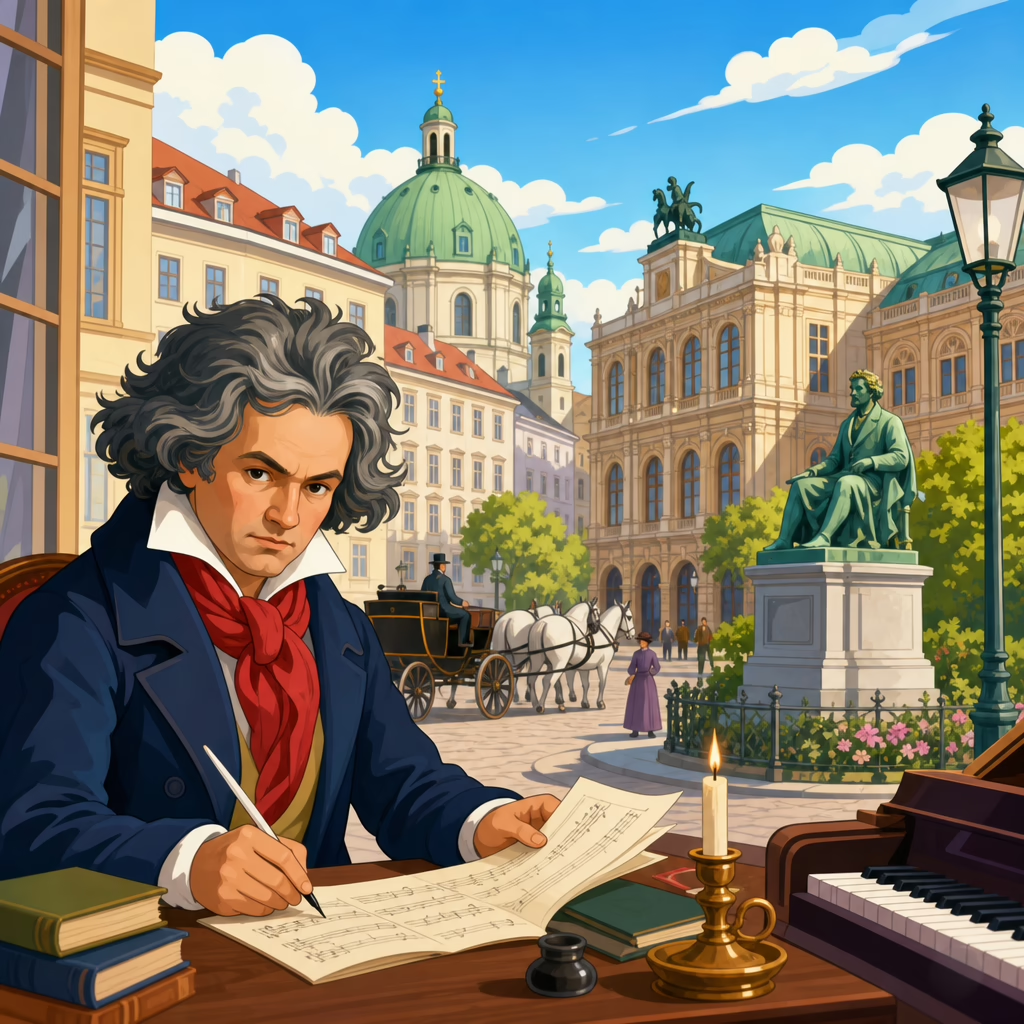
A Virtual Tour of Beethoven’s Vienna
Vienna is one of the few cities where music history still feels physically mapped onto the streets, and no composer is more deeply woven into that map than Ludwig van Beethoven. A virtual tour of Beethoven’s Vienna is more than a list of monuments or museums; it is a way to understand how the city’s theaters, apartments, coffeehouses, churches, and suburban villages shaped the work of a composer who transformed Western music. For readers exploring a multimedia gallery, this hub article gathers the essential places, themes, and historical context that connect Beethoven to Vienna, while also pointing toward the wider miscellaneous material that makes his world vivid.
Beethoven arrived in Vienna in 1792, likely intending a short period of study, and remained there for the rest of his life. During those thirty-five years, Vienna was the capital of the Habsburg Empire, a city of aristocratic patronage, public concerts, publishers, military anxiety during the Napoleonic Wars, and fast-changing musical taste. When historians speak of Beethoven’s Vienna, they mean both the physical city and the social network around it: patrons such as Archduke Rudolph, venues like the Theater an der Wien, copyists, instrument makers, publishers, and fellow composers including Haydn and Schubert. Understanding those relationships makes a virtual tour meaningful because each address becomes evidence of how music was financed, rehearsed, heard, and remembered.
I have built Beethoven itineraries for travelers and digital exhibits alike, and the same issue always comes up first: people expect one fixed Beethoven house, when in fact he moved constantly. More than sixty addresses are associated with him. Some stays were brief, some seasonal, and several buildings no longer survive. That instability matters. It reflects a composer working through unreliable health, uneven domestic routines, changing finances, and a need to retreat to quieter districts for composition. A good virtual tour therefore balances surviving landmarks with reconstructed context. It answers simple questions directly: where did he live, where did he perform, where was he buried, and which sites still communicate his presence most clearly today?
Central Vienna: the core addresses every visitor should know
The best place to begin is the historic center, because it condenses Beethoven’s professional life into a walkable area. The Pasqualati House, on Mölker Bastei, is the most famous surviving Beethoven residence in central Vienna. He lived there at intervals between 1804 and 1815 under the patronage of Johann Baptist Freiherr von Pasqualati. Several major works are linked to this address, including parts of the Fifth, Seventh, and Eighth Symphonies and the opera Fidelio. The museum today is not a perfectly preserved apartment, but it effectively frames Beethoven’s working life with manuscripts, portraits, and city views that remind visitors how close he remained to publishers, noble patrons, and performance venues.
Also central is the Theater an der Wien, one of the decisive Beethoven sites in Vienna. He lived temporarily in the theater complex in 1803–1804, and on 22 December 1808 the venue hosted the marathon concert that premiered the Fifth and Sixth Symphonies, the Fourth Piano Concerto, and the Choral Fantasy. That single event explains why the theater matters: it shows Beethoven not as an abstract genius but as a practical musician assembling performers, battling freezing conditions, and testing ambitious new music before a paying audience. Nearby streets, though altered, still preserve the scale of the entertainment district in which opera, instrumental music, and commerce overlapped every night.
St. Stephen’s Cathedral also belongs on any virtual route, not because Beethoven worked there directly but because it anchors his final public story. His funeral rites in 1827 drew enormous crowds, often estimated at around 10,000 to 20,000 people. The exact figure is debated, but the scale is not. Vienna understood that it was burying its most famous living composer. From the cathedral precinct, a virtual tour can expand to the old city gates, booksellers, and publishers who circulated Beethoven’s music far beyond Austria. In practical terms, central Vienna shows how reputation was built: through visibility, elite contact, and institutions dense enough to turn local performances into European cultural events.
Heiligenstadt and the outskirts: where crisis became artistic breakthrough
If central Vienna reveals Beethoven’s public career, Heiligenstadt explains his inner life. Now part of the city’s 19th district, this village on Vienna’s edge was a health retreat when Beethoven stayed there in 1802. He hoped the quieter environment and mineral treatments might ease his worsening hearing loss. Instead, he confronted the possibility that his condition was permanent. The result was the Heiligenstadt Testament, a private letter to his brothers never sent during his lifetime, in which he described despair, social withdrawal, and his resolve to continue living for art. Few documents in music history expose a creative turning point so clearly.
The Beethoven Museum in Heiligenstadt treats this episode with the seriousness it deserves. Rather than reducing hearing loss to a biographical anecdote, it places the crisis alongside the expansion of Beethoven’s middle-period style. After 1802, the music grows broader in scale, more assertive in motive, and more structurally daring. When I guide people through this phase virtually, I stress that Heiligenstadt is not a sentimental stop. It is the point where biography and artistic method intersect. The inability to hear normally did not create genius, but it forced Beethoven to rethink communication, performance, and the very sound world he imagined internally.
Beyond Heiligenstadt, outer districts such as Döbling, Baden, and the villages around the Vienna Woods matter because Beethoven repeatedly sought rural lodgings there in summer. These seasonal moves were practical. He needed cleaner air, less urban noise, and room to work. For modern readers, these sites also widen the idea of a multimedia gallery. A city tour should include not only buildings but environmental evidence: landscape paintings, historical maps, letters describing walks, and even the acoustical difference between a crowded central street and a vineyard village. Beethoven’s Vienna was not confined to imperial façades. It included paths, taverns, rented rooms, and suburban horizons where some of his most concentrated work was done.
Residences, work habits, and what the moving addresses reveal
One of the most useful ways to organize miscellaneous Beethoven material is by residence type. Some addresses were tied to patrons, some to convenience, some to health, and some simply to short-term availability. The House of the Black Spaniards, long associated with his final years through the Schwarzspanierhaus, no longer stands, but the site remains historically important because Beethoven died there on 26 March 1827. By contrast, places like the Eroica House in Oberdöbling survive with varying degrees of certainty regarding exactly which works were completed there. Scholars are rightly cautious: attribution should rest on documents, not tourist legend.
These moving addresses reveal several reliable facts about Beethoven’s working habits. He composed in notebooks, drafted obsessively, and revised far more than the myth of spontaneous genius suggests. He was sensitive to interruptions and often difficult as a tenant because of irregular hours, clutter, and piano noise. He walked constantly, carrying sketch materials. He valued pianos from makers such as Broadwood, Erard, and Conrad Graf because instrument technology affected what he could imagine at the keyboard. In exhibition terms, that means a virtual tour should not stop at exterior photographs. It should show floor plans, facsimiles of sketch leaves, period pianos, lease records, and anecdotal reports from neighbors.
| Site | Why it matters | Best virtual material |
|---|---|---|
| Pasqualati House | Central residence linked to major symphonic and operatic work | Museum photography, manuscript images, city panoramas |
| Theater an der Wien | Major premieres and Beethoven’s temporary lodging | Performance history timelines, seating plans, premiere programs |
| Heiligenstadt | Hearing crisis and the Heiligenstadt Testament | Letter facsimiles, medical context, maps of village retreats |
| Schwarzspanierhaus site | Place of Beethoven’s death in 1827 | Historic prints, funeral route diagrams, memorial records |
| Central Cemetery grave | Modern focus of remembrance | Grave photography, burial history, nearby composer memorials |
For a hub page, this residential perspective is especially effective because it connects many article types that might otherwise feel miscellaneous: tenancy disputes, instrument ownership, household assistants, medical treatment, manuscript transport, and seasonal relocation. Each topic belongs because Beethoven’s Vienna was lived experience before it became heritage. When visitors see how unstable his domestic life often was, they understand the achievement differently. The symphonies, quartets, and sonatas did not emerge from a serene studio; they were produced amid rented rooms, legal frustrations, illness, and a city whose cultural opportunities came with relentless practical demands.
Performance venues, patrons, and the business of Beethoven’s Vienna
Beethoven’s Vienna can only be understood through its musical economy. Aristocratic patronage remained crucial, but the old system was changing. Prince Lichnowsky, Prince Lobkowitz, and Archduke Rudolph provided money, status, and access, yet Beethoven also negotiated with publishers across Europe and depended on benefit concerts, subscriptions, and dedications. This mixed economy is visible in the city’s venues. The Theater an der Wien, the Kärntnertor Theater, salon rooms in noble palaces, and church spaces each supported different kinds of performance and different audiences. A virtual tour gains authority when it explains not just where Beethoven appeared, but who paid, who listened, and what risks were involved.
The famous annuity agreement of 1809 captures the system perfectly. Archduke Rudolph, Prince Kinsky, and Prince Lobkowitz promised Beethoven an annual income to keep him in Vienna after he considered an offer from Kassel. Inflation and political disruption later weakened the arrangement, but the document still marks a turning point: Vienna recognized that retaining Beethoven was a matter of civic prestige. During the Napoleonic occupation of 1809, cannon fire reportedly drove Beethoven to shelter with pillows over his ears, a dramatic image that also reminds us how war affected artistic life. Concert schedules, aristocratic finances, and publishing networks all moved under pressure from European conflict.
For modern audiences, this section of the tour answers a practical question: how did Beethoven actually sustain a career? The short answer is through diversification before the term existed. He taught, performed, published, accepted commissions, dedicated works strategically, and cultivated patrons while fiercely guarding artistic independence. That tension defines his Vienna. He needed elite support but resisted servility; he wanted public success but often wrote beyond immediate public comprehension. Any comprehensive multimedia hub should therefore include concert chronologies, patron biographies, period currency explanations, and venue histories. Without that framework, the city becomes a backdrop rather than the active marketplace in which Beethoven’s art was made, sold, negotiated, and contested.
Memory, burial, and how Vienna turned Beethoven into civic heritage
The final layer of a virtual tour is memory: what Vienna chose to preserve, rebuild, commemorate, and narrate after Beethoven’s death. He was first buried at the Währing cemetery beside Franz Schubert, then reinterred in Vienna’s Zentralfriedhof in 1888, where both graves remain major pilgrimage points. The movement of the body itself reflects changing memorial culture. Nineteenth-century Vienna increasingly treated composers as civic icons, using monuments, named streets, museum rooms, and ceremonial graves to turn music into public heritage. The city’s Beethoven statues are therefore not decorative extras. They show how later generations defined seriousness, genius, and national prestige through commemoration.
That memorial process also creates distortions, and a trustworthy tour should say so plainly. Not every plaque marks a verified masterpiece site. Not every reconstructed room reflects original furnishing. Some Beethoven locations are powerful because of documentation; others are meaningful mainly because of tradition. Good interpretation distinguishes between those levels of certainty. It also places Beethoven within a broader Viennese landscape that includes Mozart, Haydn, Schubert, and the institutions that outlived them all. For readers using this page as a hub, the benefit is clarity. You can move from grave to museum, from manuscript to map, from legend to evidence, and build a more accurate picture of the city Beethoven inhabited and the city that later mythologized him.
A virtual tour of Beethoven’s Vienna works best when it combines geography, biography, and musical history into one coherent route. Start with central landmarks such as the Pasqualati House and the Theater an der Wien, move outward to Heiligenstadt and the summer villages, then finish with the cemeteries, memorials, and museums that shaped Beethoven’s afterlife in public memory. Along the way, pay attention to residences, patrons, instruments, manuscripts, and performance spaces, because each reveals how the music was actually created and heard. That is the main value of this hub: it turns scattered miscellaneous material into a usable framework.
For anyone exploring a multimedia gallery, Beethoven’s Vienna is not a single attraction but an interconnected archive of places, documents, and stories. The city explains the composer, and the composer illuminates the city. Use this page as your starting point, then continue into focused articles on individual houses, premiere venues, funeral history, suburban retreats, and museum collections to complete the tour.
Frequently Asked Questions
What makes Vienna essential to understanding Beethoven’s life and music?
Vienna was not just the city where Beethoven lived for much of his adult life; it was the environment that shaped his career, artistic ambitions, and public identity. When Beethoven arrived from Bonn in the 1790s, Vienna was the musical capital of the German-speaking world, with powerful aristocratic patrons, active publishing houses, major theaters, church music traditions, and a sophisticated culture of private salon performance. In that setting, he developed from a brilliant pianist and improviser into a composer whose works redefined the symphony, piano sonata, string quartet, and concerto.
A virtual tour of Beethoven’s Vienna helps readers see that his music did not emerge in abstraction. The city’s neighborhoods, courtly institutions, and social spaces formed a real geographic network around him. The Theater an der Wien connects directly to the premieres of landmark works, including the only opera he completed, Fidelio, and the monumental concert academy of 1808. His many apartments tell another story: Beethoven moved frequently, and those addresses reflect both practical realities and changing phases of his creative life. Churches such as St. Stephen’s Cathedral and the broader sacred music culture of the city reveal the religious and ceremonial sound world he inherited and transformed. Even the suburban villages around Vienna, where he often stayed in warmer months, were important retreats where he composed some of his most innovative music.
What makes Vienna especially powerful for modern audiences is that much of this history still feels spatially legible. Streets, squares, and buildings create a map that allows readers to connect Beethoven’s biography with specific places. That physical continuity gives his story unusual immediacy. Rather than treating Beethoven as an isolated genius, Vienna shows him as a working composer moving through theaters, meeting patrons, attending rehearsals, publishing music, and wrestling with the demands of a fast-changing cultural capital.
Which places are usually considered the most important stops on a virtual tour of Beethoven’s Vienna?
The most important stops usually combine sites directly tied to Beethoven’s daily life with places associated with major premieres, patrons, and the broader musical culture of Vienna. A strong virtual tour often begins with the Pasqualati House, one of the residences most closely associated with Beethoven and now one of the best-known museum sites connected to him. Although he lived in many apartments across the city, the Pasqualati House has become especially meaningful because several important works are linked to his years there, and it offers a useful entry point into his domestic and creative world.
Another essential stop is the Theater an der Wien. This theater is central to Beethoven’s public career in Vienna because it hosted important performances and is inseparable from the story of Fidelio. It also represents the vibrant theatrical life of the city, where opera, instrumental music, and public concerts intersected. Readers should also encounter the legacy of the city’s court and aristocratic culture through sites connected to Beethoven’s patrons, since noble support was crucial to his ability to remain in Vienna and compose with relative independence.
The Heiligenstadt area is also indispensable. Located outside the dense urban center, it is associated with the famous Heiligenstadt Testament of 1802, the deeply personal document in which Beethoven confronted the despair caused by his increasing hearing loss. For many readers, this stop adds emotional depth to the tour because it frames the crisis from which some of his most ambitious later work emerged. Beyond Heiligenstadt, a virtual itinerary may include Baden and other suburban or nearby retreat locations where Beethoven spent summers composing.
Churches, coffeehouses, publishing districts, and cemeteries also enrich the picture. St. Stephen’s Cathedral matters not only because of its symbolic place in Vienna but also because it connects Beethoven to the ceremonial life of the city and, ultimately, to the story of his funeral in Vienna, which became a major public event. Some tours also include the House of Music or archival institutions that help readers understand how Beethoven’s manuscripts, instruments, and reception history have been preserved. Together, these locations create a fuller portrait: not just Beethoven the legend, but Beethoven the resident, performer, collaborator, and cultural force.
How did Beethoven’s many apartments and seasonal moves influence his work in Vienna?
Beethoven’s constant movement from one residence to another is one of the defining features of his Viennese life, and it reveals a great deal about both his personality and his circumstances. Unlike some composers whose careers can be tied to a single court or household, Beethoven lived in a succession of apartments across different parts of Vienna and its outskirts. These moves were driven by practical concerns such as rent, noise, health, changing relationships with landlords, and his desire for quiet places suitable for composition. As a result, the map of Beethoven’s Vienna is also a map of an unsettled but intensely productive artistic life.
For readers on a virtual tour, this matters because each address can represent a distinct chapter. Some residences are linked to major works, some to periods of personal crisis, and others to his gradual withdrawal from ordinary social hearing as deafness advanced. The image of Beethoven working in scattered apartments helps correct a common misconception that genius operated outside everyday life. In reality, he composed amid urban pressures, household frustrations, and the logistical instability of frequent relocation. His domestic environments were often imperfect, yet out of those conditions came music of extraordinary structural power and emotional range.
Seasonal moves to suburban villages and spa towns were equally important. Beethoven often sought relief from the noise and heat of the city by relocating during the summer months to places such as Heiligenstadt, Döbling, or Baden. These settings offered cleaner air, more open landscapes, and a rhythm of life different from the formal intensity of central Vienna. They also gave him space to walk, sketch musical ideas, and work with a degree of solitude. Many readers find it striking that some of his most expansive and visionary music is associated with these semi-rural environments rather than with the grandest urban institutions.
In this way, Beethoven’s residences should not be seen as incidental background details. They are part of the story of how he balanced public ambition with private struggle. A virtual tour that traces these addresses allows readers to understand composition as something rooted in lived experience: rooms, neighborhoods, climate, routine, and escape. The result is a more vivid and human portrait of Beethoven in Vienna.
Why is Heiligenstadt so important in the story of Beethoven’s Vienna?
Heiligenstadt holds a special place in Beethoven’s biography because it is associated with one of the most revealing documents he ever wrote: the Heiligenstadt Testament of 1802. At the time, Heiligenstadt was a village on the outskirts of Vienna, known for its quieter atmosphere and reputation as a place of health and rest. Beethoven went there hoping for physical and emotional recovery, especially as his hearing problems became more severe. Instead, the period forced him into a confrontation with the terrifying implications of encroaching deafness.
In the Testament, addressed to his brothers though never sent in the form we know it, Beethoven describes the isolation, humiliation, and despair caused by his condition. For a musician whose livelihood and identity depended on hearing, the crisis was existential. He writes with startling honesty about thoughts of death, yet he also describes being held back by art and by the sense that he still had important work to complete. That tension makes Heiligenstadt one of the most emotionally significant stops on any virtual tour. It is not simply a scenic suburb; it is the setting for a turning point in Beethoven’s inner life.
Heiligenstadt also matters because it changes how readers hear the music that followed. After 1802, Beethoven entered the phase often called his “heroic” middle period, during which he produced works of unprecedented scale, force, and formal ambition. While historians rightly avoid simplistic cause-and-effect narratives, it is hard to ignore the symbolic power of Heiligenstadt as a site where suffering, resolve, and artistic purpose converged. The location helps readers understand that Beethoven’s greatness was not separate from struggle; it was forged through it.
In a broader sense, Heiligenstadt represents the importance of Vienna’s edges, not just its center. Beethoven’s story unfolded in theaters and aristocratic salons, but also in quieter peripheral landscapes where reflection and composition could happen away from constant public demands. Including Heiligenstadt in a virtual tour ensures that Beethoven’s Vienna is understood as a larger cultural region, not merely a cluster of famous inner-city monuments.
How can a virtual tour help modern readers experience Beethoven’s Vienna more meaningfully than a simple list of landmarks?
A simple list of Beethoven-related places can be useful, but it often reduces the city to disconnected facts: a house here, a monument there, a theater somewhere else. A well-designed virtual tour does something much more valuable. It creates relationships among places, events, and works, allowing readers to understand Vienna as an interconnected ecosystem that shaped Beethoven’s development. Instead of seeing isolated sites, readers begin to see pathways: from apartment to theater, from patron’s palace to publisher, from church ceremony to concert life, from summer retreat to late masterpiece.
This approach is especially effective in a multimedia format. Maps, archival images, manuscript reproductions, audio excerpts, and historical commentary can work together to restore context that a static monument cannot provide on its own. For example, showing the Theater an der Wien