Educational Posters and Infographics Featuring Beethoven
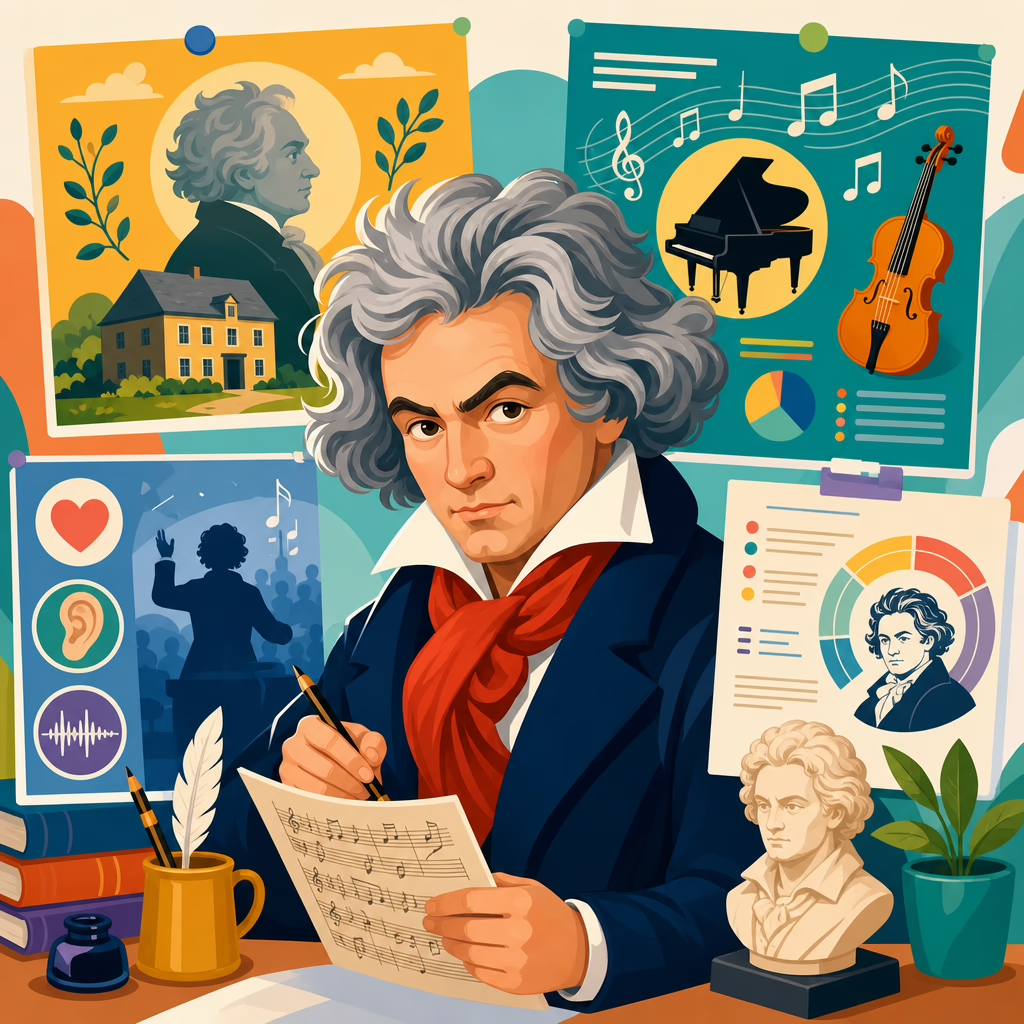
Educational posters and infographics featuring Beethoven turn a familiar composer into a practical teaching tool, helping students connect biography, music history, listening skills, and visual learning in one format. In schools, libraries, homeschool settings, and community music programs, I have seen Beethoven materials work best when they do more than decorate a wall. The strongest pieces explain who Ludwig van Beethoven was, place him in the Classical and early Romantic eras, and break down why his work still shapes music education today. A good poster can introduce essential facts such as his birth in Bonn in 1770, his move to Vienna, his increasing hearing loss, and his major works, while an effective infographic can show relationships among dates, compositions, forms, and historical context at a glance.
In this context, educational posters are large-format visual aids designed for display, usually emphasizing readability, hierarchy, and immediate recall. Infographics are more data-driven visual summaries that organize timelines, comparisons, processes, or statistics into digestible sections. When the subject is Beethoven, both formats can support multiple learning goals at once: music appreciation, literacy development, art integration, and historical understanding. They also fit a wide age range. Elementary learners often respond to portraits, bold icons, and short fact blocks, while middle school, high school, and adult learners benefit from timelines, work categories, and explanations of musical innovation.
This topic matters because Beethoven sits at the intersection of cultural literacy and accessible arts education. Many learners recognize his name before they can identify a sonata, symphony, or string quartet. Well-made Beethoven classroom posters and Beethoven infographics close that gap. They help teachers answer common questions quickly: Why is Beethoven important? What did he compose? How did deafness affect his career? What should students listen for in Symphony No. 5 or Symphony No. 9? They also provide durable hub content for broader community and education initiatives, linking music rooms, museum programs, concert handouts, and interdisciplinary curriculum. For any organization building resources around composers, educational posters and infographics featuring Beethoven are not miscellaneous extras; they are one of the clearest entry points into meaningful engagement.
What Educational Posters and Infographics About Beethoven Should Include
The most useful Beethoven educational resources start with core facts, but they do not stop there. Every strong piece should answer five questions clearly: who Beethoven was, when he lived, what he composed, why he mattered, and how students can explore his music. In practice, that means including his full name, key dates, nationality, principal cities, major genres, and signature achievements. I usually recommend a structure that begins with identity and chronology, then moves to works and influence. Without that foundation, a poster becomes decorative rather than instructional.
Content selection matters. A Beethoven poster for a classroom should mention his early training, his reputation as a pianist, his study with figures connected to Haydn’s circle, and the gradual onset of hearing loss beginning in his late twenties. It should also identify major categories of output: nine symphonies, thirty-two piano sonatas, sixteen string quartets, five piano concertos, one violin concerto, one opera, and important choral and chamber works. These are not trivia points. They show students the range of his contribution and help teachers frame listening units by genre.
Infographics can go further by showing patterns. For example, they can explain the often-used three-period framework—early, middle, and late Beethoven—while acknowledging that scholars use these labels as convenient teaching tools rather than rigid boundaries. The early period highlights Classical influence and refinement. The middle period emphasizes expansion, drama, and works often described as heroic. The late period introduces greater structural complexity, introspection, and experimentation. That kind of organization helps learners understand that Beethoven was not a static genius producing the same style repeatedly; he evolved over time.
Design choices should support reading from a distance. Large title text, one dominant portrait, restrained color palettes, and disciplined section spacing outperform crowded layouts. I have seen schools hang music history posters too high on walls, which means small body text becomes useless. A practical rule is that key facts should be legible from at least six to eight feet away. For infographics, visual hierarchy is everything: chronology should flow in one direction, icons should be consistent, and labels should use plain language before introducing specialized terms such as motif, sonata form, variation, or counterpoint.
Best Formats for Classrooms, Libraries, and Community Spaces
Different settings require different formats, and Beethoven teaching materials work best when the format matches the use case. In elementary classrooms, portrait posters with brief captions and a listening prompt are usually more effective than dense graphics. Younger students need quick anchors: a recognizable face, a dramatic fact, and a question such as “Can you hear the short-short-short-long rhythm in Symphony No. 5?” In middle school and high school, infographic formats become more valuable because students can interpret timelines, compare genres, and connect music to historical events such as the French Revolutionary era, the Napoleonic period, and the Congress of Vienna.
Libraries and community centers benefit from hybrid designs. A Beethoven display poster may combine a central portrait with a side timeline, a works list, and a short panel on hearing loss and resilience. These spaces often serve mixed audiences, so the content has to be layered. A child may focus on the image and a famous title like “Ode to Joy,” while an adult may read about the Missa solemnis or late quartets. In museum education or concert outreach, infographics are particularly useful as handouts because they compress biography, repertoire, and listening cues into one reference sheet that visitors can keep.
Print specifications also matter more than many people expect. For wall posters, common sizes include 18 x 24 inches and 24 x 36 inches. Matte finishes reduce glare in fluorescent classrooms. Laminated copies last longer in music rooms where humidity, handling, and repeated reuse are common. For infographics shared digitally, vertical layouts tend to perform better on phones and school learning platforms, while landscape versions suit projectors and hallway screens. Accessibility should be built in from the start: high contrast, readable fonts, alt text for digital versions, and color choices that do not rely solely on hue to communicate meaning.
| Format | Best Use | Strength | Example Beethoven Content |
|---|---|---|---|
| Portrait poster | Elementary classroom wall | Fast recognition and recall | Name, dates, portrait, Symphony No. 5 motif |
| Timeline infographic | Middle or high school lesson | Chronological understanding | Bonn, Vienna, hearing loss, major premieres |
| Genre comparison chart | Library or homeschool study | Shows range of output | Symphonies, sonatas, quartets, concertos, opera |
| Concert handout infographic | Community event or museum program | Portable reference for audiences | Listening guide to Symphony No. 9 and “Ode to Joy” |
When organizations treat format as part of instruction, not just presentation, Beethoven resources become more useful and more likely to be reused across programs.
Key Themes That Make Beethoven Visuals Effective
Several themes consistently make Beethoven posters and infographics stronger. The first is historical context. Students understand Beethoven better when they see him as a composer living through political and cultural upheaval, not as an isolated monument. He was born in the Electorate of Cologne, built his career in Vienna, and worked during a period marked by revolution, war, and changing ideas about the artist’s role in society. A timeline that places his life alongside events in Europe immediately deepens understanding.
The second theme is musical structure made visible. Beethoven is often taught through famous pieces, but visuals should also explain how the music works. For Symphony No. 5, a poster might identify the opening four-note motif and show how it recurs and transforms. For piano sonatas, an infographic might outline sonata form in simple steps: exposition, development, recapitulation, with a note that Beethoven frequently stretched inherited forms in expressive ways. For the late quartets, a more advanced resource can point to contrasts in texture, fugue writing, and formal innovation without pretending these works are easy listening for beginners.
The third theme is hearing loss and adaptation, handled accurately and carefully. Beethoven did not become completely deaf overnight, and educational materials should avoid melodramatic simplifications. His hearing decline was gradual, documented in letters and in the 1802 Heiligenstadt Testament, where he described despair but also commitment to his art. This part of his story matters because it invites discussions about disability, persistence, identity, and the limits of romantic mythmaking. The strongest infographics present this with dignity, showing both challenge and continued productivity.
A fourth theme is influence. Beethoven’s works shaped composers including Brahms, Wagner, Mahler, and countless others, but educational visuals should be specific rather than vague. Symphony No. 3 expanded expectations for symphonic scale and ambition. Symphony No. 9 integrated chorus and soloists into the symphonic tradition in a way that changed how later composers thought about the genre. The Diabelli Variations became a benchmark for variation writing. When influence is named with concrete examples, students grasp why Beethoven remains central to music history curricula.
Using Beethoven Posters and Infographics Across Subjects
One reason this subtopic serves well as a hub is that Beethoven visuals belong in more than music classrooms. In language arts, students can pair a biography poster with primary-source excerpts from letters, then write short responses about voice, struggle, and public reputation. In history, an infographic can connect Beethoven’s career to broader changes in Europe, including aristocratic patronage, urban concert life, and the spread of print culture. In art classes, students can analyze portrait styles, typography, and visual symbolism, then design their own composer posters using clear information hierarchy.
In social-emotional learning settings, Beethoven’s life can support thoughtful discussion about frustration, perseverance, ambition, and adaptation. That must be handled responsibly. His story should not be reduced to a slogan about overcoming adversity. Instead, educational materials should show that creative work can continue under serious constraints, while also acknowledging the emotional toll those constraints imposed. In community education, especially adult lifelong-learning programs, Beethoven infographics often work as gateways to listening clubs, pre-concert talks, and neighborhood arts events because they reduce intimidation and give participants a map for what they are about to hear.
Digital use expands the possibilities further. A school can post a Beethoven infographic on a learning management system, link it to listening assignments, and reuse the same visual in newsletters or hallway displays. Community orchestras can build event pages around a concise Beethoven fact sheet. Homeschool families can print a timeline and add composer cards over several weeks. The practical advantage of this miscellaneous hub is flexibility: posters and infographics are modular, easy to update, and adaptable across age groups, venues, and teaching objectives.
How to Evaluate Quality and Build a Useful Beethoven Resource Hub
Not all Beethoven educational posters are equally reliable, and quality control matters. Start by checking factual accuracy against standard references such as Grove Music Online, major conservatory materials, established orchestra education pages, and scholarly editions. Dates, opus numbers, genre labels, and historical claims should be correct. I regularly see weaker resources misstate when hearing loss began, flatten the distinction between Classical and Romantic style, or present unattributed quotations. Once an error appears on a classroom wall, it tends to be repeated.
Next, evaluate whether the resource serves a real teaching purpose. A useful Beethoven infographic should answer a question a teacher or learner genuinely has: Which works are most important for beginners? How did Beethoven’s style change? What happened during his middle period? What should I listen for in the Ninth Symphony? If a poster cannot support instruction, discussion, or independent exploration, it is not strong hub content. It may still be attractive, but attractiveness alone does not justify inclusion in a community and education collection.
Finally, think like a curator. A comprehensive miscellaneous hub should include biography posters, timeline infographics, genre overviews, listening guides, disability-awareness resources related to hearing loss, printable classroom displays, and digital shareables for community outreach. Internal organization matters. Group resources by audience, format, and instructional goal so visitors can quickly find what they need. When I build composer resource pages, the most successful structure is simple: start with beginner-friendly visuals, add intermediate analytical materials, then provide specialized resources for concerts, libraries, and interdisciplinary projects. That approach keeps Beethoven accessible without diluting the depth that educators and serious learners expect.
Educational posters and infographics featuring Beethoven succeed when they combine visual clarity with factual depth. They should identify the man, explain the music, and show why his life and works still matter in classrooms and community spaces. The best resources include essential biography, major compositions, hearing loss presented accurately, historical context, and clear listening guidance. They also respect audience needs by matching format to setting, whether that means a large classroom poster, a concise concert handout, or a digital infographic for online learning.
As a hub within community and education content, this topic is valuable because it connects many practical uses that are often scattered: wall displays, lesson supports, outreach materials, interdisciplinary projects, and family learning tools. When curated well, Beethoven visuals become more than decoration. They improve recall, lower barriers to classical music, and give educators reusable assets that support discussion, analysis, and appreciation. That is especially important for a composer whose name is famous, but whose actual music and historical significance are often only partially understood by general audiences.
If you are building or expanding Beethoven educational resources, start with the essentials: one accurate biography poster, one timeline infographic, and one listening guide tied to a well-known work such as Symphony No. 5 or Symphony No. 9. From there, add genre charts, interdisciplinary materials, and community-friendly handouts. A clear, accurate visual resource can open the door to deeper listening, better teaching, and stronger public engagement with Beethoven.
Frequently Asked Questions
1. What should educational posters and infographics about Beethoven include to be truly useful in a classroom or homeschool setting?
The most effective educational posters and infographics featuring Beethoven do much more than display his portrait and a few famous dates. They should introduce Ludwig van Beethoven as a central figure in Western music history, explain where he fits between the Classical and early Romantic eras, and present that information in a way students can understand quickly. A strong visual should include a clear timeline of his life, key milestones such as his birth in Bonn in 1770, his move to Vienna, his studies with important musicians, and the periods in which he composed many of his best-known works. It should also identify major compositions such as the symphonies, piano sonatas, string quartets, and concertos, ideally with short explanations of why each work matters.
Beyond biography, useful Beethoven teaching materials should help students connect music history to listening skills. For example, a poster might highlight the famous four-note opening motif of Symphony No. 5, explain the emotional range of Symphony No. 6 “Pastoral,” or summarize the importance of Symphony No. 9 and its choral finale. Infographics are especially valuable when they break complex ideas into simple visual sections, such as Beethoven’s musical style, how his compositions changed over time, or how he expanded the symphony and sonata forms. Including musical vocabulary, era labels, maps, portraits, manuscript images, and guided listening prompts can transform the material from decoration into a practical instructional tool.
In classroom, library, and homeschool environments, the best designs also support different learning styles. Visual learners benefit from timelines, icons, and color-coded sections. Reading-focused students benefit from concise but accurate text. Music students benefit from examples of instruments, forms, and themes. When all of those elements work together, a Beethoven poster or infographic becomes a flexible teaching resource that supports discussion, review, and deeper understanding.
2. Why is Beethoven such a strong subject for educational posters and music infographics?
Beethoven is an especially strong subject because he gives educators a natural way to connect biography, music history, creativity, perseverance, and listening analysis in one topic. Many students have at least heard his name before, which gives teachers a useful starting point. From there, posters and infographics can build on that familiarity by explaining what made him so important: he stood at a turning point in music history and helped shape the transition from the Classical style associated with composers like Haydn and Mozart to the more emotionally expansive early Romantic style.
His life story also offers meaningful educational value beyond music appreciation. Students often respond to the fact that Beethoven continued to compose despite worsening hearing loss, and that part of his biography can open age-appropriate discussions about determination, adaptation, and artistic purpose. At the same time, educational materials should present this aspect of his life with balance. Beethoven should not be reduced only to “the deaf composer.” A well-designed infographic places his hearing challenges within the larger context of his achievements, innovations, and lasting influence on musical form, expression, and cultural history.
Another reason Beethoven works so well in visual educational materials is that his music contains recognizable examples that lend themselves to charts, listening guides, and quick comparisons. Teachers can use posters to show how motives develop, how a symphony is structured, or how Beethoven’s style evolved from early to middle to late periods. Because his works are so widely taught and widely available in recordings, educators can easily pair a poster or infographic with listening activities, research assignments, or performance study. That combination of familiarity, historical significance, emotional depth, and practical teachability makes Beethoven an ideal subject for educational visuals.
3. How can teachers use Beethoven posters and infographics for more than simple wall decoration?
Teachers can get the most value from Beethoven posters and infographics by treating them as active teaching tools rather than passive displays. One of the simplest methods is to use the visual during direct instruction. A teacher might point to a timeline while introducing Beethoven’s life, refer to a chart of major works during a music history lesson, or use labeled sections of an infographic to explain how his music changed across different periods. This kind of guided use helps students connect what they hear in class to what they see on the wall, reinforcing retention and understanding.
These materials are also highly effective for listening exercises. A teacher can ask students to examine a poster section about Symphony No. 5 before hearing the opening movement, then identify the famous rhythmic motive as they listen. For younger students, this could be as simple as following symbols or images tied to specific musical ideas. For older students, it could involve comparing formal structure, mood, orchestration, and thematic development. In this way, the visual resource becomes a bridge between historical information and actual musical experience.
Posters and infographics can also support independent learning stations, review activities, and classroom discussion prompts. Students might use a Beethoven infographic to complete a scavenger hunt, summarize one major composition, compare Beethoven to Mozart, or explain the difference between the Classical and early Romantic eras. In library and homeschool settings, these visuals can anchor project-based learning, composer studies, or notebooking activities. In community music programs, they can serve as conversation starters before rehearsals or concerts. When educators build questions, listening tasks, and written responses around the poster, it becomes a meaningful part of instruction rather than just background decor.
4. What design features make a Beethoven infographic engaging and easy for students to understand?
A successful Beethoven infographic balances accuracy, readability, and visual clarity. The first priority should be organization. Information should be divided into clear sections such as biography, historical era, major works, musical characteristics, and legacy. When students can instantly see where to look for different types of information, the infographic becomes much more usable. Strong headings, short text blocks, bullet-style callouts, and logical sequencing all help reduce cognitive overload, especially for younger learners or students encountering classical music history for the first time.
Visual hierarchy is equally important. The most important ideas should stand out first, whether that means Beethoven’s name, a life timeline, a portrait, or a central concept such as “Classical to Romantic transition.” Supporting details can then appear in smaller sections. Good use of color can reinforce this structure, especially if colors consistently mark categories like life events, compositions, instruments, and listening tips. However, the design should avoid being so decorative that the content becomes difficult to read. Clean typography, good spacing, and high contrast matter just as much as attractive graphics.
For student engagement, the best designs include elements that invite observation and interpretation. These might include a map of Europe showing Bonn and Vienna, icons representing symphonies and sonatas, a simplified diagram of orchestra sections, or a short listening box highlighting a specific theme to notice in a famous piece. Quotations, manuscript images, and portraits can add historical interest, but they should support learning rather than crowd the page. If the goal is educational effectiveness, every design choice should help students answer key questions: who Beethoven was, when he lived, what he composed, why he mattered, and what to listen for in his music.
5. How do Beethoven educational posters and infographics support different ages and learning environments?
One of the greatest strengths of Beethoven educational posters and infographics is their flexibility across age groups and settings. For elementary students, the focus is usually on simple biography, a few memorable facts, and basic listening connections. A poster might introduce Beethoven as a composer from long ago, show where he lived, and highlight one or two famous pieces with friendly visuals and easy language. At this level, colorful design, clear labels, and brief explanations are especially important. The goal is to build recognition and curiosity without overwhelming students with too much detail.
For middle school and high school students, the same general format can support more sophisticated learning. Infographics can explain Beethoven’s role in music history, compare the Classical and Romantic eras, analyze the structure of major works, or introduce concepts such as motif, sonata form, and symphonic development. Older students can use these materials as springboards for deeper listening, written analysis, research projects, and discussions about artistic innovation. In these settings, it helps when the visual includes both quick-reference facts and richer historical context.
Different learning environments benefit in different ways as well. In schools, posters can support daily instruction and long-term content review. In libraries, they can complement composer displays, reading programs, or interdisciplinary exhibits linking music, art, and history. In homeschool settings, they are especially useful because they combine reference material and visual reinforcement in one place, making it easier to revisit ideas over time. In community music programs, they can help students connect performance with historical understanding. Across all of these environments, the best Beethoven materials are accessible, accurate, and intentionally designed to encourage active learning rather than passive viewing.