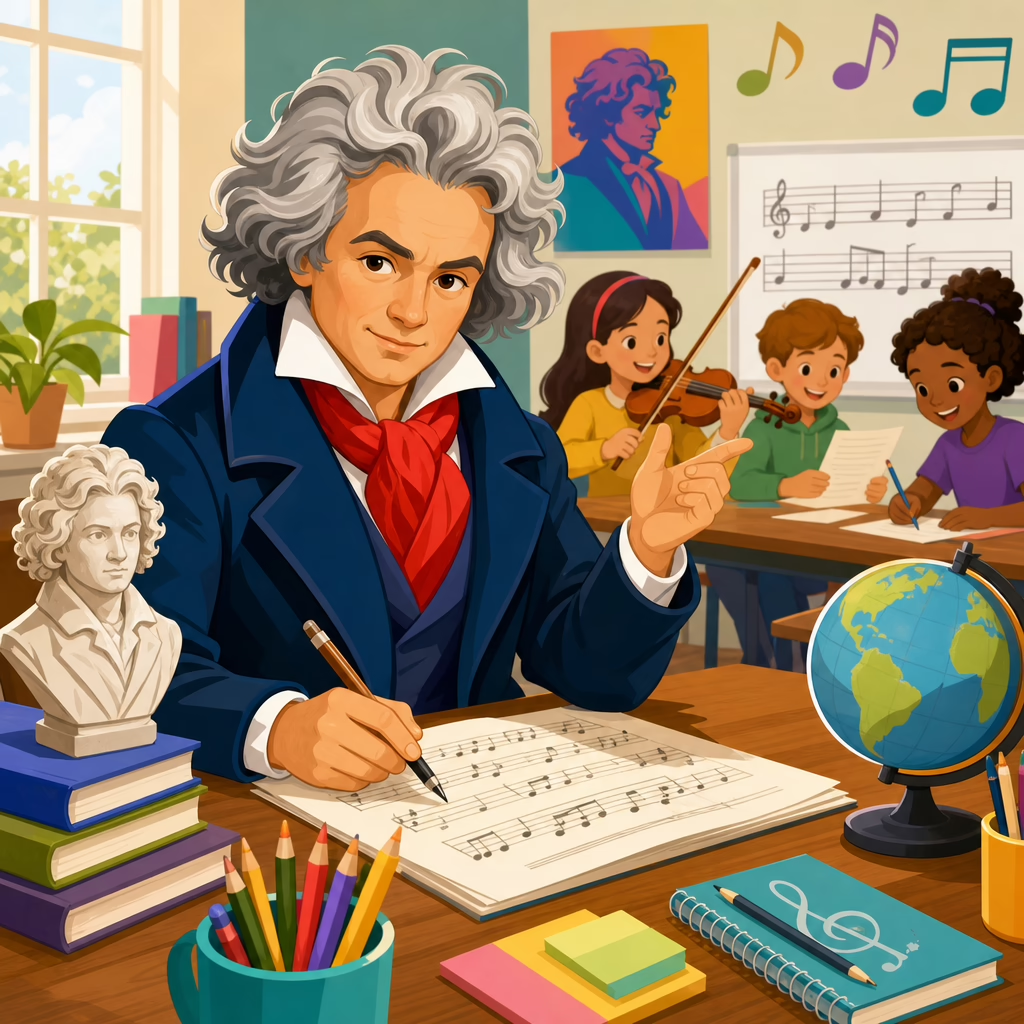
Beethoven-Inspired Lesson Plans for Teachers
Beethoven-inspired lesson plans for teachers give educators a flexible way to connect music, history, literacy, creativity, and social-emotional learning through one of the most recognizable figures in Western art. In classroom practice, I have found that Ludwig van Beethoven works especially well as a cross-curricular anchor because his life contains clear turning points, his music offers strong emotional contrast, and his legacy opens discussion about perseverance, innovation, disability, and cultural influence. A useful lesson plan in this context is not limited to music appreciation. It is a structured sequence of objectives, materials, activities, assessment, and extension tasks built around Beethoven’s works, era, and ideas. For teachers in elementary, middle, and secondary settings, that structure matters because it turns a famous composer into an accessible entry point for standards-aligned learning.
Beethoven matters in education for several reasons. He lived at the intersection of the Classical and Romantic periods, so students can hear artistic change rather than only read about it. He composed symphonies, sonatas, chamber works, and choral music, allowing teachers to choose formats that fit short class periods or larger projects. His increasing hearing loss also invites careful, respectful discussion about disability, adaptation, and achievement without reducing him to a simplistic inspirational stereotype. In practical terms, teachers can use Beethoven to teach close listening, biography, historical context, pattern recognition, descriptive writing, collaborative performance, and critical reflection. As a hub topic, miscellaneous Beethoven lesson planning includes quick activities, interdisciplinary units, differentiated supports, and project ideas that other community and education resources can deepen.
Why Beethoven Works Across Grade Levels and Subjects
Beethoven is unusually teachable because students can access his work at many levels. Younger learners respond to musical contrasts such as loud and soft dynamics, fast and slow tempo, and repeating motifs. The opening of Symphony No. 5 is ideal for this because its four-note idea is instantly identifiable and easy to map with movement, clapping, or simple notation symbols. In upper grades, the same excerpt supports analysis of motif development, orchestration, and form. The “Ode to Joy” theme from Symphony No. 9 can be sung, played on classroom instruments, or examined as a cultural artifact connected to poetry, civic ceremonies, and global events. Piano miniatures such as “Für Elise,” while sometimes overused, remain effective for discussing melody, popular recognition, and how one piece can circulate far beyond the concert hall.
His biography strengthens the academic value. Teachers can place Beethoven within the Enlightenment, the French Revolution, Napoleonic Europe, and early nineteenth-century Vienna. That allows social studies classes to ask how political change influences artists. English language arts classes can compare letters, diary-style writing, and program notes. Art classes can pair Beethoven listening with studies of mood, portraiture, or Romantic-era aesthetics. I have also used Beethoven successfully in advisory periods because students understand struggle, frustration, and ambition; when those themes are handled with accuracy instead of mythmaking, discussion becomes thoughtful rather than sentimental. The key is to present him as a working artist who revised, experimented, collaborated, and faced limitations.
Core Components of Strong Beethoven-Inspired Lesson Plans
The best Beethoven-inspired lesson plans begin with a narrow objective. Instead of “students will learn about Beethoven,” a stronger goal is “students will identify how a short motif changes across a movement” or “students will explain how historical context shaped public reception of Symphony No. 3.” This precision makes assessment easier and prevents the lesson from becoming a biography lecture. I recommend building each plan around one anchor source: a listening excerpt, a letter, a score fragment, a timeline, or a performance video. From there, add vocabulary such as motif, dynamics, tempo, variation, sonata, symphony, and premiere. When students know the terms they can speak about the music with confidence.
Effective plans also balance listening and doing. Passive listening rarely holds attention for long, especially in mixed-ability groups. Better options include listening maps, movement cues, sketching emotional shifts, peer discussion, or recreating rhythmic cells on desks and hand percussion. If technology is available, tools such as Chrome Music Lab, Noteflight, Flat, GarageBand, and Soundtrap let students compose short motifs inspired by Beethoven’s techniques without needing advanced notation skills. For source credibility, teachers should rely on recordings and background materials from organizations such as the Library of Congress, the San Francisco Symphony, the New York Philharmonic, Carnegie Hall, or major conservatories. Those institutions provide accurate composer timelines, instrument guides, and classroom media that save planning time.
Differentiation is essential. Some students need a one-minute excerpt instead of a full movement. Others benefit from sentence frames like “The music sounds ___ because Beethoven uses ___.” English learners respond well to visuals paired with sound examples. Students with sensory sensitivities may need volume adjustments, headphones, or advance notice before dramatic passages. Assessment can be equally varied: exit tickets, annotated listening maps, short oral explanations, creative responses, or standards-based rubrics for projects. When teachers design Beethoven lesson plans this way, the composer becomes a framework for inclusive teaching rather than a narrow music history topic.
Lesson Plan Ideas by Classroom Goal
One reliable approach is the “motif and memory” lesson. Play the opening of Symphony No. 5 and ask students to echo the rhythm. Then have them listen for every return of the motif in a short excerpt. Younger students can mark each appearance with a tally; older students can describe how instrumentation or dynamics alter the effect. The learning payoff is immediate: students hear that a large piece of music can grow from a tiny cell. Another effective lesson is “emotion and evidence.” Use excerpts from the “Moonlight” Sonata, Symphony No. 6 “Pastoral,” and Symphony No. 7 second movement. Students choose emotional descriptors, then justify them with observable musical evidence such as tempo, articulation, register, and texture.
A history-centered lesson can examine Beethoven and heroism through Symphony No. 3 “Eroica.” Students read a short background summary on Beethoven’s initial admiration for Napoleon and his later rejection of Napoleon’s imperial turn. They then discuss how titles, dedications, and political events shape meaning. This works well in middle and high school because it ties music to civics and historical interpretation. For literacy integration, assign students to write program notes for a school concert featuring a Beethoven excerpt. Good program notes require concise explanation, audience awareness, and factual accuracy, making the task more rigorous than a generic summary assignment. In STEM-oriented classrooms, teachers can explore sound waves, vibration, hearing, and instrument design through Beethoven’s life and the mechanics of orchestral performance.
| Classroom goal | Beethoven source | Sample activity | Assessment idea |
|---|---|---|---|
| Pattern recognition | Symphony No. 5 opening | Track motif returns on a listening map | Exit ticket explaining one variation |
| Emotional analysis | “Moonlight” Sonata and Symphony No. 7 | Compare mood words with musical evidence | Short paragraph using vocabulary correctly |
| Historical context | Symphony No. 3 “Eroica” | Discuss dedication, politics, and revision | Timeline or source-based response |
| Creative composition | Fate motif model | Compose a four-note class motif | Performance and reflection rubric |
| Community performance | “Ode to Joy” theme | Sing or play in ensemble groups | Peer feedback on collaboration |
Interdisciplinary and Community-Based Extensions
Because this page serves as a miscellaneous hub under community and education, it is worth treating Beethoven as more than a composer unit. He can anchor schoolwide and community-facing projects. A library display might combine biographies, listening QR codes, student artwork, and historical maps of Vienna. A family engagement night can feature short student performances of “Ode to Joy,” rhythm stations based on Symphony No. 5, and simple explanations of orchestral instrument families. In one outreach project I helped design, students interviewed grandparents and community members about the first classical music they remembered hearing; Beethoven surfaced repeatedly, which led to rich discussion about media, memory, and cultural transmission.
Cross-curricular units benefit from partnerships. Music teachers can collaborate with social studies teachers on Europe between 1789 and 1815, with science teachers on acoustics and hearing, and with English teachers on persuasive or descriptive writing. Visual arts classes can ask students to create abstract color studies responding to contrasting Beethoven excerpts, then defend their artistic choices. Physical education and theater teachers can use tempo, pulse, and dramatic contrast for movement-based interpretation. Community ensembles, local universities, public radio stations, and symphony education departments often provide guest artists, open rehearsals, instrument demonstrations, and curriculum packets. These partnerships deepen authenticity and help students see that music education connects to real institutions and careers.
Teachers should also be honest about limits. Beethoven is important, but he should not dominate the curriculum so completely that students encounter only one tradition, one geography, or one demographic profile. The strongest hub planning places Beethoven beside other composers and community voices. For example, compare his symphonic problem-solving with Florence Price’s orchestral writing, his piano legacy with Clara Schumann’s performance culture, or his choral idealism with community singing traditions from other cultures. This comparative method keeps Beethoven central without making him the entire story, which is better pedagogy and more accurate cultural education.
Practical Tips for Assessment, Inclusion, and Long-Term Planning
Assessment works best when it measures listening, thinking, and communication rather than trivia. Students do not need to memorize every opus number to demonstrate understanding. More meaningful evidence includes whether they can identify a recurring idea, explain how dynamics shape mood, connect a piece to historical context, or collaborate respectfully in performance. Rubrics should define criteria clearly: accuracy of musical vocabulary, use of evidence, creativity, and participation. For project-based learning, I recommend checkpoints for research notes, draft products, rehearsal progress, and final reflection. These checkpoints reduce last-minute confusion and improve quality.
Inclusion requires deliberate planning. When discussing Beethoven’s hearing loss, avoid framing disability as a simple obstacle that individual willpower alone can conquer. A better approach recognizes adaptation, support systems, changing identity, and the complexity of lived experience. Invite students to think about access in concert spaces, classroom acoustics, captioning, seating, and alternative ways to engage music through vibration, visuals, and movement. This makes the unit both more respectful and more relevant. It also broadens participation for students who may not connect with traditional lecture-and-listen formats.
For long-term curriculum design, treat this hub as a starting point. Build a sequence of linked lessons: an introductory listening day, a context lesson on Beethoven’s era, a creative composition workshop, a comparative study with another composer, and a culminating performance or exhibition. Internal connections between lessons matter. If students first learn motif in Symphony No. 5, revisit that concept later in student compositions or in another Beethoven work to reinforce transfer. Keep a bank of reliable excerpts, discussion prompts, and formative assessments so the unit becomes easier to teach each year. Well-designed Beethoven-inspired lesson plans save time, increase engagement, and create memorable connections across subjects. Start with one focused lesson, gather student responses, and expand the unit into a broader community and education project.
Frequently Asked Questions
1. How can teachers use Beethoven-inspired lesson plans across multiple subjects, not just music?
Beethoven-inspired lesson plans work especially well as cross-curricular tools because his life and music naturally connect to several academic areas at once. In music, students can listen for mood, dynamics, tempo, and form while comparing different pieces and discussing how composers communicate feeling without words. In history or social studies, teachers can place Beethoven in the context of late eighteenth- and early nineteenth-century Europe, helping students understand the cultural and political climate surrounding the Enlightenment, revolution, and changing ideas about the individual artist. In literacy, students can read short biographies, journal responses to musical excerpts, compare descriptive vocabulary, or write narrative and opinion pieces based on what they hear and learn. In art, students can create visual responses to symphonic contrasts, design concert posters, or illustrate emotional shifts in a piece of music. In social-emotional learning, Beethoven’s story supports discussions about persistence, frustration, self-expression, and personal growth.
The strength of this approach is flexibility. A single Beethoven-centered unit can be adapted for elementary, middle, or even interdisciplinary upper-grade classrooms. For younger students, the focus might be on listening, storytelling, and identifying emotions in music. For older students, teachers can guide more complex inquiry into biography, historical change, creative process, and the idea of artistic legacy. Because Beethoven is such a recognizable figure, he gives students a memorable anchor point while still leaving room for active learning, discussion, writing, movement, and project-based exploration. Rather than treating music as a separate enrichment topic, these lesson plans allow teachers to build meaningful bridges between subjects in a way that feels coherent and engaging.
2. Why is Beethoven such an effective figure for teaching perseverance, innovation, and disability awareness?
Beethoven remains a powerful classroom figure because his life offers students a concrete example of challenge, adaptation, and creative determination. One of the most compelling aspects of his biography is his gradual hearing loss, which eventually became profound. For students, this opens an important conversation about disability not as a limitation that defines a person completely, but as one part of a complex life that can shape experience, perspective, and problem-solving. Teachers can use this part of Beethoven’s story to discuss accessibility, resilience, and the importance of recognizing human potential beyond obstacles. When taught thoughtfully, the lesson is not that struggle automatically produces greatness, but that individuals can respond to hardship with creativity, discipline, and purpose.
Beethoven also represents innovation. He did not simply follow musical traditions; he pushed them forward. His works often expanded emotional range, structure, and expressive intensity, making him an excellent example for discussing what it means to challenge expectations. In the classroom, that can become a broader conversation about originality in any field. Students can reflect on times when rules are helpful, when traditions matter, and when new ideas move a discipline forward. His life also supports strong social-emotional learning because students can consider how people manage disappointment, isolation, ambition, and identity. These themes feel relevant across grade levels, especially when teachers frame Beethoven as a real person who experienced struggle, growth, and artistic purpose rather than as a distant historical icon.
3. What kinds of classroom activities fit well in a Beethoven-inspired lesson plan?
A strong Beethoven-inspired lesson plan usually combines listening, discussion, writing, and creative response. One highly effective activity is guided listening, where students hear a short excerpt and identify changes in dynamics, mood, pace, and instrumentation. Teachers can ask questions such as: What emotions do you hear? What story might this music tell? Where does the music feel calm, tense, triumphant, or uncertain? This kind of close listening builds attention, vocabulary, and interpretive thinking. Another useful activity is timeline work. Students can create a simple or detailed chronology of Beethoven’s life, marking major events such as his early training, important compositions, hearing loss, and enduring influence. This helps students connect biography to artistic output and historical context.
Writing activities are also especially effective. Students might write a journal entry from Beethoven’s perspective, a response paragraph describing how a piece makes them feel, or an essay explaining how music can communicate ideas without language. Teachers can also incorporate compare-and-contrast tasks by having students listen to two different Beethoven works and identify differences in tone and energy. For creative extensions, students can paint or draw while listening, compose short rhythmic patterns inspired by Beethoven motifs, act out emotional changes through movement, or work in groups to present a mini research project. In literacy-rich classrooms, read-alouds and short biographies pair well with musical excerpts. In SEL-focused settings, reflection prompts about overcoming challenges, expressing emotions, and staying committed to goals can deepen the learning. The best activities are those that invite students to actively interpret and create rather than only memorize facts.
4. How can teachers make Beethoven lesson plans age-appropriate and engaging for different grade levels?
The key to making Beethoven lesson plans age-appropriate is to scale the content, language, and tasks to students’ developmental levels while keeping the core themes consistent. In early elementary classrooms, teachers can introduce Beethoven through storytelling, pictures, simple listening activities, and emotion-based discussion. Young students respond well to questions like “Does this music sound happy, stormy, sleepy, or powerful?” They can draw what they hear, move their bodies to changing tempos, or sequence basic events from his life with teacher support. At this level, the emphasis should be on curiosity, feeling, and discovery rather than detailed historical analysis.
In upper elementary and middle school, teachers can add more structure and depth. Students can read age-appropriate biographies, explore the idea of a composer’s job, discuss how hearing loss affected Beethoven’s life, and connect his experiences to themes such as determination and creativity. They can compare musical excerpts, write evidence-based reflections, and complete short research tasks. For older students, lessons can become more analytical. Teachers may introduce historical context, musical form, primary source excerpts, and discussion about artistic change and cultural influence. Across all grade levels, engagement improves when instruction includes variety: short listening segments, visual supports, interactive questioning, collaborative tasks, and opportunities for personal response. Beethoven becomes most meaningful when students are not just told why he matters, but are given ways to hear, discuss, interpret, and connect his story to their own learning.
5. What are the biggest benefits of using Beethoven-inspired lesson plans in today’s classroom?
One of the biggest benefits is that Beethoven provides a rich, recognizable entry point into interdisciplinary teaching. His name is familiar to many students and families, which gives teachers an immediate hook, but the real value lies in the depth behind that familiarity. Through Beethoven, students can learn to listen closely, analyze emotional expression, engage with biography and history, build descriptive language, and reflect on human resilience. This makes his story especially useful in classrooms that aim to integrate academic content with creativity and social-emotional development. Rather than teaching isolated facts, Beethoven-inspired lesson plans encourage students to connect ideas across disciplines, which often leads to stronger retention and deeper engagement.
Another major advantage is that these lessons support a wide range of learners. Music provides access for students who may not always connect first through text alone, and multimodal activities can make instruction more inclusive. Listening, drawing, speaking, writing, moving, and discussing all offer different pathways into the content. Beethoven’s life also opens thoughtful conversations about perseverance, identity, disability, and legacy in ways that feel authentic rather than forced. In today’s classroom, where teachers often seek meaningful, standards-aligned material that still allows for creativity, Beethoven-inspired planning offers both structure and flexibility. It can serve as a short enrichment activity, a full interdisciplinary unit, or a recurring theme throughout a semester. That versatility, combined with the emotional power of the music and the human depth of Beethoven’s story, is what makes these lesson plans so effective.