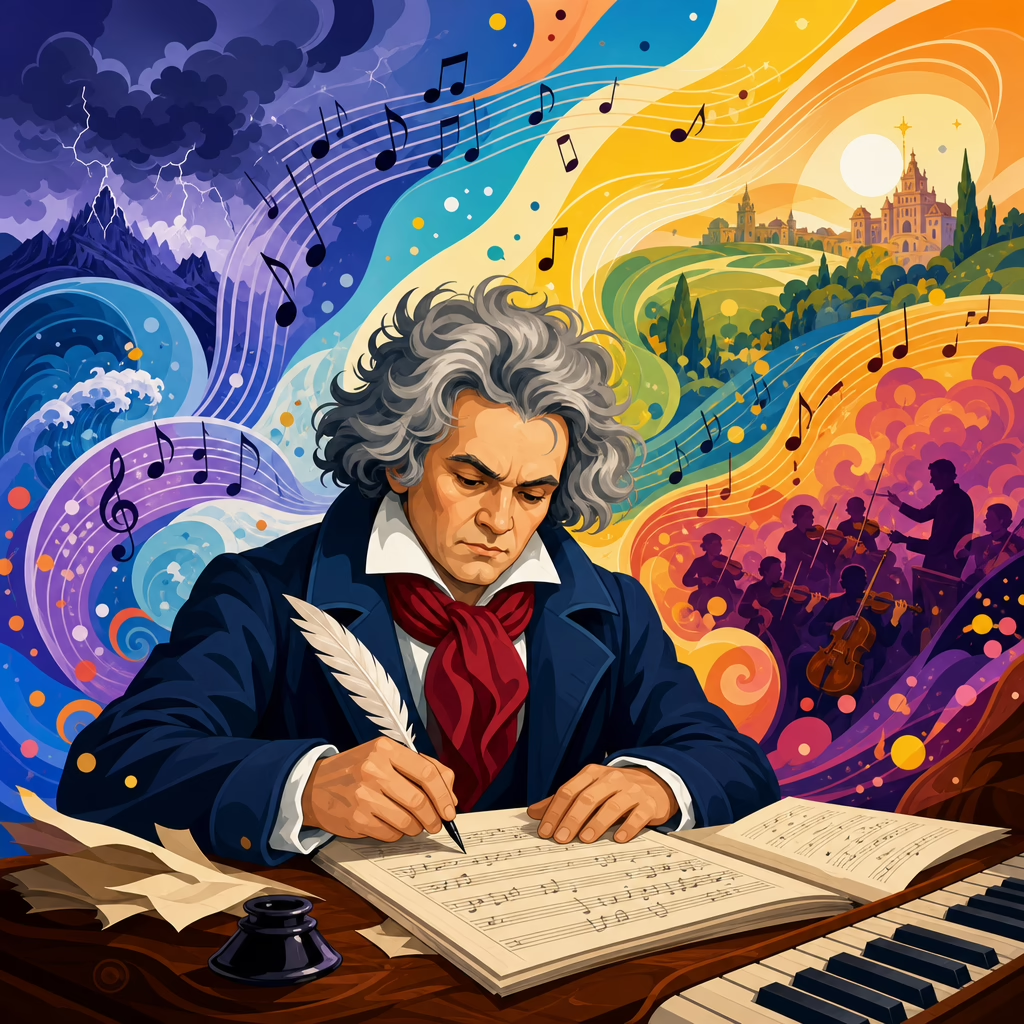
Stunning Visualizations of Beethoven’s Music
Stunning visualizations of Beethoven’s music reveal something listeners often feel but struggle to describe: structure made visible. In the Multimedia Gallery, this Miscellaneous hub gathers the broadest range of approaches for turning Beethoven’s symphonies, sonatas, quartets, and sketches into images, animations, interactive diagrams, and data-driven artworks. A visualization can mean a traditional score excerpt, a waveform, a color map of harmonic motion, a network graph of motifs, or a 3D animation that tracks orchestral texture over time. The core idea is simple. Sound unfolds in time, while visual media can display time, pattern, contrast, and proportion at once.
I have worked with score videos, MIDI reductions, spectrograms, and phrase maps for classical catalogs, and Beethoven consistently produces the richest results because his music combines memorable motives with unusually strong large-scale architecture. A four-note cell in the Fifth Symphony, a sudden sforzando in a piano sonata, or the gradual expansion of the “Ode to Joy” theme can all be represented visually without losing musical meaning. That matters for more than aesthetics. Strong Beethoven music visualization helps students grasp form, helps performers compare interpretations, helps casual audiences enter complex works, and helps archives present historical material in accessible ways.
This hub page covers the main visualization categories, what each one explains best, where each one falls short, and how related Multimedia Gallery articles can branch from here into dedicated examples. If you want to understand how to visualize Beethoven’s music clearly, the answer is to match the visual method to the musical question. Are you showing melody, rhythm, orchestration, harmony, or historical process? The best visualizations of Beethoven’s music do not merely decorate the audio. They expose craft, tension, and design.
Score-based visualizations and annotated listening guides
The most familiar Beethoven music visualization is the animated score video. Notes scroll or highlight in sync with a recording, usually using software such as MuseScore, Dorico exports, Sibelius video rendering, or custom After Effects layouts. These work because they preserve the notated source. A viewer can see phrase lengths, rests, dynamics, articulations, and instrumental entries exactly where they occur. For Beethoven, that precision matters. His accents, sf markings, hairpins, and registral contrasts are structural signals, not cosmetic details.
Annotated listening guides extend the score model by adding labels for form and motive. In the first movement of Symphony No. 5, a useful guide highlights the opening motive, then traces its transformation through transitions, development fragments, and recapitulation. In the “Moonlight” Sonata, first movement, a guide can map phrase groups, pedal blur, and left-hand arpeggio continuity. These annotated videos are especially effective for hub content because they answer common search questions directly: What should I listen for? Where does the second theme appear? Why does a Beethoven development section feel so dramatic?
Still, score-based views have limits. Full orchestral pages can overwhelm nonreaders, and piano-reduction videos can hide orchestral color. The strongest examples solve this by layering information selectively: instrument families in color, motives boxed only when they reappear, formal labels introduced sparingly, and synchronized timestamps. When I build these guides, I keep one principle in mind: every annotation must clarify a decision Beethoven made, not simply restate what the eye already sees.
Spectrograms, waveforms, and frequency maps
Not every listener reads notation, which is why audio-derived visualization is indispensable. Waveforms display amplitude over time, making Beethoven’s dynamic shape visible at a glance. Spectrograms add frequency information, showing where low strings, brass peaks, or bright upper-register piano attacks dominate. In the opening of the “Pathétique” Sonata, a spectrogram reveals the gravity of the low-register chords versus the thinner response above. In Symphony No. 9, a broad spectrogram can show the transition from orchestral turbulence to the clearer choral texture of the finale.
These tools are standard in audio analysis platforms such as Sonic Visualiser, Audacity, iZotope RX, and Librosa-based research workflows. For Beethoven visualizations, they are best used to answer specific questions. How does one conductor pace crescendos differently from another? Why does a period-instrument recording sound leaner? Where does a piano recording use more sustaining pedal than the score implies? Spectral views can expose those distinctions in ways the ear senses but may not isolate immediately.
The caution is that waveforms and spectrograms can tempt creators into mistaking sound energy for musical importance. A quiet harmonic pivot may be more consequential than a loud cadence. Beethoven’s late quartets especially resist simplistic loud-equals-significant readings. The best frequency maps pair audio data with context: movement divisions, tempo zones, or motive markers. Used carefully, they are among the most powerful miscellaneous tools in any Multimedia Gallery because they translate interpretation into visible evidence.
Color maps for harmony, key relationships, and form
Color is one of the clearest ways to visualize Beethoven’s architecture. A harmonic heat map can assign a color family to each key area, then track modulations across a movement. In the “Eroica” Symphony, this instantly shows how far Beethoven stretches tonal expectations before returning home. In Piano Sonata Op. 110, a color timeline can separate arioso, fugue, inversion, and restoration, allowing viewers to perceive formal contrast before they can name every chord. For teaching sonata form, color-coded exposition, development, recapitulation, and coda blocks remain one of the most reliable methods I have used.
Good harmonic color systems are consistent rather than decorative. If C minor is deep blue and E-flat major is gold, those assignments should remain stable across the project. Analysts often build these maps from Roman numeral analysis, tonicization tracking, or key-finding algorithms, then refine them manually. Beethoven rewards that extra work because he uses tonal departure as drama. The move to remote keys, deceptive returns, and delayed cadential closure all become visible patterns.
Form maps are equally useful. A circular diagram can show repeated sections, while a linear bar can represent phrase length and density. For the Diabelli Variations, a compact form strip helps viewers understand the sequence of character changes without hearing all thirty-three variations first. For a hub page, color maps are valuable because they connect easily to deeper articles on harmony, sonata form, variation technique, and late-style experimentation.
| Visualization type | Best for | Beethoven example | Main limitation |
|---|---|---|---|
| Animated score | Notation, motive tracking, orchestration | Symphony No. 5 first movement | Dense pages can overwhelm beginners |
| Spectrogram | Timbre, register, dynamic contour | Symphony No. 9 finale | Shows energy, not formal meaning by itself |
| Harmonic color map | Key changes, form, tonal tension | Eroica Symphony opening movement | Requires analytical choices behind colors |
| Network graph | Motivic relationships across movements | Late string quartets | Can become abstract quickly |
Motif networks, pattern analysis, and computational views
Beethoven is ideal for network visualization because his music grows from compact cells. Computational analysis can identify repeated interval patterns, rhythms, or contour shapes, then map where they recur. In a network graph, each node may represent a motive instance and each link a transformation such as transposition, inversion, rhythmic augmentation, or fragmentation. This is not gimmickry when done well. It makes a central Beethoven principle visible: large structures often emerge from small, persistent ideas.
Take the Grosse Fuge. To many first-time listeners, it sounds overwhelming. A motif network can reduce that complexity by showing how a handful of characteristic figures generate the movement’s argument. In the Fifth Symphony, a simpler network can compare the famous short-short-short-long rhythm across movements, helping audiences test the long-debated idea of cyclic unity. In piano sonatas, contour analysis can reveal how Beethoven reshapes a lyrical idea under changing harmonic pressure.
Tools for this work include music21, Humdrum, Verovio, and custom Python workflows using symbolic music data from MusicXML or MIDI. The challenge is interpretive validity. Pattern-matching software may find repetitions that musicians would dismiss as trivial. That is why the strongest computational visualizations combine algorithmic detection with human filtering. In practice, I only keep relationships that survive musical scrutiny: same structural placement, audible resemblance, or analytically meaningful transformation. The result is a visual that respects both data and listening.
3D environments, immersive installations, and gallery experiences
Some of the most stunning visualizations of Beethoven’s music move beyond the screen into installation art, projection mapping, and immersive room-scale experiences. Museums and digital galleries have used particle systems, motion capture, and surround projection to interpret symphonic texture spatially. Strings may appear as flowing ribbons, brass as geometric bursts, and percussion as shockwaves. When synchronized carefully, these environments can communicate density and release better than a flat diagram.
This approach works particularly well for famous works with broad audiences. The Seventh Symphony’s rhythmic propulsion translates naturally into motion-heavy visuals. The pastoral scenes of Symphony No. 6 invite environmental imagery, though the best installations avoid literal birds-and-brooks clichés and instead visualize pattern, pulse, and instrumental layering. For the late quartets, immersive galleries often succeed by using abstraction: fractured planes for registral tension, shifting grids for fugue entries, or light fields that thin during suspended harmonic passages.
There are practical considerations. Projection-based work demands exact cueing, high-resolution assets, and attention to latency. If the visual engine drifts even slightly from the audio, Beethoven’s sharply profiled attacks make the error obvious. Accessibility also matters. Installations should provide captions, movement labels, and alternate explanatory panels for visitors who want analytical depth instead of pure spectacle. As a hub topic within Multimedia Gallery, immersive Beethoven pieces belong alongside more technical articles because they show how scholarship and public presentation can reinforce each other.
Historical sketches, manuscripts, and process visualizations
One of the richest miscellaneous areas is process visualization: showing how Beethoven composed, revised, and rethought material. Digitized sketchbooks, manuscript layers, and editorial reconstructions let viewers watch ideas evolve. This is especially important with Beethoven because his reputation for struggle and revision is documented in surviving sources. A static facsimile already has value, but process visualization goes further by highlighting deletions, insertions, reordered fragments, and variant readings across stages.
For example, a layered manuscript view can compare a sketch of a sonata theme with the final published version, using color overlays to mark rhythmic tightening or harmonic strengthening. Timeline animations can show when a motive entered the work and how long Beethoven kept refining it. The Fidelio materials, the sketch history around Symphony No. 3, and selected late piano sonata drafts all support this method well. Scholars have long relied on these documents, but visual platforms now make them legible to broader audiences.
The key benefit is that process visualizations humanize genius without reducing it to myth. They show craft, iteration, and problem-solving. They also teach an essential truth: Beethoven’s originality often came from revision, not from untouched inspiration. For readers browsing a hub article, this section points naturally to deeper pieces on manuscripts, critical editions, autograph sources, and the difference between performing from a polished score and studying a work’s compositional history.
How to choose the right Beethoven visualization for your goal
The best Beethoven music visualization depends on what you need the audience to understand in under a minute, in ten minutes, or over repeated visits. If the goal is introductory listening, use annotated score excerpts or clean form maps. If the goal is performance comparison, use waveforms, spectrograms, and synchronized timelines. If the goal is analytical depth, deploy harmonic color systems and motif networks. If the goal is public exhibition, combine abstraction with concise labels and strong synchronization.
I recommend starting with one work and one question. For Symphony No. 5, ask how a short motive drives an entire movement. For the “Hammerklavier,” ask how scale and register create extremity. For the late quartets, ask how fragmentation and continuity coexist. Once the question is fixed, the visual grammar becomes clearer. Avoid piling every technique onto a single page. Mixed media should feel integrated, not crowded.
Across this Miscellaneous hub, the common standard is usefulness. A successful visualization of Beethoven’s music should let a viewer notice something concrete on the next listen: an unexpected return, a hidden connection, a sharper contrast in texture, a more daring modulation, or a revision that changed the expressive outcome. When that happens, visual design has done real musical work.
Stunning visualizations of Beethoven’s music succeed when they make sound easier to perceive without flattening its complexity. The strongest methods each solve a different problem. Animated scores reveal notation and entry points. Spectrograms and waveforms expose timbre and performance shape. Harmonic color maps make tonal architecture legible. Motif networks show how Beethoven builds large forms from small cells. Immersive installations widen public access, while manuscript and sketch visualizations uncover the compositional process behind the finished score.
As the Miscellaneous hub within the Multimedia Gallery, this page is designed to orient readers before they dive into specialized articles. The central lesson is consistent across every format: Beethoven rewards visual treatment because his music balances immediacy with structure. Even listeners who know the famous works well often discover new things once patterns are placed in front of the eye. Performers can compare interpretive choices more rigorously, teachers can explain difficult forms more clearly, and general audiences can move from admiration to understanding.
If you are building, studying, or curating Beethoven music visualization, choose the method that answers a real musical question, keep the design faithful to the source, and prefer clarity over ornament. Then explore the related Multimedia Gallery articles from this hub and apply these approaches to a sonata, quartet, concerto, or symphony you love next.
Frequently Asked Questions
What do visualizations of Beethoven’s music actually show?
Visualizations of Beethoven’s music translate sound, notation, and musical relationships into forms the eye can follow. Depending on the approach, they may show melody as motion, harmony as color, rhythm as pattern, dynamics as changing intensity, or form as a large-scale architectural design. In practice, that means one visualization might resemble a scrolling score, another might display a waveform of loudness and texture, and another might map recurring motifs as nodes and connections in a network graph. More advanced projects can even represent Beethoven’s symphonies, sonatas, quartets, and sketches as animated timelines or 3D environments that reveal how ideas return, develop, and transform.
What makes these visualizations so compelling is that they reveal structure made visible. Listeners often sense tension, release, balance, surprise, and inevitability in Beethoven, but a good visual model helps explain why those sensations occur. You can see a motif reappear in altered form, track harmonic movement across a movement, compare the density of different passages, or observe how Beethoven builds momentum over time. Rather than replacing listening, visualizations deepen it by showing the hidden design behind the emotional impact.
Why is Beethoven especially well suited to musical visualization?
Beethoven is ideal for visualization because his music is both highly expressive and remarkably structural. He often builds entire movements from compact cells, small rhythmic figures, or sharply defined motifs, which makes his compositional thinking particularly visible when converted into diagrams or animations. A single idea can be followed through repetition, fragmentation, inversion, expansion, and dramatic recontextualization. That gives visual artists, musicologists, and digital designers rich material to work with, whether they are highlighting formal architecture, motivic development, or harmonic trajectory.
His catalog also spans an enormous range of genres and scales, from piano sonatas and string quartets to monumental symphonies and unfinished sketches. This variety allows for many types of representation. A sonata might lend itself to a detailed thematic map, while a symphony can become a sweeping orchestral visualization showing density, instrumental balance, or large formal divisions. Beethoven’s manuscripts and sketchbooks add another dimension as well, because they make it possible to visualize not just the final work but the creative process itself. In that sense, Beethoven’s music is uniquely suited to projects that connect sound, analysis, performance, and visual interpretation.
What kinds of visualizations might appear in a multimedia gallery devoted to Beethoven?
A multimedia gallery devoted to Beethoven can include a surprisingly wide range of formats, from traditional scholarly materials to experimental digital art. At one end of the spectrum, you may find annotated score excerpts, phrase diagrams, thematic charts, and harmonic analyses designed to help readers understand specific passages. At the other end, there may be animated timelines, color-coded harmonic maps, waveform studies, spectrograms, interactive motif networks, and data-driven artworks that convert entire movements into abstract visual experiences. Some galleries also include synchronized score-following videos, where listeners can watch notation unfold in real time as the music plays.
Because the category is broad, a “visualization” does not have to mean only one thing. It can be analytical, educational, aesthetic, or immersive. One project may focus on how often a theme returns; another may show orchestral texture by instrument family; another may turn a quartet into a geometric animation based on pitch, register, and duration. Interactive diagrams are especially useful because they let users isolate sections, compare movements, or trace relationships between themes and tonal centers. In a miscellaneous multimedia hub, the value lies in seeing how many valid ways there are to make Beethoven’s music visible, each one illuminating a different aspect of the same artistic world.
How can visualizations help listeners understand Beethoven’s form, motifs, and emotional power?
Visualizations are especially helpful because they make abstract musical processes easier to grasp over time. Beethoven’s works often unfold on multiple levels at once: a motif may be transformed locally from bar to bar while a larger harmonic plan guides the movement toward major turning points. For many listeners, those processes are felt intuitively but are hard to articulate in words alone. A well-designed visualization can reveal where themes enter, how long transitions last, where climaxes occur, and how recurring material creates coherence across an entire movement. This is invaluable in works where Beethoven’s structural logic is part of the drama.
They also clarify emotional impact by showing the mechanics behind it. For example, a visualization might display increasing rhythmic density, tightening motivic repetition, or harmonic instability leading into a climax. It can show how silence, contrast, sudden dynamic change, or textural thinning affects the listener’s perception. In Beethoven, emotional force often comes from disciplined construction rather than surface effect alone. Visual tools help connect those two dimensions: what the listener feels and what the composer is doing. That makes them useful not only for students and scholars but for casual listeners who want a deeper, more satisfying understanding of why the music feels so urgent, monumental, or intimate.
Are Beethoven music visualizations meant for scholars only, or can casual listeners enjoy them too?
Beethoven music visualizations are absolutely for casual listeners as well as specialists. In fact, one of their greatest strengths is that they can bridge the gap between technical analysis and immediate experience. A scholar may use a motif graph to examine developmental procedures, while a first-time listener may simply appreciate seeing patterns emerge on screen as the music plays. Good visualizations do not require advanced theory knowledge to be rewarding. They can guide attention, highlight contrasts, and make long forms easier to follow, especially in works that might otherwise feel dense or intimidating.
At the same time, more detailed visualizations offer serious depth for musicians, teachers, performers, and researchers. The best examples work on several levels at once: approachable enough for newcomers, precise enough for informed analysis, and visually engaging enough to stand as artworks in their own right. That balance is what makes a multimedia gallery so valuable. It invites people into Beethoven’s world through multiple entry points, whether they arrive out of curiosity, academic interest, performance practice, or love of the music itself. In every case, the goal is the same: to make Beethoven’s imagination more legible, more vivid, and more unforgettable.