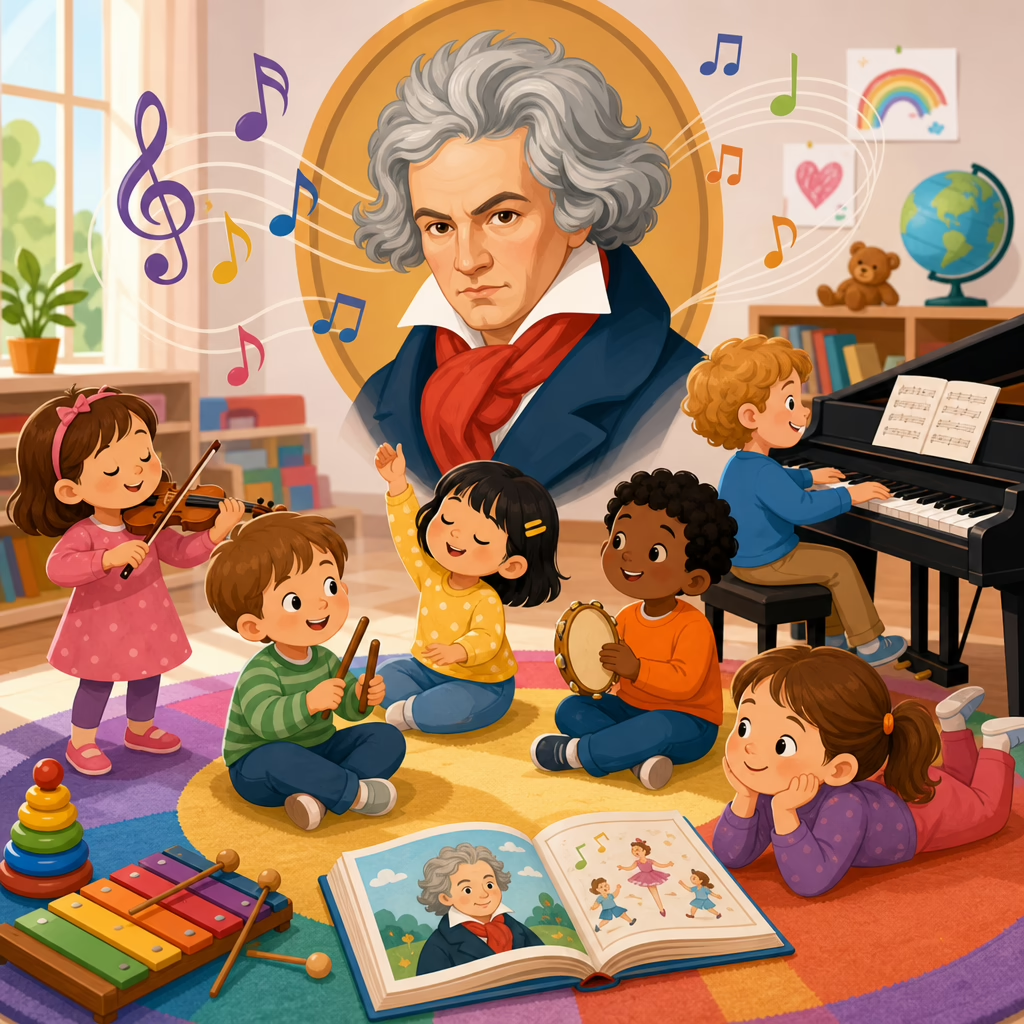
How Beethoven’s Music Is Used in Early Childhood Education
How Beethoven’s music is used in early childhood education is best understood by looking at what teachers actually do with it in classrooms, therapy rooms, and home-based learning settings. In practice, Beethoven is not introduced to preschoolers as a monument of classical culture first; he is used as a tool for movement, listening, language, emotional regulation, and social participation. Early childhood education generally refers to learning from birth through about age eight, with the preschool and kindergarten years being especially important for music-rich routines. In that context, Beethoven’s music offers distinct advantages: memorable rhythm, dramatic contrast, strong motifs, and broad emotional range. Pieces such as “Ode to Joy,” the “Moonlight Sonata,” Symphony No. 5, and the “Pastoral” Symphony are easy to adapt into circle time, transition cues, guided movement, and storytelling activities.
When educators choose music for young children, they usually look for three things: predictability, expressive variety, and flexibility across learning goals. Beethoven meets all three. I have seen teachers use the opening of Symphony No. 5 to help children recognize short-short-short-long rhythmic patterns, then turn that pattern into clapping games, syllable work, and turn-taking exercises. I have also watched calmer works support rest time, drawing, and breathing routines. That range matters because early childhood education is never only about music appreciation. It is about whole-child development, including attention, self-regulation, motor planning, vocabulary growth, and cooperative play. Beethoven’s music becomes useful because it can be structured for teaching without being simplified into background noise.
The topic matters for schools, community programs, and families because music exposure in the early years is linked with stronger auditory discrimination, memory, and social engagement when used intentionally. Research in music education and developmental psychology consistently shows that active music-making supports phonological awareness, timing, and executive function more reliably than passive listening alone. Beethoven’s works fit especially well in this setting because they contain clear contrasts in tempo, dynamics, phrasing, and mood. Those musical elements can be mapped directly onto early learning objectives. This hub article explains where Beethoven’s music fits in early childhood education, what specific classroom uses are most effective, how educators adapt famous works for young learners, and what limitations should be considered when building a balanced music program.
Why Beethoven works in early childhood settings
Beethoven works in early childhood settings because his music is highly patterned and emotionally legible. Young children respond strongly to repetition and contrast. Beethoven often builds a piece from a short motif, then repeats, varies, and develops it in ways children can hear physically as well as intellectually. Symphony No. 5 is the clearest example. The four-note opening is compact enough for children to imitate with claps, drums, footsteps, or spoken sounds. “Ode to Joy” from Symphony No. 9 is another classroom favorite because the melody moves mostly stepwise, making it easy to sing, hum, or play on xylophones and handbells.
Teachers also value Beethoven because his music supports gross-motor movement. In many preschool classrooms, listening happens through the body first. Children march to steady beats, stretch during slow phrases, freeze at cadences, and use scarves to trace melodic contour. The “Pastoral” Symphony is especially useful for movement-and-imagination lessons because it evokes outdoor scenes, weather, and pastoral life. Educators can connect those sounds to themes children already study, such as animals, seasons, rain, wind, and community environments. That cross-curricular flexibility makes Beethoven practical, not just prestigious.
Another reason Beethoven is used is that his music introduces expressive listening without requiring verbal explanation beyond a child’s level. A teacher can ask, “Does this sound strong or gentle?” “Would you tiptoe or stomp?” “Does this music feel like morning, nighttime, or a storm?” Those are developmentally appropriate entry points into musical understanding. Instead of teaching historical biography in detail, educators translate musical features into sensory and emotional experiences. That approach is aligned with standards from organizations such as the National Association for the Education of Young Children and the National Association for Music Education, which emphasize active engagement, play, responsiveness, and age-appropriate exploration over lecture-based instruction.
How teachers use Beethoven for movement, rhythm, and self-regulation
One of the most effective uses of Beethoven’s music in early childhood education is structured movement. Movement activities help children internalize beat, phrase, tempo, and form while also strengthening balance, coordination, and inhibition control. In a preschool music session, a teacher might use the first movement of Symphony No. 7 for marching, stopping, and directional changes. Children listen for loud sections to take big steps and softer sections to switch to small steps. This kind of exercise trains auditory attention and the ability to adjust behavior to an external cue, which is foundational for classroom readiness.
Beethoven is also useful for rhythm imitation. The opening motive of Symphony No. 5 can be tapped on knees, echoed on rhythm sticks, or paired with spoken words. Educators often connect it to language by assigning simple phrases with the same rhythm. That supports phonological awareness because children begin to notice sound patterns, syllable timing, and stress. In classrooms serving dual-language learners, rhythm-based participation can lower the verbal barrier to entry, allowing children to join successfully before they can explain concepts in full sentences.
For self-regulation, slower Beethoven works are often used as part of calming routines. The first movement of the “Moonlight Sonata,” for example, can accompany breathing, stretching, or quiet drawing. The goal is not to claim that one piece magically calms every child. Regulation is individual, and some children respond better to silence or to familiar songs. But when used consistently, selected Beethoven excerpts can help create predictable transitions. I have seen teachers pair a calm piano excerpt with a visual schedule so children learn that the music signals cleanup, rest preparation, or quiet centers. Over time, the music becomes an auditory scaffold for routine and emotional settling.
| Beethoven work | Common early childhood use | Primary skill supported | Example activity |
|---|---|---|---|
| Symphony No. 5 opening | Rhythm imitation | Auditory patterning | Clap and echo short-short-short-long |
| “Ode to Joy” | Singing and instrument play | Pitch matching | Play melody on bells by color or number |
| “Moonlight Sonata” | Calm transition | Self-regulation | Breathe slowly while tracing shapes in the air |
| “Pastoral” Symphony | Story and movement | Imaginative listening | Move like rain, birds, or wind during guided play |
Language, literacy, and cognitive development through Beethoven
Beethoven’s music supports language and literacy best when educators build active listening tasks around it. Simply playing classical music in the background is not the strongest instructional strategy. What works better is guided interaction. For example, a teacher may play “Ode to Joy,” then ask children to identify repeating parts, describe the music with adjectives, or sequence picture cards showing beginning, middle, and end. These tasks develop vocabulary, narrative structure, and auditory memory. In kindergarten classrooms, that can connect directly to early reading behaviors such as noticing patterns, predicting what comes next, and discussing details using precise language.
There is also a useful connection between musical phrasing and oral language. Both rely on timing, pauses, stress, and turn-taking. When children chant a rhythm from Beethoven and then speak a sentence with the same contour, they practice expressive speech in a playful way. Speech-language pathologists sometimes integrate musical cues into sessions for children who need support with pacing, imitation, or joint attention. Beethoven’s clearly shaped motifs can be easier to follow than music with less defined structure. The purpose is not to replace targeted therapy methods, but to provide a motivating medium that reinforces them.
Cognitively, Beethoven can be used to teach comparison, classification, and prediction. A teacher might contrast a loud orchestral excerpt with a soft piano passage and ask children what changed. They may sort musical examples by fast versus slow, smooth versus detached, or happy versus tense. Those are foundational analytical skills. Children are learning to attend to attributes, hold information in working memory, and verbalize observations. In Reggio Emilia–influenced settings, educators often extend this by inviting children to draw what they hear or build block structures that match the music’s energy. That turns listening into representation, which deepens understanding.
Social-emotional learning, inclusion, and community-based programs
Beethoven’s music is frequently used to support social-emotional learning because it gives children a shared way to explore feelings and group participation. Emotional literacy in early childhood starts with naming sensations and recognizing expressions in self and others. Beethoven’s dramatic contrasts provide clear material for that work. A teacher can play two excerpts and ask which one sounds peaceful, excited, worried, or triumphant. Children may disagree, and that is valuable. The discussion teaches that music can hold multiple interpretations while still inviting respectful listening and conversation.
Group music-making with Beethoven also supports cooperation. In community early learning centers, I have seen children pass beanbags on the beat to “Ode to Joy,” freeze together at phrase endings, or take turns conducting classmates through dynamic changes. These activities strengthen impulse control, shared attention, and awareness of others. They are especially effective when adults model participation rather than standing apart. Young children learn musical confidence through co-regulation and imitation.
In inclusive classrooms, Beethoven can be adapted for children with different sensory, motor, and communication needs. A child who does not sing may participate by activating a switch-adapted instrument at the start of each phrase. A child with sensory sensitivities may benefit from shorter excerpts, lower volume, and visual supports that preview what is coming. For neurodivergent learners, predictable musical cues can reduce uncertainty, but strong orchestral intensity can also be overwhelming if introduced too abruptly. Good practice means observing individual responses and adjusting duration, volume, and task demands. Community programs do this well when they treat classical music as a flexible resource, not a rigid canon to be delivered the same way to every child.
Best practices, common mistakes, and how to build a balanced program
The best practice for using Beethoven in early childhood education is intentional selection. Teachers should choose short excerpts with a clear teaching purpose rather than long unbroken works intended mainly for adult concert listening. One minute of focused engagement is more educationally useful than ten minutes of passive exposure. Start with a single objective: steady beat, contrasting dynamics, calm breathing, storytelling, or melodic imitation. Then pair the excerpt with an active response such as movement, drawing, singing, instrument play, or conversation. This keeps music integrated with child development rather than ornamental.
A common mistake is relying on outdated claims that listening to classical music automatically raises intelligence. That oversimplifies the evidence and leads to weak practice. The strongest outcomes come from interactive music experiences, especially those involving repetition, adult guidance, and child choice. Another mistake is presenting Beethoven as the only “serious” music worth hearing. Early childhood programs should be musically diverse, including songs from children’s home cultures, folk traditions, jazz, contemporary educational repertoire, and opportunities for improvisation. Beethoven belongs in a balanced curriculum because his music is rich and teachable, not because it should dominate.
Practical implementation is straightforward. Build a small Beethoven playlist with one piece for greeting, one for movement, one for focused listening, and one for calming transitions. Use the same excerpts for several weeks so children recognize them. Add visual icons for fast, slow, loud, soft, start, and stop. Link activities to broader themes such as weather, feelings, family routines, or neighborhood sounds. Document how children respond, then adjust. That reflective cycle is what makes a miscellaneous hub on Beethoven’s role in community and education useful: it connects music appreciation with teaching practice, inclusion, and family engagement. If you are developing lessons, start with one familiar excerpt and one clear goal, then build from there.
Beethoven’s music has lasting value in early childhood education because it is adaptable, expressive, and developmentally useful when taught with intention. Young children can move to it, sing parts of it, describe it, draw it, and use it to practice listening, coordination, vocabulary, and self-regulation. The strongest classroom results come from active engagement, not passive background listening. Teachers, therapists, and families get the most from Beethoven when they match specific excerpts to clear goals, keep activities short and concrete, and observe how individual children respond.
This matters across community and education settings because Beethoven can function as a shared cultural resource without becoming exclusive or intimidating. In preschool classrooms, public library programs, early intervention sessions, and home routines, his music can support rhythm games, emotional expression, calming transitions, and collaborative play. At the same time, a balanced program recognizes limits. Not every child will connect with the same excerpt, and classical repertoire should sit alongside culturally responsive, child-centered music from many traditions. That balance makes music education stronger and more welcoming.
For educators building this miscellaneous hub area, Beethoven is a practical anchor topic because his works connect to movement, literacy, inclusion, and family learning all at once. Start with accessible pieces like “Ode to Joy,” Symphony No. 5, the “Pastoral” Symphony, and the “Moonlight Sonata.” Use them actively, repeat them consistently, and adapt them thoughtfully. Then expand into related articles, lesson plans, and community resources that help children experience music as something they do, feel, and share every day.
Frequently Asked Questions
How is Beethoven’s music actually used in early childhood education settings?
In early childhood education, Beethoven’s music is typically used as a practical teaching resource rather than as a formal history lesson about a famous composer. Teachers, therapists, and caregivers use selected pieces to support movement, listening, language development, emotional regulation, and group participation. In a preschool classroom, for example, a teacher may play a lively excerpt while children march, sway, freeze, or tap to the beat, helping them connect sound with body awareness and self-control. In a home-based learning setting, a parent might use a calm piano passage during quiet time, reading, or transitions, giving children a predictable auditory cue that helps them settle.
Educators often choose Beethoven because his music contains strong contrasts in tempo, dynamics, mood, and structure. Those musical features are especially useful for young children, who learn well through clear patterns and sensory experiences. A teacher may ask children to listen for when the music gets louder or softer, faster or slower, or to draw how the music feels, turning a listening activity into a lesson in attention, vocabulary, and emotional expression. In therapy rooms, practitioners may also use Beethoven to encourage turn-taking, imitation, rhythm response, and shared engagement. In other words, Beethoven’s music is not usually the end goal; it is a flexible tool that helps adults create rich, developmentally appropriate learning experiences.
What skills can young children develop by listening to and moving with Beethoven’s music?
When used thoughtfully, Beethoven’s music can support a wide range of early childhood skills. One major area is motor development. Young children can clap to a steady beat, walk in rhythm, wave scarves to musical phrases, or stop and start with changes in the music. These activities build coordination, balance, timing, body control, and spatial awareness. Even simple classroom games based on musical cues can strengthen children’s ability to organize movement and respond to instruction.
Beethoven’s music can also support listening and language development. Teachers often ask children to describe what they hear using words such as loud, soft, quick, smooth, exciting, sleepy, or surprising. This expands vocabulary while helping children connect auditory experiences with descriptive language. Children can retell stories inspired by a piece of music, sequence what happened first and next, or act out characters and emotions suggested by the music. These kinds of activities strengthen comprehension, expressive language, and narrative thinking.
Social-emotional learning is another important area. Because Beethoven’s music often includes dramatic emotional contrasts, it gives children a safe way to explore feelings such as calm, joy, tension, or excitement. Teachers can ask questions like, “How do you think this music feels?” or “What could your body do when the music changes?” This supports emotional identification, empathy, and self-expression. Group music activities also encourage turn-taking, cooperation, and shared attention, all of which are foundational skills in early education. While Beethoven is only one musical option among many, his music can be especially effective because it offers clear, expressive material for guided learning.
Why do teachers choose Beethoven for preschool and early elementary activities instead of other music?
Teachers do not necessarily choose Beethoven exclusively, but they often include him because his music gives them many useful teaching possibilities. Beethoven’s works frequently contain memorable rhythmic patterns, strong emotional character, and noticeable contrasts in volume, speed, and intensity. For young children, these features are easier to experience physically and respond to than music that is more subtle or uniform. A teacher can quickly build a lesson around “move when the music sounds big,” “tiptoe when it becomes soft,” or “raise your scarf when the phrase grows,” and Beethoven’s music often supports that kind of direct, embodied learning very well.
Another reason Beethoven is used is that his music adapts well across different early childhood contexts. In one setting, a short excerpt may be used for circle time movement. In another, it may support art, storytelling, dramatic play, or relaxation. Some educators also appreciate that using well-known classical repertoire introduces children to a broad musical world without requiring a formal lecture on music history. The goal is not to make preschoolers memorize facts about Beethoven, but to expose them to rich sound patterns and expressive experiences that support development.
Importantly, strong teachers choose music based on suitability, not prestige. Beethoven is most effective when the selected piece matches the children’s age, attention span, sensory needs, and learning goals. In practice, that means educators may use only short excerpts, repeat them often, and pair them with movement, visuals, or routines. Beethoven is chosen not because children are expected to appreciate him in an adult, concert-hall sense, but because certain pieces work extremely well as tools for active, responsive learning.
Can Beethoven’s music help with emotional regulation and classroom routines?
Yes, Beethoven’s music can be very helpful for emotional regulation and classroom routines when it is used intentionally. Young children often respond strongly to predictable sensory cues, and music can provide structure during transitions, calming periods, and group activities. A teacher might use a gentle Beethoven excerpt during rest time, table work, or breathing exercises to create a quieter emotional atmosphere. Over time, children begin to associate that piece with slowing down, listening, and preparing their bodies for a calmer activity.
Music can also help children practice regulation through contrast. For example, an educator may invite children to move energetically during a lively section and then notice how their bodies change when the music softens. This teaches children to shift attention, modulate energy, and follow external cues. In emotional coaching, adults may pair music with simple reflective language such as, “This part sounds strong,” “This part feels peaceful,” or “Let’s breathe slowly while we listen.” That gives children a vocabulary for inner states while also modeling how sound can support self-soothing.
In both classrooms and therapy settings, Beethoven’s music may be especially useful because it often contains clear emotional contours without relying on lyrics. That allows children to focus on tone, pacing, and feeling without needing to process words at the same time. Still, effectiveness depends on the child and the context. Some children need very short listening periods, reduced volume, or fewer dramatic shifts. The best use of Beethoven for regulation is individualized, structured, and connected to routines children can understand and repeat.
What is the best way for parents and educators to introduce Beethoven to young children at home or in the classroom?
The best approach is simple, interactive, and age-appropriate. Young children do not need a formal introduction to Beethoven as an important historical figure before they can benefit from his music. It is usually more effective to begin with short excerpts and pair them with concrete activities. Adults can invite children to march, rock, clap, draw, stretch, cuddle with a book, or make up a story while listening. These experiences help children engage with the music through action, imagination, and emotion rather than passive listening alone.
It is also important to keep expectations realistic. Early childhood learners often respond best to repetition, routine, and brief experiences. Rather than playing a long piece from beginning to end, a parent or teacher might use one familiar excerpt for cleanup time, another for movement, and another for winding down. Asking open-ended questions can deepen learning: “What do you hear?” “Is this music fast or slow?” “What animal would move like this?” “How does this sound make your face or body want to move?” Questions like these build observation skills, vocabulary, and creative thinking without making the activity feel academic or pressured.
Adults should also watch children’s responses carefully. Some children are energized by dramatic music, while others prefer softer, more predictable sounds. The most successful introduction to Beethoven is responsive rather than rigid. If a piece encourages focus, joyful movement, shared attention, or calm engagement, it is doing valuable educational work. In early childhood education, the goal is not mastery of classical music culture; it is meaningful developmental support through sound, rhythm, relationship, and play.