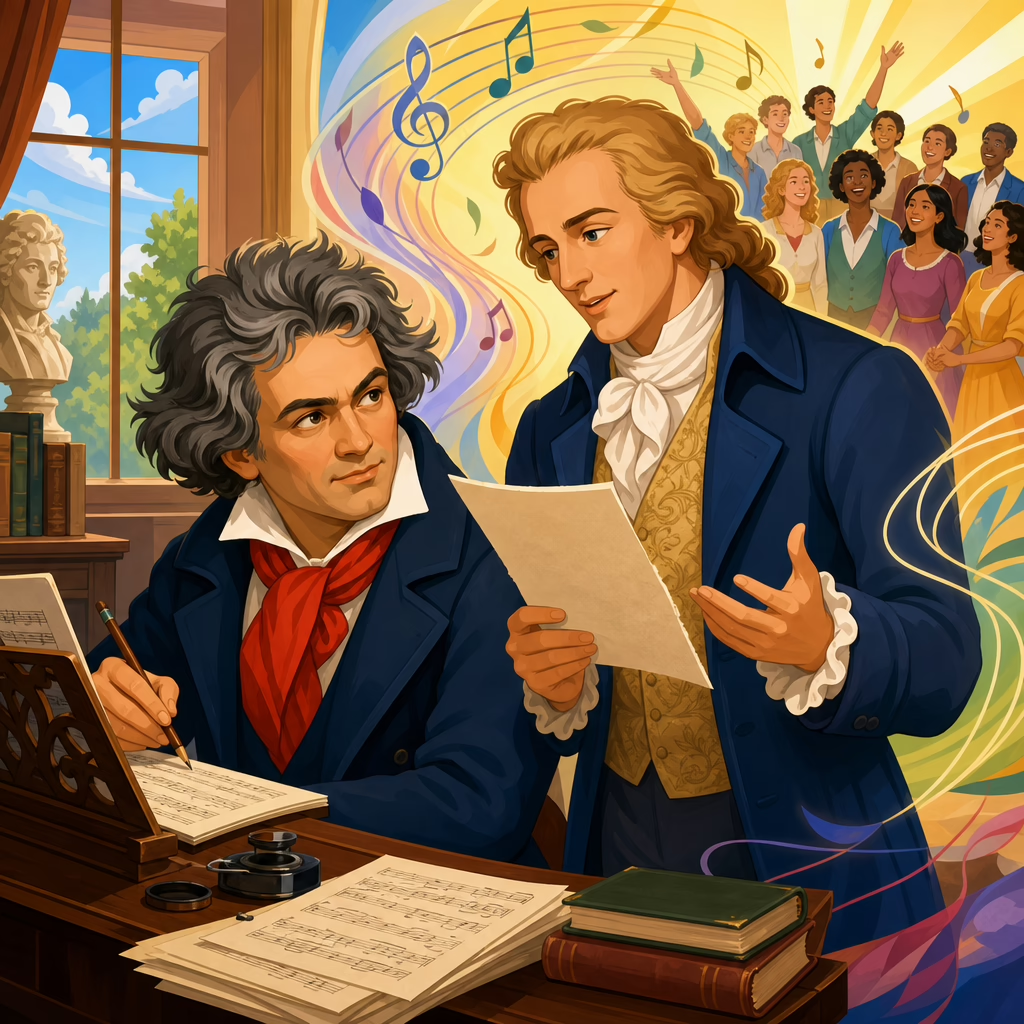
Beethoven and Schiller: Setting “Ode to Joy” to Music
Few collaborations in cultural history are as powerful as the meeting of Friedrich Schiller’s poem “An die Freude” and Ludwig van Beethoven’s music in the finale of the Ninth Symphony. “Ode to Joy” names both the original 1785 poem and the choral setting Beethoven unveiled in 1824, yet the phrase now signifies something larger: a vision of human brotherhood expressed through words, orchestra, and chorus at once. For readers exploring Beethoven’s inspirations and influence, this topic matters because it reveals how literature, politics, philosophy, and compositional craft converged in one work that still circulates through concert halls, classrooms, films, and public ceremonies. I have found that whenever people ask why Beethoven remains central to Western music, the best answer often begins here. The Ninth is not simply famous; it is a case study in how an artist absorbs ideas over decades, reshapes a source text to fit a new medium, and produces a work whose afterlife exceeds its original moment.
Schiller wrote “An die Freude” during the late Enlightenment, a period that prized reason, moral freedom, and universal human dignity. The poem celebrates joy not as private happiness but as a binding force joining all people as brothers under a benevolent order of nature. Beethoven encountered Schiller’s text as a young man and remained drawn to it for decades. By the time he finally set it in the symphony, Europe had passed through revolution, Napoleonic war, censorship, and restoration. That long delay matters. Beethoven did not merely illustrate a popular poem; he transformed it into a hard-won statement about reconciliation after conflict. Understanding “Ode to Joy” therefore means tracking three linked questions: what Schiller originally meant, why Beethoven chose and altered the poem, and how the resulting music changed the history of the symphony and choral art.
Schiller’s poem and the intellectual world behind it
Schiller drafted “An die Freude” in 1785 and revised it in 1808. The poem belongs to a generation shaped by Enlightenment thought, Masonic ideals of fraternity, and an expanding belief that art could elevate civic life. Its central image is joy as a spiritual energy that reunites what custom, class, and power have divided. The line “Alle Menschen werden Brüder,” usually translated “All men become brothers,” captures the poem’s universalizing ambition, though modern readers rightly note the gendered language typical of the era. Schiller’s joy is not lightweight cheerfulness. It is ethical and communal, tied to friendship, sacrifice, and the conviction that humanity shares a moral destiny.
That broader context helps explain the poem’s appeal to Beethoven. He consistently gravitated toward texts and ideas that framed struggle as the route to freedom. In works from the “Eroica” Symphony to the opera Fidelio, he returned to liberation, dignity, and moral courage. Schiller’s poem gave him language for ideals he already pursued musically. Yet the original poem is expansive, uneven, and rhetorically cumulative in a way that works on the page better than on the concert stage. It includes stanzas Beethoven omitted, reframed, or condensed. That editorial intervention was not incidental. It was the essential act that made the poem performable within the architecture of a symphonic finale.
Beethoven’s long path to setting “Ode to Joy”
Beethoven likely knew Schiller’s poem by the early 1790s, and documentary evidence shows he considered setting it long before the Ninth Symphony. Friends reported his enthusiasm for the text, and sketchbooks reveal recurring interest in a vocal treatment. Across his career he tried different forms for combining voices and orchestra. The Choral Fantasy, Op. 80, premiered in 1808, is often treated as a laboratory for the Ninth because it closes with variations on a broad, hymnlike melody supporting a text about art’s unifying power. It is not a draft of “Ode to Joy,” but it proves Beethoven was actively testing solutions to a problem that fascinated him: how to bring the human voice into a large-scale orchestral argument without sacrificing symphonic coherence.
By the early 1820s Beethoven had practical reasons as well as artistic ones to think big. He was financially insecure, increasingly isolated by deafness, and aware of his public stature. The Philharmonic Society in London had invited a new symphony, and Vienna still expected monumental statements from him. At the same time, late Beethoven was pushing every genre toward expanded form and heightened meaning, as seen in the Missa solemnis and the final piano sonatas. The Ninth emerged from this late style. When it premiered in Vienna on 7 May 1824 at the Kärntnertortheater, audiences encountered not merely another symphony but an audacious remapping of what a symphony could contain. Bringing in Schiller’s text solved a decades-long expressive challenge and created the work’s defining surprise.
How Beethoven reshaped the poem for the Ninth Symphony
Beethoven did not set Schiller’s poem in full, nor did he preserve its exact sequence. He selected lines, repeated some phrases extensively, introduced cuts, and added his own words, most famously the baritone recitative opening: “O Freunde, nicht diese Töne!”—“O friends, not these sounds!” That intervention is one of the most consequential editorial gestures in music history. It turns the finale into a drama of rejection and renewal. After recalling themes from earlier movements and dismissing them, the music searches for a new path, then presents the “Joy” theme instrumentally before the singers enter. Beethoven thereby stages the arrival of Schiller’s ideal as a solution to prior unrest.
The text choices also sharpen the poem’s focus. Beethoven emphasizes fellowship, joy, divine order, and the embrace of humanity, while bypassing stanzas that would diffuse momentum or alter tone. He uses repetition not to pad the text but to let music enlarge key concepts. A single line can become processional, ecstatic, intimate, or triumphant depending on harmony, orchestration, and register. This is where many summaries undersell Beethoven’s achievement. He was not simply accompanying a famous poem. He was translating rhetoric into musical time. The poem’s universal claims become believable because the music enacts struggle, release, and collective affirmation step by step.
The music itself: theme, variation, and symphonic drama
The “Ode to Joy” melody is often described as simple, and that is true in the best sense. It moves largely by step, outlines a clear phrase structure, and can be sung by amateurs, which partly explains its immense afterlife. But its simplicity is strategic, not naïve. After three intense movements, Beethoven introduces a tune capable of broad participation, then subjects it to a sequence of transformations. First it appears in the cellos and basses, unadorned and almost tentative. Then it gains orchestral weight, acquires rhythmic profile, and finally becomes the basis for vocal proclamation. The formal principle is variation, but the emotional effect is social expansion: one line becomes many voices.
As the finale unfolds, Beethoven juxtaposes march rhythms, fugato writing, Turkish-style percussion with triangle and bass drum, double fugue, lyrical slow sections, and blazing choral tuttis. These contrasts are not random spectacle. They dramatize the idea that a universal community must accommodate difference. Conductors and analysts often point out how carefully Beethoven controls tonal return and thematic recall so the movement, despite its episodes, maintains a persuasive long-range arc. For listeners, the key point is direct: the finale convinces because the music earns its optimism. Joy arrives after refusal, memory, conflict, and renewed striving, not as decorative sentiment.
| Element | In Schiller’s poem | In Beethoven’s setting | Why it matters |
|---|---|---|---|
| Core idea | Joy unites humanity | Joy resolves symphonic conflict | Music gives the poem dramatic function |
| Text structure | Multiple stanzas, literary flow | Selected lines, reordered and repeated | Editing makes the text performable and focused |
| Speaker | Poetic voice | Soloists, chorus, orchestra, baritone interruption | Many voices embody collective experience |
| Audience effect | Reflective reading | Public ritual in sound | The setting turns ideals into shared event |
Premiere, reception, and the problem of hearing the work
The premiere of the Ninth has acquired legendary status partly because Beethoven, profoundly deaf by then, participated in ways that exposed both his authority and his physical isolation. Accounts differ in detail, but the basic image is consistent: after the performance, he had to be turned toward the audience to witness the applause he could not hear. That scene has invited mythmaking, yet it also captures a genuine paradox. Beethoven composed one of history’s most public musical statements while cut off from ordinary hearing. For musicians, this is not just biography. It affects interpretation. The score’s force comes from inner hearing, structural discipline, and tactile knowledge of instrumental possibilities rather than acoustic convenience.
Early reception mixed awe with uncertainty. Some listeners grasped at once that the symphony was unprecedented; others found the choral finale baffling, excessive, or too heterogeneous. That split has never fully disappeared. Even now, some critics regard the finale as gloriously unruly rather than classically seamless. In performance, everything depends on proportion: tempi, diction, orchestral balance, choral articulation, and the transition from instrumental recitative to vocal declaration. When those choices align, the movement feels inevitable. When they do not, “Ode to Joy” can sound merely ceremonial. The work’s durability comes from surviving both reactions. It invites reverence, but it also withstands scrutiny.
Influence, appropriation, and why this hub matters
No account of “Ode to Joy” is complete without acknowledging its extraordinary and sometimes contradictory afterlife. The melody has been quoted in political rallies, religious services, films, advertisements, student demonstrations, state occasions, and New Year concerts. Herbert von Karajan’s arrangement became the anthem of the Council of Europe in 1972 and later the European Union, notably without Schiller’s words so it could function across languages. Leonard Bernstein conducted the Ninth in Berlin after the fall of the Wall, famously substituting “Freiheit,” freedom, for “Freude,” joy, in a symbolic gesture. At the same time, authoritarian regimes have also claimed Beethoven, proving that universal art does not control its users.
That ambiguity is exactly why this page serves as a hub within Beethoven’s inspirations and influence. “Miscellaneous” is not a catchall in the weak sense; it is where overlapping themes meet. From here, readers can branch into Schiller and German idealism, Beethoven’s political imagination, the history of the Ninth Symphony, the role of chorus in symphonic writing, reception history, European cultural symbolism, and the modern uses and misuses of canonical music. In my experience, students understand Beethoven more deeply once they see “Ode to Joy” as a living network rather than a single tune. The piece connects poetry to music, private conviction to public ritual, and artistic innovation to cultural memory. Begin with the poem, then listen closely to the finale, compare translations, and trace how later generations reused it. That is the surest way to hear not only what Beethoven borrowed from Schiller, but what he made entirely his own.
Frequently Asked Questions
What is the relationship between Schiller’s “An die Freude” and Beethoven’s “Ode to Joy”?
Schiller’s “An die Freude,” written in 1785, is the poetic source behind what most people now call “Ode to Joy.” The original text was a celebration of joy, friendship, human dignity, and the ideal of universal brotherhood. Decades later, Beethoven took that poetic vision and transformed it into music in the final movement of his Symphony No. 9, premiered in 1824. In other words, Schiller supplied the words and philosophical spirit, while Beethoven created the now-famous musical setting that gave the poem a worldwide public life.
The relationship is not simply one of poem-to-song adaptation. Beethoven did not set Schiller’s text in a straightforward, literal way from beginning to end. Instead, he selected, rearranged, and modified portions of the poem to fit the dramatic and musical architecture of the symphony’s finale. This means the “Ode to Joy” heard in the Ninth Symphony is best understood as a collaboration across time: Schiller’s Enlightenment-era idealism reframed through Beethoven’s late style, with all its emotional intensity, grandeur, and urgency.
That is why the phrase “Ode to Joy” can refer to both Schiller’s poem and Beethoven’s setting, but in modern culture it usually points to something larger than either alone. It has become a symbol of shared humanity expressed through literature, orchestral music, and choral proclamation all at once.
Why was Beethoven so drawn to Schiller’s poem?
Beethoven was attracted to Schiller’s poem because its themes closely matched convictions he held throughout his life. He admired ideals associated with the Enlightenment, especially freedom, moral dignity, and the possibility that human beings could rise above division through reason and fellow feeling. “An die Freude” gave poetic form to exactly those aspirations. Its language about unity, brotherhood, and joy as a force connecting all people would have resonated deeply with Beethoven’s artistic and personal worldview.
There is strong evidence that Beethoven had been interested in setting Schiller’s poem long before he completed the Ninth Symphony. He appears to have contemplated it for many years, which suggests that this was not a late or casual decision. Rather, the poem remained with him as a meaningful artistic goal. By the time he finally incorporated it into the Ninth, he had reached a stage in life where he could give it unusually profound treatment. He was dealing with deafness, isolation, and enormous personal struggle, yet he responded not by turning inward alone, but by creating one of the most expansive statements of collective hope in Western music.
That contrast is part of what makes Beethoven’s attraction to the poem so compelling. He was not drawn to shallow optimism. He was drawn to an ideal hard won through suffering. In the Ninth Symphony, joy does not appear as a simple happy feeling; it emerges as a triumphant answer to conflict, darkness, and fragmentation. Schiller’s poem offered Beethoven the perfect text for that kind of musical and philosophical journey.
How did Beethoven adapt Schiller’s text in the Ninth Symphony?
Beethoven treated Schiller’s poem with considerable freedom. Rather than setting every stanza exactly as written, he chose specific lines that best served the shape and meaning of the symphony’s finale. He also altered the order of some passages and introduced connective material of his own. One of the most famous additions is the bass solo’s opening invitation, “O Freunde, nicht diese Töne!” (“O friends, not these sounds!”), which is Beethoven’s own dramatic intervention rather than a line from Schiller’s original poem. That moment announces a change in direction and helps launch the central “Ode to Joy” theme.
This adaptation was necessary because Beethoven was not composing a standalone art song or a simple choral hymn. He was building the culmination of a vast symphonic structure. The finale begins in turbulence, recalls earlier movements, and then gradually discovers the melody that will carry Schiller’s message. Once introduced, that tune is developed through a remarkable sequence of variations, orchestral expansions, vocal entries, and climactic choral writing. Schiller’s words become part of a much larger musical drama.
Beethoven’s changes also show that he wanted to emphasize certain universal aspects of the poem over others. His setting highlights communal joy, embrace, and shared humanity in ways that fit the emotional trajectory of the symphony. As a result, the text in the Ninth is not merely quoted literature; it is reimagined as a living component of a monumental musical argument. Beethoven preserved Schiller’s central spirit while shaping the words into something unmistakably his own.
Why is the finale of Beethoven’s Ninth Symphony considered so important in cultural history?
The finale of Beethoven’s Ninth is considered a landmark because it changed expectations for what a symphony could do. Before Beethoven, symphonies were instrumental works, and while vocal music had long occupied a central place in European culture, combining full symphonic development with chorus and soloists on this scale was revolutionary. Beethoven did not simply add voices for novelty. He expanded the symphony into a vehicle for philosophical declaration, making it capable of speaking directly, through text, to universal human concerns.
Its historical importance also comes from the power of its message. By joining Schiller’s words to an unforgettable melody, Beethoven created a work that could be heard simultaneously as high art, moral vision, and public statement. The “Ode to Joy” theme is memorable enough to be widely recognized even outside concert halls, yet the full finale remains structurally complex and artistically ambitious. That combination of accessibility and depth has helped the work travel far beyond its original context.
Over time, the music has been used in ceremonies, political events, commemorations, and international institutions, often as a symbol of reconciliation or shared identity. At the same time, scholars and listeners continue to debate its meanings, uses, and appropriations, which is another sign of its enduring cultural force. The finale matters not only because it is famous, but because it remains active in public life, continually reinterpreted by different generations seeking language for collective hope.
What does “Ode to Joy” mean today, and why does it still resonate?
Today, “Ode to Joy” means far more than the title of an eighteenth-century poem or the closing chorus of a nineteenth-century symphony. It has come to represent an ideal: the belief that art can express a common human bond across differences of nation, class, language, and circumstance. That ideal is rooted in Schiller’s poem and amplified by Beethoven’s music, but its modern resonance comes from the way both artists speak to enduring questions about solidarity, dignity, and the search for meaning in a fractured world.
The piece continues to resonate because it holds together emotional immediacy and moral aspiration. Listeners do not need to know every line of Schiller or every formal detail of Beethoven’s score to feel the effect of the melody and the chorus. At the same time, the more one learns about the work, the richer it becomes. Its themes invite reflection on Enlightenment thought, Romantic expression, political symbolism, and the role of music in shaping public ideals. Few works can operate so powerfully on both a popular and an intellectual level.
Its lasting relevance also lies in its tension between ideal and reality. “Ode to Joy” does not describe a perfect world that already exists; it points toward a world people continue to strive for. That is why it remains compelling. Each performance asks whether joy, fellowship, and mutual recognition are still possible, and each new generation answers in its own way. The work endures because it offers not just beauty, but a challenge and a hope.