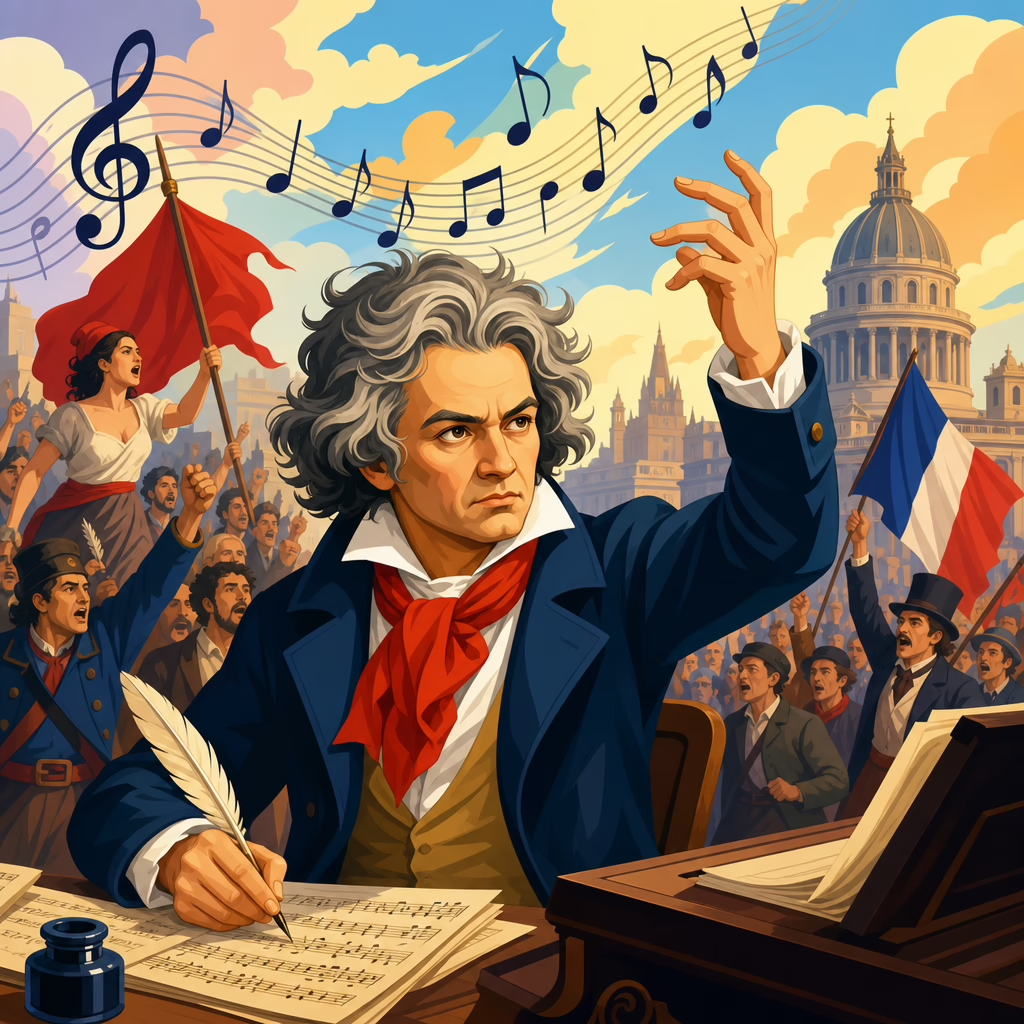
Beethoven’s Music and Its Influence on Political Revolutions
Ludwig van Beethoven’s music has long stood at the crossroads of art and power, and few composers have been invoked as often in the language of political revolution. When people ask how Beethoven’s music influenced political revolutions, they are usually asking something larger: how instrumental music, without explicit slogans, came to represent liberty, resistance, citizenship, and the moral dignity of ordinary people. That question matters because Beethoven lived through the French Revolution, Napoleon’s rise and fall, and the reshaping of Europe after the Congress of Vienna, and his works absorbed those shocks more directly than those of almost any major composer before him.
In practical terms, Beethoven’s political influence did not come from campaign songs or party anthems alone. It came from a new musical rhetoric. He expanded scale, intensified conflict, and made struggle itself a central dramatic principle. In symphonies, overtures, chamber music, piano sonatas, and vocal works, listeners heard confrontation, rupture, mourning, perseverance, and collective affirmation. Over years of working with concert programming and historical notes, I have seen the same pattern repeatedly: audiences may not know every harmonic detail, but they immediately recognize Beethoven’s language of crisis moving toward hard-won resolution. That pattern made his music unusually portable into revolutionary settings.
Key terms help clarify the discussion. A political revolution is a rapid transformation of state power or political legitimacy, often driven by mass mobilization, elite fracture, or both. Influence, in this context, does not mean Beethoven directly caused uprisings. It means his music supplied symbols, emotional scripts, public rituals, and moral vocabulary that movements could adopt. Influence also worked retrospectively. Later generations used Beethoven to legitimize causes he never personally knew, from liberal constitutionalism in the nineteenth century to anti-fascist resistance and democratic protest in the twentieth.
This article serves as a hub for the miscellaneous side of Beethoven’s inspirations and influence because the topic does not fit neatly into one genre, one country, or one ideology. Beethoven inspired revolutionaries, reformers, republicans, nationalists, dissidents, and state institutions that wanted to present themselves as guardians of freedom. That breadth is exactly why the subject deserves careful treatment. His music became politically powerful not because it said one thing clearly, but because it joined heroic aspiration to human suffering in ways that groups across history could claim as their own.
Beethoven in an age of revolution
Beethoven was born in 1770 in Bonn and came of age as the American and French Revolutions changed political expectations across the Atlantic world. By the time he settled in Vienna, ideas of citizenship, rights, constitutional order, and popular sovereignty were circulating intensely, even under censorship. He admired aspects of revolutionary thought, especially the promise that inherited hierarchy could be challenged by merit and public virtue. That background matters because Beethoven’s artistic career unfolded in a Europe where music was leaving purely courtly functions and entering a broader public sphere of ticketed concerts, publishers, critics, and politically alert listeners.
The clearest early example is the Third Symphony, the “Eroica.” Beethoven originally associated the work with Napoleon Bonaparte, whom he appears to have viewed as a champion of republican ideals before Napoleon crowned himself emperor. The familiar story of Beethoven angrily removing Napoleon’s name captures a genuine shift: the symphony remained heroic, but its heroism was no longer simple hero worship. Musically, the piece is expansive, disruptive, and argumentative. Its funeral march gives public grief an unprecedented scale, while the finale transforms struggle into communal energy. For nineteenth-century liberals, that trajectory sounded like the fate of revolution itself: promise, betrayal, mourning, and renewed resolve.
Another pivotal work is the opera Fidelio, Beethoven’s only opera and perhaps his most explicit political statement. Its plot centers on Leonore, who disguises herself as Fidelio to rescue her unjustly imprisoned husband Florestan from a tyrannical regime. The themes are unmistakable: political imprisonment, abuse of power, marital courage, and liberation through truth. I have watched modern productions place the action in settings ranging from Napoleonic police states to twentieth-century dictatorships, and the opera survives each transfer because its core argument is stable. Arbitrary power is illegitimate, conscience is active, and freedom requires risk.
Even works without overt political narratives contributed to revolutionary culture by normalizing an art of resistance. The Fifth Symphony’s concentrated opening motive has often been reduced to “fate knocking at the door,” a phrase of uncertain origin, but the broader public meaning is real. Its progression from C minor conflict to C major triumph established a model of adversity overcome through relentless action. During the Second World War, Allied propaganda linked the opening rhythm to the Morse code for the letter V, turning Beethoven into a sonic emblem of victory. That was not a distortion from nowhere; it built on a century of hearing Beethoven as the composer of struggle transformed into public courage.
Why Beethoven’s style translated into political meaning
Beethoven’s political reach depended on musical design as much as historical circumstance. He did not simply inherit Classical forms from Haydn and Mozart; he intensified their contrasts and made development feel like contest. Themes collide, motives are broken apart and rebuilt, silences become dramatic, and codas often function as second climaxes rather than polite conclusions. To non-specialists, this means Beethoven’s music feels like action with stakes. The listener senses opposition and consequence. That perception is ideal for political appropriation, because revolutions also narrate history as conflict moving toward transformation.
His command of public ceremonial style was equally important. Beethoven could write music that sounded collective rather than private, especially in finales, marches, choruses, and variation structures. The “Ode to Joy” finale of the Ninth Symphony is the supreme example. By introducing voices into the symphonic form, Beethoven turned an elite instrumental genre into something resembling civic proclamation. Friedrich Schiller’s text celebrates joy, brotherhood, and universal fellowship, but the music gives those abstractions physical force through accumulative repetition and broad, memorable melody. That is why the movement has functioned in settings as different as 1848 liberal demonstrations, postwar reconciliation, and the modern European anthem.
There is also a moral reason Beethoven traveled so well politically. His music rarely sounds frivolous. Even in wit or dance, there is pressure, weight, and purpose. That seriousness encouraged listeners to treat performances as occasions of civic reflection. In the nineteenth century, public concerts became places where educated middle-class audiences practiced attention, discipline, and shared response. Beethoven sat at the center of that emerging canon. To attend Beethoven was not merely to be entertained; it was to encounter a model of human dignity tested by adversity. Revolutionary movements need precisely that kind of symbolic capital.
| Work | Political theme listeners attached to it | Historical example |
|---|---|---|
| Symphony No. 3 “Eroica” | Heroism, republican promise, betrayal, renewal | Nineteenth-century liberal readings after Napoleon’s turn to empire |
| Fidelio | Resistance to tyranny, political imprisonment, liberation | Performed in contexts highlighting prisoners of conscience |
| Symphony No. 5 | Struggle, endurance, victory | Allied wartime use of the opening motif as “V for Victory” |
| Symphony No. 9 | Brotherhood, civic unity, democratic hope | Adopted in ceremonies tied to European reconciliation and protest |
Because Beethoven’s music combines formal rigor with emotional directness, it also lends itself to quotation, commemoration, and institutional reuse. A movement can be excerpted for a rally, a state can program a symphony for legitimacy, or activists can reclaim the same piece in opposition. Few composers offer that range. Beethoven does, and that flexibility explains why his influence on political revolutions has remained durable rather than confined to one era.
Nineteenth-century revolutions and the Beethoven myth
The revolutions of 1830 and 1848 did not unfold to a single soundtrack, yet Beethoven became central to their political imagination. By then he had already been elevated from respected composer to cultural monument. Critics, biographers, and performers framed his life as a narrative of independence: a difficult genius who confronted suffering, deafness, aristocratic patronage, and convention without surrendering inner freedom. That life story, polished into legend, mattered almost as much as the scores. Revolutionaries and reformers prefer figures who embody moral resistance, and Beethoven’s biography provided one.
In the German lands, his music was often associated with aspirations for constitutional government and national renewal. This was not nationalism in the later narrow ethnic sense alone. It was also a vision of civic seriousness and educated public culture. Choral festivals, commemorative events, and print commentary treated Beethoven as proof that a people could achieve greatness through art rather than conquest. During 1848, when demands for constitutions, representation, and civil rights surged across Europe, the Ninth Symphony and other monumental works could be heard as sounding a future political community not yet fully realized.
At the same time, there were limits. Beethoven was useful precisely because he was not programmatically partisan. Conservatives could admire his order, discipline, and grandeur; radicals could emphasize defiance and emancipation. This ambiguity is not a weakness in the historical record. It is the central fact. Political revolutions rarely rely only on explicit propaganda. They also recruit prestige symbols that appear to stand above faction while quietly supporting one side’s moral claims. Beethoven’s authority allowed many groups to speak through him.
Outside Central Europe, similar patterns emerged. In France, where memories of 1789, Napoleon, restoration, and republic remained volatile, Beethoven’s reputation grew as part of a broader Romantic culture that valued artistic genius and heroic suffering. In Italy, where movements for unification and independence were gathering force, the language of liberation in Fidelio resonated alongside native operatic traditions. Beethoven was not the street song of every uprising, but he was a reservoir of prestige and emotional grammar that politically engaged musicians, writers, and audiences repeatedly drew upon.
Twentieth-century revolutions, resistance, and state power
In the twentieth century, Beethoven’s political afterlife became even more complex because mass media, recording, radio, and film multiplied his reach. Revolutionary regimes, democratic states, exile communities, and underground movements all used the same repertoire for different ends. The Nazi regime claimed Beethoven as a symbol of German greatness, yet anti-fascists also claimed him as a defender of human freedom. This apparent contradiction reflects a hard truth about cultural icons: the more canonical they become, the more fiercely they are contested.
The Fifth Symphony’s wartime role is one of the clearest examples of politically effective musical shorthand. The BBC opened transmissions with the famous short-short-short-long rhythm because it matched the Morse code letter V. That converted Beethoven into a daily acoustic sign of resistance across occupied Europe. Listeners did not need a lecture in musicology to understand the message. A canonical work had become a public code. In practical terms, that is political influence at its strongest: recognizable, repeatable, and adaptable under pressure.
The Ninth Symphony followed a different path. After 1945 it increasingly signified reconciliation, democratic renewal, and supranational cooperation, especially in Europe. Yet it also appeared at moments of rupture. Leonard Bernstein famously conducted it in Berlin after the fall of the Wall, substituting the word “Freiheit,” freedom, for “Freude,” joy, in a symbolic gesture. Scholars can debate the textual propriety, but the event demonstrated how firmly Beethoven had become attached to the political imagination of liberation. When barriers collapsed, people reached for Beethoven.
Communist states also appropriated Beethoven, often emphasizing his revolutionary energy, his connection to the Enlightenment, and his struggle against oppression. Soviet criticism frequently presented him as a heroic artist aligned with historical progress, though filtered through ideological expectations. Here again the tradeoff is revealing. Beethoven’s music could inspire genuine listeners under authoritarian systems while also serving official cultural policy. A political symbol powerful enough to animate revolution is also powerful enough to be institutionalized.
How this hub connects the wider miscellaneous subtopic
As a hub article within Beethoven’s inspirations and influence, this page points to several related directions. One is Beethoven and nationalism: how his music was used in state building, memorial culture, and national canons. Another is Beethoven in protest performance: from student demonstrations to commemorative concerts for prisoners, martyrs, and democratic movements. A third is Beethoven in media and public memory, including wartime broadcasting, recordings, films, and ceremonial events. Readers exploring this miscellaneous cluster should also examine Beethoven’s reception history, because influence often tells us as much about later listeners as about Beethoven himself.
The central lesson is straightforward. Beethoven’s music influenced political revolutions not by issuing policy demands but by shaping how societies heard struggle, justice, sacrifice, and collective hope. The “Eroica” offered heroic history without blind obedience. Fidelio dramatized the moral illegitimacy of tyranny. The Fifth turned conflict into determination. The Ninth gave a mass public a language of shared humanity. Across revolutions, reforms, occupations, and transitions, these works supplied both emotional force and cultural authority.
For anyone studying Beethoven’s inspirations and influence, political revolution is not a side note. It is one of the clearest demonstrations of how art enters public life and stays there. Beethoven became useful to revolutionaries, reformers, and institutions because his music sounds like humanity under pressure refusing defeat. That is why it still appears at turning points. If you are building out this subtopic, use this article as your starting map, then follow the connected themes of nationalism, resistance, public memory, and performance history to see how Beethoven’s political meanings continue to evolve today.
Frequently Asked Questions
How did Beethoven’s music become associated with political revolution if it contains no explicit political slogans?
Beethoven’s music became politically charged not because it delivered direct verbal messages, but because it embodied values that revolutionary audiences recognized and wanted to claim. His works often dramatize struggle, disruption, moral resolve, and hard-won triumph. That emotional architecture made his music unusually adaptable to political meaning. In an era shaped by the French Revolution, the rise and fall of Napoleon, and fierce debates about citizenship and freedom, listeners heard in Beethoven a new kind of heroic voice—one that seemed to elevate human dignity above courtly entertainment or aristocratic display.
What made this especially powerful was Beethoven’s break from older expectations about what instrumental music could do. His symphonies, overtures, and sonatas often feel argumentative, as though they are working through conflict in public. That sense of tension and resolution gave political thinkers, activists, and later revolutionaries a musical language for ideas like resistance, emancipation, sacrifice, and collective purpose. Even without words, the music suggested that suffering could lead to transformation and that ordinary human beings were capable of moral greatness.
Just as important, Beethoven’s reputation as an artist mattered alongside the notes themselves. He came to be seen as an independent creative figure rather than a mere servant of aristocratic patrons. That image fit neatly with modern political ideals about liberty, conscience, and the rights of the individual. Over time, people did not simply listen to Beethoven; they interpreted him. Different movements, regimes, and reformers treated his music as a symbolic resource, using it to express hopes for national liberation, democratic renewal, or resistance to oppression.
What role did the French Revolution and Napoleon play in shaping Beethoven’s political image?
The French Revolution formed the political backdrop of Beethoven’s early adulthood, and its language of liberty, equality, and citizenship deeply influenced the world in which he composed. Like many intellectuals and artists of his generation, Beethoven was drawn to the revolutionary promise that old hierarchies could be overturned and that human beings might be judged by merit rather than birth. This does not mean he was a simple partisan or a consistent ideologue, but it does mean that revolutionary politics helped shape the moral atmosphere surrounding his work.
Napoleon was central to this story. Beethoven initially admired him as a figure who seemed to represent the modern, secular, anti-feudal hero emerging from the Revolution. That admiration is famously connected to the Symphony No. 3, the “Eroica,” which has long been linked to Beethoven’s early hopes for political renewal. But when Napoleon crowned himself emperor, Beethoven reportedly reacted with anger and disillusionment. Whether every detail of the legend is exact or not, the episode became enormously important in later memory because it crystallized Beethoven’s image as a composer committed not to power for its own sake, but to principle.
This distinction mattered for later political revolutions. Beethoven could be presented as a witness to the betrayal of revolutionary ideals, a composer who understood both the promise of liberation and the danger of authoritarian ambition. That made his music relevant not only to movements seeking freedom, but also to those warning against revolutions that reproduce domination in new forms. In that sense, Beethoven’s political image was shaped by a historical drama larger than any one composition: the hope that history could be remade, and the fear that its liberators might become rulers indistinguishable from the old order.
Which of Beethoven’s works have been most closely linked to revolutionary ideals?
Several Beethoven works have become especially associated with political revolution, but the most prominent is the Symphony No. 3, or “Eroica.” This symphony is frequently interpreted as a musical representation of heroic struggle on a scale unprecedented in its time. Its forceful opening, expansive development, funeral march, and eventual emergence into renewed energy gave listeners a model of history as conflict and transformation. For generations, people heard in it not just personal heroism, but the drama of societies confronting crisis and change.
Another key work is the Symphony No. 9, especially its final movement setting Friedrich Schiller’s “Ode to Joy.” The text’s celebration of human brotherhood and unity made the work politically flexible and globally influential. Revolutionaries, democrats, internationalists, and later institutions of European cooperation all found in it a musical vision of human solidarity. At the same time, because it is so universal in tone, the Ninth has been adopted by very different political projects, sometimes in contradictory ways. That broad appeal reflects both its greatness and its ambiguity.
Beethoven’s only opera, Fidelio, has also carried strong revolutionary significance. Its story centers on unjust imprisonment, political tyranny, moral courage, and liberation. Those themes made it especially resonant in contexts where people were fighting censorship, despotism, or state violence. The opera speaks directly to the idea that personal loyalty and public justice can converge, making it one of Beethoven’s clearest artistic statements about freedom under oppression.
Other works, including the Egmont Overture, have likewise been drawn into political readings. Inspired by Goethe’s drama about resistance to foreign rule, the overture became a frequent symbol of defiance against tyranny. Across these compositions, the recurring pattern is clear: Beethoven wrote music that dramatized conflict with exceptional seriousness, and later generations repeatedly turned to those works when they needed cultural symbols for resistance, sacrifice, and liberation.
Did Beethoven’s music actually influence political revolutions, or was it mainly used symbolically afterward?
The answer is both. Beethoven’s music did not cause political revolutions in any simple, direct sense. Revolutions emerge from economic pressures, social grievances, institutional crises, war, ideology, and mass mobilization. Music alone does not overthrow governments. However, Beethoven’s works undeniably influenced the emotional and symbolic life of political movements. They helped people imagine themselves as participants in a larger historical struggle and gave public events a sound world associated with seriousness, courage, and moral legitimacy.
In practice, this influence often appeared through performance, commemoration, and ritual. Beethoven’s music was played at concerts tied to civic causes, national anniversaries, reformist gatherings, and later memorial events connected to resistance movements. In such settings, the music functioned as a form of cultural authority. It could dignify protest, frame sacrifice as noble rather than futile, and bind individual feeling to collective purpose. That kind of influence is not merely decorative. Political movements depend on symbols, memory, emotion, and shared language, and Beethoven became one of the most powerful cultural figures available for that work.
It is also important to note that the meaning of his music changed across time. Nineteenth-century liberals, nationalists, republicans, social reformers, and anti-authoritarian activists all claimed Beethoven in different ways. In the twentieth century, his works continued to appear in contexts of both liberation and ideological appropriation. This does not weaken the case for influence; it shows how politically potent the music became. Beethoven mattered because his compositions could be used to articulate aspiration, grief, endurance, and victory in moments when political communities were trying to define themselves.
Why does Beethoven continue to matter in discussions about revolution, liberty, and political change today?
Beethoven still matters because he occupies a rare place where artistic achievement and political imagination meet. His music continues to be invoked whenever people want to connect private emotion with public ideals. In times of upheaval, societies often search for cultural works that feel larger than immediate politics yet still capable of expressing the deepest stakes of political life. Beethoven’s music does exactly that. It speaks in a language of tension, aspiration, suffering, and release that many listeners continue to associate with the fight for freedom and dignity.
He also remains relevant because his legacy reveals how art works in political history. Beethoven shows that music does not need explicit propaganda to shape political meaning. Instrumental music can become revolutionary when listeners hear in it a model of human struggle and moral purpose. His example helps explain why art so often appears at turning points in public life: not because it replaces political action, but because it gives political action emotional depth, symbolic form, and historical memory.
At the same time, Beethoven’s afterlife warns us to be careful. His music has been used by democrats and authoritarians, reformers and states, dissidents and institutions. That complexity is part of why he remains so important. He forces us to ask not just what a piece of music means, but who is using it, in what context, and to what end. For readers interested in political revolutions, Beethoven is therefore more than a composer from the past. He is a case study in how cultural prestige, historical memory, and artistic intensity can help shape the way societies understand freedom, resistance, and the rights of ordinary people.