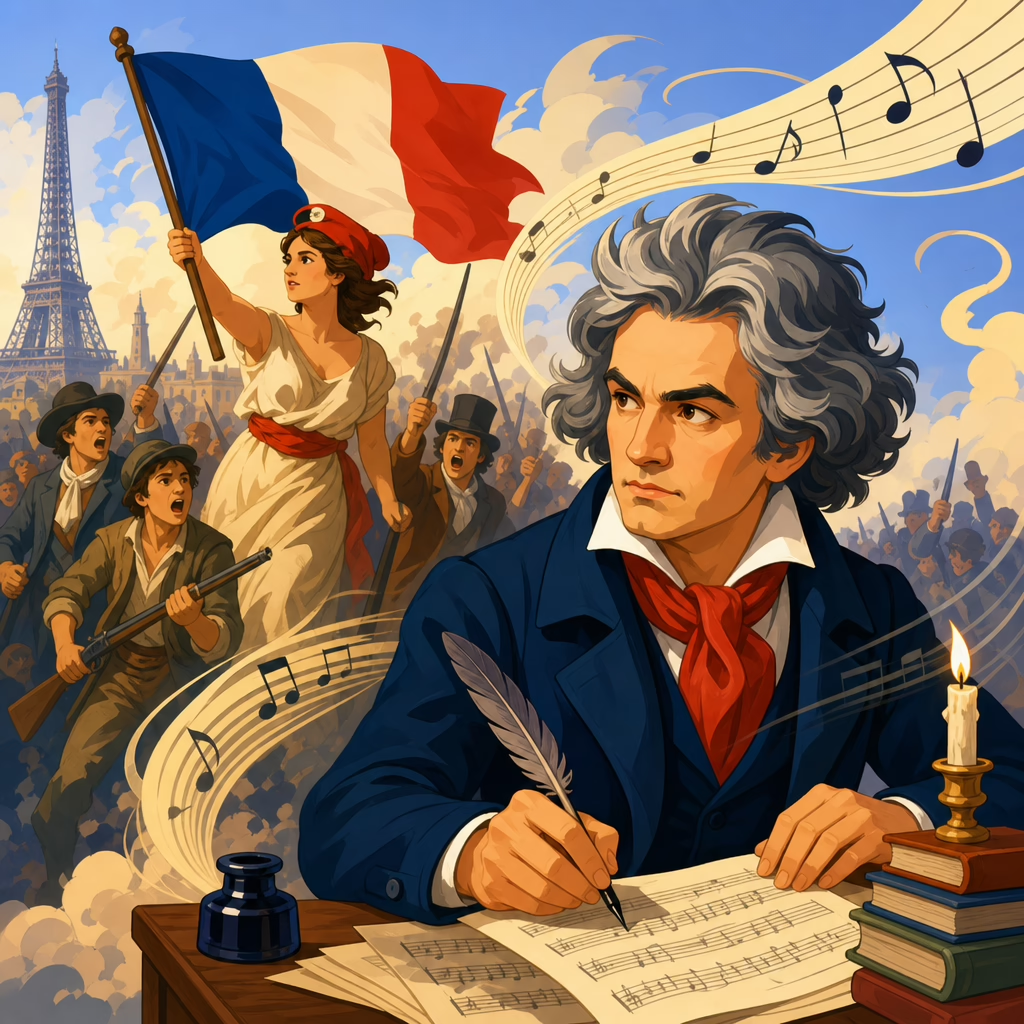
How the French Revolution Shaped Beethoven’s Music
The French Revolution did not simply unfold alongside Ludwig van Beethoven’s career; it altered the political language, moral vocabulary, and emotional temperature in which his music was conceived. When people ask how the French Revolution shaped Beethoven’s music, they usually mean more than whether he admired Napoleon for a time or withdrew a dedication in anger. They are asking how revolutionary ideas—liberty, citizenship, anti-aristocratic reform, public heroism, and the dignity of ordinary people—entered the sound world of one of history’s most influential composers. The answer is substantial. Beethoven absorbed the Revolution less as a party program than as a force that changed what music could represent and whom it could address.
In practical terms, the French Revolution refers to the upheaval beginning in 1789 that overthrew Bourbon absolutism, dismantled feudal privilege, and spread new political ideals across Europe. Beethoven, born in Bonn in 1770 and active mainly in Vienna, never lived in Paris during the key revolutionary years, but he came of age in the Revolution’s immediate intellectual aftermath. Bonn was no isolated provincial town. It was touched by Enlightenment debate, reform-minded patronage, and, eventually, French occupation. By the time Beethoven moved to Vienna in 1792, the old courtly order that had framed Haydn and Mozart was under pressure. That pressure mattered because music in the late eighteenth century was tied closely to aristocratic service, social hierarchy, and ceremonial display.
What changed was not only politics but expectation. Revolutionary culture elevated the “hero,” the “citizen,” the “funeral march,” the “public festival,” and the idea that art could carry ethical meaning. Beethoven recognized these shifts earlier and more deeply than many contemporaries. In my experience reading his letters, studying the middle-period scores, and comparing them with late eighteenth-century conventions, the revolutionary influence is clearest not in slogans but in scale, rhetoric, and purpose. Beethoven expanded the symphony into a field of struggle and resolution. He wrote music that sounds as if it addresses a community rather than entertains a salon. He treated instrumental works as vehicles for moral drama. That was a decisive break.
This matters because Beethoven became the model for nineteenth-century musical seriousness. If the French Revolution helped shape Beethoven, then it also helped shape later ideas of the artist as independent, politically conscious, and socially significant. His music became a bridge between Enlightenment classicism and modern artistic idealism. Understanding that bridge clarifies why works such as the “Eroica” Symphony, the Fifth Symphony, the opera Fidelio, and the Ninth Symphony feel larger than private expression. They stage questions of power, freedom, sacrifice, and collective hope. To understand Beethoven’s inspirations and influence under this miscellaneous hub topic, you have to see the Revolution not as a footnote, but as a central current running through his imagination.
Beethoven’s Revolutionary Environment in Bonn and Vienna
Beethoven’s early environment prepared him to respond sympathetically to revolutionary thought. In Bonn, he worked within the court of Elector Maximilian Franz, whose circle included reform-minded officials and intellectuals influenced by the Enlightenment. Beethoven encountered literature by Friedrich Schiller and other writers who linked freedom with human dignity. Bonn’s reading societies, theater life, and university atmosphere exposed him to ideas far broader than strict court service. This setting matters because Beethoven did not emerge from political innocence. Before he wrote his major heroic works, he had already formed habits of mind that valued merit over inherited rank.
French armies entered the Rhineland in the 1790s, and Bonn’s political realities changed dramatically. Revolutionary France was not merely an abstraction discussed in pamphlets; it became a governing force in territories Beethoven knew personally. That proximity sharpened the stakes. When he moved permanently to Vienna, he entered a city fascinated by and fearful of French developments. Austrian authorities censored dissent and watched revolutionary language closely, yet the ideals unleashed in 1789 could not be contained. Beethoven lived inside that contradiction: aristocratic patronage still funded music, but the old assumptions about unquestioned hierarchy were weakening. This tension helps explain both his dependence on noble supporters and his refusal to behave like a conventional servant-composer.
His famous insistence on personal dignity with patrons was itself historically significant. Haydn and Mozart negotiated status within older systems, but Beethoven pressed harder for artistic autonomy. He accepted support from princes such as Lichnowsky, Lobkowitz, and Kinsky, yet he increasingly presented himself as a creator whose value did not depend on court rank. That posture aligned with a post-revolutionary moral world. It did not make him a democrat in the modern sense, but it did place him within a culture transformed by the claim that human worth was not identical with noble birth.
Liberty, Heroism, and the New Musical Imagination
The clearest way the French Revolution shaped Beethoven’s music was by redefining heroism. Eighteenth-century instrumental music often conveyed elegance, wit, pathos, or ceremonial grandeur, but Beethoven pushed it toward public struggle. In his hands, conflict became structural. Themes do not simply appear and charm; they confront resistance, fracture, regroup, and win hard-earned victories. That narrative logic parallels revolutionary culture, which celebrated action, sacrifice, and transformation. Beethoven did not invent musical tension, but he made it feel historical and ethical.
The “heroic style” associated with his middle period depends on several concrete musical features: expanded forms, emphatic rhythmic drive, bold contrasts, brass-heavy orchestration, and thematic development that treats small motives as agents of conflict. These are technical matters, yet they carry ideological weight. Revolutionary rhetoric prized energy, resolve, and the remaking of inherited forms. Beethoven’s procedures enact similar principles inside music. The result is that even without words, listeners perceive striving. This is why audiences often hear political meaning in works that contain no explicit program.
| Work | Revolutionary Connection | Musical Evidence | Why It Matters |
|---|---|---|---|
| Symphony No. 3 “Eroica” | Originally linked to Napoleon as a citizen-hero | Massive scale, funeral march, conflict-driven development | Turns the symphony into public moral drama |
| Fidelio | Rescue from political imprisonment | Trumpet calls, dungeon scene, liberation finale | Frames freedom as an urgent human right |
| Symphony No. 5 | Struggle leading to collective victory | Motivic unity, dark-to-bright trajectory, triumphant coda | Embodies perseverance under pressure |
| Symphony No. 9 | Universal brotherhood and civic celebration | Choral finale on Schiller’s “Ode to Joy” | Extends revolutionary fraternity into global idealism |
This shift in imagination also changed the listener’s role. Beethoven increasingly wrote for a public prepared to hear meaning beyond surface beauty. Concert life was moving, slowly but unmistakably, away from purely aristocratic settings toward broader civic spaces. Revolutionary politics encouraged the idea that collective audiences mattered. Beethoven’s music answered that change. It does not flatter background listening; it demands engagement, almost judgment. That demand is one reason his works became central to public concert culture in the nineteenth century.
Napoleon, the “Eroica,” and Beethoven’s Political Disillusionment
No discussion of the French Revolution and Beethoven can avoid Napoleon Bonaparte. Beethoven initially admired Napoleon because he appeared to embody revolutionary merit: a man rising by talent rather than birth, carrying legal and political reform across Europe. According to Ferdinand Ries’s well-known account, Beethoven intended to dedicate the Third Symphony to Bonaparte, but tore the title page when he learned Napoleon had crowned himself Emperor in 1804. Scholars debate details of the anecdote, yet the broader truth is secure. Beethoven’s attraction to Napoleon was real, and his disillusionment was equally real.
The significance of the “Eroica” goes beyond the canceled dedication. This symphony, premiered in 1805, sounds unlike a ceremonial tribute. It is too unstable, too long, and too searching. The first movement’s dissonances and development section create a sense of historical risk. The second movement funeral march introduces grief on a public scale. The scherzo restores energy, and the finale transforms variation form into something dynamic and affirmative. Beethoven seems to ask what heroism costs, what it survives, and whether ideals can outlast corrupted leaders.
That arc mirrors the Revolution’s own trajectory from exalted promise to violence, war, and authoritarian consolidation. Beethoven’s response was not withdrawal from political feeling but refinement of it. He ceased identifying freedom with a single ruler and attached it instead to principles: dignity, resistance to tyranny, lawful justice, and moral courage. The “Eroica” therefore stands as the hinge between admiration for revolutionary possibility and sober awareness of political betrayal. In practical listening terms, it is music that honors action but distrusts domination.
Fidelio and the Politics of Freedom
If the “Eroica” treats political idealism through instrumental drama, Fidelio states Beethoven’s commitments more directly. His only opera, revised several times between 1805 and 1814, tells the story of Leonore, who disguises herself as Fidelio to rescue her husband Florestan from unjust imprisonment by the tyrant Pizarro. The plot belongs to the “rescue opera” tradition associated with late eighteenth-century revolutionary theater, where innocence, courage, and lawful authority overcome despotism. Beethoven chose this subject because it aligned perfectly with his moral imagination.
In performance, the political force of Fidelio comes from specific moments. Florestan’s dungeon aria presents solitary suffering under arbitrary power. Leonore’s music combines tenderness with resolve, making heroism ethical rather than merely martial. The offstage trumpet announcing the minister’s arrival is one of the most famous signals in opera: law interrupts tyranny. The finale restores public order, but not as empty celebration. It frames liberation as communal recognition of justice. Beethoven gives freedom sound through contrast—darkness versus light, confinement versus open choral space.
This opera also shows Beethoven balancing ideals with practicality. He was not a natural man of the theater, and Fidelio has structural challenges. Yet its weaknesses are inseparable from its intensity. Beethoven cared less about elegant stage convention than about moral conviction. That conviction reflects the revolutionary inheritance at its best: opposition to political imprisonment, faith in principled courage, and belief that institutions should answer to justice rather than privilege.
From Private Patronage to Public Voice
The French Revolution also shaped Beethoven indirectly by changing the social function of music. Before 1789, composers commonly served courts, churches, or noble households within relatively fixed hierarchies. After the Revolution, even in conservative Vienna, the prestige of public opinion grew. Publishing expanded, benefit concerts mattered more, and the notion of the composer as an independent cultural authority strengthened. Beethoven became the crucial figure in this transition.
He still needed patrons, and his finances were often precarious. Yet he negotiated from unusual strength. The annuity agreement of 1809 with Archduke Rudolph, Prince Kinsky, and Prince Lobkowitz was historically important because it aimed to keep him in Vienna without binding him to ordinary service. Beethoven treated artistic labor as worthy of support without servility. That was a post-revolutionary stance in practice. His letters repeatedly defend his autonomy, and his career shows a composer increasingly accountable to posterity and public culture rather than to a single household employer.
This social shift affected style. Large symphonies, piano sonatas of unprecedented scope, and works designed for publication made sense in a world where music circulated beyond immediate patrons. Beethoven wrote not only for rooms but for history. Revolutionary change had made that ambition thinkable. The artist could now speak in a broader civic register, and Beethoven seized that possibility more fully than any major composer before him.
Long-Term Influence: Why Revolutionary Beethoven Still Matters
Beethoven’s revolutionary inheritance did not end with his lifetime. Nineteenth-century composers, critics, and political movements repeatedly turned to him when they wanted music to signify freedom, resistance, or human solidarity. The 1848 generation heard him as a voice of moral seriousness. Later liberals, national movements, and even conflicting ideologies claimed him, which shows both his breadth and the risks of symbolic appropriation. Yet some constants remain. When communities need music for commemorations, memorials, democratic ceremonies, or statements of shared resolve, Beethoven is often present.
The Ninth Symphony is the strongest example. Its choral finale on Schiller’s “Ode to Joy” transformed the ideal of fraternity into a musical ritual of collective aspiration. The text predates the Revolution, but its later resonance is inseparable from the political culture the Revolution created: humanity imagined as a community of equals rather than a ladder of estates. Modern institutions have adopted the melody for precisely that reason. Even detached from words, it conveys inclusion, uplift, and common purpose.
For readers exploring Beethoven’s inspirations and influence, the key takeaway is that the French Revolution gave him more than topical references. It supplied a new horizon for musical meaning. It encouraged the heroic symphony, energized his concept of freedom, strengthened his insistence on artistic independence, and helped convert instrumental music into a medium for public ideals. To go deeper into this miscellaneous hub, follow the related articles on Napoleon and Beethoven, Fidelio, Schiller’s impact, the “Eroica” Symphony, and Beethoven’s political legacy. Together, they show why revolutionary thought remains essential to hearing Beethoven clearly.
Frequently Asked Questions
How did the French Revolution influence Beethoven’s overall musical outlook?
The French Revolution helped reshape the intellectual and emotional world in which Beethoven composed. Its importance was not limited to politics in the narrow sense. It changed the way Europeans talked about human dignity, public virtue, freedom, citizenship, and the role of the individual in history. Beethoven came of age during this upheaval, and his music absorbed that new atmosphere. Rather than writing primarily for courtly entertainment in the old aristocratic model, he increasingly treated instrumental music as a serious moral and dramatic art capable of expressing struggle, conviction, sacrifice, and triumph.
That shift matters because Beethoven’s style often sounds larger than personal feeling alone. His works frequently present conflict as something meaningful and public, not just private sadness or joy. In many of his symphonies, sonatas, and chamber works, listeners hear a musical language of resistance, tension, breakthrough, and renewal. Those qualities aligned strongly with revolutionary-era values, especially the belief that individuals and societies could transform themselves through courage and action. Even when Beethoven was not writing explicit political propaganda, the revolutionary era gave him a new scale of expression: music could embody ideals, dramatize ethical struggle, and elevate ordinary human experience into something heroic.
In that sense, the French Revolution helped move Beethoven away from inherited hierarchies of taste and toward a more modern artistic identity. He emerged as a composer who did not merely decorate the social order but challenged, expanded, and morally charged the possibilities of music itself. That is one of the deepest ways the Revolution shaped his art.
Was Beethoven actually inspired by revolutionary ideals like liberty and equality?
Yes, although the answer requires nuance. Beethoven was clearly drawn to many of the ideals associated with the French Revolution, especially liberty, human dignity, merit, and opposition to inherited privilege. He admired the idea that greatness should come from character and achievement rather than birth. That outlook appears repeatedly in the way he chose subjects, shaped musical narratives, and positioned himself as an artist. He did not think of himself as a servant writing agreeable music for elites alone; he cultivated the image of an independent creator whose work carried intellectual and moral weight.
At the same time, Beethoven was not a simple partisan slogan-maker. Like many educated Europeans of his generation, he could admire the Revolution’s principles while also recoiling from violence, instability, and authoritarianism. His politics were idealistic but not naive. He was attracted to the promise of liberation and reform, yet he remained alert to the danger that revolutions could betray themselves. That tension makes his music especially compelling. It often expresses hope without innocence, heroism without simplicity, and victory as something earned through struggle rather than merely proclaimed.
This is why discussions of Beethoven and the French Revolution often go beyond biographical anecdotes. The influence is audible in the values his music seems to dramatize: the rise of the individual, the worth of perseverance, the challenge to old constraints, and the belief that human beings possess inner nobility regardless of rank. Those themes resonated deeply with revolutionary thought and became central to Beethoven’s artistic voice.
Why is the “Eroica” Symphony so important in discussions of Beethoven and the French Revolution?
The Symphony No. 3, known as the “Eroica,” is one of the clearest musical landmarks connecting Beethoven to the revolutionary age. Originally associated with Napoleon Bonaparte, the work has long been read as Beethoven’s engagement with modern heroism. According to the famous story, Beethoven admired Napoleon as a symbol of republican ideals and then angrily withdrew the dedication when Napoleon crowned himself emperor. Whether every detail of that story has been polished by repetition, the larger point remains persuasive: Beethoven was deeply invested in the meaning of heroism, and the “Eroica” reflects a world transformed by revolutionary politics.
What makes the symphony so significant is not just the dedication controversy, but the music itself. It is far more expansive, disruptive, and ambitious than most earlier symphonies. Beethoven turns the genre into a vast public drama. The first movement is full of conflict and propulsion; the funeral march suggests collective mourning on a monumental scale; later movements point toward renewal and hard-won affirmation. This is not music of polite balance alone. It feels historical, almost civic, as though the fate of ideals is being tested in sound.
For that reason, the “Eroica” is often treated as Beethoven’s revolutionary masterpiece even beyond Napoleon. It channels the age’s fascination with the exceptional individual, but it also questions the cost of greatness and the instability of political hope. The symphony captures a central revolutionary-era paradox: the longing for liberating leadership and the fear that heroic power can become domination. That complexity is exactly why the work remains central to understanding how the French Revolution shaped Beethoven’s music.
Did the French Revolution change who Beethoven was writing for?
In an important sense, yes. Beethoven still depended on aristocratic patrons throughout much of his career, and he never lived in a world fully detached from elite support. However, the cultural consequences of the French Revolution helped alter the idea of the audience itself. Music was no longer understood only as a refined possession of courts and noble households. The revolutionary era encouraged broader notions of public life, civic culture, and the value of art for society at large. Beethoven’s career developed within that changing environment.
This helps explain why so much of his music seems to address listeners as citizens or moral participants rather than as passive consumers of elegance. His works often demand concentration, engagement, and emotional investment. They speak in a language of urgency and consequence. That quality fits with a post-revolutionary world in which art could function in public discourse, shaping collective feeling and embodying shared ideals. Beethoven’s music does not flatter an audience into comfort; it frequently summons an audience into seriousness.
The change was also personal. Beethoven’s increasingly forceful self-conception as an autonomous artist reflects a broader erosion of the old system in which composers were expected to defer to aristocratic taste. He negotiated with nobles, accepted patronage, and worked within existing institutions, but he also insisted on artistic authority in a new way. The revolutionary age made that stance more imaginable. In practical terms, Beethoven lived between worlds: one still dependent on old elites, another moving toward the modern public sphere. His music bears the tension and energy of that transition.
Can you hear the Revolution in Beethoven’s music even when a piece is not openly political?
Absolutely. The French Revolution influenced Beethoven not only through explicit references or dedications, but through habits of feeling, scale, and dramatic structure. Many Beethoven works sound animated by ideas that became especially urgent in the revolutionary era: liberation from constraint, confrontation with authority, the testing of character, and the possibility of renewal after crisis. These are not always literal political statements, but they are part of the same moral climate. In Beethoven’s hands, purely instrumental music could suggest a narrative of ordeal and emergence that listeners associated with modern historical experience.
You can hear this in the way Beethoven intensifies contrast, stretches form, and turns musical development into something like struggle. Themes are not merely presented and decorated; they are challenged, fragmented, rebuilt, and transformed. Rhythms can sound insistent and defiant. Harmonic movement can create a sense of pressure and release that feels almost existential. The result is music that often gives the impression of action and consequence, as though it is wrestling with obstacles rather than simply unfolding according to convention.
This is one reason Beethoven became such a powerful symbol for later generations. His music seemed to express the modern individual entering history—vulnerable, determined, and unwilling to remain confined by inherited limits. That sensibility owes much to the world the French Revolution helped create. So even when Beethoven is not composing about France, Napoleon, or a specific event, the revolutionary transformation of European thought can still be heard in the ethical seriousness, heroic energy, and human breadth of his music.