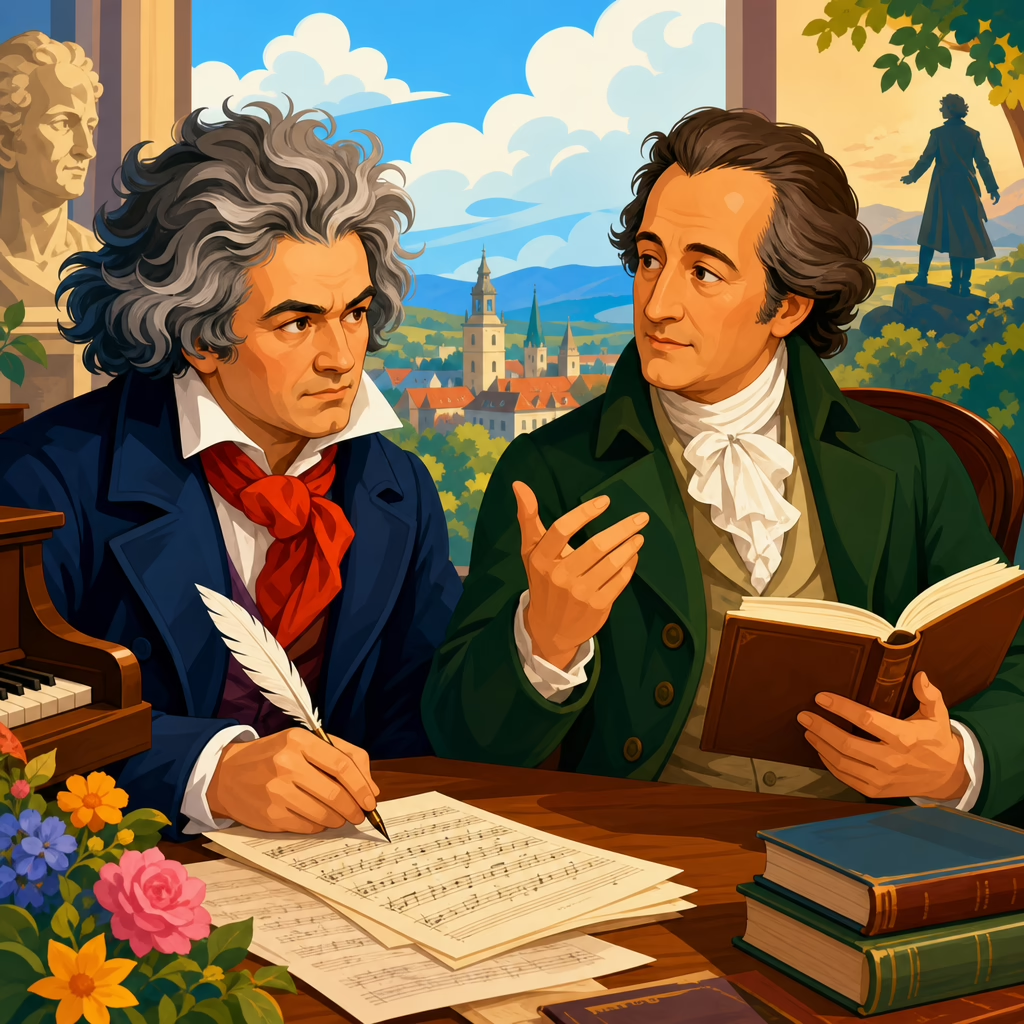
Beethoven and Goethe: A Creative Relationship
Beethoven and Goethe represent one of the most intriguing creative relationships in European culture, not because they collaborated extensively, but because their brief personal contact and sustained artistic dialogue reveal how music and literature shaped one another during a decisive historical moment. In the context of Beethoven’s inspirations and influence, this relationship belongs in a miscellaneous hub because it touches biography, aesthetics, politics, patronage, performance culture, and the wider circulation of ideas in the early nineteenth century. Beethoven was the revolutionary composer from Bonn and Vienna whose work transformed the language of instrumental music; Goethe was the leading German poet, dramatist, novelist, and public intellectual whose writing helped define modern literary culture. When readers search for Beethoven and Goethe, they usually want to know three things: did they meet, what did Beethoven compose from Goethe’s texts, and why did their relationship matter. The short answer is yes, they met in 1812 at Teplitz, Beethoven set several Goethe texts including the music for Egmont, and the relationship matters because it exposes both harmony and tension between artistic genius, social hierarchy, and ideas of freedom.
I have always found this subject especially revealing because it resists the easy myth that great artists naturally admire each other without reservation. Beethoven admired Goethe deeply for years before they met. He read Goethe, set his poetry, and believed the poet embodied the modern German spirit. Goethe, for his part, respected Beethoven’s extraordinary gifts, yet he was unsettled by the composer’s intensity, rough manners, and disdain for court etiquette. Their encounter therefore offers more than anecdote. It provides a case study in how creators from different disciplines respond to the same age of Napoleon, aristocratic patronage, bourgeois ambition, and emerging Romanticism. It also helps explain why Beethoven’s relationship to literature was not decorative but structural. He did not simply borrow words to make songs. He treated texts, characters, and moral conflicts as engines for musical form, from incidental music to overtures and dramatic scenes. Goethe’s works gave him a language of heroism, inwardness, and ethical struggle that fit his artistic instincts.
As a hub article within Beethoven’s inspirations and influence, this page maps the full scope of the topic and points toward related subthemes readers often explore next: Beethoven’s songs, his stage works, his relationship with German literature, the political world around Egmont, the 1812 Teplitz meeting, Bettina Brentano’s role in shaping the legend, and the contrast between Beethoven’s artistic independence and Goethe’s courtly practicality. Understanding these connections clarifies a larger truth. Beethoven was inspired not only by melodies, patrons, and predecessors, but also by writers whose ideas could be translated into sound. Goethe influenced Beethoven directly through texts and indirectly through the prestige of literary classicism. Beethoven, in turn, influenced the reception of Goethe by giving several works a powerful musical afterlife. Their relationship was brief in person, long in cultural memory, and still central to any serious discussion of Beethoven’s wider intellectual world.
How Beethoven Encountered Goethe Before They Met
Beethoven’s admiration for Goethe began well before 1812. By the 1790s and early 1800s, Goethe was already the dominant figure in German letters, known for The Sorrows of Young Werther, Iphigenie auf Tauris, Wilhelm Meister, Faust, and a large body of lyric poetry. Beethoven, who moved in educated Viennese circles despite lacking polished social manners, encountered Goethe through reading, salon culture, and the growing market for published German literature. This matters because Beethoven chose texts carefully. He was not a composer who set words casually. When he turned to Goethe, he was aligning himself with the most serious literary authority available.
Several song settings show the depth of that engagement. Beethoven composed lieder on Goethe texts such as “Neue Liebe, neues Leben,” “Wonne der Wehmut,” “Sehnsucht,” and “Mit einem gemalten Band.” These songs do not occupy the same public space as the symphonies, yet they reveal how Beethoven responded to poetic nuance. In “Neue Liebe, neues Leben,” for example, the restless piano writing mirrors emotional agitation rather than merely accompanying the voice. Beethoven reads the poem dramatically, making the keyboard a psychological participant. That approach anticipates later song composers, especially Schubert and Schumann, and demonstrates that Goethe mattered to Beethoven as a source of inner drama.
Goethe was also connected to circles Beethoven already valued. Publishers, aristocratic patrons, and intellectual intermediaries treated Goethe as a cultural benchmark. To admire Goethe was not only a matter of taste; it was a statement about one’s position within German high culture. Beethoven, who often insisted on his dignity in dealings with nobles, wanted recognition as an artist of equal seriousness to the greatest writers. His attraction to Goethe therefore had an aspirational side. He saw in the poet a model of artistic stature, even if he later discovered that Goethe’s social instincts differed sharply from his own.
Goethe Texts in Beethoven’s Music
The single most important Goethe-related work in Beethoven’s catalogue is the incidental music to Egmont, Op. 84, written in 1809–1810 for Goethe’s tragedy about the sixteenth-century Count Egmont and the Dutch struggle against Spanish oppression. The play’s political message aligned powerfully with Beethoven’s ideals. He had admired heroic resistance before, most famously in the troubled history of the Eroica Symphony and in Fidelio. In Egmont, he found a literary framework for sacrifice, liberty, and moral victory over tyranny. The overture became one of his most enduring concert works because it compresses the drama into purely orchestral terms: dark oppression, mounting conflict, and a blazing “Siegessymphonie,” or victory symphony, at the end.
Beyond Egmont, Beethoven’s Goethe settings include standalone songs and smaller vocal works that show different facets of his response. Some are lyrical and intimate, others more declamatory. What unites them is Beethoven’s refusal to treat text as a pretext for melody alone. He shapes rhythm, harmony, and texture to articulate meaning. In performance, this becomes immediately audible. A singer cannot approach these songs as salon miniatures with generic expression. The piano part carries argument, hesitation, urgency, and atmosphere. That compositional seriousness is one reason Goethe remained important to Beethoven even without a long personal friendship.
| Work by Beethoven | Goethe Source | Why It Matters |
|---|---|---|
| Egmont, Op. 84 | Goethe’s tragedy Egmont | Most significant collaboration in effect; defines Beethoven’s musical response to political freedom and heroic sacrifice. |
| “Neue Liebe, neues Leben,” Op. 75 No. 2 | Goethe lyric poem | Shows Beethoven’s ability to render emotional instability through active piano writing. |
| “Wonne der Wehmut,” Op. 83 No. 1 | Goethe lyric poem | Illustrates compressed expression and sensitivity to poetic contradiction. |
| “Sehnsucht,” settings including Op. 83 No. 2 | Goethe poem | Engages a central Romantic idea of longing with layered harmonic color. |
| “Mit einem gemalten Band,” Op. 83 No. 3 | Goethe lyric poem | Demonstrates Beethoven’s lighter, graceful response to refined poetic sentiment. |
The Teplitz Meeting of 1812
Beethoven and Goethe finally met in 1812 at the Bohemian spa town of Teplitz, where many aristocrats and cultural figures gathered during the summer season. The meeting has become famous partly because of later recollections, especially those associated with Bettina Brentano, whose accounts helped romanticize the encounter. Even allowing for embellishment, the essentials are clear. Beethoven admired Goethe intensely and was eager to know him personally. Goethe recognized Beethoven’s greatness, spent time with him, and observed at close range a personality far more volatile than his own. Their conversations likely ranged across art, society, and the political climate, although the surviving evidence is fragmentary.
The most quoted story concerns the two men encountering members of the imperial court while walking. According to the well-known account, Goethe stepped aside respectfully, while Beethoven continued forward with minimal deference, perhaps even forcing the nobles to make way. Whether every detail is exact matters less than what the story captures truthfully about their differences. Goethe was accustomed to court life at Weimar and believed social forms had practical value. Beethoven despised empty rank and insisted that true worth belonged to the artist, not the titleholder. In letters and behavior across many years, he repeatedly affirmed this principle. The Teplitz anecdote persisted because it distilled a genuine conflict of temperament and worldview.
After the meeting, Goethe wrote with admiration for Beethoven’s talent but also with unease about his “untamed” personality. Beethoven, in turn, became disappointed by Goethe’s deference to aristocratic society. This mutual ambivalence is essential. It prevents the relationship from being reduced either to a triumphant union of genius or to a complete failure. They recognized each other’s stature, yet each found the other limited. Goethe saw Beethoven as overwhelming and difficult. Beethoven saw Goethe as too attached to courtly conventions. Their brief friendship did not deepen into lasting intimacy, but the encounter sharpened the contrast between literary classicism and musical radicalism in the public imagination.
Politics, Freedom, and the Meaning of Egmont
If one work explains why Beethoven cared so much about Goethe, it is Egmont. Goethe’s drama portrays Count Egmont as a noble defender of liberty under foreign repression. Beethoven composed the music during a period when Vienna had experienced Napoleonic occupation and political instability. Although the play deals with the Spanish Netherlands, the themes were contemporary and urgent. In Beethoven’s hands, Egmont became more than theatre music. It became a statement about resistance, suffering, and the possibility of moral triumph even when the hero dies. That final victory music is not naïve optimism. It is a transformation of tragedy into collective resolve.
From a musical standpoint, the Egmont Overture is masterly dramatic compression. The slow introduction evokes oppression through dark sonorities and weighty orchestral writing. The faster main section drives forward with tension and conflict. At the close, the sudden release into the victory symphony reframes the entire narrative. I have heard audiences respond viscerally to this ending even when they do not know the play, which proves how effectively Beethoven translated Goethe’s dramatic structure into orchestral rhetoric. This is influence in the deepest sense: not illustration, but re-creation in another medium.
The work also had a long afterlife in political culture. Conductors, critics, and listeners repeatedly turned to Egmont during periods of national struggle or calls for freedom. That reception history belongs in any hub on Beethoven and Goethe because it shows how their combined legacy escaped the salon and the stage to enter public memory. Goethe provided the story; Beethoven supplied the sonic emblem. Together they created one of the most durable artistic statements of liberty in the nineteenth-century repertoire.
Why Their Personal Relationship Stayed Limited
The obvious question is why two towering figures did not become close collaborators after 1812. The answer lies in temperament, age, circumstance, and artistic priorities. Goethe was more than twenty years older, deeply established, administratively experienced, and practiced in navigating elite society. Beethoven was already burdened by worsening deafness, financial anxieties, health problems, and a combative streak intensified by years of struggle. He formed intense attachments, but he could also alienate allies quickly. Goethe appreciated order, measured self-presentation, and institutional life. Beethoven often seemed to reject all three.
There were artistic differences as well. Goethe’s literary values, though broad, retained classical balance and clarity. Beethoven’s mature style increasingly embraced abrupt contrasts, compressed motifs, and an uncompromising expressive force that some contemporaries found difficult. Goethe admired music, but he did not respond to Beethoven with the wholehearted advocacy Beethoven may have hoped for. Nor was Goethe inclined to center his literary identity around one composer. He occupied a different kind of fame, with a wider social and administrative role. That mismatch of expectations limited the relationship.
Bettina Brentano complicates the story. She admired both men and helped mediate their reputations, but some of her published recollections are unreliable or stylized. Modern scholarship therefore treats her accounts cautiously, comparing them with letters and documentary evidence. This is important for trustworthiness. The Beethoven-Goethe relationship has attracted legend precisely because it feels symbolically rich. Yet the strongest interpretation depends on careful distinction between documented fact and later mythmaking.
Legacy, Influence, and Related Paths for Further Reading
The lasting significance of Beethoven and Goethe lies less in personal friendship than in reciprocal cultural amplification. Goethe gave Beethoven texts, characters, and themes worthy of his highest dramatic instincts. Beethoven gave Goethe’s words musical settings that extended their reach and emotional force. Their encounter also became a touchstone for debates about the role of the artist in society. Should genius adapt to institutions, as Goethe often did, or confront them, as Beethoven preferred? The question remains alive because both answers contain truth. Art needs structures of support, but it also needs independence from social vanity.
For readers exploring this sub-pillar hub on Beethoven’s inspirations and influence, several related topics naturally branch from this page. One is Beethoven’s complete Goethe song settings, where close reading of text and music reveals his response to lyric poetry. Another is Beethoven’s political imagination, linking Egmont, Fidelio, and the Eroica period. A third is Beethoven’s interactions with other writers and intellectuals, including Schiller, whose “An die Freude” became the choral finale of the Ninth Symphony. Readers may also compare Goethe’s reception of composers such as Zelter, Reichardt, and Schubert to understand why Beethoven occupied a distinctive but not uncomplicated place in Goethe’s musical world.
In summary, Beethoven and Goethe formed a creative relationship defined by admiration, misunderstanding, and extraordinary artistic consequence. They met briefly, never became intimate allies, and yet left behind one of the richest intersections between music and literature in European history. Beethoven’s settings of Goethe texts, above all Egmont, prove how literary influence can be transformed into enduring musical form. Goethe’s cautious response to Beethoven reminds us that greatness does not erase difference. If you are building a deeper understanding of Beethoven’s inspirations and influence, start with the songs, listen closely to the Egmont Overture, and follow the thread from Teplitz into the wider world of art, politics, and reputation.
Frequently Asked Questions
Why is the relationship between Beethoven and Goethe considered so important if they did not work together extensively?
The importance of the Beethoven-Goethe relationship lies less in the quantity of direct collaboration and more in the extraordinary cultural meaning of their encounter. Here were two towering figures of German-speaking Europe, each reshaping his own art form at a moment of political upheaval, social transformation, and changing ideas about genius, individuality, and public culture. Beethoven, the revolutionary composer who expanded the expressive power of instrumental music, and Goethe, the preeminent poet, playwright, and novelist of his age, embodied parallel artistic ambitions even when their personalities and values diverged. Their brief personal contact, especially in 1812 at Teplitz, has fascinated scholars because it exposed sharp contrasts between them: Beethoven appeared defiant toward aristocratic etiquette and deeply invested in the moral authority of the artist, while Goethe remained more comfortable within court society and traditional hierarchies.
That contrast helps explain why the relationship matters so much in discussions of Beethoven’s inspirations and influence. Beethoven admired Goethe’s writing for years and set several of his texts to music, most notably in the incidental music for Egmont, Op. 84, as well as a number of songs and choral works. Goethe, for his part, recognized Beethoven’s immense talent, though he sometimes found the composer’s personality overpowering and his artistic intensity unsettling. Their connection therefore reveals more than mutual admiration. It opens a window onto larger questions: how literature could inspire music without requiring close collaboration, how artists responded differently to power and patronage, and how the ideal of the independent genius emerged in the modern age. In that sense, their relationship belongs naturally to a broader miscellaneous cultural hub, because it touches biography, aesthetics, politics, performance culture, and the social role of art all at once.
How did Goethe’s writings influence Beethoven’s music?
Goethe’s influence on Beethoven was both direct and conceptual. On the most practical level, Beethoven used Goethe’s texts as the basis for multiple compositions, showing that he found in Goethe’s language a powerful emotional and dramatic resource. The best-known example is Egmont, Goethe’s drama about resistance to political oppression, which Beethoven set as incidental music in 1810. This work was not just a decorative accompaniment to theater. Beethoven transformed Goethe’s political and moral themes into a vivid sonic narrative, culminating in the famous Egmont Overture, which has long been heard as a musical statement of struggle, sacrifice, and eventual triumph. The drama’s emphasis on freedom and heroic resistance strongly resonated with Beethoven’s own artistic temperament and political imagination.
Beethoven also set Goethe’s lyric poetry in songs such as “Neue Liebe, neues Leben,” “Wonne der Wehmut,” “Sehnsucht,” and “Mit einem gemalten Band,” among others. These settings show his sensitivity to Goethe’s language, but they also reveal his independence. Beethoven was not a passive illustrator of poetry. He often intensified the emotional and structural tensions within the text, using harmony, rhythm, and piano writing to deepen or complicate the literary meaning. That approach reflects a broader aesthetic shift of the period: music was increasingly treated not merely as support for words, but as an equal interpretive force capable of expressing inner life with unique authority.
On a conceptual level, Goethe’s writing offered Beethoven access to themes he cared about deeply: nature, inwardness, moral struggle, classical balance, and the dignity of the individual. Even when Beethoven was not directly setting Goethe, he was operating in a cultural world Goethe had helped define. The literary climate shaped by Goethe and his contemporaries encouraged a richer understanding of subjectivity and artistic seriousness, and Beethoven’s music can be heard as participating in that same intellectual environment. Their relationship therefore demonstrates how literary culture nourished musical creativity in subtle as well as obvious ways.
What happened when Beethoven and Goethe met in person, and why has that meeting become so famous?
Beethoven and Goethe met in 1812 in the Bohemian spa town of Teplitz, where many prominent European figures gathered during the Napoleonic era. Their meeting has become legendary partly because of the symbolic weight later generations attached to it, and partly because contemporary accounts suggest that the two men reacted to one another in revealing ways. Beethoven had long admired Goethe and had already engaged with his texts musically. Goethe, meanwhile, was well aware of Beethoven’s reputation. Their personal encounter thus carried the promise of a union between Germany’s greatest living composer and greatest living writer. Yet instead of confirming a simple harmony between them, the meeting highlighted important differences in temperament and worldview.
The most frequently repeated anecdote concerns a walk the two men took together when they encountered members of the imperial family or aristocratic company. According to accounts associated with Beethoven’s circle, Goethe stepped aside respectfully, while Beethoven continued forward with little regard for ceremonial deference. Whether every detail of the story is exact matters less than why it endured. It captured a widely felt distinction between them. Beethoven came to symbolize uncompromising artistic independence and impatience with inherited social privilege, while Goethe appeared more adept at navigating elite society and more willing to accept its conventions. This contrast fed later Romantic ideas about the artist as an autonomous moral force standing above rank and court protocol.
The meeting is famous, then, not because it produced a major collaboration, but because it dramatized a turning point in European cultural history. It showed how two geniuses shaped by the same era could respond very differently to authority, patronage, and public life. For readers and listeners today, Teplitz remains compelling because it turns an abstract cultural debate into a human scene: admiration mixed with discomfort, shared greatness shadowed by incompatible instincts, and mutual recognition complicated by different visions of how an artist should move through the world.
Did Goethe fully appreciate Beethoven’s music?
Goethe appreciated Beethoven’s talent, but his response was complex and not always wholehearted. He certainly respected Beethoven as a major artist, and there is clear evidence that he recognized the power of his music. Goethe praised aspects of Beethoven’s work and was connected to performances of music Beethoven wrote for his texts. At the same time, Goethe’s aesthetic sensibility had been formed in an earlier cultural framework that prized clarity, proportion, restraint, and a certain classical self-command. Beethoven, especially in his middle and later periods, often pursued a more turbulent, expansive, and disruptive form of expression. That difference helps explain why Goethe could admire Beethoven while still feeling uneasy about the extremity of his artistic personality and perhaps the force of his musical language.
It is important not to reduce this issue to a simple failure of understanding. Goethe did not dismiss Beethoven, nor was he incapable of recognizing innovation. Rather, he encountered in Beethoven a kind of intensity that challenged his own preferences. Beethoven’s music could seem elemental, confrontational, and emotionally uncompromising. Goethe, who had spent decades balancing literary ambition with life in courtly and administrative settings at Weimar, tended to value mediation, order, and cultivated form. From that perspective, Beethoven represented both a triumph of genius and a destabilizing force. Goethe admired him, but perhaps from a slight distance.
This tension is one reason the relationship continues to attract attention. It reminds us that great artists do not necessarily respond to one another with uncomplicated enthusiasm. Appreciation can be mixed with reservation, especially when one artist embodies emerging values that unsettle another’s artistic world. Goethe’s response to Beethoven therefore tells us as much about shifting cultural standards as it does about personal taste. It marks a transition from the classical ideal toward a more modern understanding of artistic subjectivity, and that transition is one of the key reasons their connection remains historically significant.
What does the Beethoven-Goethe connection reveal about art, politics, and patronage in their time?
The connection between Beethoven and Goethe reveals how deeply art in the late eighteenth and early nineteenth centuries was entangled with politics, social class, and systems of patronage. Both men lived through the French Revolution, the Napoleonic wars, and the reorganization of Europe’s political order. Those events did not remain outside their work. They shaped ideas of freedom, heroism, national culture, public morality, and the role of the individual in history. Beethoven’s attraction to Goethe’s Egmont is a perfect example. The drama concerns resistance to tyranny, and Beethoven’s music for it gave those themes urgent emotional force at a time when political oppression and liberation were not abstract ideas but lived realities.
At the same time, both artists depended in different ways on elite structures. Goethe worked within the Weimar court and spent much of his life as both writer and statesman, while Beethoven relied on aristocratic patrons even as he cultivated the image of an independent creator. This created a productive but sometimes uncomfortable contradiction. Neither man existed outside patronage, yet each contributed to the emerging prestige of the modern artist as a figure whose authority derived from genius rather than social rank. Their famous differences over etiquette and aristocratic behavior should be understood within that context. They were not simply personal quirks. They reflected larger tensions between old social orders and new artistic identities.
Their relationship also sheds light on performance culture and the circulation of ideas across artistic media. Goethe’s works traveled through print, theater, salons, and court performance; Beethoven’s music moved through concerts, domestic music making, publication, and theatrical production. When Beethoven