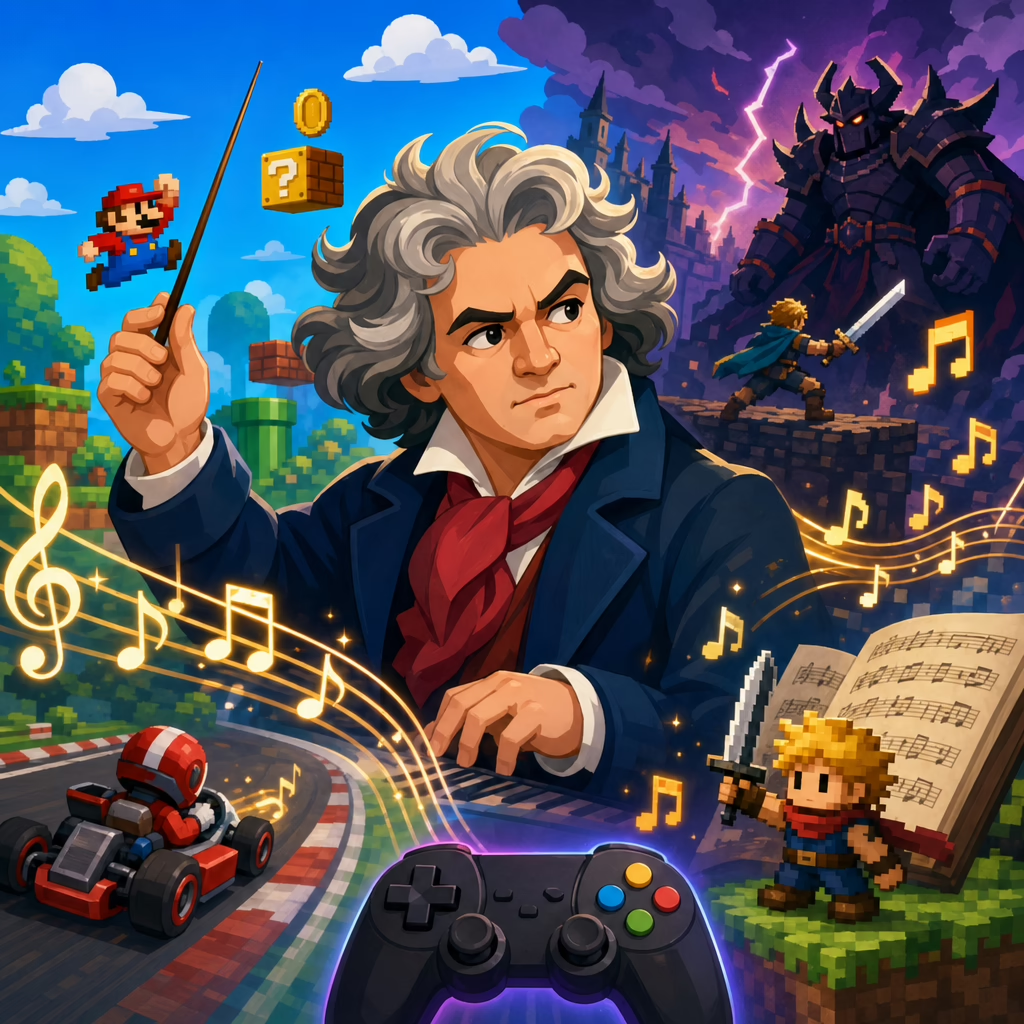
How Video Games Incorporate Beethoven’s Music
Video games have become one of the most interesting places where Beethoven’s music survives, evolves, and reaches audiences who may never set foot in a concert hall. In game design, “incorporate” can mean direct licensing of a Beethoven composition, orchestral quotation inside a score, adaptive rearrangement for gameplay, or narrative use of Beethoven as a cultural symbol. For players, these choices do more than add prestige. They shape emotion, pacing, worldbuilding, and memory. I have worked on music analysis for interactive media projects, and Beethoven appears in games for a simple reason: his themes are recognizable, dramatically flexible, and loaded with cultural meaning. This hub article explains how video games incorporate Beethoven’s music across genres, why developers choose it, what technical and artistic methods they use, and where this subject connects to broader Beethoven in pop culture research.
Beethoven’s catalog fits games unusually well because it spans intimacy, tension, triumph, grief, and formal clarity. The “Moonlight Sonata” can underscore solitude or unease. Symphony No. 5 can signal fate, conflict, or looming threat. “Ode to Joy” can frame victory, utopian aspiration, irony, or collapse, depending on context. Because many Beethoven works are in the public domain, studios can arrange the compositions without paying composition royalties, though they still pay for specific recordings or produce their own. That practical advantage matters. So does audience literacy. Even players who cannot name Opus numbers often recognize the emotional code of Beethoven. As a miscellaneous hub under Beethoven in Pop Culture, this page maps the full landscape: soundtrack practice, narrative symbolism, legal realities, technical implementation, game examples, and the main questions readers typically ask before exploring more specialized pages.
Why game developers use Beethoven
Developers use Beethoven because his music solves multiple creative problems at once. First, it gives immediate emotional definition. A few measures of the Piano Sonata No. 14 in C-sharp minor, popularly called “Moonlight Sonata,” establish melancholy faster than a newly introduced motif often can. Second, Beethoven carries cultural authority. When a game references him, it can imply refinement, historical depth, obsession, genius, tragedy, Europe, revolution, or the burden of legacy. Third, the music is structurally strong. Beethoven’s rhythmic cells and harmonic trajectories adapt well to looping, recomposition, and thematic fragmentation, all common needs in interactive audio.
I have seen teams choose Beethoven at the concept stage because temp music featuring him can align a whole room quickly. Narrative designers hear a familiar emotional palette. Marketing teams hear prestige. Audio directors hear motifs sturdy enough for orchestration, piano reduction, ambient treatment, or trailer editing. This does not mean Beethoven is always the best choice. Overuse can feel clichéd, and direct quotation can overpower a game’s original identity. But when the goal is to anchor a scene with instantly legible emotion, Beethoven remains one of the most efficient musical tools available to game creators.
Common ways Beethoven appears in games
Video games incorporate Beethoven in four main ways: direct performance, arrangement, quotation, and symbolic reference. Direct performance means a piece appears essentially as written, perhaps through a licensed recording or newly recorded version. Arrangement means the composition is reworked for game context, such as solo piano transformed into electronic ambience or full orchestra adapted to a smaller ensemble. Quotation is more selective: a composer may borrow a recognizable melodic gesture, rhythmic figure, or harmonic progression without presenting a complete work. Symbolic reference uses Beethoven as an idea, even when no full composition is heard, through titles, character names, environmental cues, or diegetic performance scenes.
These methods often overlap. A horror game might begin with a faithful piano statement of “Moonlight Sonata,” then dissolve it into processed drones as danger rises. A strategy game might quote the four-note motif associated with Symphony No. 5 inside an original battle cue. A narrative adventure might place Beethoven on a character’s record shelf to communicate personality before any dialogue occurs. Understanding those categories helps readers compare games accurately. Not every Beethoven connection is a soundtrack credit. Sometimes the influence sits in level design, story framing, or a composer’s thematic language.
Which Beethoven pieces appear most often
Certain works dominate because they are familiar, adaptable, and semantically rich. “Moonlight Sonata” appears often in games needing introspection, haunted elegance, or gothic tension. Symphony No. 5 is used for conflict, foreboding, and recognizable dramatic shorthand. Symphony No. 9, especially “Ode to Joy,” appears in grand finales, satirical juxtapositions, and scenes about collective destiny. “Für Elise,” though technically bagatelle rather than large-form statement, shows up because it is instantly recognized and works well in puzzle, mobile, and casual contexts. The “Pathétique” Sonata and “Appassionata” are also attractive to developers seeking emotional intensity without using the most overfamiliar examples.
The reason these works recur is not simply popularity. They offer clean motifs that survive heavy adaptation. The opening of Symphony No. 5 can be orchestrated for brass, rendered as chiptune, slowed into horror ambience, or hidden in percussion ostinato. “Moonlight Sonata” retains identity even when reharmonized or fragmented. In practical scoring terms, that durability is invaluable. A game score must often respond to mechanics, transitions, and memory limits. Beethoven’s strongest themes remain legible through those constraints, which is why the same pieces keep returning across very different genres and platforms.
How Beethoven supports gameplay, story, and mood
In games, music is not background decoration. It directs attention, shapes perceived difficulty, and tells the player how to feel about what they are doing. Beethoven supports gameplay when his music matches a mechanic or reframes it. Slow piano can make exploration feel reflective. A forceful symphonic gesture can make a boss encounter feel inevitable rather than merely loud. In story-driven games, Beethoven often signals a character’s interior world. A villain associated with Beethoven may read as disciplined, aristocratic, emotionally repressed, or grandiose. A fragile protagonist practicing Beethoven may suggest aspiration, loneliness, or inherited pressure.
There is also productive irony. I have analyzed scenes where triumphant Beethoven accompanies destruction, making the player question whether victory is morally clean. This works especially well with “Ode to Joy,” a melody culturally tied to brotherhood and celebration. When placed against dystopian imagery, it can feel unsettling rather than uplifting. Developers rely on this double-coding because games are interactive systems, not passive films. Players may be causing the event on screen. Beethoven’s historical associations give designers a powerful way to complicate player agency, reward, and guilt within a single scene.
Representative examples across game types
Beethoven appears in many kinds of games, from rhythm titles to action adventures, visual novels, strategy games, horror games, and educational software. Rhythm games may present Beethoven straightforwardly because recognizable classics support note-chart design and broad audience appeal. Horror and mystery titles often gravitate to “Moonlight Sonata” or sparse Beethoven piano textures because they communicate refinement touched by dread. Grand strategy and historical games may use Beethoven-adjacent orchestral language to place the player in a European cultural frame. Even mobile games and casual titles use fragments like “Für Elise” because short motifs fit menus, tutorials, and completion cues.
Specific implementations vary. In some Japanese games, classical pieces appear as part of a broader tradition of quoting Western concert music to signal seriousness or eccentricity. In some Western games, Beethoven is folded into cinematic scoring conventions and may not be foregrounded in marketing even if he is clearly audible in the soundtrack. Educational and edutainment titles have long used Beethoven because his name carries curricular legitimacy. That means the Beethoven-in-games topic is broader than blockbuster examples alone. The miscellaneous category matters because many appearances are brief, diegetic, regional, or embedded in larger musical systems rather than showcased as headline features.
Technical and legal realities behind using Beethoven
Public domain status makes Beethoven accessible, but implementation is not automatic. The compositions are free to arrange, yet a studio cannot simply lift a famous commercial recording without permission. If developers want the Berlin Philharmonic’s recording of Symphony No. 9, they need master rights. Many teams instead commission new recordings, use sample libraries, or create hybrid arrangements. Audio middleware such as Wwise and FMOD then allows these recordings to behave interactively, with stems fading, layering, or shifting based on player state. A Beethoven cue in a game may therefore be less like a fixed concert performance and more like a modular system.
| Method | How it works in games | Main advantage | Main limitation |
|---|---|---|---|
| Licensed recording | Uses an existing performance | High artistic prestige | Master rights can be expensive |
| New studio recording | Game team records its own version | Full control over tempo and mix | Requires budget and musicians |
| Sample-based arrangement | Built with orchestral libraries or synths | Flexible and efficient | May sound less organic |
| Thematic quotation | Uses motifs inside an original score | Subtle integration | Recognition may be partial |
From experience, the hardest part is usually not licensing but fit. Beethoven was written for concert listening, not non-linear systems. Loops can expose cadences too obviously. Dynamic layering can flatten expressive rubato if arranged poorly. Strong themes can also dominate dialogue or UI sounds. Good game audio teams solve this by composing connective tissue around Beethoven, isolating motifs for transition states, and controlling register so the quote feels intentional rather than pasted on. When the implementation is thoughtful, the result feels native to play rather than imported from a recital hall.
What Beethoven references communicate to players
Beethoven references communicate fast because they draw on collective memory. Even without formal music education, many players associate Beethoven with genius, struggle, depth, and seriousness. That symbolic bundle can characterize a setting or person in seconds. A mansion with a damaged piano playing Beethoven suggests old wealth, loss, and cultivated decay. A futuristic regime using Beethoven in propaganda implies an attempt to claim universal culture for political legitimacy. A comic game can reverse expectations by using a dignified Beethoven phrase during absurd action, creating humor through contrast.
These signals are not universal in exactly the same way across regions, ages, or gaming communities, so interpretation needs nuance. Younger players may recognize the tune but not the composer. Some audiences hear European elitism where others hear timeless art. That variation is part of why Beethoven remains useful. His music can operate at multiple literacy levels: pure mood for one player, historical reference for another, and intertextual commentary for a third. For a hub page, that is the key insight. Beethoven in video games is never just about soundtrack sourcing. It is about meaning, status, and how interactive media repurpose inherited cultural symbols for new audiences.
How this hub connects to broader Beethoven in pop culture
This miscellaneous hub sits within a larger Beethoven in Pop Culture framework because games borrow from the same cultural reservoir as film, television, advertising, anime, and internet media, yet they use the music differently. Interactivity changes everything. In a film, Beethoven unfolds against a locked sequence. In a game, the player may interrupt, repeat, accelerate, or delay the cue. That changes composition, mixing, and interpretation. It also changes memory. Players often remember Beethoven not only because they heard it, but because they acted while hearing it. The association becomes experiential rather than merely observational.
For readers exploring this subtopic, the next useful step is to compare game usage with other media forms and then drill down into specific pieces, franchises, or composers. The big takeaway is straightforward. Video games incorporate Beethoven’s music because it is emotionally precise, culturally legible, technically adaptable, and economically practical. Whether presented faithfully, rearranged for interaction, or quoted as symbolic shorthand, Beethoven helps games communicate complex ideas quickly. If you are building out knowledge of Beethoven in Pop Culture, use this hub as your starting map, then follow the related articles on individual works, recurring game examples, and the broader history of classical music in interactive entertainment.
Frequently Asked Questions
How do video games actually incorporate Beethoven’s music?
Video games incorporate Beethoven’s music in several distinct ways, and each approach serves a different creative purpose. The most direct method is licensing or using a Beethoven composition itself, such as the “Moonlight Sonata,” Symphony No. 5, or “Für Elise,” either in an original orchestral recording or a newly produced interpretation. Developers also quote Beethoven more subtly by weaving a recognizable melodic fragment, harmonic progression, or rhythmic gesture into an original score. In other cases, composers adapt Beethoven’s themes to fit gameplay systems, turning a concert work into something dynamic that can shift with combat intensity, exploration, or story events.
Games can also use Beethoven narratively rather than purely musically. A piece associated with him may signal sophistication, tragedy, obsession, or historical depth. That means Beethoven is not just background music; he can function as a storytelling device, a marker of class or culture, or a shorthand for emotional seriousness. In practice, incorporation may happen at the level of soundtrack composition, scene design, character identity, or worldbuilding. This flexibility is one reason Beethoven remains so useful in interactive media: his music is familiar enough to be meaningful, but rich enough to be reinterpreted in modern, playable forms.
Why do game developers choose Beethoven instead of other classical composers?
Developers choose Beethoven because his music carries immediate emotional and cultural weight. Even players with little formal knowledge of classical music often recognize the force of his most famous works. A few notes from Symphony No. 5 can suggest fate, conflict, and urgency. The “Moonlight Sonata” can imply melancholy, introspection, or gothic atmosphere. “Ode to Joy” can evoke triumph, unity, irony, or even controlled chaos depending on how it is staged. That instant recognizability is incredibly valuable in games, where audio has to communicate quickly and effectively while players are busy interacting with the world.
Beethoven also works well because his music is structurally dramatic. It has tension, release, contrast, momentum, and strong thematic identity, all of which align naturally with game design needs. Action sequences, boss fights, mystery scenes, and emotionally charged cutscenes benefit from music that already contains a sense of movement and high stakes. On top of that, Beethoven occupies a unique place in cultural imagination: he represents genius, struggle, rebellion, discipline, and artistic intensity. When a game invokes Beethoven, it can borrow all of those associations at once. That combination of recognizability, dramatic power, and symbolic meaning makes him especially attractive compared with composers whose music may be beautiful but less instantly legible to broad audiences.
How is Beethoven’s music adapted to fit interactive gameplay rather than a fixed concert performance?
Adapting Beethoven for games usually means reshaping linear music into a system that can respond to player behavior. In a concert hall, a Beethoven movement unfolds at one pace from beginning to end. In a game, music may need to loop, expand, contract, or transition seamlessly as the player explores, fights, solves puzzles, or triggers story beats. To make that work, composers and audio teams often break music into modular layers. A Beethoven-inspired theme might begin with a sparse piano texture during exploration, then add strings, percussion, brass, and choir as danger increases. The core identity of the piece remains intact, but its presentation becomes interactive.
Developers may also reharmonize, reorchestrate, or fragment Beethoven’s material so it can serve multiple gameplay states without sounding repetitive. A famous melody might appear in ambient form in one location, then return in a full orchestral arrangement during a major encounter, reinforcing memory and emotional continuity. Tempo and instrumentation can be adjusted to fit genre conventions as well. In a science-fiction game, a Beethoven theme might be translated into synthetic textures. In a horror game, it may become slower, thinner, and more dissonant. The key point is that adaptation is not simply a matter of inserting classical music into a scene. It is a design process that turns a historically fixed composition into something elastic, reactive, and deeply integrated with play.
What does Beethoven’s music add to storytelling, worldbuilding, and player emotion in games?
Beethoven adds depth because his music can shape how players interpret a scene before any dialogue explains it. A carefully placed classical piece can establish tone, era, social environment, or psychological state almost instantly. If a game uses Beethoven in a ruined mansion, an opera house, a military setting, or a futuristic dystopia, the same music can communicate very different meanings depending on context. That is why Beethoven is so effective for worldbuilding: his work brings historical resonance, but it is flexible enough to function in period drama, fantasy, satire, science fiction, and psychological narrative.
Emotionally, Beethoven’s music is powerful because it often feels larger than the immediate moment. It can elevate a scene from simple action to something memorable and symbolic. A battle underscored by Beethoven may feel less like routine combat and more like a confrontation with destiny. A quiet scene accompanied by one of his more intimate works can deepen feelings of loss, longing, or reflection. This is especially important in games, where memory is tied not only to what players saw but to what they did while hearing it. When Beethoven’s music is attached to a key decision, a boss fight, a revelation, or a tragic ending, it can fuse with player agency and become far more personally memorable than the same piece might be in passive listening. That fusion of music, narrative, and action is one of the strongest reasons Beethoven continues to thrive in interactive media.
Does using Beethoven in games help introduce classical music to new audiences?
Yes, and this is one of the most significant cultural effects of Beethoven’s presence in games. Many players encounter classical music first not in school, film, or the concert hall, but through game soundtracks. When a game uses Beethoven effectively, it can create a powerful first impression that is tied to excitement, emotion, and discovery. A player may hear a melody during a pivotal scene, become curious, and later seek out the original sonata or symphony. Because games are immersive and participatory, they often create stronger personal associations than more passive media. That makes them an unusually effective gateway into older musical traditions.
Just as important, games do not merely preserve Beethoven; they reinterpret him for contemporary listeners. A player might first experience his music through a hybrid orchestral-electronic arrangement, a dark ambient variation, or an adaptive combat cue before ever hearing the original score. Far from diminishing the source, that can broaden its relevance. It shows that Beethoven is not frozen in history but still capable of meaning something in new technological and artistic environments. For audiences who might never attend a symphony performance, games can serve as a living introduction to his music, demonstrating that classical works are not museum pieces but active tools for storytelling, emotion, and imagination.