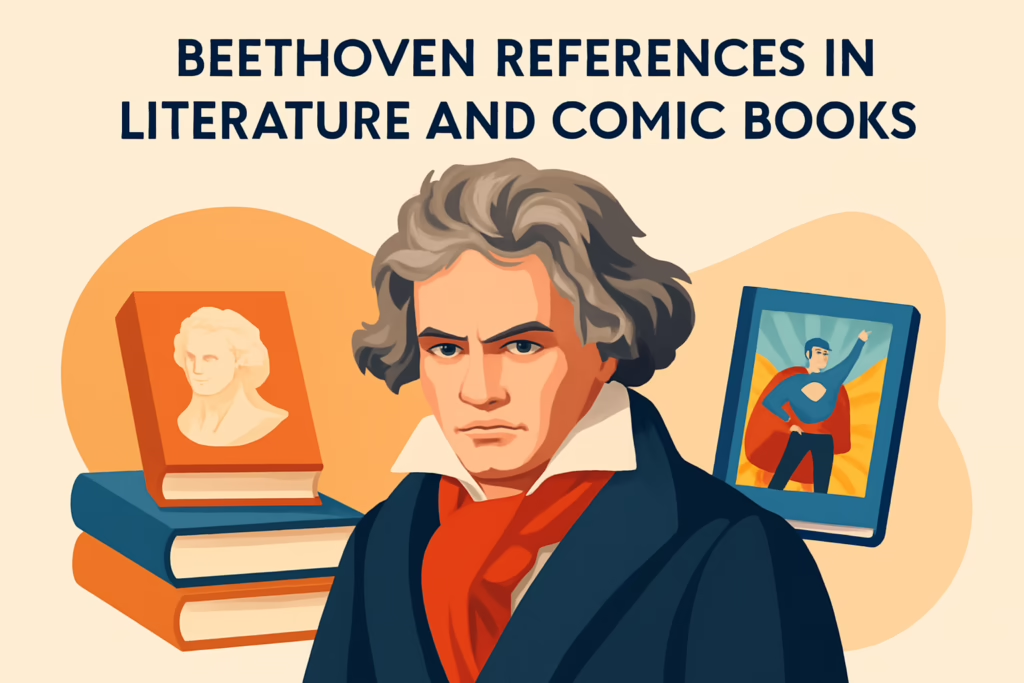
Beethoven References in Literature and Comic Books
Beethoven references in literature and comic books reveal how a nineteenth-century composer became a durable modern symbol for genius, struggle, rebellion, discipline, and cultural prestige. In this miscellaneous corner of Beethoven in pop culture, the subject is broader than simple name-checks. A reference can be a direct quotation from the music, a character named after Beethoven, a plot built around a sonata or symphony, or a visual cue such as wild hair, a stern portrait, or manuscript pages signaling high art. In practice, I have found that writers and comics creators use Beethoven when they need shorthand that instantly carries emotional weight. Readers recognize him even if they cannot identify a specific movement. That recognition matters because literature and comics work through compressed signals: a single allusion can establish class aspiration, obsessive creativity, moral seriousness, or ironic contrast. This hub article maps the major patterns, explains why Beethoven appears so often, and shows how these references function across novels, short stories, graphic narratives, superhero titles, manga, and literary comics.
Understanding the range of Beethoven references starts with a few key terms. An allusion is an indirect mention that expects readers to catch the association. An adaptation reshapes a biographical episode, composition, or public myth into a new story. An intertext links one work to another, sometimes by quoting titles such as the “Moonlight Sonata” or “Ode to Joy,” sometimes by borrowing the emotional architecture of struggle followed by triumph. In comic books, iconography matters as much as dialogue. A concert hall, a record sleeve, a bust on a shelf, or jagged lettering suggesting orchestral force can carry the reference visually. The reason this matters is simple: Beethoven is one of the few classical composers who functions as a global cultural sign. He can signify elite taste, universal humanism, tortured artistry, revolutionary energy, or comic exaggeration, depending on context. That flexibility makes him especially useful in miscellaneous pop culture, where creators need a familiar cultural anchor while telling very different kinds of stories.
Why Beethoven Works So Well as a Literary and Comics Reference
Beethoven survives in fiction and comics because his public image is unusually adaptable. Authors can invoke the deaf composer battling fate, the heroic artist breaking formal rules, the difficult genius alienated from ordinary society, or the canonical master assigned in schools and conservatories. Few cultural figures offer this range without lengthy explanation. In novels, that means a passing mention can establish a character’s ambitions or insecurities immediately. In comics, it means one panel can do the work of a paragraph. I have seen this repeatedly when tracking references across mainstream and literary publishing: Beethoven is used not just because he is famous, but because his fame contains tension. He belongs to institutions, yet he also represents defiance against institutions. He is associated with refinement, yet his music often signals raw intensity. That duality is dramatically useful.
Specific works amplify the effect. The Fifth Symphony often stands for destiny, crisis, and relentless momentum because of its iconic four-note opening. The Ninth Symphony, especially “Ode to Joy,” carries associations of universal brotherhood, political ceremony, and grand collective feeling. The “Moonlight Sonata” frequently signals introspection, melancholy, romance, or misunderstood darkness, even though popular interpretations often flatten the work’s actual structure. Because these pieces are culturally overdetermined, creators can use them quickly. A detective novel may place the “Appassionata” on a record player to suggest a suspect’s intensity; a comic may parody “Für Elise” as beginner-piano shorthand before pivoting into deeper characterization. The point is not strict musicology. The point is that Beethoven references arrive preloaded with emotional and social meaning.
Beethoven in Literature: Symbol, Structure, and Characterization
In literature, Beethoven appears in several recurring ways. First, he functions as a marker of interior life. Characters who listen to Beethoven are often presented as serious, disciplined, lonely, or emotionally overfull. Second, he can represent cultural capital. A bookshelf with Goethe and a piano score of Beethoven tells readers something about education, class performance, or aspiration. Third, his biography provides narrative structure. The arc from adversity to artistic achievement is attractive to novelists because it mirrors the shape of many Bildungsroman and artist novels. Fourth, Beethoven can work ironically. A pompous character who talks grandly about the Ninth may be signaling vanity rather than depth.
Writers from different traditions have used Beethoven for different ends. In modernist and postwar fiction, Beethoven often appears as a test case for whether great art elevates or deceives. In campus novels, he can stand for the canon under pressure. In psychological fiction, a sonata or quartet may trigger memory, grief, or obsessive analysis. In popular fiction, a Beethoven recording can anchor a scene quickly, giving readers an instant emotional cue without stopping the plot. Even when the reference is brief, it rarely feels random. Beethoven usually enters the text at moments where a writer wants to intensify stakes, expose contradiction, or connect a private emotion to something culturally monumental.
Some literary uses are more structural than symbolic. A novel may borrow the movement pattern of a sonata or symphony, using exposition, development, and recapitulation as a loose narrative model. Others borrow the public mythology of Beethoven rather than his music, emphasizing the solitary creator who persists despite physical limitation. That matters because many readers know the man’s legend more readily than they know Opus numbers. The result is a layered effect: even when the music itself is not analyzed, the name Beethoven can carry biography, canon, and emotion at once.
Beethoven in Comic Books and Graphic Narratives
Comic books use Beethoven differently because the medium combines text, image, pacing, and design. A comics page can present Beethoven as portrait, parody, soundtrack cue, plot device, or visual metaphor. Superhero comics often deploy classical music references to create grandeur or contrast. A villain who quotes Beethoven may be coded as cultured and dangerous. A hero practicing piano under pressure may reveal vulnerability and discipline. In manga and graphic novels centered on music, Beethoven is more likely to be treated with technical respect, appearing in rehearsal scenes, conservatory settings, or stories about competition and artistic identity.
Visual shorthand is crucial. The broad forehead, unruly hair, severe expression, and period clothing make Beethoven immediately identifiable even in caricature. Artists can also suggest his presence through scores, busts, or concert posters. Because comics cannot literally play music, they often compensate with typography and panel rhythm. Dense black lines, expanding splash pages, and repeated visual motifs can imply the force of a symphonic passage. I have noticed that creators often choose Beethoven when they want readers to imagine overwhelming sound, not merely pleasant background music. His references therefore tend to cluster around intensity, revelation, breakdown, or ambition.
Graphic narratives also exploit contrast. Beethoven can appear in absurdist or comedic scenes precisely because he signifies seriousness. A chaotic team of heroes arguing beneath a bust of Beethoven creates instant irony. A cartoon animal earnestly pounding out “Moonlight Sonata” can signal exaggerated melancholy. Yet parody does not erase prestige. Even jokes depend on the assumption that Beethoven still means something important. That continuing recognizability explains why he remains useful across all-ages comics, literary graphic memoir, satire, and genre storytelling.
Common Reference Patterns and What They Usually Mean
Across literature and comics, a few Beethoven references recur so often that they have become narrative tools with relatively stable meanings. These patterns do not lock a text into one interpretation, but they provide a reliable starting point for readers. The table below summarizes the most common uses and the effect they typically create.
| Reference | Typical Use in Literature | Typical Use in Comics | Usual Meaning |
|---|---|---|---|
| Fifth Symphony | Moments of crisis, inevitability, pressure | Battle buildup, dramatic montage, parody of fate | Conflict, destiny, momentum |
| Ninth Symphony / “Ode to Joy” | Collective ideals, irony about humanism, public ceremony | Epic scale, apocalyptic contrast, triumphant finale | Universality, grandeur, contested hope |
| “Moonlight Sonata” | Private grief, romantic introspection, brooding memory | Melancholic character beat, gothic atmosphere | Sadness, mystery, emotional depth |
| “Für Elise” | Domestic music-making, beginner familiarity, nostalgia | Comic cue, instant recognition in light scenes | Accessibility, memory, cliché with affection |
| Beethoven portrait or bust | Signals education, canon, aspiration | Visual shorthand for seriousness or parody | Authority, prestige, cultural weight |
| Deafness biography | Art despite suffering, isolation, endurance | Backstory mirror for misunderstood characters | Resilience, tragic genius |
These patterns matter because they help explain why some references feel deep and others feel merely decorative. A sophisticated novel may invoke the Ninth to question whether universal brotherhood is achievable; a simpler adventure comic may use the same work just to signal epic scale. Both uses are valid, but the surrounding context determines whether the reference adds thematic complexity or functions as cultural wallpaper. Readers evaluating Beethoven in fiction should therefore ask three direct questions: Which Beethoven is being invoked, what emotional shortcut does the reference provide, and does the work confirm or challenge that expected meaning?
Notable Examples, Variations, and Recurring Motifs
One major recurring motif is Beethoven as the soundtrack of obsession. Fictional pianists, conductors, and scholars often measure themselves against him, and that comparison can become unhealthy. The reason is obvious: in Western art music, Beethoven has long been treated as a benchmark of seriousness. A novel about a student preparing the “Hammerklavier” does not need pages of exposition to establish extreme difficulty. Readers who know the repertoire understand the demand; readers who do not still sense prestige from context. Comics and manga about music use the same logic. Rehearsing Beethoven becomes a visible sign of discipline, hierarchy, and emotional exposure.
Another motif is Beethoven as a democratic icon whose music escapes elite spaces. Street musicians play “Für Elise,” cartoons repurpose the Fifth, and graphic memoirs place Beethoven recordings in ordinary homes. This movement from concert hall to everyday life is central to his pop-cultural afterlife. It explains why references can appear in both high literary fiction and mass-market comics without seeming misplaced. His music has circulated through radio, film, school curricula, advertisements, and sampled media for generations. By the time a novelist or artist uses Beethoven, the reference often carries several prior media histories at once.
A third motif is tension between sincere admiration and ironic distance. Postmodern fiction especially likes to test whether Beethoven still commands belief. A character may love the late quartets deeply while recognizing that public talk about genius can become exclusionary or pretentious. Comics can stage the same tension visually: a sublime concert sequence may be interrupted by mundane commentary, undercutting reverence without dismissing the music itself. That balanced approach tends to be the most convincing. Pure hero worship feels dated; total mockery ignores the genuine emotional force that keeps Beethoven references alive.
How to Read Beethoven References Critically
Reading Beethoven references well requires more than spotting titles. Start with function. Ask what the reference is doing in the scene: defining character, elevating stakes, signaling irony, marking social status, or linking a private struggle to a larger cultural myth. Then examine precision. If a text names the Ninth but describes intimate solitude, the mismatch may be intentional. If a comic uses Beethoven imagery around a villain, the goal may be to complicate easy assumptions that culture equals virtue. Context always matters more than the prestige of the name alone.
It also helps to separate historical Beethoven from cultural Beethoven. The historical composer left sketches, letters, and scores shaped by specific political and artistic conditions. Cultural Beethoven is the later myth assembled by critics, educators, filmmakers, advertisers, and fans. Literature and comics usually engage the myth, though strong works often let the history push back. When creators acknowledge the tension between the real musician and the oversized legend, references gain depth. When they rely only on stereotype, the result can feel thin. For readers exploring this miscellaneous hub, that distinction is the best guide. Follow the reference, identify the version of Beethoven in play, and notice how the work uses him to think about art, power, feeling, and identity. If you are building out your understanding of Beethoven in pop culture, use this page as your starting map, then move into specific books, characters, and titles with these patterns in mind.
Frequently Asked Questions
Why does Beethoven appear so often in literature and comic books?
Beethoven appears so frequently in literature and comic books because he functions as more than a historical composer; he has become a cultural shorthand that readers instantly recognize. His image, music, and biography carry a dense cluster of meanings: artistic genius, emotional intensity, personal suffering, moral seriousness, rebellion against convention, and the idea of transcendent art created under pressure. Writers and comics creators use Beethoven because he lets them communicate all of that quickly, whether they want to invoke high culture, inner turmoil, discipline, or dramatic ambition.
His life story also helps explain his staying power. The narrative of a gifted artist confronting deafness while producing monumental music is one of the most durable myths in Western culture. In fiction, that myth can be adapted in many directions. A novelist might use Beethoven to symbolize the burden of genius. A satirical comic might use his stern face and wild hair to parody artistic seriousness. A mystery story might center a lost manuscript or coded musical quotation. Even a casual mention of the “Moonlight Sonata” or the Fifth Symphony can instantly create a mood of melancholy, inevitability, or heroic struggle.
Another reason is visual and symbolic convenience. Beethoven is easy to caricature and easy to identify. In comic books especially, his hair, frown, profile, manuscripts, or keyboard imagery can communicate “great composer” in a single panel. That makes him useful not only as a subject but also as a visual icon. Because his name has crossed from music history into general cultural literacy, creators can reference him without lengthy explanation, which is exactly what durable symbols do in storytelling.
What counts as a Beethoven reference in fiction, beyond simply mentioning his name?
A Beethoven reference in fiction can take many forms, and the most interesting examples often go far beyond a simple name-drop. At the most direct level, a reference may involve a specific composition such as the Ninth Symphony, the “Moonlight Sonata,” the “Appassionata,” or the opening motif of the Fifth Symphony. If a story builds a scene around a performance, a rehearsal, a recording, or even a character’s emotional response to one of those works, that is already a meaningful Beethoven reference rather than a casual mention.
References can also be structural or thematic. A novelist may pattern a plot around the movement structure of a sonata, use Beethoven’s struggle with deafness as a parallel to a character’s isolation, or present him as a touchstone for arguments about artistic purity, class aspiration, or cultural authority. In comic books and graphic narratives, references may be visual rather than verbal: manuscript pages in the background, a familiar portrait on a wall, exaggerated untamed hair, or a dramatic staging that visually echoes the mythology of the tortured genius. Even a character named Beethoven, or nicknamed “Beethoven” because of temperament, talent, or unruly appearance, participates in this tradition.
There are also ironic and playful references. Some works invoke Beethoven to contrast lofty ideals with everyday chaos, using the weight of classical prestige in a humorous setting. Others use him to question cultural hierarchy, asking who gets to define “great art” and why Beethoven is treated as a universal benchmark. In that sense, a Beethoven reference can be musical, visual, thematic, symbolic, or satirical. What unites these examples is that Beethoven brings a recognizable set of associations into the narrative and changes how the audience reads the scene.
What does Beethoven usually symbolize when authors and comic creators reference him?
In most literature and comic books, Beethoven symbolizes a powerful combination of genius, struggle, and seriousness. He often stands for the artist who creates something enduring through pain, discipline, and force of will. That makes him especially useful in stories about ambition, obsession, perfectionism, sacrifice, and the cost of exceptional talent. If a character admires Beethoven, the story may be suggesting intellectual depth, emotional intensity, or a desire to align with greatness. If a character resents Beethoven, the work may be critiquing elitism, cultural snobbery, or impossible standards.
He can also symbolize rebellion. Historically, Beethoven was absorbed into the idea of the independent artist who pushes beyond old rules and speaks with a personal, uncompromising voice. Fiction often draws on that image, especially when portraying outsiders, visionaries, prodigies, or difficult personalities. In this way, Beethoven references can imply not only refinement but defiance. A comic book hero, antihero, or villain associated with Beethoven may be framed as someone who is brilliant, intense, and unwilling to submit to ordinary expectations.
At the same time, Beethoven often symbolizes cultural prestige. His name carries institutional weight, so invoking him can signal education, status, or the presence of “serious” art in a narrative. Some creators use that sincerely, while others use it critically or comedically. A refined literary household may display Beethoven to show aspiration and cultivated taste. A comic may place Beethoven imagery in an absurd context to puncture that seriousness. This flexibility is one reason he remains so useful: the symbol can elevate a scene, deepen it, complicate it, or mock it, depending on how the reference is framed.
How are Beethoven references used differently in literature versus comic books?
Literature and comic books often draw on the same Beethoven mythology, but they tend to use it through different storytelling tools. In literature, Beethoven references are frequently internal, thematic, and interpretive. A novel can spend pages exploring what a sonata means to a character, how a symphony shapes memory, or why Beethoven becomes a personal or philosophical obsession. Prose has room to connect music to consciousness, social identity, grief, aspiration, and time. Authors can use Beethoven to deepen characterization, create symbolic architecture, or frame debates about aesthetics and morality.
Comic books, by contrast, have the advantage of visual immediacy. A single panel can signal Beethoven through hair, costume, portraiture, manuscript notation, piano imagery, or exaggerated conducting gestures. Comics can also pair those visuals with sound-effects language, rhythm in panel layout, or ironic contrast between image and dialogue. This makes Beethoven especially effective in comics as both icon and atmosphere. His presence can be solemn, operatic, absurd, or explosive, depending on the art style and narrative context. In superhero, horror, satire, and alternative comics alike, Beethoven can represent grandeur while also being available for parody.
That said, the distinction is not absolute. Literary works can be playful and visually minded, while comics can be intellectually dense and musically sophisticated. The key difference is usually emphasis: literature often explains or meditates on Beethoven, whereas comics often show him, quote him graphically, or deploy him as a recognizable visual symbol. Both forms benefit from the fact that Beethoven is culturally legible across audiences, but each medium activates that legibility in its own way.
Why do Beethoven references still matter to modern readers, especially in pop culture contexts?
Beethoven references still matter because they show how classical music survives not only in concert halls but also in the shared language of modern storytelling. When literature and comic books invoke Beethoven, they are not merely preserving an old composer’s reputation; they are continually reinterpreting what he means. For contemporary readers, these references can open a path between so-called high culture and popular culture, showing that symbols of genius, struggle, discipline, and emotional extremity remain useful across genres and audiences. Beethoven’s durability is evidence of cultural adaptability, not just historical prestige.
These references also matter because they reveal how art accumulates meanings over time. Modern readers rarely encounter Beethoven as a blank historical figure. They encounter a layered symbol shaped by biography, performance tradition, education, cinema, advertising, parody, and collective memory. Literature and comics tap into that layered symbol in sophisticated ways. A Beethoven reference may invite admiration, critique cultural gatekeeping, dramatize artistic obsession, or expose the comic absurdity of treating genius as a sacred brand. Understanding those uses helps readers see that references are active tools of interpretation, not decorative allusions.
Finally, Beethoven references remain relevant because they help creators discuss universal questions in a concise and resonant way. What does greatness cost? Can suffering produce insight, or is that a romantic myth? Is culture liberating or intimidating? Can “serious” art belong to everyone? Because Beethoven sits at the crossroads of those questions, he continues to function as an effective narrative resource. In pop culture contexts, his presence reminds readers that even a nineteenth-century composer can remain vividly alive as a modern symbol.