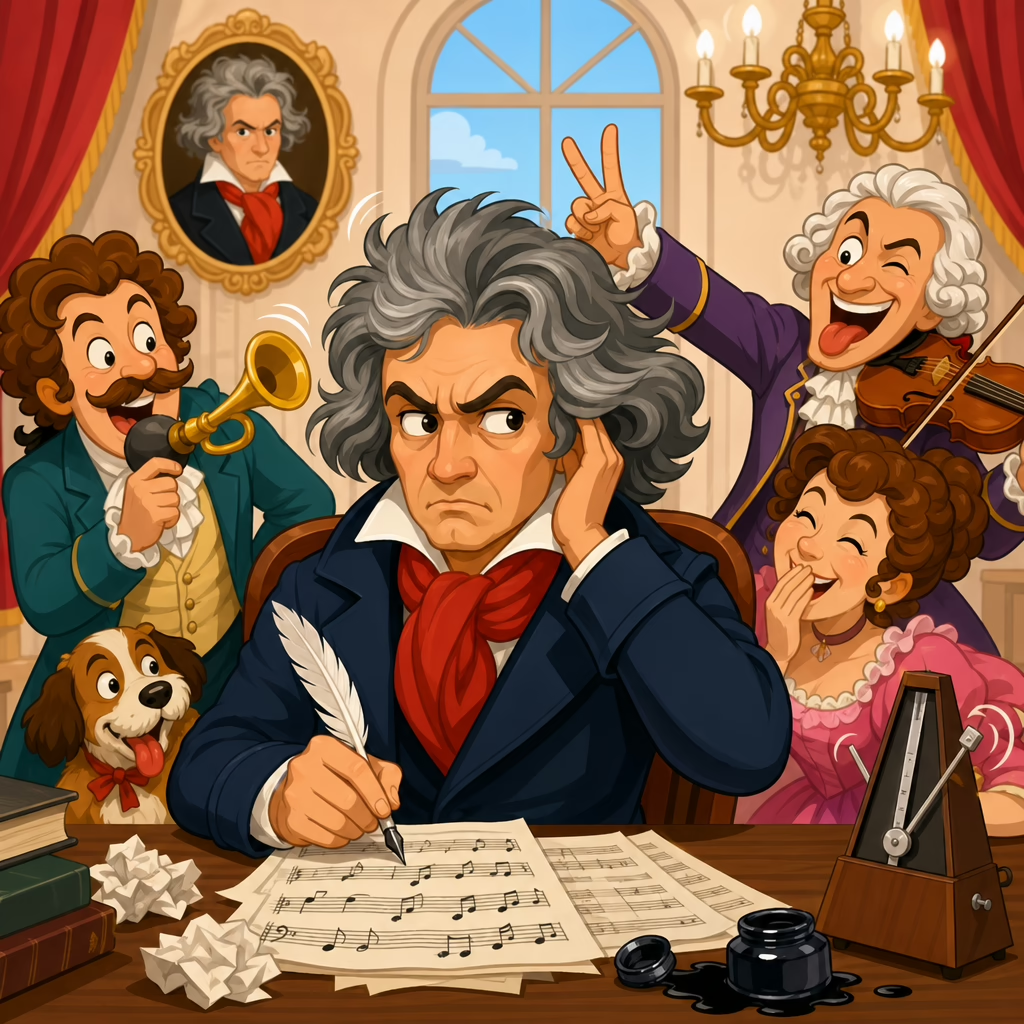
Beethoven Parodies: When the Classics Meet Comedy
Beethoven parodies show how a composer associated with concert halls, stern portraits, and cultural prestige can become one of comedy’s most durable raw materials. In pop culture, parody means imitation with exaggeration, irony, or playful distortion, while satire uses humor to expose habits, institutions, or expectations. When the subject is Ludwig van Beethoven, those comic tools land quickly because the audience already recognizes the visual shorthand: wild hair, intense expression, dramatic gestures, and, above all, the instantly familiar opening of Symphony No. 5. I have worked with music references in media analysis long enough to see the same pattern repeatedly: creators return to Beethoven because his music carries authority, urgency, and emotional scale, which makes it ideal for comic contrast. A cartoon chase scored like a world-ending symphonic crisis is funny precisely because the music sounds too important for the action on screen.
This matters within Beethoven in pop culture because parody acts as a gateway category. A viewer may first encounter Beethoven through a joke in an animated short, a sitcom gag built around “da-da-da-dum,” or a commercial that turns “Ode to Joy” into a punchline. That joke is not trivial. It reveals how deeply Beethoven’s work has entered mass recognition and why his image remains commercially useful two centuries after his death. It also raises bigger questions: Which pieces get parodied most often? Why does the humor work across generations? Where is the line between affectionate homage and lazy stereotype? This hub answers those questions and maps the miscellaneous territory of Beethoven parody across film, television, animation, advertising, internet culture, live performance, and educational media, so readers can explore the full comic afterlife of the classical canon.
Why Beethoven Is Exceptionally Easy to Parody
Beethoven is unusually parody-proof because he combines musical recognizability with a powerful public persona. Many great composers are famous inside music history, but fewer are instantly legible to general audiences. Beethoven’s silhouette, unruly hair, and association with genius under pressure make him as visually adaptable as his music is sonically adaptable. In practical media terms, he offers creators two assets at once: a face that signals “serious classical music” and themes that can be identified within seconds. The first four notes of Symphony No. 5 function almost like a brand mnemonic. “Für Elise” carries a different value: it sounds refined, familiar, and slightly overused, which makes it perfect for jokes about piano lessons, pretension, or domestic chaos.
There is also a structural reason the parodies work. Beethoven wrote in sharply defined rhythmic cells and strong dynamic contrasts, so editors can cut visual jokes against his music with precision. Silent-era accompanists understood this, and modern trailer editors still do. The comic mechanism is usually one of mismatch. Grand music accompanies small behavior, noble ideals frame petty conflict, or the image of tortured genius is dropped into ordinary settings. I have seen this work in everything from children’s cartoons to sketch comedy because the setup is immediate. You do not need music theory to understand the joke. You only need cultural memory. That broad accessibility is why Beethoven remains more parody-friendly than many equally important composers.
Common Parody Formats Across Media
Beethoven parody appears in several repeatable formats, and recognizing them helps explain why the category feels so large. The most common is the high-low contrast gag: a mundane event receives an overblown Beethoven soundtrack. Think of a character making breakfast as if commanding a revolution. Another format is the genius caricature, where Beethoven appears as irritable, deaf, melodramatic, or impossibly intense, usually to mock the stereotype of the suffering artist. A third format turns a canonical piece into a novelty arrangement, such as a swing version of “Ode to Joy,” a kazoo-led Symphony No. 5, or a deliberately clumsy beginner-piano “Für Elise.” In each case, recognition comes first, then distortion.
Animation has historically been one of the richest spaces for these devices. Studios from the theatrical cartoon era onward discovered that classical music could heighten timing and lend instant sophistication to visual nonsense. Television then expanded the field by using Beethoven references as shorthand for intellect, parental aspiration, school recitals, and old-world seriousness. Advertising adopted the same shorthand because a few bars of Beethoven can communicate premium quality, urgency, or cultural legitimacy faster than spoken copy. More recently, internet creators have recycled these conventions through memes, mashups, and short-form videos, often compressing the joke into a few seconds. The medium changes, but the formula remains consistent: start from a work everybody knows, then bend it until the prestige itself becomes funny.
The Beethoven Pieces Most Often Used for Comedy
Not every Beethoven composition is equally useful for parody. In practice, four works dominate: Symphony No. 5, “Für Elise,” Symphony No. 9’s “Ode to Joy,” and, somewhat less frequently, the “Moonlight Sonata.” Each carries a different comic meaning. Symphony No. 5 suggests fate, drama, emergency, or exaggerated seriousness. “Für Elise” evokes beginner pianists, middle-class music education, and decorative culture. “Ode to Joy” signals grand unity and uplift, making it ideal for ironic deployment in chaotic or selfish situations. “Moonlight Sonata,” especially the first movement, tends to be used when the joke needs mock gloom, melodrama, or faux depth.
| Beethoven work | Typical parody use | Why it works quickly |
|---|---|---|
| Symphony No. 5 opening | Mock crisis, epic overreaction, villainous seriousness | Four-note hook is instantly recognizable |
| Für Elise | Piano lesson jokes, refined pretension, domestic comedy | Familiar to beginners and casual listeners |
| Ode to Joy | Ironic triumph, fake nobility, mass singalong humor | Simple tune with huge cultural footprint |
| Moonlight Sonata | Melodrama, gothic mood, exaggerated sadness | Slow, moody texture reads emotionally fast |
What matters here is not only fame but flexibility. These works survive parody because their identities remain intact under heavy modification. You can reharmonize “Ode to Joy,” speed up “Für Elise,” or orchestrate Symphony No. 5 for absurd instruments, and audiences still recognize the source. That recognizability is central to successful music comedy. If the audience has to work too hard to identify the reference, the joke weakens. Beethoven’s best-known themes solve that problem before the scene even develops.
Film, Television, and Animation Examples That Shaped the Trope
Many audiences know Beethoven parody less from dedicated classical spoofs than from scattered appearances across mainstream entertainment. Animated comedy has been especially influential because it can literalize music in impossible visual ways. Characters conduct storms to Symphony No. 5, destroy pianos while mangling “Für Elise,” or stage overblown cultural battles to “Ode to Joy.” These scenes teach viewers, often unconsciously, what Beethoven signifies in comic grammar: importance, intensity, and a hint of snobbery waiting to be punctured. The joke works even better when the character wielding Beethoven is pompous, underprepared, or wildly outmatched by events.
Live-action film and television use a different angle. Sitcoms frequently place Beethoven in lessons, recitals, and aspirational family settings because those contexts are socially recognizable. A parent who insists on “culture,” a child who can only play the first phrase of “Für Elise,” or a self-serious intellectual using Symphony No. 9 to signal depth are all durable character types. Sketch comedy tends to go broader, presenting Beethoven himself as a celebrity absurdity or turning his music into a vehicle for period jokes. Even when the references are brief, they reinforce a stable cultural code. Beethoven means “the classics,” and comedy emerges from overcommitment to that label.
One reason these portrayals endure is that they borrow from established performance history. Conductors, virtuosos, and conservatory training already carry rituals, costumes, and hierarchies that comedy can heighten. A strict maestro, an impossible rehearsal, a disastrous audition, and a concert interrupted by modern life all become funnier with Beethoven because the stakes sound monumental. In my experience reviewing these scenes, the funniest examples are rarely anti-classical. They understand the music well enough to exploit its authority, which is why affectionate parody ages better than generic mockery.
Advertising, Memes, and Short-Form Digital Comedy
Advertising has long used Beethoven to create instant cultural positioning. Luxury products borrow “Ode to Joy” or a piano arrangement of “Für Elise” to suggest heritage and quality. Budget ads sometimes do the opposite, pairing Beethoven with slapstick to imply that even high art can be practical, affordable, or accessible. The comic strategy is efficient because viewers decode it in seconds. A polished showroom scored with Beethoven reads premium; a chaotic household set to the same music reads knowingly exaggerated. Agencies continue to use these cues because licensing familiar classical repertoire can be cost-effective compared with commissioning an equally recognizable new score.
Digital culture accelerated this process. Meme creators isolate the famous opening of Symphony No. 5 to dramatize trivial mishaps, from missing a bus to opening an alarming email. Short-form video creators use “Für Elise” as shorthand for “someone trying to seem classy” or “the first thing every beginner learns.” “Ode to Joy” appears in ironic celebrations, fake inspirational montages, and edits where the emotional grandeur is intentionally disproportionate to the event. These are not random choices. Platforms reward immediate recognition, and Beethoven’s themes remain among the fastest audio signals available.
There is also a remix culture dimension. Creators blend Beethoven with hip-hop beats, lo-fi production, metal guitar, or absurd sound effects not simply for novelty but because the clash itself generates humor. The audience hears historical prestige colliding with everyday internet informality. Some of these mashups are throwaway jokes; others reveal genuine arranging skill. The strongest digital parodies preserve the musical logic of the original theme while relocating it into a new comic frame. That balance between fidelity and distortion is what keeps the material fresh instead of disposable.
What Beethoven Parodies Get Right, and Where They Go Wrong
At their best, Beethoven parodies democratize classical music. They lower the entry barrier, give audiences a recognizable starting point, and prove that canonical works are not museum objects. Good parody depends on knowledge. It notices Beethoven’s rhythmic force, his public mythology, and the way certain pieces have accumulated social meaning. It can even send audiences back to the originals. I have seen viewers laugh at a comic Symphony No. 5 cue and then seek out the full movement, curious about why the music sounds so commanding. In that sense, parody often functions as cultural outreach.
Still, the category has limitations. The most obvious is repetition. If every Beethoven joke reduces him to wild hair, deafness, and four ominous notes, the result becomes lazy rather than insightful. There is also the risk of flattening classical music into a single stereotype of elitism. That misses the historical complexity of Beethoven’s audience, politics, patronage, and formal innovation. Another issue is musical inaccuracy. Some productions use Beethoven references so loosely that they muddy the identity of the actual work, which weakens both the joke and the educational value.
The best way to judge a parody is simple: does it understand what it is distorting? Strong examples answer yes. They know why “Ode to Joy” sounds communal, why “Moonlight Sonata” reads inward, and why Symphony No. 5 can make almost anything seem urgent. Weak examples rely only on reputation. For a hub page on Beethoven in pop culture, that distinction matters because it helps readers separate meaningful comic adaptation from generic classical wallpaper.
How to Explore This Miscellaneous Hub More Deeply
This miscellaneous hub works best as a launch point into the wider study of Beethoven in pop culture. If you are researching media references, start by tracking which compositions recur and in what contexts: animation, family sitcoms, commercials, school settings, internet memes, and live parody concerts. If your interest is historical, compare early cartoon usage with contemporary short-form video trends to see how the same musical cues retain meaning while formats change. If you are teaching, Beethoven parody is an effective bridge from recognition to analysis. Play the spoof, identify the source piece, then ask why that specific composition was chosen over another.
The central takeaway is straightforward. Beethoven parodies endure because they convert prestige into play without destroying recognizability. They work through contrast, cultural memory, and the extraordinary durability of a few famous themes. They also reveal something larger about pop culture: the classics survive not only through reverence but through reuse, exaggeration, and laughter. To go further, explore related pages in this Beethoven in pop culture cluster, compare recurring works like Symphony No. 5 and “Für Elise,” and listen again to the originals with fresh ears. The joke lands best when you understand the music behind it.
Frequently Asked Questions
Why is Beethoven such a popular target for parody in movies, TV, and pop culture?
Beethoven is unusually easy to parody because he is instantly recognizable even to people who know very little about classical music. His image has become cultural shorthand: the stormy expression, the unruly hair, the dramatic posture, and the aura of artistic seriousness all communicate “great composer” in a single glance. Comedy works best when audiences understand the reference quickly, and Beethoven delivers that recognition almost immediately. A comedian, animator, or writer does not need a long setup to make the joke land.
There is also a built-in contrast that makes Beethoven ideal for humor. He represents prestige, intensity, genius, and high culture, while parody thrives on deflation, exaggeration, and surprise. Putting a figure associated with concert halls and artistic reverence into ordinary, absurd, or low-stakes situations creates instant comic tension. Whether he is depicted arguing over something trivial, reacting dramatically to a modern inconvenience, or having his music remixed in an unexpected context, the joke often comes from the gap between his monumental reputation and the silliness of the scene.
Another reason is that Beethoven’s music itself has entered public memory. Even people who cannot identify many classical composers can often recognize the opening of the Fifth Symphony or the “Ode to Joy” melody from the Ninth. Those familiar musical hooks make imitation, distortion, and comedic reuse much easier. In short, Beethoven is a perfect parody subject because his face, biography, reputation, and music are all culturally legible, and comedy depends on that fast shared recognition.
What makes a Beethoven parody funny rather than simply disrespectful?
A successful Beethoven parody usually works because it understands the original well enough to play with it intelligently. Good parody is not random mockery; it is imitation with purpose. It takes the recognizable features of Beethoven’s public image or musical style and heightens them in ways that reveal something amusing about artistic seriousness, cultural prestige, audience expectations, or our own tendency to treat the classical canon as untouchable. The humor often comes from precision: the joke is funnier when the audience can see exactly what is being exaggerated.
That is where parody differs from empty ridicule. If a work simply uses Beethoven as a convenient symbol of “old-fashioned classical stuff,” it may feel shallow. But when the comedy draws on real traits—his reputation for intensity, his association with genius, the mythic framing of his life, or the instantly recognizable drama of his music—it often feels more playful than hostile. In many cases, parody actually signals admiration. You usually do not parody a figure unless that figure is already important, widely known, and culturally powerful.
Context matters too. Many Beethoven parodies are not really attacking Beethoven himself so much as the way society reveres him. The satire may be directed at elitism, museum-like attitudes toward art, schoolroom simplifications of composers, or the assumption that classical music must always be solemn. In that sense, the parody can broaden appreciation rather than diminish it. It gives audiences permission to engage with Beethoven as a living cultural symbol instead of a sacred relic. When done well, the result feels witty, affectionate, and surprisingly revealing.
How do parody and satire work differently when Beethoven is the subject?
Parody and satire overlap, but they are not exactly the same, and Beethoven is a great example of the difference. Parody focuses on imitation. It borrows recognizable elements—Beethoven’s appearance, his musical gestures, his larger-than-life reputation—and reshapes them through exaggeration, incongruity, or playful distortion. A parody might portray him as melodramatic in a ridiculous situation, or it might imitate the thunderous style associated with him and apply it to something trivial. The main comic engine is resemblance with a twist.
Satire, by contrast, uses humor to critique something broader. If Beethoven appears in satire, the real target might be cultural snobbery, the commercialization of great art, the educational habit of reducing complex artists to clichés, or the modern tendency to package genius into a brand. In that case, Beethoven serves less as the endpoint of the joke and more as a tool for exposing assumptions about class, taste, authority, and cultural prestige.
In practice, many works combine both modes. A sketch might parody Beethoven’s iconic image while also satirizing institutions that treat classical music as inaccessible or superior. That combination is especially effective because Beethoven already carries so much symbolic weight. He can stand for authentic artistry, intimidating genius, European cultural authority, or overblown seriousness depending on the context. As a result, creators can use parody to make audiences laugh at the surface details and satire to make them think about what those details represent.
Why do Beethoven’s visual image and musical style translate so well into comedy?
Comedy often depends on exaggeration, and Beethoven’s public image is already halfway there. The standard portrait version of Beethoven looks intense, volatile, and consumed by inspiration. That visual vocabulary is almost cartoon-ready. A furrowed brow, flying hair, and emphatic body language can be pushed just a little further and become instantly comic without losing recognizability. This is one reason Beethoven appears so often in animation, caricature, and visual humor: his iconic features can be simplified, enlarged, and stylized while still remaining unmistakably him.
His music also lends itself to comedic adaptation because it contains strong contrasts, memorable rhythms, and emotionally charged gestures. Beethoven’s most famous themes often feel decisive and dramatic, which makes them excellent raw material for subversion. A creator can interrupt a familiar phrase, speed it up, place it in an absurd setting, or pair it with an unexpected image, and the audience immediately senses the mismatch. Comedy thrives on violated expectation, and familiar Beethoven excerpts provide exactly the kind of expectation that can be overturned for humorous effect.
There is also a long cultural tradition of framing Beethoven as the embodiment of the “serious genius.” Once that image becomes fixed, it invites comic reversal. If a composer is universally associated with struggle, depth, and grandeur, then even small deviations become funny. The stern genius ordering lunch, dealing with technology, appearing in advertising, or functioning as a stock character in a sketch already contains comic potential. Beethoven works so well in comedy because both his face and his sound are highly legible symbols, and humor is often strongest when symbols are clear enough to be playfully disrupted.
Do Beethoven parodies help people connect with classical music, or do they trivialize it?
In many cases, Beethoven parodies help more than they harm. They can act as a gateway for audiences who might otherwise see classical music as distant, intimidating, or overly formal. Humor lowers the barrier to entry. A person who first encounters Beethoven through a joke, a cartoon reference, a comedic performance, or a playful remix may become curious about the original work behind the laugh. Because Beethoven is already such a familiar cultural figure, parody can turn vague recognition into genuine interest.
Parody can also make classical music feel more human. One reason some audiences keep their distance from canonical composers is the sense that they belong to a protected realm beyond ordinary conversation. Comedy breaks that spell. It allows Beethoven to be discussed, imitated, questioned, and enjoyed without ceremonial reverence. Far from erasing his importance, that flexibility can make his continued relevance more obvious. A figure who can survive parody is often one whose influence remains strong enough to be reinterpreted across generations.
That said, parody can become trivializing if it relies only on stereotypes and never moves beyond them. If Beethoven is reduced to wild hair, background music, and a vague idea of “fancy old genius,” then the audience may be left with a flattened version of both the man and the music. The best Beethoven comedy avoids that problem by balancing accessibility with specificity. It invites laughter while preserving the qualities that made Beethoven culturally powerful in the first place. In that balance lies the real value of parody: it can entertain, critique, and introduce new listeners to classical music all at once.