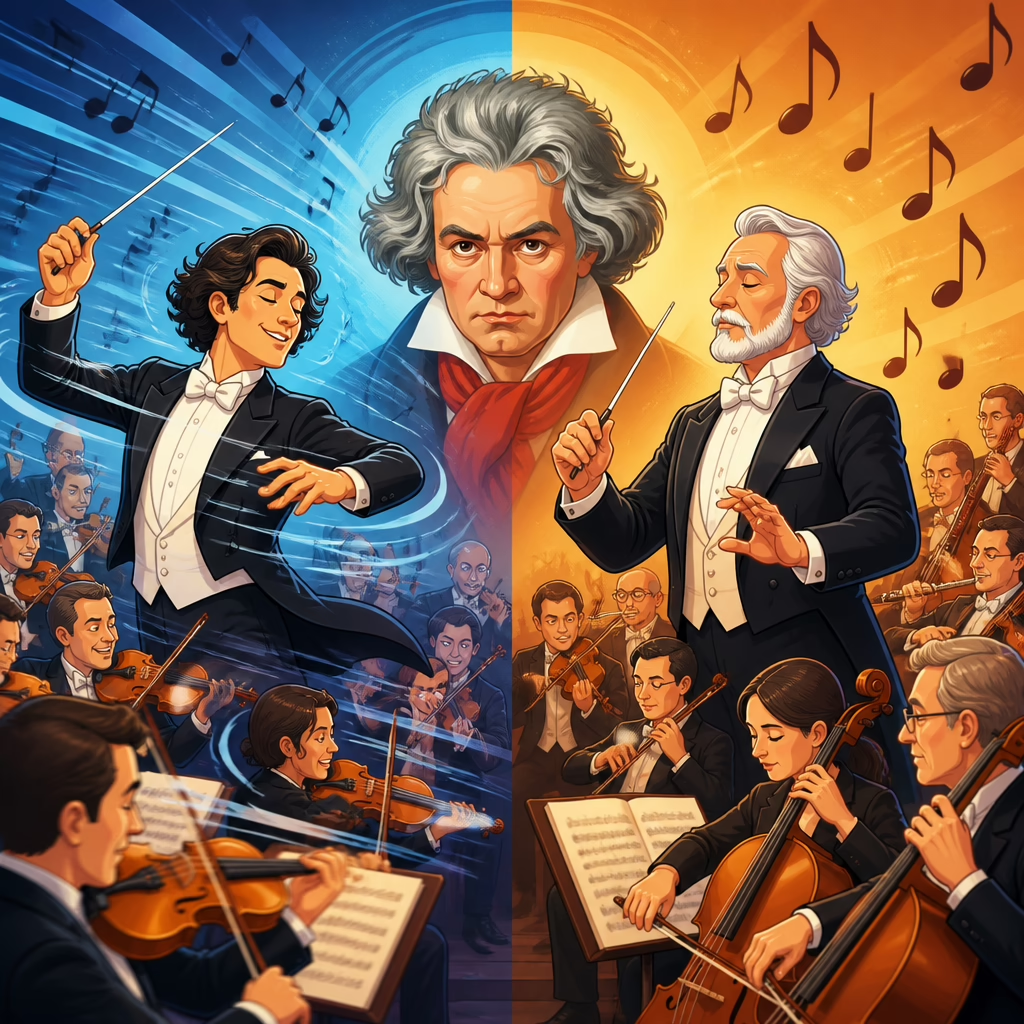
Why Some Conductors Take Beethoven Faster Than Others
Tempo is one of the fastest ways a conductor reveals a philosophy of Beethoven, and it is also one of the easiest things for listeners to notice without reading a score. When one recording of the Fifth Symphony feels urgent and combustible while another sounds granite-solid and monumental, the difference often begins with speed. Yet the question is not simply why one maestro likes excitement and another prefers breadth. Conductors take Beethoven faster than others because they weigh competing evidence: the composer’s sometimes controversial metronome marks, eighteenth-century performance habits, orchestral size, hall acoustics, instrument design, editorial traditions, and the emotional architecture they believe the music requires. Over years of comparing Beethoven cycles in rehearsal rooms and on recordings, I have found that tempo choices are rarely arbitrary. They are arguments made in sound.
In Beethoven performance, “faster” does not always mean reckless, and “slower” does not always mean profound. Tempo refers to the underlying pace of a movement, but musicians also think in terms of pulse, articulation, subdivision, and rhythmic stress. A conductor can keep a brisk basic beat yet sound controlled if attacks are clean and phrases are clearly weighted. Conversely, a nominally moderate speed can feel heavy when the orchestra plays with broad vibrato, sustained legato, and thick bass reinforcement. This matters because Beethoven’s symphonies are built on propulsion. His motifs gain force through repetition, harmonic tension, and dramatic timing; alter the speed, and you alter the listener’s sense of inevitability, danger, humor, and release.
Why does this matter so much in recordings? Because Beethoven is one of the most documented conductorial battlegrounds in classical music. The same Seventh Symphony can run several minutes shorter under Carlos Kleiber than under Otto Klemperer. Historically informed specialists such as John Eliot Gardiner, Roger Norrington, and Frans Brüggen often move more quickly than mid-century conductors shaped by Austro-German tradition. But there are exceptions in every direction. Wilhelm Furtwängler could broaden a line dramatically for expressive reasons, while Arturo Toscanini drove many passages hard with relentless pulse. The result is not merely personal taste. It reflects differing answers to a practical question: what tempo best translates Beethoven’s notation into convincing sound for modern ears?
The Metronome Marks and the Argument They Started
The most obvious reason some conductors take Beethoven faster is that Beethoven himself supplied metronome marks for the symphonies, and many of them are surprisingly swift. After Johann Nepomuk Mälzel popularized the metronome, Beethoven embraced the device as a way to pin down his intentions more exactly than Italian tempo words alone. Conductors who want to honor the printed evidence often feel compelled to test these markings seriously. In movements such as the first movement of the “Eroica” or the scherzo of the Ninth, Beethoven’s numbers can produce a tauter, more volatile character than listeners raised on grand nineteenth- and twentieth-century traditions expect.
Still, the marks are not self-executing facts. Scholars and conductors have long debated whether some were copied inaccurately, whether Beethoven misread the mechanism, or whether later editions introduced errors. There is no universal agreement. What matters in practice is that the marks shifted the burden of proof. A conductor choosing broad tempos must usually justify departing from them, while a conductor choosing quick tempos can claim documentary support. Norrington built much of his Beethoven reputation on taking the markings at or near face value, arguing that they restore rhythmic spring and structural clarity. Critics who dislike the results often concede that the experiment exposes details buried in slower readings.
Another complication is that a metronome mark indicates a beat unit, not a total expressive plan. If a movement is marked Allegro con brio with a specific pulse, the conductor must still decide how to shape transitions, fermatas, crescendos, and local flexibility. Beethoven did not write like a machine. The best faster conductors do not simply obey a number; they organize articulation and phrasing so the tempo feels grounded. Gardiner’s Beethoven often persuades because his quick speeds come with sharply etched sforzandos, buoyant bass lines, and transparent inner voices. The pulse is fast, but the rhetoric remains legible.
Orchestra Size, Instruments, and Acoustic Reality
Physical conditions push tempo in practical ways. Beethoven wrote for smaller orchestras than the large modern symphonic ensembles that became standard later in the nineteenth and twentieth centuries. A leaner group can articulate repeated notes, syncopations, and rapid string figures with less inertia. Natural horns and trumpets speak differently from modern valved instruments; timpani with hard sticks cut through texture with crisp attack; gut strings decay faster than steel strings, leaving more air around rhythmic cells. When conductors use period instruments or modern instruments played with historically informed technique, faster tempos often become not only possible but logical.
By contrast, a conductor leading eighty or ninety players in a resonant hall may broaden tempo simply to preserve ensemble and sonority. Large sections create a richer bloom, but they also lengthen response time. If the acoustic smears sixteenth-note string patterns or brass interjections, shaving the metronome back can increase clarity more effectively than insisting on theoretical speed. I have heard conductors in rehearsal ask for a notch less tempo in Beethoven not because they wanted more solemnity, but because the room swallowed offbeat accents. What sounds thrilling in a dry studio can collapse into blur in a cathedral-like concert hall.
| Factor | Tends to Encourage Faster Beethoven | Tends to Encourage Slower Beethoven |
|---|---|---|
| Orchestra size | Chamber-scaled forces with quick response | Large symphonic forces with heavier attack |
| Instrument type | Period instruments, lighter bows, hard-stick timpani | Modern instruments, sustained legato, broad vibrato |
| Hall acoustic | Dry acoustic that preserves detail | Reverberant acoustic that blurs fast passagework |
| Editorial stance | Close adherence to Beethoven’s metronome marks | Priority given to later interpretive tradition |
| Interpretive goal | Rhythmic drive, dance character, structural tension | Monumentality, weight, lyrical expansion |
Recording technology also matters. Earlier studio conditions favored precision and control over the sweep of a live event, while modern editing can support daringly brisk performances that would once have been risky to release. Microphone placement changes perception as well. Close miking emphasizes attack and can make a fast tempo sound clearer than it does in the hall. A more distant engineering approach captures blended sonority, which may reward a broader pace. This is one reason comparing Beethoven cycles requires attention not only to conducting but also to production choices; a fuller framework appears in the main guide at how to compare Beethoven symphony cycles like a critic.
Historical Style Versus Inherited Tradition
Some conductors go faster because they are reacting against a long tradition of Beethoven performance that treated the symphonies as proto-Brucknerian monuments. In the late Romantic and early modern eras, orchestras grew, string sections deepened, and expressive portamento, continuous vibrato, and elastic rubato became normal tools. That style produced powerful Beethoven, but it also encouraged broader pacing. Klemperer’s grandeur in the “Eroica,” for example, projects titanic architecture through weight and breadth. Furtwängler often used flexible tempo to intensify harmonic arrival points, creating an almost improvisatory sense of becoming. These approaches can be electrifying, yet they are not the only historically plausible ones.
The historically informed movement challenged the assumption that Beethoven must sound massive to sound serious. Research into late eighteenth-century tempo conventions, dance types, articulation patterns, and orchestral balance suggested a leaner, more kinetic Beethoven. The Seventh Symphony, often described by Wagner as the “apotheosis of the dance,” became a prime example. Conductors such as Brüggen and Gardiner emphasized sprung rhythms and sharply profiled accents, reminding listeners that Beethoven’s energy can be physical as well as metaphysical. Faster tempos in this context are not superficial. They aim to recover character distinctions embedded in the notation: scherzos that actually joke, finales that truly blaze, and slow movements that sing without sagging.
That said, historical information does not settle everything. Beethoven stood at a crossroads. His music inherits Classical proportion from Haydn and Mozart, yet it stretches those forms toward Romantic expansiveness. Conductors differ on which side of that tension should dominate. A quicker reading may stress Beethoven the revolutionary classicist: concise, rhythmic, disruptive. A broader one may stress Beethoven the visionary dramatist: expansive, burdened, searching. Both can be defensible if internally coherent. The real failure is not choosing one side or the other, but ignoring the style implications of the choice.
What Faster Tempos Change in the Music
When conductors take Beethoven faster, several musical outcomes usually follow. First, rhythmic motives lock together more tightly. In the Fifth Symphony’s opening movement, a swift but controlled tempo can make the famous short-short-short-long figure feel less like a slogan and more like a generating cell that drives the whole structure. Second, transitions gain momentum. Beethoven often builds long crescendos over repeated patterns; at quicker speeds these can sound cumulative instead of dutiful. Third, phrase endings become more dangerous. There is less time to relax, so cadences can feel provisional, keeping tension alive deep into the movement.
Fast Beethoven also changes perceived scale. A movement played near Beethoven’s marking may seem less monumental in local weight but larger in overall architecture, because the listener hears long spans in one breath. This is especially true in sonata form. Expositions, developments, and recapitulations cohere differently when the basic pulse keeps argument flowing. Toscanini understood this. Even where some listeners find him severe, his Beethoven often demonstrates how quick tempo can clarify structure. The line from one event to the next remains visible. You hear cause and effect, not just isolated moments of rhetoric.
But speed has costs. A conductor who pushes beyond what the players, hall, or style can sustain risks trivializing the score. Inner voices disappear, woodwind dialogues lose personality, and climaxes can feel earned too cheaply. The Pastoral Symphony is a good example. Its scenes depend on atmosphere and inflection, not only motion. If the “Scene by the Brook” moves too briskly, birdsong details and harmonic tenderness may go missing. Likewise, the slow movement of the Ninth needs enough breadth for variation and vocal anticipation to register. Faster is persuasive only when it serves character, not when it flattens it.
Case Studies: Why Conductors Land in Different Places
Compare three famous Beethoven approaches and the reasons behind them become concrete. Klemperer’s Philharmonia cycle often adopts broad, weighty tempos because he treats Beethoven as architectural drama. He wants chordal pillars, clearly terraced dynamics, and an almost sculptural sense of mass. The tradeoff is reduced volatility, but the payoff is exceptional structural gravitas. Carlos Kleiber, especially in the Fifth and Seventh, chooses brisker tempos to heighten kinetic energy and phrase lift. His speeds work because every accent is alive, every transition breathed, every orchestral layer calibrated for tension. The performance feels spontaneous without losing control.
Gardiner’s cycle with the Orchestre Révolutionnaire et Romantique explains a third path. His faster tempos arise from evidence-based style: period instruments, reduced vibrato, and close attention to Beethoven’s markings. What convinces is not ideology but execution. Hard timpani strokes define pulse, winds project through lighter strings, and articulation replaces sheer volume as the engine of excitement. Then there is Furtwängler, whose tempo choices can expand and contract dramatically within a movement. He is slower in averages, yet his elasticity creates surges no stopwatch fully captures. His Beethoven asks whether truth lies in fixed pace or in the tension of breathing form.
For listeners, the useful question is not “Who is right?” but “What problem is this conductor solving?” Some are solving for textual fidelity, others for orchestral realism, others for expressive culmination. Once you hear tempo as a response to competing demands, differences among recordings become intelligible rather than arbitrary. The next time one Beethoven performance sounds exhilaratingly fast and another nobly broad, listen for the underlying rationale: notation, instruments, hall, tradition, and dramatic aim. That habit sharpens judgment and deepens enjoyment. Start with two contrasting recordings of the same symphony, follow the pulse, and decide which argument you find more convincing.
Frequently Asked Questions
Why do some conductors take Beethoven faster than others?
Because tempo in Beethoven is never just a matter of taste. When conductors choose a faster or slower pace, they are usually balancing several competing ideas at once: Beethoven’s written markings, the character of a specific movement, the acoustic of the hall, the size and sound of the orchestra, and their own view of what Beethoven’s music is fundamentally trying to say. One conductor may hear the Fifth Symphony as a work of nervous propulsion and rhythmic attack, so a quicker tempo feels truthful. Another may hear the same symphony as a monument of architectural power, where slightly broader pacing gives weight to harmony, bass line, and long-range structure.
There is also a historical dimension. Since the twentieth century, Beethoven performance has moved through different traditions. Older conductors often favored broader, more saturated readings shaped by large orchestras and romantic sonority. Later conductors, especially those influenced by historically informed performance, began to emphasize sharper articulation, lighter textures, brisker pulse, and greater attention to Beethoven’s metronome marks. So when one conductor takes Beethoven faster than another, the difference often reflects a larger philosophy: whether the music is approached as heroic and monumental, dramatic and theatrical, or urgent and speech-like. Tempo becomes the audible surface of a deeper interpretive argument.
How important are Beethoven’s metronome markings in deciding tempo?
They are extremely important, but not always treated as absolute law. Beethoven was among the first major composers to leave metronome markings on a large scale, which means we have unusually direct evidence of the speeds he had in mind. That matters because it prevents conductors from claiming complete freedom. If Beethoven indicated a pulse that feels surprisingly quick to modern ears, serious interpreters have to reckon with that fact. His markings suggest that, at least in many cases, he imagined energy, forward motion, and rhythmic definition more than heavy grandeur.
At the same time, conductors do not all agree on how literally those numbers should be applied. Some argue that Beethoven’s markings are central evidence and should guide performance whenever possible. Others point out practical complications: possible issues with early metronomes, ambiguities in notation, differences between modern instruments and those Beethoven knew, and the reality that a hall full of players can react differently than a number on a page suggests. Even conductors who respect the markings may adjust them slightly to preserve clarity, balance, and expressive shape. So the debate is not really “follow Beethoven” versus “ignore Beethoven.” It is about how to translate Beethoven’s intentions into sound under real performance conditions, and that is exactly why tempo remains such a contested issue.
Does using period instruments or historical performance practice make Beethoven faster?
Often, yes, but not automatically. Conductors working with period instruments or historically informed techniques frequently choose quicker tempos because the instruments themselves respond differently. Classical and early nineteenth-century strings, winds, brass, and timpani tend to produce a leaner, more transparent sound than a modern symphony orchestra. That transparency allows inner rhythms and articulated figures to speak clearly at speeds that might sound blurred or overblown in a larger, heavier ensemble. As a result, a fast tempo can feel not reckless but natural, even inevitable.
Historical performance practice also encourages a different sense of musical motion. Rather than treating Beethoven as a late-romantic titan whose music must always be weighty and monumental, many historically informed conductors emphasize dance impulse, rhetorical contrast, sharply profiled accents, and buoyant phrasing. That often leads to performances that sound more agile and combustible. Still, “historical” does not simply mean “fast.” Good conductors in this tradition are just as concerned with character and proportion as anyone else. A slow introduction still needs gravity, and a lyrical movement still needs room to sing. What changes is the baseline assumption: momentum and articulation are often given priority over sheer mass, which can make Beethoven feel more volatile, dramatic, and alive.
Can a slower Beethoven performance be just as valid as a faster one?
Absolutely. A slower tempo is not automatically old-fashioned, and a faster one is not automatically more authentic. What matters is whether the chosen speed illuminates the music’s structure, character, and emotional logic. A broader tempo can reveal things that a rapid reading might skate over: the weight of harmonic change, the tension between phrases, the grandeur of a crescendo, or the monumental balance of a symphonic design. In the right hands, slower Beethoven can feel powerful, inevitable, and deeply gripping rather than merely heavy.
The key question is whether the tempo preserves the music’s inner life. If a conductor slows things down so much that rhythmic energy collapses, the result can sound inert. But if the broader pace intensifies line, contrast, and orchestral color, it may offer a compelling alternative to a high-voltage reading. The same applies in reverse: a fast performance can be thrilling if it remains clear and controlled, but superficial if it sacrifices phrasing and depth for excitement alone. Beethoven is rich enough to sustain more than one tempo solution, provided the interpretation is coherent. That is why listeners can disagree passionately while still recognizing that different speeds can reveal different truths in the same score.
What should listeners pay attention to when comparing different Beethoven tempos?
Start with the feeling of pulse rather than just the stopwatch. Two performances may differ by only a minute or two overall yet create completely different impressions of urgency, tension, and scale. Listen to whether the music seems to breathe naturally or feel pushed or held back. In fast performances, notice whether rhythmic details remain crisp, whether transitions land convincingly, and whether climaxes feel earned rather than rushed. In slower performances, listen for sustained tension, line, and purpose. Does the conductor keep the music moving from within, or does the broader pace become static?
It also helps to focus on specific musical elements that tempo affects directly. Pay attention to articulation in the strings, the clarity of repeated rhythmic figures, the balance between winds and brass, and the space given to bass lines and harmonic turns. Ask yourself what the tempo makes possible. Does a quick speed heighten drama and sharpen Beethoven’s accents? Does a slower one reveal the work’s architecture and emotional breadth? Most importantly, consider the conductor’s consistency across an entire movement or symphony. A convincing Beethoven interpretation is rarely about raw speed alone. It is about how tempo interacts with phrasing, dynamics, texture, and structure to create a persuasive musical argument. Once you listen that way, differences between conductors become much more revealing than simply “fast” versus “slow.”