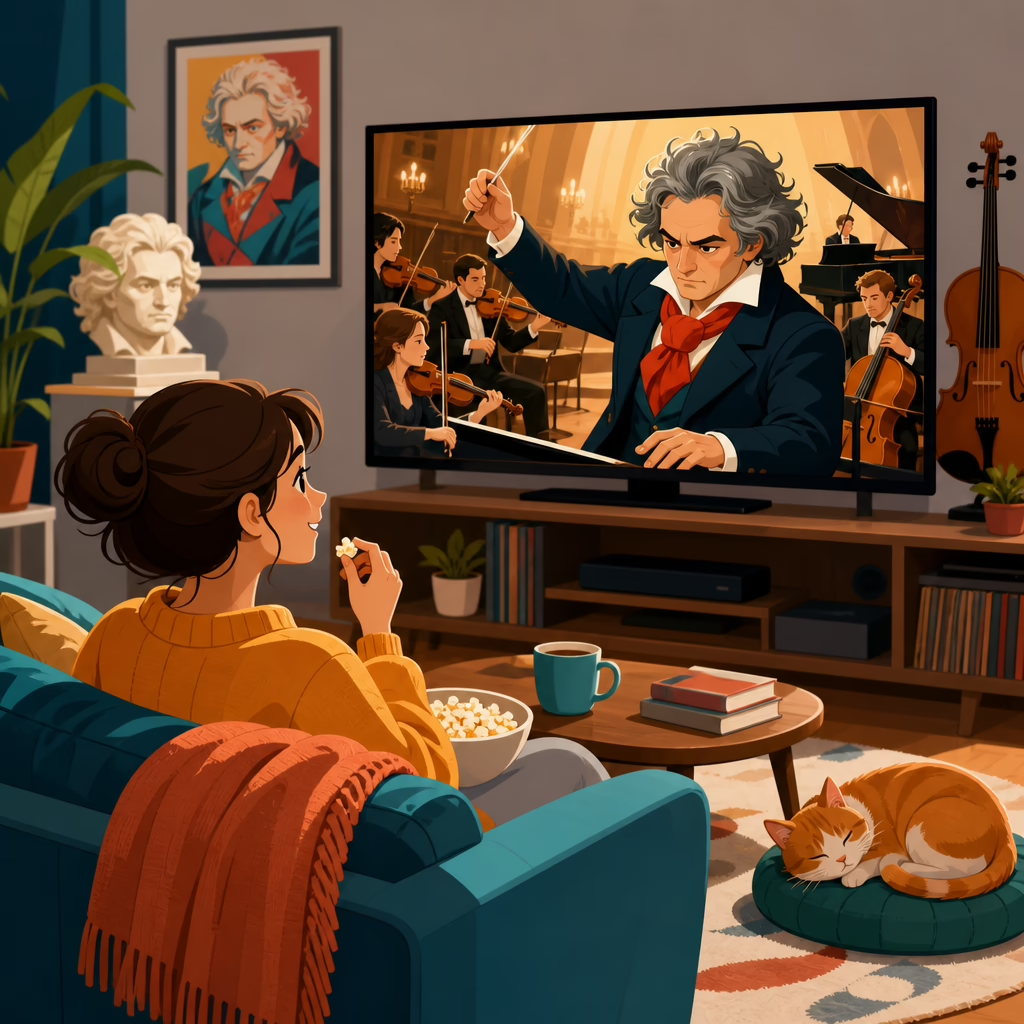
Great Beethoven Performance Films to Watch at Home
Great Beethoven performance films to watch at home are more than concert videos. The best ones combine first-rate playing, intelligent filming, strong sound engineering, and a clear sense of why Beethoven still feels urgent in a living room, not only in a concert hall. In this context, a performance film means a recorded presentation centered on musicians performing Beethoven, whether it was captured live in concert, staged specifically for cameras, or built as a hybrid of performance and documentary framing. Watching at home changes the experience. You control the screen size, the speakers or headphones, the replay button, and the level of attention. That means the finest Beethoven films are the ones that reward close listening and close looking at the same time.
I have spent years comparing Beethoven recordings across Blu-ray, DVD, broadcast archives, and streaming platforms, and one lesson keeps repeating: visual direction matters almost as much as the interpretation. A conductor may shape a monumental first movement, but if the camera cuts randomly, misses cueing, or ignores instrumental dialogue, the film weakens the music. The opposite is also true. When a director understands sonata form, motivic development, and orchestral balance, the viewer can actually see Beethoven’s architecture unfold. That is why some filmed performances become reference experiences for home viewing. They teach you how to hear the score more clearly, not just admire celebrity names.
This article focuses on films worth seeking out specifically for home watching, not a broad survey of every major Beethoven recording. The selections emphasize symphonic, orchestral, choral, concerto, piano, and chamber performance films that hold up under repeated viewing. They matter because Beethoven is unusually visual in performance. You can watch rhythmic discipline in the Seventh Symphony, bow articulation in the late quartets, breathing and balance in the Missa solemnis, or the physical dialogue between soloist and orchestra in the piano concertos. If you want a practical shortlist of Beethoven films that combine interpretive substance with strong production values, start here.
What makes a Beethoven performance film worth watching at home
The strongest Beethoven films do four things well. First, they present an interpretation with a clear point of view. Beethoven can absorb many approaches, but indecision never works. A good film lets you sense whether the musicians favor classical transparency, romantic weight, historically informed articulation, or some thoughtful synthesis. Second, the sound must preserve dynamic range. Beethoven depends on contrast: whisper to eruption, tension to release, pulse to suspension. Compression-heavy audio flattens that language. Third, camera work should follow structure. In the Fifth Symphony, for example, recurring rhythmic cells are not abstract ideas; they move through strings, winds, and brass in a way the camera can illuminate. Fourth, the venue and editing should support concentration rather than distract from it.
At home, practical factors matter too. A great Beethoven film should survive the smaller scale of domestic listening. Some huge live events feel thrilling in a hall yet diffuse on screen. Others become stronger on repeat viewing because microphones reveal inner detail and closeups clarify ensemble interaction. I generally recommend looking for labels and producers with consistent standards, such as EuroArts, Unitel, Accentus, Opus Arte, or well-produced archive releases from major broadcasters. Blu-ray usually offers the best combination of picture stability and lossless audio, but several streamers now provide very respectable alternatives if your setup is good. For viewers building listening habits, filmed performances can be a more instructive entry point than audio alone because they reveal physical cause and musical effect together.
Essential Beethoven symphony films for repeated viewing
If you want one foundational symphonic film, start with Carlos Kleiber conducting Beethoven’s Fifth and Seventh Symphonies with the Wiener Philharmoniker. Filmed in concert and widely circulated on video, this is not just famous because of Kleiber’s mystique. It endures because his beat, body language, and exacting rhythmic lift are unusually legible on camera. In the Fifth, the transition from tension to propulsion feels inevitable rather than merely loud. In the Seventh, the famous Allegretto gains power from pulse control, while the finale shows how disciplined exuberance can look almost combustible. The visual record matters here because Kleiber’s rehearsal-based precision appears in every attack and release.
For viewers interested in modern-instrument Beethoven with structural clarity, Claudio Abbado’s Beethoven cycle with the Berliner Philharmoniker is another strong home choice. Abbado avoids heaviness and lets woodwind lines speak with unusual naturalness. On film, that transparency pays off. You can see antiphonal conversations and sectional balance, especially in the Pastoral and the Eroica. The Ninth benefits too, because the build into the choral finale feels cumulative rather than inflated. Abbado’s Beethoven is humane, flexible, and lucid, which makes it easier for home listeners to grasp large spans without fatigue.
Anyone curious about leaner, historically informed energy should seek out John Eliot Gardiner’s Orchestre Révolutionnaire et Romantique cycle. Period instruments change what the camera captures: narrower vibrato, sharper articulation, more pungent brass and timpani, and often more animated wind playing. The result can make familiar symphonies sound newly dangerous. The Eighth, often underrated, comes across especially well on film because its wit is physical. You can actually watch the spring-loaded accenting and conversational timing. For listeners comparing approaches, this is a valuable counterpart to big-orchestra traditions. If you want a framework for evaluating different cycles in more detail, the main guide at how to compare Beethoven symphony cycles like a critic is a useful next step.
Piano concerto films that show Beethoven’s dramatic instincts
Beethoven’s piano concertos work exceptionally well on film because they are built on visible interaction: soloist against orchestra, then with orchestra, then inside the orchestral texture. Among classic filmed cycles, Daniel Barenboim directing from the keyboard in Beethoven concertos remains compelling because the dramatic tension is easy to read on screen. You see how the solo line emerges from orchestral material rather than simply decorating it. In the Fourth Concerto especially, the opening solo statement can look almost improvisatory, while the central movement gains force from the visual contrast between stern orchestral response and inward piano resistance.
For a more contemporary recommendation, András Schiff’s Beethoven concerto performances are often rewarding for home viewing because they emphasize proportion, touch, and stylistic discipline. Schiff does not turn Beethoven into generic grandeur. On camera, that restraint reads as confidence. The Emperor Concerto benefits when the performer avoids pounding and instead clarifies the relationship between brilliance and line. If your system reproduces piano tone accurately, you will hear why filmed concerto performances can teach as much as audio recordings: hand position, pedaling economy, cueing, and eye contact all explain interpretive choices in real time.
Martha Argerich appears in less complete Beethoven video coverage than in some other repertory, but any strong filmed Beethoven concerto appearance by her is worth attention because of the sheer electricity of response. Beethoven on film is not only about perfection. It is also about risk. The best concerto films preserve that feeling that something is being discovered publicly. When the soloist and conductor are genuinely listening to one another, the camera picks up split-second negotiation that no studio product can fully duplicate. Home viewers often underestimate how much these silent signals shape phrasing and tempo.
String quartet and chamber films that reveal the inner mechanics
For Beethoven chamber music, film can be revelatory because it exposes the democratic complexity of the writing. In late quartets especially, no single player “carries” the argument for long. A strong quartet film lets you watch motives move from first violin to viola to cello, often within seconds. The Alban Berg Quartet’s Beethoven films remain essential because the ensemble combines tonal richness with exceptional unanimity of intention. In the late quartets, their visual communication is almost telepathic. You can learn a great deal simply by watching breathing, bow distribution, and the way transitions are prepared physically before they are heard.
The Takács Quartet has also produced Beethoven performances that reward close home viewing, particularly for listeners who want emotional directness without losing structural command. Their filmed Beethoven often makes the music’s volatility easier to grasp. One moment can look fiercely concentrated, the next conversational, then suddenly visionary. That volatility is central to Beethoven’s chamber language. The late quartets are not polished wallpaper; they are argumentative, searching, and often radically discontinuous. A good performance film helps the listener follow those turns rather than smooth them over.
| Film type | Best for | What to watch for | Home-viewing advantage |
|---|---|---|---|
| Symphony concert film | Large-scale structure | Conductor cueing, wind-brass balance, string articulation | Replay major transitions and scherzo-finale links |
| Piano concerto film | Soloist-orchestra dialogue | Pedaling, hand attack, eye contact, tempo negotiation | Closeups clarify dramatic exchange |
| String quartet film | Inner voices and motivic transfer | Breathing, bowing, cueing between players | Small-screen intimacy suits chamber scale |
| Choral-orchestral film | Massed forces and text delivery | Chorus diction, conductor pacing, solo quartet blend | Subtitles and microphones improve comprehension |
Solo piano films deserve mention here too, especially sonata recitals by Alfred Brendel, Maurizio Pollini, or Igor Levit. Beethoven’s sonatas can look surprisingly dramatic when filmed well because the performer’s relationship to silence, weight, and timing becomes visible. The Hammerklavier is an obvious test case, but even shorter works such as Op. 90 or Op. 110 gain dimension on screen. You can see whether the player projects rhetoric through gesture or through economy, and that difference affects how the music lands at home.
Choral and sacred Beethoven films with real staying power
The Ninth Symphony is the Beethoven performance film many people seek first, but not every filmed Ninth is worth returning to. The strongest versions maintain tension through the instrumental movements so that the choral finale arrives as necessity, not spectacle. Herbert von Karajan’s filmed Ninths remain historically important, particularly for the Berlin Philharmonic sound and the sheer authority of ensemble execution, though some viewers will find the visual style and interpretive profile very much of their era. They are valuable documents, but for repeated home viewing I often prefer conductors who allow more rhythmic spring and textual transparency.
Leonard Bernstein’s Beethoven films, especially those connected to major commemorative events, have undeniable emotional force. Bernstein understood how to project Beethoven’s moral drama to the camera. At times the approach can be interventionist, but when it works, it works on a grand scale. Home viewers should approach these films as interpretive statements rather than neutral references. The benefit is that Bernstein makes you confront the human stakes of the music. The tradeoff is that his personality can dominate the frame.
For the Missa solemnis, filmed performances are particularly useful because the work’s architecture and spiritual intensity can be difficult to absorb in audio-only listening. A well-made film helps you track chorus, solo quartet, orchestra, and conductor as interdependent forces. This is one repertoire area where subtitles, camera patience, and balanced choral sound are decisive. If the engineering favors sheer mass over textual clarity, the performance loses much of its meaning. When the balance is right, however, the Missa solemnis becomes one of the most compelling Beethoven films you can watch at home.
How to choose the right film for your setup and taste
The best Beethoven performance film for you depends on two variables: interpretive preference and playback environment. If you like broad phrasing, plush string tone, and monumental climaxes, classic modern-orchestra films may be ideal. If you want sharper rhythmic definition, lighter textures, and quicker rhetorical contrast, historically informed performances will probably engage you more. Neither camp owns the truth. Beethoven survives many valid approaches, but each approach highlights different structural features. I always recommend choosing one familiar work, such as the Fifth Symphony, the Fourth Piano Concerto, or the Op. 131 Quartet, and comparing two visually distinct performances before buying a full cycle.
Your setup matters just as much. On a laptop, chamber films often outperform giant symphonic ones because the scale feels natural. On a television with decent speakers or headphones, symphony and concerto films come into their own. If you have surround sound, prioritize releases with lossless audio tracks because Beethoven’s dynamic architecture depends on headroom and spatial definition. Also pay attention to subtitle options, chapter indexing, and camera direction. A great interpretation can be undermined by clumsy authoring. Conversely, a good but not legendary performance can become highly watchable if the filming is musically literate and the sound is honest.
For most viewers building a home library, a balanced starter set is simple: one symphony film centered on Fifth and Seventh, one concerto program featuring the Fourth or Fifth, one late-quartet film, and one major choral work, ideally the Ninth or Missa solemnis. That combination shows Beethoven’s range without drifting into collector excess. After that, follow the interpretations that make you replay movements, not the names that merely look prestigious on the cover.
Watching Beethoven at home can be deeply rewarding when you choose films that unite interpretation, sound, and visual intelligence. The best titles do not simply document famous musicians. They clarify Beethoven’s craft: how rhythm drives form, how dialogue creates drama, how silence prepares impact, and how ensemble discipline turns notes on a page into something inevitable. That is why certain films become long-term companions. You return to them not out of duty, but because they keep revealing details in phrasing, balance, and structure that casual listening misses.
If you are deciding where to begin, start with a symphony film by Carlos Kleiber or Claudio Abbado, add a Beethoven concerto performance that lets you see real soloist-orchestra exchange, and include at least one quartet or sonata film for intimacy and detail. Then compare what you hear and what you see. The right Beethoven performance films make home listening more focused, more informed, and more moving. Pick one this week, watch it without distractions, and let the camera teach you how Beethoven breathes in performance.
Frequently Asked Questions
What makes a Beethoven performance film worth watching at home instead of just listening to an audio recording?
A great Beethoven performance film adds visual intelligence to musical excellence. At its best, it does not simply document a concert from a distance. It helps you see how the music works through phrasing, breathing, bow changes, keyboard touch, ensemble communication, and the physical architecture of performance itself. Beethoven’s music is full of tension, release, contrast, and structural drama, and film can reveal those qualities in ways that audio alone cannot. A well-directed close-up at the right moment can show how a pianist shapes a transition, how a conductor controls a long crescendo, or how a string quartet negotiates a difficult passage through eye contact and timing.
For home viewing, sound engineering matters just as much as the camera work. The best Beethoven performance films preserve clarity, dynamic range, and instrumental balance, so the experience still feels vivid through a television, laptop, or home speakers. This is especially important with Beethoven, because his music often depends on sudden dynamic shifts, sharply profiled rhythms, and an almost architectural sense of forward motion. If the sound is flat or compressed, much of that impact disappears. When the filming and audio are both first-rate, the result can feel more immediate than a seat in a large hall, because the camera puts you inside the performance rather than at a distance from it.
Another key advantage is context. Many of the strongest Beethoven films are hybrids: part concert, part visual essay, part documentary. They may include rehearsal footage, location shooting, brief commentary, or staging choices that connect the performance to the composer’s world or to modern listeners. That kind of framing can make Beethoven feel less like a monument and more like a living force. For someone watching at home, that sense of urgency is crucial. A worthwhile performance film shows not only that the music is great, but why it still feels emotionally and intellectually alive now.
Which Beethoven works tend to make the strongest performance films for home viewing?
The works that translate best to film are usually the ones with strong visual, dramatic, or ensemble elements. The symphonies are an obvious starting point, especially the Third, Fifth, Seventh, and Ninth, because they combine recognizable musical identity with clear physical drama on screen. Watching an orchestra navigate Beethoven’s rhythmic drive, brass entries, string articulation, and large-scale crescendos can be deeply satisfying, particularly when the filming captures both the collective energy of the ensemble and the personalities within it. A well-shot symphony film can make the structure feel easier to follow and the performance more visceral.
Piano sonatas are also excellent choices, especially when performed by a pianist with strong stage presence and recorded with close attention to touch, pedaling, and tonal detail. Beethoven’s piano writing is unusually physical, and film can highlight the athletic and expressive dimensions of that physicality. Works such as the “Pathétique,” “Moonlight,” “Waldstein,” “Appassionata,” and the late sonatas often work especially well, because they combine immediacy with depth. In a home setting, the intimacy of a solo performer can be a major advantage. You are not just hearing Beethoven’s language; you are watching someone think through it in real time.
String quartets and chamber works can be some of the most rewarding Beethoven films of all, even if they are less spectacular than the symphonies. The late quartets in particular are ideal for attentive viewing because so much of their meaning emerges from interaction among players. Camera direction can reveal conversational textures, leadership shifts, subtle cues, and the extraordinary concentration required to sustain Beethoven’s complex late style. The concertos, especially the Violin Concerto and Piano Concertos Nos. 3, 4, and 5, also make strong viewing because they combine solo charisma with orchestral scale. In general, the most effective Beethoven films for home audiences are the ones that balance musical greatness with visual legibility and emotional immediacy.
How can I tell whether a Beethoven performance film has good filming and sound quality before I watch it?
One of the best indicators is the reputation of the production team and distributor. Labels, broadcasters, and streaming platforms with a strong classical catalog often maintain higher standards in microphone placement, editing, lighting, and overall presentation. If available, look for information about who directed the film, where it was recorded, and whether it was produced specifically for visual release rather than simply archived from a live event. A film designed with cameras in mind usually has more coherent shot planning, smoother editing, and better coordination between visual storytelling and musical structure.
Reviews can also be very useful, but it helps to read the right kind. Many critics will comment not only on the interpretation but on the technical execution: whether the camera cuts are too fast, whether important solos are missed, whether the hall acoustic feels natural, and whether the mix favors one section of the ensemble too heavily. For Beethoven in particular, you want to know whether the recording preserves dynamic contrast and rhythmic bite. If reviewers describe the sound as muddy, over-reverberant, bright to the point of harshness, or overly compressed, that can be a warning sign. Likewise, if they mention distracting audience shots, random visual gimmicks, or editing that ignores the music’s phrasing, the film may be frustrating even if the musicians are excellent.
Previews and sample clips are often enough to tell you quite a lot. Listen for whether you can clearly distinguish lines in the texture, especially in faster passages and in climactic moments. Watch whether the camera seems to understand where the musical action is. Good Beethoven filming should feel purposeful rather than decorative. It does not need to be flashy; in fact, restraint is often better. What matters is that the visual direction supports the shape of the music. At home, where the screen and speakers become your concert hall, a technically strong film can make all the difference between passive viewing and a genuinely absorbing performance experience.
Are live concert captures or staged Beethoven performance films better for watching at home?
Neither format is automatically better; they simply offer different strengths. A live concert capture often brings a sense of occasion, spontaneity, and risk that can be thrilling. You feel the real-time pressure of performance, the energy between players, and the atmosphere of an audience sharing the event. In Beethoven, that electricity can be especially compelling, because so much of the music depends on momentum and dramatic necessity. A great live film can preserve the emotional charge of an unrepeatable night while also giving you visual access that a normal concert seat would never provide.
Staged films, however, often have advantages that are ideal for home viewing. Because they are built specifically for cameras, they can achieve greater visual coherence, better lighting, more controlled acoustics, and more thoughtful shot selection. The musicians may be recorded in ideal positions, and the audio can be captured with exceptional clarity. This can be particularly valuable in Beethoven’s denser textures, where a carefully managed production helps inner details emerge. Some staged films also use location, design, or minimal narrative framing to deepen the viewer’s engagement without distracting from the music. When done tastefully, this can make the experience more immersive and intimate.
Hybrid films often provide the best of both worlds. These productions might combine live performances with rehearsal footage, interviews, historical context, or cinematic inserts that illuminate the work’s meaning. For an article about great Beethoven performance films to watch at home, hybrids are especially relevant because they acknowledge that home viewing is different from sitting in a hall. The camera can guide attention, clarify structure, and create closeness without sacrificing seriousness. The best choice ultimately depends on what you want: the adrenaline of live performance, the refinement of a camera-centered production, or a richer documentary-performance blend that helps explain why Beethoven still speaks so powerfully today.
What should I look for in a performer or ensemble when choosing a Beethoven performance film?
Start with musical conviction. Beethoven rarely responds well to playing that is merely polished or tasteful. The strongest performers bring structural understanding, rhythmic authority, and a clear sense of dramatic direction. Whether you are watching a solo pianist, a string quartet, or a full orchestra, you want artists who make the music feel inevitable rather than routine. In film, that quality becomes even more visible, because the camera exposes concentration, communication, confidence, and sometimes uncertainty. The best Beethoven performances on screen are usually those in which technical command and interpretive purpose reinforce one another.
It also helps to consider style, but without being overly rigid about it. Some viewers prefer historically informed performance, with leaner textures, sharper articulation, brisker tempos, and period-aware phrasing. Others respond more strongly to modern-instrument performances that emphasize tonal richness, breadth, and symphonic weight. Both approaches can succeed brilliantly on film if they are internally consistent and musically persuasive. What matters is not ideology but whether the performers have a compelling point of view and whether the filming allows that point of view to come across clearly. A Beethoven film should make you feel that the musicians are in active conversation with the score, not simply reproducing received tradition.
Finally, pay attention to chemistry and presence. A performance film is not only about how Beethoven sounds but about how it communicates through gesture, attention, and human interaction. In chamber music, that means visible trust and responsiveness among players. In concertos, it means a genuine relationship between soloist and orchestra. In sym