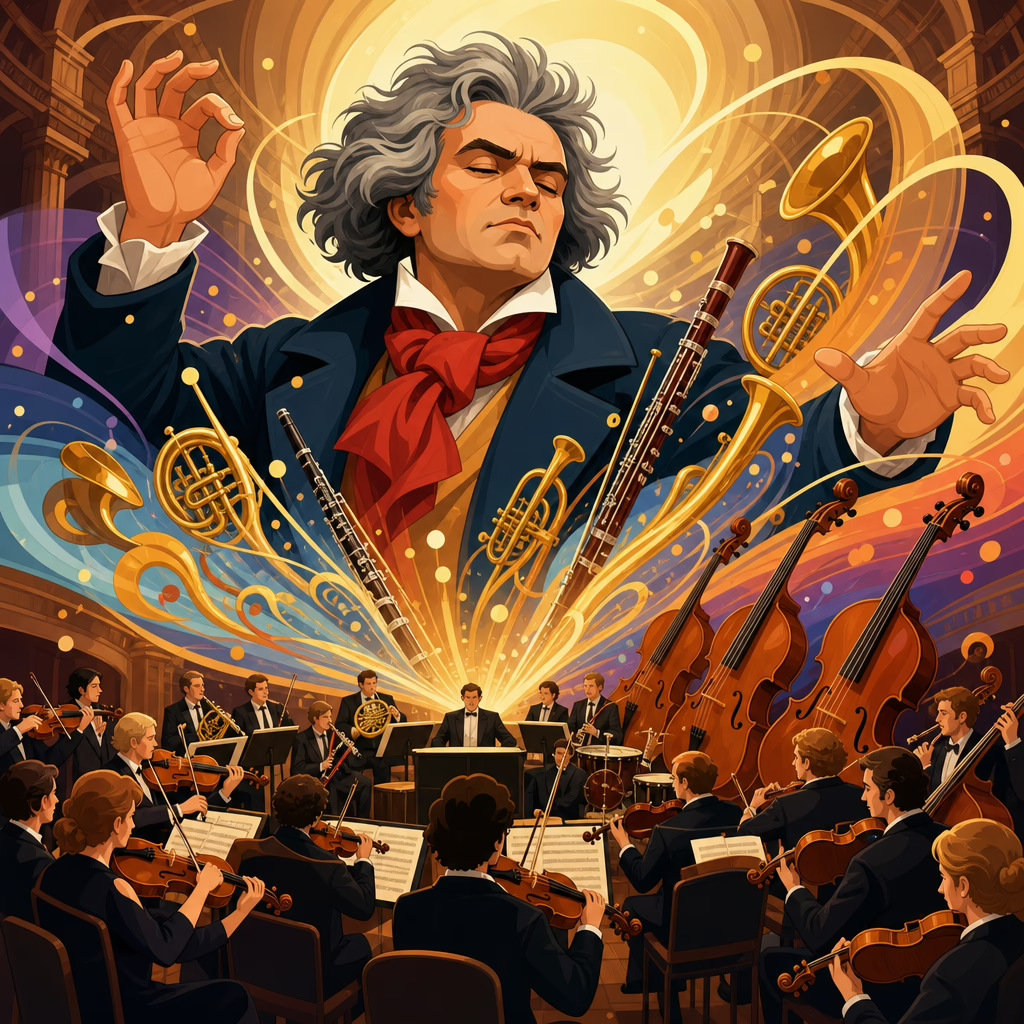
Why Beethoven’s Orchestration Felt Bigger Than the Orchestra
Beethoven’s orchestration felt bigger than the orchestra because he treated instrumental writing not as decorative color but as a structural force that could enlarge drama, weight, and perceived space without requiring unusually large ensembles. In practical terms, orchestration means the way a composer distributes musical material across instruments: who carries melody, who supplies harmony, who doubles, who punctuates, who creates tension through register, rhythm, articulation, and timbre. Many listeners assume “bigger” simply means “more players,” yet in Beethoven’s music the effect usually comes from design. He could make a classical orchestra of roughly double winds, horns, trumpets, timpani, and strings sound monumental by concentrating energy at critical moments, widening registral gaps, intensifying rhythmic profiles, and reserving the loudest sonorities for points of maximum structural consequence.
I have spent years studying scores, rehearsing orchestral players, and comparing Beethoven’s notation with what actually happens in the room, and the lesson is consistent: the sound expands because the writing expands the listener’s sense of scale. Haydn and Mozart already used the late eighteenth-century orchestra brilliantly, but Beethoven changed how often instruments act like agents in argument rather than polite participants in texture. He sharpened contrasts, prolonged suspense, and made accompaniment figures feel like engines. He also understood a physical truth conductors and orchestrators know well: audiences hear mass not only from volume, but from attack, saturation of the middle register, bass reinforcement, and the accumulation of repeated motives across sections. That is why Beethoven’s orchestration still sounds unusually large, even when played on period instruments with leaner forces.
This matters because Beethoven’s reputation for innovation is often discussed in terms of harmony, form, and heroism, while the mechanics of orchestral scale receive less precise attention. Yet if we want to understand why the Eroica, Fifth, Seventh, and Ninth project such force, we need to look closely at how he organized sound. His achievement was not merely louder climaxes. It was a new relationship between orchestration and musical architecture. The orchestra became a machine for magnifying form. By examining how Beethoven layered rhythm, deployed winds and brass, managed register, and controlled dynamic timing, we can hear why his scores feel larger than the bands that premiered them.
He Made Rhythm Carry Orchestral Weight
The fastest route to a “bigger” orchestral impression in Beethoven is rhythm. He understood that repeated rhythmic cells, especially when distributed across sections, create the sense of a single organism driving forward. The famous short-short-short-long motive in the Fifth Symphony is the clearest example. It is not only a theme; it is a generating pulse that invades melody, bass line, accompaniment, transition, and coda. Because the same profile appears in multiple layers, the orchestra sounds denser than the headcount suggests. Even when only part of the ensemble is playing, the ear perceives a totalized energy field.
In rehearsal, this becomes obvious. If the strings articulate a repeated figure with unanimity while winds and horns reinforce accents at key points, the listener hears mass through coordinated attack. Beethoven writes these attacks with extraordinary precision. Sforzandi, syncopations, offbeat punches, and repeated-note patterns turn several small groups into one large rhetorical event. The opening of the Seventh Symphony shows another strategy: a long introduction that stores rhythmic potential, followed by a Vivace whose propulsion feels almost physical. The orchestra sounds huge because every desk participates in momentum. Few notes are inert.
Unlike later romantic composers who often expanded by adding instrumental resources, Beethoven frequently expanded from within. A limited palette becomes monumental when every section articulates the same rhythmic argument from a distinct angle. Cellos and basses bite into foundational patterns, violas thicken the center, violins project urgency, winds sharpen contour, and timpani convert pulse into public declaration. This is orchestration as kinetic architecture.
He Used Register and Spacing to Create Acoustic Scale
Beethoven also made the orchestra feel larger by controlling vertical space. Register is one of the most underappreciated tools in orchestration. When a composer spreads musical material between deep bass and high treble while leaving selective openness in the middle, the ear experiences breadth. Beethoven uses this constantly. Low strings and winds can ground a passage with granite-like weight while upper violins or woodwinds project sharply above, producing a span that feels wider than the ensemble itself.
The first movement of the Eroica Symphony offers repeated demonstrations. Bass lines are not merely supportive; they are assertive, mobile, and often thematically charged. When that lower activity is paired with high-register insistence, the sonic image becomes architectural. The sound has foundations and height. Beethoven knew that if basses move with enough profile, the entire orchestra acquires size. Modern film composers use the same principle with low ostinatos and bright upper lines, but Beethoven achieved it with far fewer players and without electronic reinforcement.
Spacing within chords matters too. Close voicing can sound rich, but wide voicing often sounds grander. Beethoven alternates these states strategically. He compresses texture to build pressure, then opens it at climactic arrivals. In performance, those expansions feel like walls moving outward. This is one reason sudden tutti passages can feel overwhelming even after relatively transparent writing. The contrast in spatial perception is built into the voicing.
| Technique | How Beethoven Used It | Why It Sounds Bigger |
|---|---|---|
| Rhythmic unification | Shared motives across strings, winds, brass, and timpani | Creates one large, coordinated force |
| Wide register | Active bass with high melodic projection | Expands perceived vertical space |
| Targeted doubling | Horn, oboe, clarinet, or bassoon reinforcement at structural moments | Adds weight without constant thickness |
| Dynamic timing | Delayed full-volume release after suspenseful buildup | Makes climaxes feel earned and larger |
| Brass and timpani punctuation | Sparingly deployed, high-impact entries | Transforms local accents into public events |
He Treated Winds and Brass as Structural Voices
In much late eighteenth-century orchestral writing, winds often color string-led textures or provide harmonic filling. Beethoven certainly inherited that practice, but he increasingly demanded more. Winds and brass in his symphonies are not ornaments applied to a string body. They articulate form, reveal motive, stabilize harmonic pillars, and intensify public rhetoric. That change is central to why the orchestra sounds bigger.
Consider the horns in the Eroica. Their writing is not confined to background warmth. They announce, challenge, and help define heroic space. The famous horn entrance near the first movement recapitulation is often discussed as a formal shock, but it is also an orchestral one. A single timbral event can suddenly enlarge the perceived stage because the horn is acting as a protagonist. The same is true of trombones in the Fifth and Ninth Symphonies. Beethoven does not use them continuously; he introduces them where the form requires a new order of magnitude. Restraint increases impact.
Woodwinds are equally important. In Beethoven, oboes, clarinets, bassoons, and flutes often clarify the skeleton of a passage. They can harden a line, expose a countermelody, or illuminate harmonic motion that would sound merely busy in strings alone. In the Pastoral Symphony, wind writing shapes scene and atmosphere, but even there the larger lesson remains: color serves structure. When winds speak independently, the orchestra stops sounding like one mass and starts sounding like a civic assembly of distinct voices. Paradoxically, that independence makes the whole ensemble feel larger.
For readers interested in Beethoven’s broader transformation of symphonic thinking, the main guide at how Beethoven reinvented the symphony provides wider context, but the orchestration point is specific: Beethoven enlarged the orchestra’s rhetorical function more radically than he enlarged its personnel.
He Built Climaxes Through Timing, Not Constant Loudness
A large orchestral impression depends on dynamic timing. Beethoven rarely wastes maximum force. He prepares it, withholds it, and then releases it where formal stakes are highest. This is one of the biggest reasons his climaxes still hit so hard. If everyone plays loudly for long stretches, the ear adjusts and scale shrinks. Beethoven knew that magnitude depends on contrast and arrival.
The first movement of the Fifth Symphony is a textbook case. Short units accumulate, sequences intensify, harmonic pressure rises, and dynamic thresholds keep shifting. By the time the full ensemble asserts itself, the listener has been trained to feel necessity. The climax sounds bigger because it resolves stored energy, not because the instrumentation has suddenly become exotic. Conductors who rush these preparations or level dynamic tiers often make Beethoven sound smaller than he is on the page.
The same principle governs Beethoven’s use of silence and near-silence. General pauses, sudden dropouts, and thinly scored transitions reset the ear. In a hall, that reset is powerful. A whispered woodwind line after a tutti does not merely contrast; it enlarges the memory of what preceded it and heightens anticipation of what will return. Beethoven’s scores are full of these psychological acoustic maneuvers. He composed the listener’s expectation as carefully as the notes.
This is where his experience at the keyboard also matters. Pianistic thinking taught him how attack, decay, spacing, and surprise alter perceived scale. He transferred that instinct to orchestra. The result is music that feels physically staged, almost like lighting design in sound.
He Made the Bass Line an Engine, Not a Background
When musicians talk about Beethoven’s power, they often mention the bass. That is not incidental. In many classical textures, bass instruments support harmony and rhythm with relative discretion. Beethoven pushes them forward. Cellos and basses frequently carry motives, drive transitions, and define character. Bassoons reinforce, darken, or sharpen that foundation. Once the lower register becomes active and thematic, the whole orchestra gains depth and torque.
The Scherzo of the Fifth Symphony shows how this works. The mysterious low strings are not passive underpinning. They establish a charged space from which later eruptions emerge. In the Seventh Symphony, too, repetitive lower-string motion contributes to the sense of unstoppable momentum. Players feel this physically. If the bass articulation is alive, the rest of the orchestra can ride on it; if it is generalized, the music loses scale immediately.
Beethoven also writes bass motion that clarifies harmonic direction at moments of maximum tension. Rather than leaving dramatic responsibility only to upper voices, he lets the floor move. Audiences may not analytically track the line, but they register its force. This is a key difference between music that sounds full and music that sounds monumental. Fullness is thickness. Monumentality is directed mass.
His treatment of timpani reinforces the same point. Timpani in Beethoven are not mere ceremonial thunder. They lock harmonic roots to rhythm and turn the bass foundation into a public statement. In an era before oversized percussion sections, that was enough to transform orchestral presence.
He Wrote Textures That Stay Clear Under Pressure
Another reason Beethoven’s orchestration feels bigger than the orchestra is clarity. Large effect does not come from indiscriminate doubling. It comes from making sure each layer remains legible when intensity rises. Beethoven is often denser than Mozart, but he is rarely muddy when well performed. He knows which line must project, which can reinforce, and which should drop away.
This selective clarity is crucial in contrapuntal passages and codas. In the finale of the Fifth Symphony, for example, the blazing C major sonority works because inner activity does not obscure the main directional thrust. Trumpets, trombones, piccolo, timpani, and strings contribute to splendor, yet the texture remains organized. The result is not just loudness but legibility at high energy. That combination reads to the ear as scale.
Beethoven often achieves clarity through registral separation, differentiated articulation, and instrumental character. A bassoon doubling cellos does not merge in the same way a viola doubling second violins would. Horns can thicken harmony while still cutting through because of timbral identity. Oboes can sharpen a melodic edge without adding undue bulk. These are practical orchestration choices, and they show a composer thinking acoustically, not abstractly.
There is also discipline in what Beethoven leaves out. He does not saturate every bar with every available color. By preserving contrast between lean and full scoring, he ensures that expansions register immediately. Bigger sound, in other words, comes from proportion.
Why the Effect Still Works Today
Modern symphony orchestras are often larger than the groups Beethoven knew, yet his orchestration still projects with unusual amplitude on both modern and period instruments. That durability confirms that the effect is compositional before it is logistical. Historically informed performances, using natural horns, narrower-bore winds, harder sticks on timpani, and smaller string sections, often reveal the mechanism especially well. The transparency lets listeners hear how motive, bass drive, spacing, and punctuation generate size.
On modern instruments, conductors face a tradeoff. Larger string sections can increase sheer body, but they can also blur the athletic articulation Beethoven needs. The strongest performances solve this by preserving edge. They balance brass so climaxes crown the texture rather than swamp it, keep timpani speaking clearly, and insist on rhythmic unanimity in the strings. When those elements align, the orchestra sounds not merely large, but inevitable.
That is Beethoven’s real secret. He made orchestration serve argument so completely that the listener experiences sound as destiny. The ensemble feels bigger than it is because every technical choice points toward structural consequence. Rhythm organizes force, register enlarges space, winds and brass define form, bass lines create propulsion, and dynamic timing makes arrival overwhelming. If you want to hear Beethoven’s innovation at its most concrete, listen not for how many instruments are playing, but for how decisively each one changes the scale of the musical world. Revisit the Eroica, Fifth, and Seventh with that question in mind, and the orchestra will seem to grow before your ears.
Frequently Asked Questions
Why did Beethoven’s orchestration sound bigger than the actual size of his orchestra?
Beethoven made his orchestra feel larger by using orchestration as a structural tool rather than as mere decoration. Instead of simply assigning pleasant colors to different instruments, he used instrumental placement to shape the listener’s sense of power, tension, scale, and space. A melody might be reinforced at a crucial moment by winds and strings in different registers, or a rhythmic figure might be repeated across sections so that the entire ensemble seems to expand outward. This creates the impression of mass and inevitability, even when the number of players is not unusually large.
He was also exceptionally skilled at controlling contrast. A lean, tightly focused passage can make the next full-orchestra statement seem monumental. By pacing entrances carefully, saving brass for decisive moments, thickening harmony only when dramatically necessary, and exploiting registral extremes, Beethoven made climaxes feel earned and overwhelming. The result is that listeners often perceive more sonic weight than the orchestra literally contains. In other words, the “bigness” comes not only from volume, but from dramatic architecture, density control, and the strategic distribution of musical material.
What does it mean to say Beethoven used orchestration as a structural force?
To say that Beethoven used orchestration as a structural force means that instrumentation in his music is tied directly to form, momentum, and dramatic argument. In many earlier works, orchestration could function largely as a means of coloristic support for ideas already defined by melody and harmony. Beethoven goes further: the choice of which instruments play, in what register, with what articulation, and at what point in the musical process becomes part of the composition’s logic. The orchestra is not just presenting the structure; it is helping build it.
For example, a theme may begin in a restrained scoring that emphasizes clarity and tension rather than fullness. As the idea develops, Beethoven can redistribute fragments of that material through strings, winds, and brass, increasing pressure without necessarily changing the basic idea itself. Doublings, registral widening, sforzando accents, tremolos, pedal points, and rhythmic insistence all become structural events. They alter the listener’s perception of scale and direction. This is why his orchestration can feel so inevitable and so powerful: instrumental writing is embedded in the music’s underlying design, not added afterward as surface color.
How did Beethoven create a sense of grandeur without using extremely large ensembles?
Beethoven created grandeur through concentration, spacing, and timing. He understood that a sense of scale does not depend only on the number of players, but on how sound is organized. One of his most effective techniques was registral expansion: placing musical material across a wide vertical span so that the orchestra seems to occupy more acoustic space. Low bass support combined with brilliant upper-register writing can make a texture feel architecturally vast, even if the middle is relatively spare. This gives the ear a sense of breadth and dimension.
He also used doubling and sectional interplay with great precision. When strings, winds, and brass unite at key moments, the listener hears not just more sound, but more definition and impact. At other times, he isolates groups to preserve transparency, which makes later reunification feel especially immense. Rhythmic propulsion contributes as well. Repeated figures, syncopations, sharply profiled accents, and persistent accompaniment patterns generate energy that makes the orchestra feel larger than life. Beethoven’s grandeur is therefore not simply a matter of orchestral size; it is the product of disciplined build, dramatic pacing, and a deep understanding of how sonic mass is perceived.
What role did contrast and dynamics play in making Beethoven’s orchestration feel so powerful?
Contrast and dynamics are central to Beethoven’s sense of scale. He rarely aims for constant fullness, because uninterrupted weight can quickly feel static. Instead, he uses sharp shifts between light and heavy textures, soft and loud passages, exposed lines and massed sonorities. These contrasts heighten the listener’s awareness of space and force. A single wind line after a dense tutti can feel suddenly intimate; a full-orchestra entrance after restraint can feel seismic. This dramatic use of opposition is one of the main reasons his orchestration seems larger than the physical ensemble behind it.
His dynamic writing also works hand in hand with articulation and rhythm. Sudden accents, explosive sforzandi, crescendos built over repeated motives, and strategically delayed climaxes all intensify the impact of the orchestra. Beethoven often makes dynamic growth feel tied to the music’s inner necessity, not merely to external effect. That is why his loud moments often sound bigger than simple decibel level would suggest: they arrive with harmonic pressure, rhythmic insistence, and textural accumulation already in motion. In practical listening terms, the orchestra feels powerful because Beethoven controls how energy is stored, released, interrupted, and renewed.
How did Beethoven influence later composers in their approach to orchestration and musical scale?
Beethoven’s influence was immense because he demonstrated that orchestration could shape musical argument at the deepest level. Later composers inherited from him the idea that instrumental color, density, register, and sectional contrast could be used to enlarge form and intensify narrative, not just beautify the surface. Even composers who eventually wrote for much larger orchestras learned from Beethoven that dramatic weight comes from purposeful deployment of resources. His example showed that an orchestra could sound monumental through design, not merely through numbers.
This legacy can be heard in the nineteenth century’s growing emphasis on orchestral drama, thematic transformation, cumulative climaxes, and the psychological use of timbre. Composers after Beethoven often expanded the orchestra, but many of them were still following principles he had sharpened: build tension through texture, define form through instrumental contrast, use brass and winds strategically, and make climaxes feel structurally earned. In that sense, Beethoven helped redefine orchestration as a compositional engine. His music remains a model because it proves that the perception of size, force, and grandeur begins with imagination and control, not just with a headcount of players.