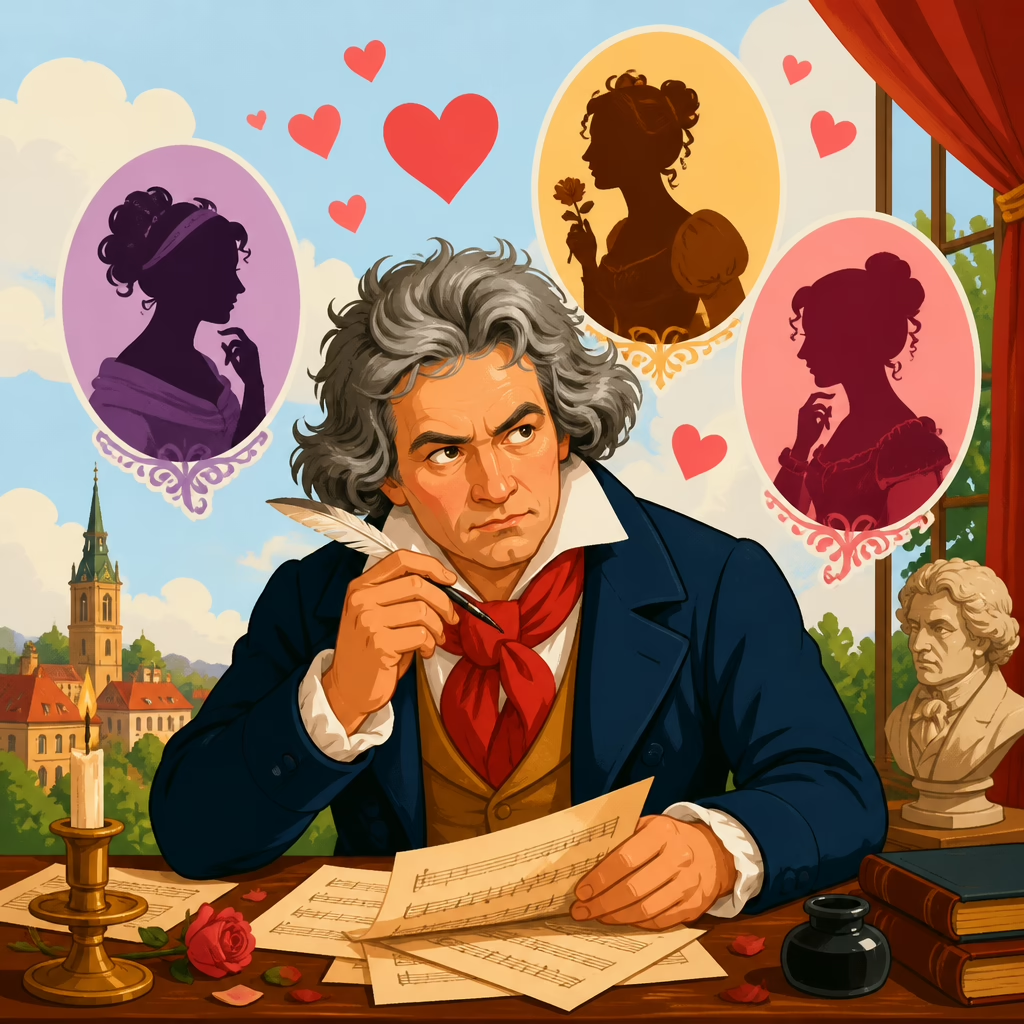
What We Know About Beethoven’s Love Life
Ludwig van Beethoven’s love life has fascinated biographers for two centuries because it reveals the private tensions behind a public figure who guarded his emotions fiercely, formed intense attachments, and yet never married. When people ask what we know about Beethoven’s love life, the honest answer is both substantial and incomplete. We have letters, diary entries, memoirs, legal records, dedications, and testimony from friends, but we do not have a single straightforward confession that explains every relationship. Key terms matter here. A documented relationship is one supported by contemporary evidence such as letters or household accounts. A suspected attachment rests on later recollection or circumstantial clues. The most famous example is the “Immortal Beloved” letter of July 1812, an unsent three-part declaration found among Beethoven’s papers after his death. It proves overwhelming romantic feeling, yet it does not name the woman. That mixture of evidence and mystery is why the subject still matters. Beethoven’s music is not a diary, but his emotional life influenced choices about patronage, friendship, domestic stability, and the women to whom he dedicated major works. In my own work with Beethoven correspondence and standard biographies, the pattern that stands out is consistency: he sought intimacy, idealized women of high social standing, and repeatedly collided with class boundaries, illness, temperament, and circumstance. Understanding those collisions gives a clearer, more human portrait of Beethoven than anecdotes about wild hair or heroic struggle ever can.
The evidence we can trust
Any serious account of Beethoven’s love life has to start with sources. The strongest evidence comes from his correspondence, especially letters preserved in editions such as the Brandenburg collection, from conversation books used in his later deaf years, and from legal and family papers. Memoirs by associates like Anton Schindler must be handled carefully because some are unreliable or embellished. Scholars also compare dedications of works, travel dates, and the social circles of Vienna, Prague, Teplitz, and the Hungarian estates of noble families. This method matters because Beethoven often wrote in emotionally intense language to friends as well as to women, and nineteenth-century recollections frequently romanticized him.
One reason the record is fragmentary is practical. Beethoven destroyed some papers, kept others, and led an unsettled life with frequent moves. Another reason is social convention. Respectable women, especially aristocratic women, did not leave behind explicit public records of romantic attachments with a composer who was socially beneath them. In Vienna around 1800, rank still mattered. A titled woman could admire Beethoven, study piano with him, host him, or inspire him, but marriage was another question entirely. This context explains why his relationships often remained emotionally charged but formally unresolved. If you want broader context on the man behind the documents, the main pillar guide at https://lvbeethoven.com/what-beethovens-birth-record-actually-tells-us/ helps ground the chronology.
Early attachments and the pattern of idealization
Before Beethoven became Vienna’s towering musical figure, he already showed a tendency toward intense admiration. In Bonn, one early and often discussed attachment involved Countess Josephine von Clary-Aldringen according to some reconstructions, though the evidence is thin. Far better documented is the pattern that emerged after his move to Vienna in 1792: he taught gifted aristocratic women, socialized in elite households, and developed strong feelings for women whose rank made marriage difficult or impossible. Teaching created intimacy. Lessons took place in private rooms, often repeatedly, and music itself provided a language of refined emotion. Beethoven was magnetic, brilliant, and often awkward. Women admired his talent; he admired intelligence and sensitivity as much as beauty.
This idealization was not casual flirting. In letter after letter, Beethoven attached moral seriousness to love. He wanted constancy and spiritual union, not merely companionship. Yet he could also be demanding, suspicious, and unpredictable. Friends described moments of charm alongside irritability. His increasing hearing loss deepened both his need for closeness and his sense of alienation. A recurring feature of his attachments is asymmetry: Beethoven imagined total devotion while the practical realities around the woman included family expectations, inheritance issues, and suitable marriage prospects. That gap between emotional absolutism and social reality explains much of the heartbreak associated with his love life.
Josephine Brunsvik: the strongest candidate for a great love
If one woman stands at the center of serious discussion about Beethoven’s love life, it is Josephine Brunsvik, later Countess Deym. Beethoven met the Brunsvik sisters through piano instruction around 1799. Josephine was aristocratic, cultured, and by many accounts deeply responsive to him. After her marriage to Count Joseph Deym, contact continued. When Deym died in 1804, Josephine became a widow with children, financial complications, and unusual vulnerability. Beethoven’s surviving letters to her from roughly 1804 to 1809 are among the most intimate pieces of evidence in his emotional history. He writes with tenderness, urgency, and language suggesting not a passing affection but a serious bond.
What prevented marriage? Class was central. Under the legal norms governing aristocratic families in the Habsburg world, a noblewoman who married beneath her rank could jeopardize the status and inheritance rights of her children. Josephine knew this. Her family knew it. Beethoven, despite growing fame, remained a commoner and a financially insecure one. The relationship may also have been complicated by her health, depression, and the practical burdens of widowhood. Some scholars argue they were briefly lovers. That cannot be proved conclusively, but the emotional stakes are unmistakable. When I weigh the documentary record, Josephine looks less like a footnote and more like the most sustained romantic attachment of Beethoven’s adult life.
Giulietta Guicciardi, Therese Brunsvik, and other women often linked to him
Popular culture tends to spotlight Countess Giulietta Guicciardi because Beethoven dedicated the Piano Sonata No. 14, Op. 27 No. 2, to her, a work later nicknamed the “Moonlight Sonata.” There was almost certainly an infatuation. Beethoven taught her around 1801 and, according to later reports, may have considered marriage. Yet the surviving evidence is weaker than in the Josephine case. Giulietta eventually married Count Wenzel Gallenberg in 1803. The idea that she was Beethoven’s singular tragic love oversimplifies the record and owes much to nineteenth-century romantic storytelling.
Therese Brunsvik, Josephine’s sister, has also been proposed as an important attachment and, in older scholarship, even as the “Immortal Beloved.” Therese clearly admired Beethoven, studied with him, and remained within his wider circle. However, the direct evidence for a reciprocal grand romance is limited. Other names recur: Countess Marie Erdődy, a close patron and friend; Bettina Brentano, who cultivated an image of intimate access to great men; and Amalie Sebald, a singer Beethoven knew in Teplitz. None can simply be dismissed, because Beethoven’s emotional world was layered and not every attachment was equal. But distinguishing between warmth, admiration, friendship, and courtship is essential if the goal is accuracy rather than legend.
The “Immortal Beloved” letter and the leading candidates
The most famous document in Beethoven’s romantic life begins “My angel, my all, my very self” and was written on 6 and 7 July 1812. It was never sent, and no name appears. Because the letter references travel disruptions, locations, and hopes for future union, scholars have reconstructed the circumstances with unusual precision. Beethoven was in the Bohemian spa region around this time, moving between Prague, Teplitz, and nearby destinations. The woman had to be someone he could realistically meet within that itinerary and someone with whom a profound existing bond already existed.
| Candidate | Why scholars consider her | Main objection |
|---|---|---|
| Josephine Brunsvik | Intimate earlier letters, strong emotional history, timing may fit 1812 | Chronology and her family situation remain contested |
| Antonie Brentano | Close Vienna connection, documented presence in relevant circles, strong modern scholarly support | She was married, and direct romantic evidence outside the letter is limited |
| Amalie Sebald | Known to Beethoven in Teplitz, socially available in the spa setting | Tone of surviving evidence seems too mild for the letter’s intensity |
| Therese Brunsvik | Long association and older biographical tradition | Documentary support is weaker than for Josephine or Antonie |
Today, the debate most often centers on Josephine Brunsvik and Antonie Brentano. Antonie, the wife of Frankfurt merchant Franz Brentano, has gained strong scholarly backing, especially after detailed chronological work by researchers such as Maynard Solomon. She was intelligent, cultivated, close to Beethoven’s circle, and present in Prague at a relevant moment. The case for Josephine rests more on the depth of prior intimacy and language in earlier letters that resembles the emotional force of 1812. No candidate commands universal agreement. What the letter proves beyond doubt is that Beethoven experienced passionate, adult, mutual-seeming love late in life, not just youthful infatuation.
Why Beethoven never married
Beethoven’s bachelorhood was not the result of indifference to love. It was the outcome of several reinforcing barriers. First was class. He repeatedly formed attachments to noblewomen, and the social cost of marrying a commoner was severe for them. Second was money. Beethoven earned substantial fees at points in his career and negotiated annuities with aristocratic patrons in 1809, but his finances were uneven, and inflation during the Napoleonic period eroded income. He could support himself, yet he did not present the stable domestic profile many families wanted for a daughter.
Third was temperament. Beethoven could be devoted and generous, but he was also volatile, disorderly in household management, and capable of abrupt quarrels. Fourth was health, especially his progressive deafness. Hearing loss was not merely a medical condition; it altered self-confidence, sociability, and the feasibility of married daily life. Finally, timing worked against him. Several relationships appear to have ripened when the woman was already constrained by widowhood, pregnancy, family oversight, or another suitor. Beethoven’s love life, in other words, was tragic not because he lacked opportunities for feeling, but because the opportunities that mattered most were structurally blocked.
What his relationships reveal about Beethoven
Beethoven’s love life shows a man who longed for emotional equality and moral seriousness, yet often sought it in situations where fulfillment was least possible. That does not make his feelings unreal. On the contrary, the documentary record suggests sincerity of a high order. He was not a cynical seducer. He was a deeply feeling man whose imagination and standards intensified attachment. The same intensity that drove his art could complicate intimacy. He wanted the absolute, and ordinary compromise rarely satisfied him.
It is tempting to read specific compositions as portraits of particular women, but caution is necessary. Musical dedications can reflect gratitude, patronage, teaching relationships, friendship, admiration, or love. Still, his romantic attachments shaped his life in practical ways. They affected where he visited, whom he taught, how he navigated elite society, and how he imagined a private future that never materialized. The most credible conclusion is neither that Beethoven was loveless nor that every lyrical page encodes a secret affair. It is that he loved repeatedly, seriously, and often unsuccessfully, leaving behind enough evidence to map the contours even if not every intimate fact can be recovered.
What we know about Beethoven’s love life rests on careful distinctions. We know he formed deep attachments to several women, especially within aristocratic circles. We know Josephine Brunsvik is central to any credible account, and we know the 1812 “Immortal Beloved” letter records a love of exceptional intensity. We also know that class barriers, deafness, finances, and Beethoven’s own difficult temperament stood between desire and marriage. What remains uncertain is not whether Beethoven loved, but which relationship fulfilled his hopes most fully and who received the unsent letter. That uncertainty is part of the historical record, not a failure of it.
For readers interested in biography, the main benefit of studying Beethoven’s love life is clarity. It strips away cliché and replaces it with a documented human story: a composer of immense power navigating the limits of his society and his own nature. Read the letters, compare the timelines, and treat romantic legends with the same discipline you would apply to the music. The result is a Beethoven who feels less mythical and more real.
Frequently Asked Questions
Did Beethoven ever marry?
No, Beethoven never married, and that fact is one of the main reasons his romantic life continues to attract so much attention. He formed deep emotional attachments to several women over the course of his life, but none of those relationships ended in marriage. In early 19th-century Vienna, marriage was shaped not just by affection but also by class, family approval, financial security, and social reputation. Beethoven, despite his fame as a composer, occupied an uncertain social position: he moved among aristocratic patrons and highly educated circles, yet he was not a nobleman, and that difference mattered greatly in courtship.
His personality also seems to have complicated matters. Accounts from friends and contemporaries describe him as intense, proud, emotionally reserved in some moments and overwhelmingly expressive in others. He wanted intimacy, but he also guarded his inner life fiercely. Add to that his worsening deafness, unstable domestic habits, and periodic financial anxieties, and it becomes easier to see why lasting partnership may have been difficult. The evidence suggests that Beethoven longed for love and companionship, but the practical and emotional conditions required for marriage never fully came together for him.
Who were the most important women in Beethoven’s romantic life?
Several women are often discussed in connection with Beethoven, though the nature and depth of each relationship varies. Among the best-known names are Countess Giulietta Guicciardi, to whom the so-called “Moonlight Sonata” was dedicated; Josephine Brunsvik, a widowed countess with whom Beethoven appears to have had a particularly intense bond; Therese Brunsvik, Josephine’s sister, who was close to him in social and intellectual terms; and Antonie Brentano, another woman frequently proposed as central to his emotional life. These women appear in letters, dedications, memoirs, and later recollections, but the surviving record does not always allow absolute certainty about what each relationship meant privately.
Josephine Brunsvik is often considered one of the strongest candidates for a truly serious love attachment because surviving correspondence suggests strong mutual feeling, and some historians think marriage was discussed or imagined. The obstacle, however, was social rank: as an aristocratic widow, a marriage to Beethoven could have endangered her children’s status and inheritance. Giulietta Guicciardi has long had a place in popular imagination, but modern scholarship tends to treat that romance more cautiously than earlier romantic biographies did. Antonie Brentano became especially prominent in discussions because some researchers have argued that she may have been the recipient of Beethoven’s most famous love document, the “Immortal Beloved” letter. In short, there was not one universally agreed-upon great love in Beethoven’s life, but rather a pattern of profound, often constrained attachments to women he admired deeply.
What is the “Immortal Beloved” letter, and why is it so important?
The “Immortal Beloved” letter is the most famous surviving document connected to Beethoven’s love life. Written in July 1812 and never sent, it is an intensely emotional declaration addressed to an unnamed woman. In it, Beethoven writes with urgency, tenderness, longing, and frustration about separation, devotion, and the impossibility of being fully together in the moment. Because the letter has no explicit name attached to it, scholars have spent generations trying to identify its recipient. That mystery has made it one of the most debated love documents in music history.
Its importance lies in what it reveals even without solving the identity question. The letter shows beyond doubt that Beethoven was capable of deep romantic passion and that at least one relationship mattered to him at the highest emotional level. It also captures recurring themes in his personal life: distance, obstacles, yearning, and the tension between ideal love and lived reality. Proposed recipients have included Josephine Brunsvik, Antonie Brentano, and others, with different scholars building cases from travel records, handwriting chronology, social networks, and known meetings around the date of composition. No theory commands universal agreement, which is why the letter remains both invaluable evidence and an enduring mystery. Even so, it is central to understanding Beethoven not as a cold monument of genius, but as a vulnerable and emotionally complex human being.
Why is it so hard to know exactly what Beethoven’s relationships were really like?
The difficulty comes from the nature of the evidence. We do have a considerable amount of material: letters by Beethoven, conversation books from his later years, memoirs by acquaintances, legal records, manuscript dedications, and reports preserved by friends and biographers. But this evidence is fragmentary, uneven, and sometimes indirect. Many letters are missing, some accounts were written long after the fact, and recollections by admirers or associates can be colored by nostalgia, self-interest, or misunderstanding. In some cases we have Beethoven’s side of a feeling but not the woman’s reply, which leaves the emotional picture incomplete.
There is also the problem of interpretation. Beethoven’s writing can be passionate without necessarily proving a formal romantic relationship, and dedications do not always indicate love. Social etiquette in his era was more coded than modern readers often realize, especially in aristocratic settings where affection, patronage, admiration, and emotional dependency could overlap. On top of that, Beethoven himself was a private man who did not leave a neat autobiographical explanation of his intimate life. So when people ask what we know about Beethoven’s love life, the most accurate answer is that we know a great deal in fragments: enough to trace real emotional intensity, recurring attachments, and thwarted possibilities, but not enough to reduce his love life to a simple list of confirmed affairs.
Did Beethoven’s love life influence his music?
Very likely, yes, though the connection should be described carefully. It is tempting to assign specific compositions directly to specific romances, but the evidence does not always support that kind of neat one-to-one reading. Beethoven did dedicate works to women he admired, and some of those dedications clearly reflect important personal ties. More broadly, his music often conveys longing, struggle, tenderness, exaltation, and inward conflict in ways that feel consistent with the emotional pressures visible in his letters and personal history. While we cannot prove that a particular sonata or quartet is a straightforward diary entry in sound, it would be equally misleading to pretend his emotional life had no bearing on his art.
What seems safest to say is that Beethoven’s experiences of desire, frustration, idealization, loneliness, and hope formed part of the emotional world from which his music emerged. He lived with powerful inner tensions: the wish for closeness, the barriers of class and circumstance, the pain of deafness, and the demands of artistic ambition. Those tensions do not translate into music in a simple biographical code, but they help explain the intensity and depth listeners often hear in his work. His love life matters not because it provides gossip, but because it offers a more human context for understanding the emotional force behind one of history’s greatest composers.