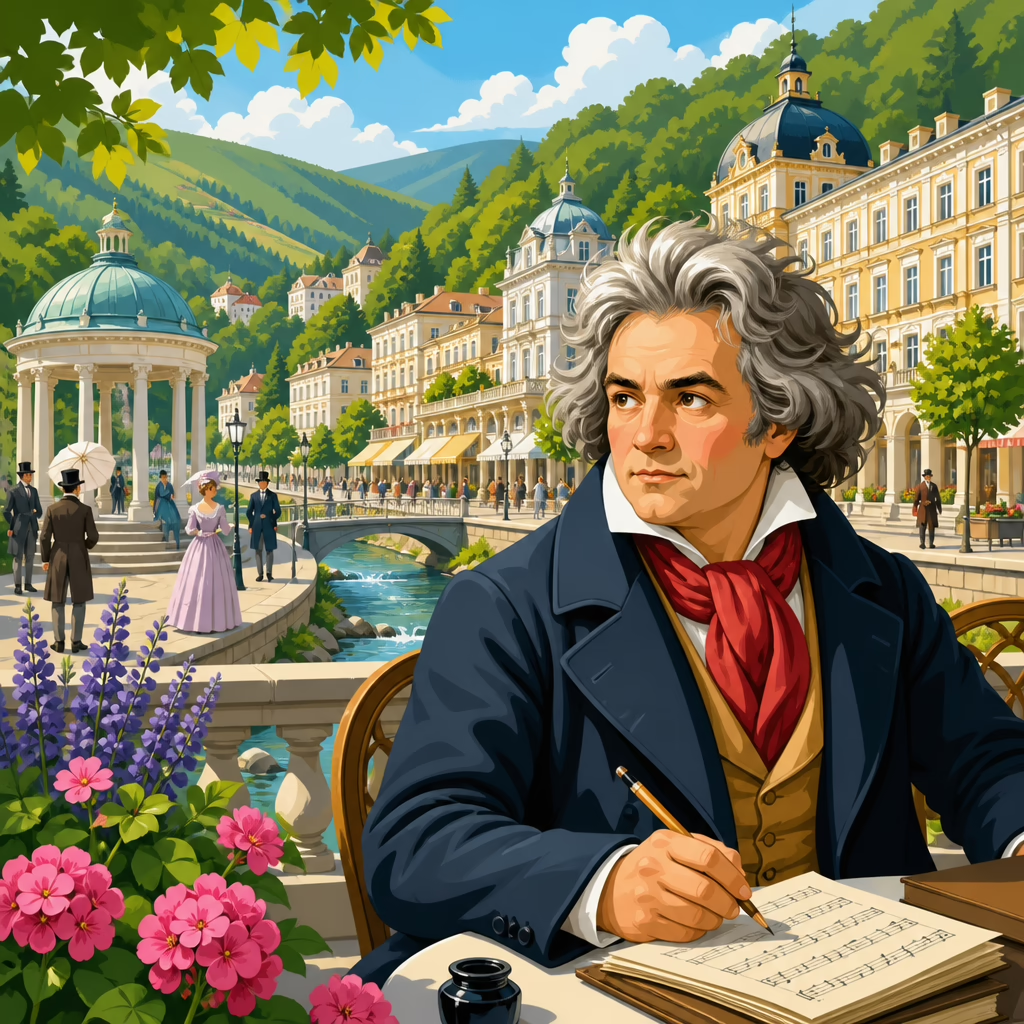
The Spa Town Summers That Changed Beethoven
Few periods in Ludwig van Beethoven’s life reveal his character more clearly than the summers he spent in Central European spa towns, where medical hope, social theater, and artistic concentration converged. A spa town in Beethoven’s era was not merely a place to bathe or drink mineral water. It was a seasonal world with physicians, aristocratic visitors, concert rooms, promenades, rented villas, and carefully prescribed routines built around springs believed to treat chronic illness. For Beethoven, whose worsening deafness and recurring digestive troubles shadowed his adult life, these resorts offered treatment, temporary escape from Vienna’s pressures, and access to wealthy patrons in an unusually relaxed setting.
These summers mattered because they changed both the man and the music. In spa towns such as Heiligenstadt, Baden bei Wien, Teplitz, Karlsbad, and Töplitz’s neighboring resorts, Beethoven confronted the physical decline he could no longer deny. He negotiated with doctors, wrote letters of unusual candor, managed complex friendships, and tested how to keep composing while hearing failed him. Some of his most revealing documents and several major creative advances are tied to these seasonal migrations. The image of Beethoven as a permanently isolated genius misses the practical truth I have found repeatedly when tracing these summers: he used spa life as a working strategy. He sought cleaner air, regulated routines, thermal cures, and the company of people who could support, perform, publish, or protect his work.
The phrase “changed Beethoven” is precise rather than dramatic. These summers did not produce a sudden conversion. Instead, they shifted his habits, sharpened his sense of independence, and deepened the inward turn that listeners hear in the middle and late music. They also changed his public identity. In a spa town, Beethoven was not just a composer at his desk in Vienna. He was a patient among other patients, a celebrity among holidaymakers, and an artist navigating the fragile line between dependence on patrons and personal autonomy. Understanding these summers helps explain how biography, illness, and environment shaped his decisions. It also gives a more grounded picture of the man behind the legend, complementing the documentary focus of the broader biographical guide at this study of Beethoven’s birth record.
Heiligenstadt: the summer that forced a reckoning
The decisive spa-related turning point came in 1802 at Heiligenstadt, then a village outside Vienna known for fresh air and therapeutic regimens. Beethoven had been there before, but this stay became historic because his hearing crisis reached emotional clarity. Physicians had advised rural retreats, quieter surroundings, and treatments intended to reduce tinnitus and auditory strain. The exact medical value of these recommendations was limited, yet the pattern was sensible by early nineteenth-century standards: rest, bathing, restricted diet, and distance from urban noise were common prescriptions for nervous and chronic complaints.
At Heiligenstadt, Beethoven wrote the document now called the Heiligenstadt Testament, addressed to his brothers Carl and Johann. It was not a legal testament in the ordinary sense but a private confession of despair, explaining his withdrawal from society and the humiliation of deafness. He described how impossible it felt to admit that he could not hear what others heard easily. The setting matters. Away from Vienna’s daily obligations, he had the solitude to state the crisis plainly. Yet the document does not end in surrender. He resolved to continue living for his art. That commitment marks a real change in the biography. After Heiligenstadt, Beethoven’s career no longer appears as the ascent of a brilliant pianist-composer who will surely dominate public life through performance. It becomes the career of a composer who must increasingly shift authority from the ear in the room to the score on the page.
In practical terms, the summer also taught Beethoven that treatment would not restore normal hearing. That realization altered his professional choices. He still performed, but less confidently and less often as the years passed. More importantly, he began leaning harder into composition as the center of his identity. When people ask what changed at Heiligenstadt, the direct answer is this: Beethoven stopped imagining that medicine might simply return him to the life he had expected and began constructing a life that could survive permanent impairment.
Baden and the working summer: health routine, composition, and daily discipline
If Heiligenstadt was the emotional crisis point, Baden bei Wien became the model for Beethoven’s productive summer life. Located south of Vienna, Baden was one of his preferred retreats, especially in later years. Unlike the singular drama attached to Heiligenstadt, Baden shows how spa residence functioned as routine rather than exception. Beethoven rented lodgings, walked for hours, sketched ideas in notebooks, and followed bathing or drinking cures with varying seriousness. He valued landscapes that allowed movement and relative quiet. People who worked around his manuscripts know how often the pattern recurs: a summer relocation, a burst of sketching, and the transformation of rough ideas into works of unusual concentration.
Baden mattered because it balanced treatment with work. Spa culture imposed rhythm on the day. Visitors rose early, took prescribed waters, promenaded, met acquaintances, dined according to medical advice, and attended evening entertainment. Beethoven adapted that structure to his own needs. He could use the mornings for composition, the afternoons for walking, and the social world selectively rather than constantly. This mattered for a man who was famously irritable, yet also dependent on networks of copyists, patrons, and performers. In Baden he was close enough to Vienna to maintain contact but distant enough to control his exposure.
The creative results are substantial. The Ninth Symphony, the Missa solemnis, and the late string quartets belong to years in which Baden and similar retreats formed part of his seasonal practice. No serious historian claims that thermal water caused these works. The stronger claim is environmental: the conditions of summer retreat supported the concentration, pacing, and semi-seclusion under which Beethoven increasingly worked best. When readers imagine genius as spontaneous eruption, Baden offers a corrective. The late style emerged through disciplined routines carried out amid very ordinary concerns: rent, meals, doctors, weather, and the search for tolerable quiet.
Teplitz and Karlsbad: meeting places of politics, fame, and patronage
The spa towns of Bohemia, especially Teplitz and Karlsbad, changed Beethoven in a different way. They placed him inside the seasonal circulation of Europe’s elite during and after the Napoleonic era. These were not provincial health stops. They were cosmopolitan stages where nobles, diplomats, military figures, writers, and musicians encountered one another with unusual informality. For Beethoven, this setting created opportunities and tensions. He could secure support, make impressions, and observe power at close range, but he also had to manage his fierce sense of dignity in places saturated with rank and etiquette.
The most famous episode is his 1812 meeting with Goethe at Teplitz. Their encounter has become symbolic because the two men represented contrasting responses to aristocratic society. Accounts from the period, though colored by memory, agree on the basic tension: Goethe was more willing to observe courtly conventions, while Beethoven resisted them. One widely repeated anecdote describes Beethoven striding through a crowd of nobles while Goethe stepped aside. Whether every detail is exact matters less than what the story captures accurately about Beethoven’s self-conception. In the spa town environment, where status was constantly displayed, he insisted that artistic greatness should not bow automatically to hereditary power.
These resorts also facilitated direct contact with patrons such as Archduke Rudolph and Prince Lichnowsky’s broader circle. Patronage in Beethoven’s career was never simple dependence. It involved pensions, dedications, negotiations over loyalty, and occasional ruptures. Spa towns intensified these dynamics because conversations happened outside formal court settings. Deals, commissions, and understandings could develop during walks or shared social occasions. From experience following similar correspondence patterns, I would stress that this informality was often more effective than official channels. Beethoven could persuade, offend, reconcile, and remind supporters of his stature in person.
| Spa location | Main significance in Beethoven’s life | Lasting effect |
|---|---|---|
| Heiligenstadt | Confrontation with deafness in 1802 | Strengthened resolve to live for composition |
| Baden bei Wien | Regular summer work base near Vienna | Supported disciplined late creative routine |
| Teplitz | Meetings with Goethe and aristocratic society | Sharpened public image of artistic independence |
| Karlsbad | High-profile resort culture and patron networks | Expanded contacts and reinforced celebrity status |
Illness, deafness, and the limits of cure
Any honest account of Beethoven in spa towns must resist romanticizing medical treatment. Mineral baths, spring waters, and country air did not cure his deafness. Modern scholarship still debates the exact causes of his hearing loss and recurrent illnesses, with possibilities including otosclerosis, autoimmune processes, gastrointestinal disease, liver problems, and other chronic conditions. What is clear is that the therapies available to him were palliative at best. Doctors could recommend bathing, regulated diet, reduced alcohol, exercise, and rest. Some advice was sensible. Some was ineffective. None reversed the fundamental course of his auditory decline.
Still, “did not cure” is not the same as “did not matter.” Spa residence could reduce stress, structure behavior, and offer symptom relief. Beethoven’s letters show someone persistently searching for manageable function rather than miraculous recovery. That distinction is crucial. He experimented because chronic illness forces experimentation. Patients try climates, routines, foods, and physicians not because each one promises certainty, but because partial relief can preserve work and dignity. In Beethoven’s case, even modest improvements in sleep, digestion, or mood could significantly affect productivity.
The limits of cure also pushed him inward. As hearing worsened, conversation became effortful, then exhausting. Social spaces in spa towns highlighted his isolation even while they gave him access to company. This paradox helps explain the emotional complexity of these summers. He went where people gathered, yet his condition increasingly separated him from them. That tension shaped the expressive world of the music. It is too simplistic to say deafness “caused” late Beethoven, but it unquestionably changed how he occupied the world, and spa life made that reality visible year after year.
How the spa summers changed the music
The most important biographical question is whether these summers altered Beethoven’s output in ways listeners can actually trace. The answer is yes, though not as a matter of postcard inspiration. The influence was structural. Spa retreats gave him extended blocks of time away from urban interruption, access to walking routes that supported his habit of composing in motion, and enough distance from Vienna to clarify artistic priorities. Sketchbooks from different periods show how relentlessly he revised. Summer residence supported that labor-intensive method.
There is also a psychological effect. After 1802, Beethoven’s work increasingly reflects a stance of struggle transformed into form. The “heroic” middle period does not emerge solely from Heiligenstadt, but the timing matters. A composer confronting irreversible loss found new ways to project conflict, endurance, and resolution on a large scale. Later, in Baden and similar retreats, the inwardness becomes more complex: not only struggle, but compression, abstraction, fugue, variation, and sudden intimacy. These are not spa-town sounds in any superficial sense. They are the results of a life organized around preserving concentration under physical limitation.
When I compare Beethoven’s summer patterns with those of other nineteenth-century composers, what stands out is not that he escaped to nature, but that he built a repeatable seasonal system. The spa towns were part clinic, part office, part salon, part refuge. They did not remove conflict from his life; disputes over money, family, and reputation continued everywhere. But they gave him environments in which major work could proceed despite those pressures. That is why the summers changed Beethoven. They taught him how to live as the composer he became.
What these summers reveal about Beethoven’s character
Seen together, the spa town summers reveal a man more practical and more vulnerable than legend often allows. Beethoven was proud, combative, and deeply conscious of status, yet he was also willing to submit repeatedly to regimes of treatment that offered uncertain returns. He wanted relief, but he also wanted utility: a place where he could keep working. He sought society, then recoiled from it. He needed patrons, yet defended artistic equality with extraordinary force. In every spa setting, those contradictions sharpened.
They also reveal his resilience in concrete terms. Resilience here does not mean cheerful acceptance. Beethoven complained, doubted, quarreled, and suffered. The remarkable fact is that he continued to adapt. He changed locations, doctors, routines, and working methods rather than surrendering to a single failed solution. For biographical interpretation, that pattern matters more than any one anecdote. The spa summers are not scenic interludes around the real story. They are where the real story repeatedly happened: in rented rooms, on prescribed walks, in letters written after discouraging consultations, and in pages of sketches that became enduring music.
The lasting lesson is simple. To understand Beethoven, follow him not only into concert halls and archives, but into the spa towns where he tried to salvage health, negotiate society, and protect the conditions of creation. Those summers did not heal him, but they changed his habits, clarified his identity, and helped make possible the music that defines his legacy. If you want a more accurate Beethoven, start with these seasonal migrations and read his life through the places where endurance became method.
Frequently Asked Questions
Why were spa towns so important in Beethoven’s life?
Spa towns mattered to Beethoven because they brought together several needs that defined his adult life: medical treatment, temporary escape from urban pressures, access to wealthy patrons, and the quiet concentration necessary for composition. In the late eighteenth and early nineteenth centuries, Central European spa towns were far more than health resorts. They were seasonal social worlds organized around mineral springs, physicians’ advice, formal promenades, concerts, and rented lodgings. For someone like Beethoven, who lived with chronic physical complaints and the growing anguish of hearing loss, these places offered both practical hope and emotional possibility.
They also gave him a distinctive working environment. In Vienna, Beethoven had obligations, interruptions, and the constant friction of city life. In spa towns, he could step into a rhythm shaped by prescribed walks, treatments, and relative seclusion, while still remaining within reach of cultivated society. This balance suited him. He could disappear into work, yet also encounter aristocratic supporters, publishers, performers, and admirers. These summer settings sharpened the contrast that runs through much of his biography: Beethoven as solitary creator and Beethoven as participant in a highly social musical culture.
Just as importantly, the spa years reveal his character in unusually vivid ways. They show his stubborn pursuit of relief, his willingness to hope in the face of long-term illness, and his determination to keep composing under conditions that might have silenced a less forceful artist. The “spa town summers” are therefore not a decorative episode in Beethoven’s life. They are a window into how he managed suffering, protected his creativity, and navigated the social structures that sustained his career.
What did a spa town experience actually look like in Beethoven’s era?
In Beethoven’s time, a spa town operated according to a highly structured seasonal routine. Visitors came for cures centered on mineral waters, whether by drinking them, bathing in them, or following medical regimens built around them. Physicians evaluated patients and prescribed strict schedules that might include early-morning visits to the springs, measured quantities of water, special diets, walks, rest periods, and limits on stimulation. This medical framework gave the spa experience an air of seriousness, even though it unfolded amid a very visible social scene.
That social world was one of the defining features of these towns. Aristocrats, diplomats, wealthy families, artists, and professionals gathered in places designed for both treatment and display. There were promenades where one saw and was seen, assembly rooms for conversation, rented villas and apartments, musical entertainments, and opportunities for introductions that could lead to patronage or artistic collaboration. In other words, a spa town was part clinic, part summer capital, part theater of status. One did not simply recover there; one participated in a seasonal public culture.
For Beethoven, this environment could be both useful and difficult. Useful, because it provided therapeutic routines, distance from Vienna, and access to circles of influence. Difficult, because he was not naturally easy in polished social settings and often felt the strain of his health problems and increasing deafness. Yet this tension is exactly what makes the spa context so revealing. It placed him at the intersection of illness, ambition, and society. The ordered tempo of spa life could support his work, while the ceremonial and social dimensions of the towns exposed the friction between his inward artistic life and the expectations of the world around him.
How did Beethoven’s health shape his relationship with spa towns?
Beethoven’s health was one of the central reasons he returned to spa environments. He suffered from a range of chronic complaints over the course of his life, including digestive troubles and, most devastatingly, progressive hearing loss. In an age when medicine offered limited effective treatment, mineral springs and supervised cures represented a serious form of hope. Spa towns promised relief not only through the waters themselves but through carefully managed routines, cleaner air, rest, and physical withdrawal from the demands of ordinary life. For a man desperate for improvement, even temporary or uncertain improvement, that promise mattered enormously.
His hearing loss gives this story particular emotional force. Beethoven’s deafness was not merely a medical condition; it affected his social confidence, his professional interactions, and his inner life. Spa cures could not solve the problem in any modern sense, but they belonged to the wider pattern of his attempts to confront, slow, or ease his suffering. The fact that he kept seeking treatment tells us something important about him: he was not passively resigned. He searched, experimented, endured disappointment, and continued working. That persistence is one of the defining qualities of his life.
At the same time, the spa setting should not be romanticized as a simple refuge. Beethoven often remained burdened by anxiety, discomfort, and frustration. A spa town could offer hope, but it could also remind him of his vulnerability. The contrast between public cure culture and private distress must have been sharp. Even so, these summers show how he built a life around adaptation. He did not wait for perfect health to create. Instead, he composed within the reality of chronic illness, using the resources of spa life—routine, temporary distance, and medical attention—as part of the larger struggle to preserve both function and purpose.
Did Beethoven compose important music during his spa town summers?
Yes, the summer periods associated with spa towns and seasonal retreats were deeply connected to Beethoven’s creative life. Even when a stay was motivated by health, it often became a working season. Removed from some of Vienna’s distractions, he could concentrate intensely, sketch ideas, revise ongoing projects, and develop music that would later emerge in finished form. For Beethoven, travel and treatment were not separate from composition; they frequently created the conditions under which composition became possible.
This is one reason the spa-town setting matters so much to understanding his artistry. Beethoven did not produce great music only in heroic isolation or under ideal conditions. He worked amid uncertainty, discomfort, changing lodgings, medical routines, and social obligations. The ability to transform those circumstances into creative energy is one of the striking features of his career. Summer residence in resort and spa regions could provide long walks, changes of scenery, and a disciplined daily rhythm, all of which seem to have supported his imagination and concentration.
More broadly, these summers helped shape the emotional and psychological atmosphere in which he composed. The spa world combined natural surroundings, physical fragility, and encounters with elite society. That combination mirrors some of the tensions in his music: intimacy and grandeur, struggle and release, introspection and public statement. It would be too simplistic to claim that spa towns directly “caused” specific masterpieces, but they clearly formed part of the lived environment out of which his mature work emerged. To study Beethoven’s summers in these places is to see creativity not as detached from life, but as inseparable from the routines, hopes, illnesses, and social networks that surrounded him.
What do Beethoven’s spa town summers reveal about his personality and legacy?
They reveal a Beethoven who was more complex than the familiar image of the isolated genius suggests. In spa towns, we see a man who was vulnerable yet fiercely disciplined, socially connected yet personally difficult, physically troubled yet artistically unyielding. He sought help from physicians, relied on networks of support, and moved through environments filled with ritual and status, but he also guarded his independence and remained intensely focused on his own inner standards. These summers bring his contradictions into focus in a particularly human way.
They also show how much of his legacy depends not just on inspiration, but on endurance. Beethoven’s greatness was built through sustained effort under pressure. The spa town context makes that fact visible because it places his work beside the daily realities of treatment, fatigue, social negotiation, and recurring disappointment. He was not composing from some realm beyond ordinary life. He was composing while managing a body that often failed him and while navigating a culture that expected both sociability and performance. That practical resilience is as important to his legacy as any romantic myth of genius.
Finally, these summers help explain why Beethoven remains so compelling. They remind us that his life joined hope and hardship in unusually dramatic ways. Spa towns promised restoration, but never certainty. Beethoven entered those spaces looking for relief, usefulness, and room to work. What he left behind was not a story of easy recovery, but a richer example of perseverance. His legacy is therefore not only the music itself, but the model of an artist who kept creating through instability, sought order without ever fully finding peace, and turned periods meant for healing into chapters of lasting cultural transformation.